
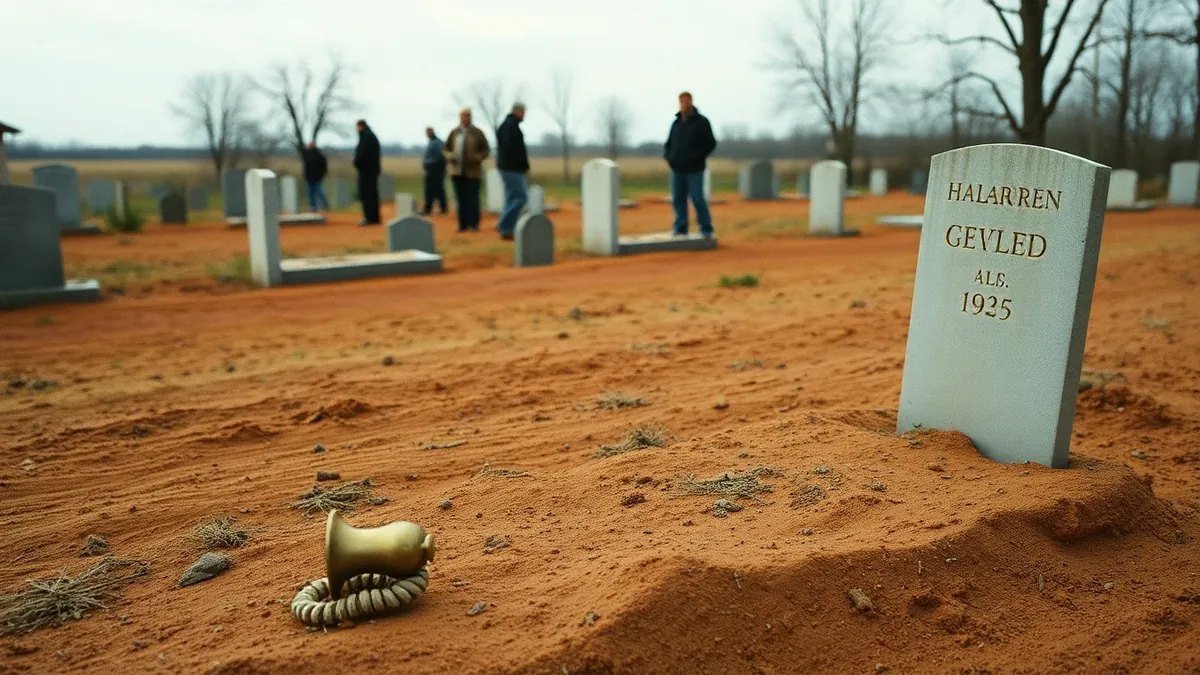
Four brass bugles sounded the death march at a countryside cemetery just outside the precincts of Stevens Point, Wisconsin. The red, sandy soil of the Upper Middle West was soft under the feet of the on-lookers, friends, and close relatives of the deceased. The sky bellowed forth with a grand feeling, coupled with the rays of the hot sun. The atmosphere hugged close to the grass, and below, the hole awaited the body and casket. Under the shade of a soft-needled pine-tree, a minister was giving the eulogy.
“We are gathered here today to bury a man of the military, a man of the church, the husband of a wife, the father of three children, a personal friend of mine, and a friend to many others . . . Yea, though I walk through the valley of the shadow of death, I will fear no evil, for thou art with me. . . let these simple words remind us of the comfort the Lord might bring us on such an occasion as this.”
A shot of rifles broke through the quiet afternoon. The soldiers marked the death of their fellow soldier with these shots. Into the air, they fired. A simultaneous cry of grief broke out; the soldier’s wife Margaret Humphrey wept aloud. The inner pain overflowed onto her face. She brought a handkerchief to her eyes, dabbing the tears away. She blew her nose. Her youngest daughter, Stacey, was holding her closely. As the casket was lowered, Mrs. Humphrey looked into the sky; she could not stand to watch the lowering of her husband’s body into the earth. From dust to dust, she thought. Years in the church, service after service, hymn after hymn, and so this was her natural thought.
Dust to dust.
The luncheon after the funeral ceremony was cheerful despite the triumph of death over Mr. Humphrey. He had lived his life well. As well as it could be lived. He fought in the Second World War, taking the wounded from the field of battle to military hospitals set up on the front. He served two years away from his wife, whom he had married six months before his departure. He returned a victor over the Germans, and the father of a two-and-a-half-year old son, Oliver. Oliver himself was now married to a beautiful wife, and they were both at the luncheon eating disinterestedly at one of the many tables spread with the food.
“My father was a good man!” exclaimed Oliver. “His unrelenting sense of loyalty has forever remained with me.”
“Why, it’s true,” echoed his wife Ophelia. “Only last week, Oliver couldn’t tell what he called a ‘lie’ to his employer, who had asked him to accomplish more than he could handle. He simply said, ‘No, sir, I can’t do all that. It’s too much.’ Why, you could’ve told him ‘Sure, I’ll do it,’ and waited until he got on your case about finishing it too late.”
“It’s true, it’s true,” repeated Oliver. “I just can’t tell a ‘lie.’”
Thinking back upon the last year, Oliver’s thoughts meandered. Ophelia’s thoughts were entirely elsewhere. Her father-in-law, Mr. Humphrey, had loved his son very much.
True. And this love had overflowed. It had overflowed onto Ophelia. The first time she had met him, she had been timidly nervous. His dark-brown eyes glowed upon her comely figure, in part easing the tension of the first meeting. She grew accustomed to his larger-than-life personality over time. His loud voice slightly perturbed her quiet sensitivity. She recognized the harsh personality of Mr. Humphrey in her own husband.
The father and son held together in their family ties of years in the same household.
Ophelia felt it was set against her. This is how it felt to her, but it was not so.
Ophelia ruminated further. She thought about a Christmas holiday several years prior at the Humphrey’s home in Stevens Point. Ophelia and Oliver had just arrived after an hour car-trip from their small home in Neenah, Wisconsin, in the Fox Valley. Having sat in the car for an hour, their leg muscles were stiff. They got out of the car slowly, stretching their arms, their backs, and their legs. Too cold to remain outside stretching, they hurried to the front door. Snow covered the frozen ground. Mr. and Mrs. Humphrey greeted them at the screen door, swiveling open at the front of the one-story red-painted wide-paneled home.
“Good to see you both!” hollered Mr. Humphrey. He smothered them both in separate hugs. The hug left Ophelia breathless, the caress seeming more appropriate for Mrs. Humphrey than her, the daughter-in-law. She did not say anything about her discomfort. It was not a real sort of discomfort. It was one imagined. So she thought. “Welcome!” shouted Mrs. Humphrey, who was busy hurrying about the kitchen, preparing food for the afternoon lunch. The smell of ham drenched the atmosphere; baked potatoes were in the oven. The meal was almost ready. The plates, forks, knives, and glasses sat neatly arranged on the darkly varnished oaken table. After taking their coats and hanging them in the walk-in closet at the front door, all four gathered in the parlor next to the kitchen. Mr. and Mrs. Humphrey sat on their prized antique sofa.
Ophelia and Oliver sat opposite on separate cushioned chairs. All four were physically living in comfort. The oven bell dinged.
“The potatoes should be ready now,” said Mrs. Humphrey, as she stood up and went into the kitchen.
“She is a fine, fine cook,” boasted Mr. Humphrey. “Isn’t that right?”
“She sure is. I grew up with the best hot meals in the neighborhood.” Oliver declared, thoroughly convinced.
“It’s true,” said Ophelia, non-committal. Suddenly, Mr. Humphrey asked Ophelia to move over to the antique sofa.
“It’s far more comfortable than the chair you’re on.”
“Oh, no, Mr. Humphrey!” exclaimed Ophelia, “I am more than comfortable over here.”
“You should try it, dear,” interposed Oliver.
“Really, dear, I’m fine in this chair,” she countered. She shifted nervously.
Normally, she was as calm as a purring cat. She was a bit frazzled by their insistence. Luckily, Mrs. Humphrey came into the room, announcing the afternoon lunch.
“Time to eat!” she cried out joyously. She felt a strange tension among the three but ignored it in her excitement for the praise she would get for the fine meal. Another fine meal, of course! Without a doubt, they will love it!, she thought.
At the table, Mr. Humphrey sat at the head of the table. On his right was his wife. On his left was his charming daughter-in-law. He was the king of his house, a man’s man, his sole and unconscious desire. Unconscious, because he himself did not recognize it. Only Ophelia perceived some of his less appealing traits as a man. His ego was the size of a baseball stadium. But who could blame him? Who has no ego?
Unfortunately for Ophelia, it meant bouts of feeling uneasy, and it cost her stable nerves. She was not unkind - but to deal with it without saying anything to her husband? Without saying anything to her father-in-law? Mr. Humphrey was a womanizer, and he did not even know it. She felt under his gaze. He looked down her shirt, and his eyes lit up. His passionate drive was aroused. She herself was horrified.
She felt bore down. The weight was immense, overbearing and grotesque.
~~~ The rest of the meal at the funeral passed without her gaining consciousness of herself.
Oliver asked her how the food was; she sat motionless.
“Dear, dear, what’s the matter? Why do you sit so, without uttering a word?” In a climax of dissatisfaction and profound feeling of being betrayed, she projected, “He wanted to touch me! He wanted to touch me!”
“Who, dear? Who, dear? Who wanted to touch you?”
“Your father!”

“The Burial” was printed in Salem Cemetery, No. 6 of Inwood Indiana. Pick up the paperback from Prolific Press; the stories and poems published online are free to read here.
Get the paperback