
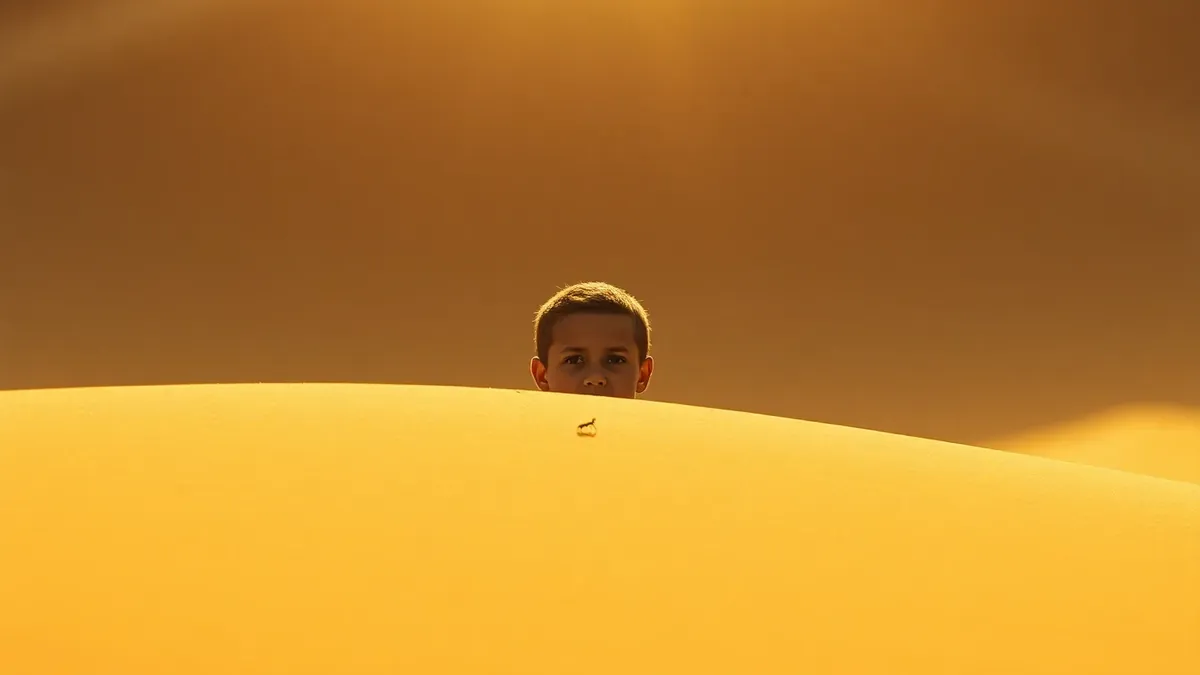
Everywhere he looked: sand. Golden, blinding in the midday sun, small clouds of it blowing in the breeze, and he was buried to his neck in it. He could tell he was closer to the ground than usual; the dunes looked different than they would have were he standing up, and he could feel the sand prickling the underside of his chin. The real clue came when he tried to stretch his arms, bend at the knees, and wiggle his toes.
Nothing. He cried for help, help, could anybody hear him, he was stuck in the sand, and it was during these cries that he woke up screaming for his wife Laney. She wasn’t there, wasn’t going to be there, and he didn’t know what to do.
Jack Trundle sat up in bed. The writhing he’d done before waking scattered the sheets half off the bed. He’d gotten used to the small layer of sweat, the tears he felt coursing down his face. He looked at his bedside clock: half past one. That dawn was still hours away only made him feel worse. The following day was supposed to be his first back on the job after a sabbatical to clear up Laney’s affairs, and to grieve and get his life back together. He’d been hoping to get a full night’s sleep, but that hadn’t happened in weeks. Now he would turn up feeling like a blunted pencil. On the set, at least, he had the help of make-up. The hairdresser made his hair neat, Wardrobe put him in a smart suit—never the same one twice, except for that nice one he wore every Christmas—and when the red light came on, the city got the Jack Trundle it knew and loved. Detroit’s favorite morning anchorperson having nightmares? Impossible!
Trundle made his way to the master bathroom that opened off the bedroom. His foot hit an unexpected obstacle, a carton of sympathy mail he’d forgotten in his exhaustion. The day after Laney died, his co-anchor on the show (the attractive younger woman to his educated older man) made an impassioned plea for support, and the public had responded with letters of well-wishing too numerous to count or adequately store in his townhouse. Trundle hadn’t read most of the letters. The one time he’d tried, he teared up after three letters. After that, he wanted to avoid them altogether. Despite that the mail cartons were cramping the floor space, Trundle found he couldn’t throw the letters out either. To do so, he felt would imply that he didn’t care about the public’s concern, even if no one but he knew he’d not read the letters before tossing them.
As soon as Trundle turned on the bathroom light he turned it off again. The bright light reminded him of the desert sun he was trapped beneath on a nightly basis. Besides, he knew where everything was, knew where all the fixtures were, and knew what was what by touch. Trundle turned on the cold water tap and splashed some on his face. It brought him back to where he was and who he was, and once upon a time that would have been enough to push a dream out of his head. This time, it did nothing. Jack Trundle was being buried to the neck in a desert on a nightly basis by his subconscious.
Three hours later, he was shivering. He agreed to come back on two days’ notice to do a remote location shoot, even though it meant standing outside at dawn on Woodward in below freezing temperatures, because the story was too big to ignore. The station provided him with a heavy winter coat, thick wool gloves, and a fur-lined hat left over from the last Soviet Army. Still the three-degree wind-chill managed to find its way through these and every other layer Trundle was wearing.
“We’re here live at the Detroit Institute of Arts, where tonight an unprecedented display of undiscovered artistic talent will be exhibited.” This he said with a popular Trundleism, the knowing right index finger pointed upward, the uncapped black pen gripped in the web of the hand, forming a V with the finger. “Former Senator Brent Hawkins is displaying what he calls his real life’s work, art and sculptures that he has created over his lifetime, here tonight.”
The museum was closed, off limits to everyone except Hawkins, the curator, and a guard; all of whom were unavailable for interviews. Hawkins had hinted in press releases for weeks that he would take one member of the press on a personally guided tour of the exhibit. The identity of the reporter hadn’t been announced yet, but at the moment, the only thing on Trundle’s mind was the next commercial break and the warm cup of coffee that would be waiting in the van.
Trundle recited the rest of his speech, prompted the weather person to give the day’s forecast, and another reporter to run down the national and international news (gas prices up, unemployment down, war on the other side of the world, and quick sports highlights) before some playful banter with his co-host back in the studio, and the commercial break. After that, nothing for twenty minutes while the co-host did an exposé piece about corrupt government officials.
The red light on the camera went dark and Trundle stopped pretending to try to smile.
The cameraman—Hugh, who had gloves that covered his fingertips—relaxed the shoulder holding the camera as Trundle stepped closer. “How you holding up?” Hugh said.
“Fine, I guess.”
Hugh looked him up and down for a moment then said, “Let’s get you back in the van.”
A minute later, Trundle was pulling the door shut on the passenger side. Hugh handed him a Thermos full of coffee and lit a cigarette. “Didn’t get much sleep last night, huh?” Trundle poured some coffee into a Styrofoam cup and stirred in some sugar. “Some.
More than I have been.”
“Buried in the sand again?”
Trundle had told Hugh about the dreams a few weeks before. “Yeah.” He put the cup down on the table and started to rub his eyes. Hugh rolled down the window half an inch and tipped the ash from his cigarette onto the street.
“I don’t mind so much, you know, the dream. If I could sleep, if I knew what the dream meant.”
“Something to do with your wife, maybe.”
Trundle didn’t respond right away. If there was a connection between Laney and the desert-scape, he couldn’t see it. They’d never been to a tropical climate together, no places with sand that didn’t have a large body of water nearby. “Maybe,” he said. “I don’t know.”
Hugh took another long drag on his cigarette, flipped the butt out the window, and motioned for the Thermos. “You’ll figure it out. I know you will.”
“Yeah,” Trundle said. “Yeah.”
Almost as soon as Hugh opened the Thermos, his cellphone rang. He checked the number before answering, but Trundle didn’t see who it was. “Yeah, what’s up? Uh huh.
Uh huh. Yeah. I’ll tell him.” Hugh closed the phone and sighed. “Hawkins picked you.
Twelve thirty, front entrance.”
The last time he brought Laney to this museum was for the opening of a group of local women artists that she’d wanted to see. Trundle went more out of a sense of husbandly duty than anything else. His appreciation of art was uninformed. He could recognize a fine painting when he saw it, and the paintings and sculptures were fine, to be sure; but after four rooms one painting seemed very much like another. The truly artistic eye belonged to Laney, who was at one museum or another every other week it seemed.
She was on her way to developing a fine collection of her own, displaying new acquisitions in places of prominence in their townhouse. People complimented Trundle on the art during parties, and he gently deflected each commendation toward Laney.
Three months later, Trundle found himself outside the doors to that same museum, peering inside to see if he could get the attention of a security guard. He was presenting himself at the prescribed hour, ready to get his interview, and very much wanting to be somewhere else, anywhere else but there. Trundle hadn’t been back to the museum since, hadn’t had the inclination to go. It had been bad enough out at the curb that morning during the live broadcast, but now that he was up close to the thing, Trundle desperately didn’t want to be there. Thoughts of Laney here and the art event bounded through his head like rampaging cattle.
Trundle looked toward the street where the van was still parked from the morning shoot; students from the adjacent university dotting the sidewalk in packs of twos and threes, ants in a colony. The sun peeked through the clouds and bathed the entire street in a wash of light. Trundle shielded his eyes and blinked, and opened to see the street covered in sand, the buildings gone, and the ants going about their business in the open desert. He rubbed his eyes and blinked again, and the city was back.
A guard pushed open one of the front doors from the inside. “Mr. Trundle?”
Trundle turned. “Yes?”
“You can come in.” The guard stood to one side as Trundle entered the building. “He’s waiting for you in the gallery,” the guard said, and resumed his position to one side of the main doors.
Trundle looked around the main foyer. The entrance to the gallery with Hawkins’s installation beyond was on one wall. Trundle could see a few walls, but nothing in the way of actual artwork. After a moment he turned back toward the guard. “What’s this all about?”
“Sir?”
“Why the secrecy? What’s he got going on back there that he’s not letting us in on?”
“Can’t say. I’m not much on art. All’s I was told to do was to let you in the front door at twelve thirty sharp, and no one else until six.” The guard shifted on his stool.
Trundle chewed on that for another second, then said, “My cameraman. He’s getting his gear together. We thought we might do a sit down interview with Hawkins. Let him in, will you? He won’t come any further than the lobby.”
The guard nodded and Trundle went off to explore the gallery. Even the doorframe was decorated special, everything in merlot. For two dozen rooms that twisted and turned through the complex, paintings and sculptures of varying quality lined the walls. One of the paintings jumped out at him. It was almost entirely of sky blue, putting it into stark contrast with the wall behind it. Thoughts of the last event here with Laney, of the painting she’d tried so hard to get him to understand, came flooding back into his mind.
Laney tried to educate him at every turn. She knew he was somewhat of a lost cause, but she wanted to share her appreciation. “See this piece,” she said that night, gesturing at one of the paintings. “Look at the brush strokes there and there, soft, trailing off into the horizon. It seems like an unfinished thought, but it’s all over the canvas. It’s meant to convey distance, how vast the world is at ground level.”
“Uh huh,” Trundle said, and leaned in close to the painting as if to examine the portion she was talking about. To him, it was a large light blue area toward the top and a large beige area at the bottom, with some little black dots where the two areas met. He didn’t give her the chance to explain the picture more fully, as she’d moved on to the next piece. Six days after that she was gone. Trundle turned his attention to a nearby sculpture to stem the flow of memories. He studied it, lost in thought, until he could sense someone standing behind him.
There was a minute’s worth of silence before the other person spoke. “You’ve found my attempt at a Venus. Not very good, I’m afraid. I’ve never been great at sculpting. This one took half a dozen tries to get right. I kept over-sculpting. Typical. I’d be going along just fine for a bit, get the ears done or something like that, and then whoops, I’ve accidentally chopped off her nose. Ah, well. Gotta break some eggs. But you should see the scrap pile. What a mess that is.”
Through all this Trundle had been standing with his back to the man, but he knew the voice. “I’m sure it’s not so bad as all that, Senator.”
“Take my word for it, Mr. Trundle, it is. Do you like what you see?”
Trundle shrugged. “Art was never my thing.”
The pause that followed suggested a handful of things to Trundle: annoyance, amusement, a decision to redirect the conversation. “Pity. Do you have any questions?”
Trundle turned around to face the Senator. “Several. My cameraman’s setting up in the lobby.”
“In due course. First I want to ask your opinion on something. Come into the next room and look at something for me.”
Hawkins exited into a short hallway that emptied into a room with nothing in it save for a life-sized stuffed camel. Trundle entered the room, saw the camel, and stopped. Two walls were painted a dusk blue, a fading sun was portrayed on a third, a city wall exterior painted on the wall the camel was facing, a small opening in the center of that wall to a fifty-foot long tunnel, five feet to a side, painted in complete black. The floor under the camel, under Hawkins, and under Trundle, was covered in sand.
“This room took me three weeks to complete, most of it doing the city wall there. The hard part was the texture. Go ahead up and feel it. I had some rocks from Egypt shipped in special for the wall. I was trying to make it as real as possible, give whoever sees this the feeling they’re actually in the desert with the camel.”
Trundle looked around the room, not moving from the doorway. For a moment, he thought he was buried to the neck again, trapped by sand on all sides and tortured by his own mind. “What— How—?”
Hawkins stroked the neck of the stuffed camel. “I just wanted to see if you got the reference.” Trundle was still trying to wrap his mind around what was in front of him. He couldn’t shake the feeling of being restrained. The spotlights in the room burned his face as if he was back under the sun, back in the desert.
“No? ‘And again I say unto you, it is easier for a camel to go through the eye of a needle, than it is for a rich man to enter the Kingdom of God.’ Book of Matthew. This is the popular version of what they were talking about, though. This tunnel here—which wasn’t quite so long at the time—was referred to as the Needle’s Eye. A lot of biblical era cities had them. After the city gates closed for the evening, the only way in or out of the city was through one of these. As you can see, it’s hardly big enough for a fully loaded camel to pass through.” Hawkins motioned to the tunnel.
Trundle bent double and went through. On the other end was a room, twenty by twenty by twenty, completely black except for some stars, little glowing dots on the walls, floor, and ceiling. He felt almost weightless then, as if someone had pulled the ground out from under him but he’d forgotten to fall, forgotten how to.
“Do you know what this is, Mr. Trundle?” Hawkins had quietly entered behind him.
He wanted to say something, but his mind was still trying to wrap itself around what he’d seen in the last room, and now in this one. “No.”
“What most people see when they close their eyes. Certainly no artistic rendering will ever do it justice, but something like this.”
Trundle stared at the dots, slackjawed.
Hawkins ducked back into the tunnel. “That’s what I wondered. Thank you very much, Mr. Trundle.”
After a moment, Trundle went back through the tunnel to the room with the camel, unnerved by the floating sensation the room with the stars gave him. Hawkins was nowhere to be found. The feeling of being enclosed in the sand came on him again, and he left the room quickly and headed back to the museum foyer, his disbelief hanging over him like a shroud.
The formal opening of the Hawkins exhibit was strictly a black-tie affair. Only four hundred of the nation’s elite and their spouses, all dressed to the nines, were extended invitations; power lobbyists, Congressmen, and three former Presidents had run the tight security brigade in support of one of their own. To the surprise of some, the invitees were not party-specific, but those that knew him best knew that half of Hawkins’s Wednesday golfing foursome sat on the other side of the aisle. The main entrance hall had been made over in the course of the afternoon, gold and white balloons lining the ceilings and the balustrades, a full course buffet flanked by ice sculptures, garcons and garconettes wandering this way and that with their trays of hors d’oeuvres. “So, this is how the other half lives,” Hugh said, taking it all in. “I’ve never hadda wear a tuxedo to do my job.” He wriggled his bow tie for effect.
The station had known about Trundle’s invitation to the opening before he had, and sent Hugh duly armed to get some shots of the interior that the other networks wouldn’t have for another day. Still, though, when Jack Trundle walked into a party, no matter how formal or informal, he was used to being recognized by at least a few of his fellow partygoers. Tonight, nothing. A concierge showed no sign of recognizing who he was as his coat was taken in exchange for a ticket, or possibly didn’t want to admit it. Trundle looked around the room again, hoping someone would break from the pack, come over, shake his hand, welcome him, but no one did. Hawkins himself was nowhere to be seen.
Suddenly, Trundle felt like he didn’t want to be recognized, didn’t even want to be here. “Relax,” Trundle told Hugh. “Try to look like you belong here. Come find me in half an hour and we’ll tape the bit they asked you to.”
Hugh nodded and the two went their separate ways. Most of the crowd was gathered in the general area of the entrance to Hawkins’s exhibit, some queued up awaiting entrance to the rooms beyond, others chatting in groups of two and three as they absently ate hors d’oeuvres and drank champagne. Trundle went instead to another smaller open space further back in the museum, where the exhibit of the local women artists was still set up. Every step he took echoed off the hardwood floor and marble walls like Trundle was in a cave. Almost by accident, he found himself on a bench in front of the painting Laney had explained to him, with the brush strokes that led off to nowhere. Trundle sat there, stared at the painting, and Laney’s explanation played over and over again in his head. It’s meant to convey distance, how vast the world is at ground level.
“Strange, isn’t it?” said a voice from beside him. It was Hawkins. “Room full of people all looking for conversation, all looking to make an impression on me on the one night I’m trying to be something other than what they’re used to seeing. Suddenly I wish I’d done this in a more low-key sort of way, maybe even used a pseudonym or something.”
Trundle didn’t jump at the sound of the voice. He’d almost been expecting it.
“I heard about your wife. I’m sorry.”
Trundle didn’t know what to say. He was shocked that Hawkins had taken the time and effort to find out anything about him. Surely the Senator had greater concerns than Trundle’s personal well-being.
“Good woman, I take it,” Hawkins said.
Trundle nodded.
“I’m told she enjoyed art. Came here often.”
Trundle shifted his head slightly toward Hawkins, wondering how he would have known something as trivial as that.
“I play poker once a month with your boss. That’s strictly on the QT, of course. If the media found out a Senator and a local news executive played poker every month, they’d have a field day with it. You won’t tell, will you?” The smile on Hawkins’s face was evident in every word.
“She liked this one,” Trundle said, and lifted a limp arm toward the painting. “Tried to tell me about it, what was going on, what the brushstrokes of it meant and all that.”
“Think about her a lot?”
“Every day. Every—every minute. I still think of her in the present tense, still expect her to come through the door sometime in mid-evening. And eight, nine o’clock comes and goes, and I remember Laney isn’t coming home and why, and that just makes everything worse.”
Trundle ran his hands through his hair and looked at the beige of the painting, the little black dots sitting atop it like so many afterthoughts. His waking and dreaming lives had started bleeding into each other, and it was difficult to tell the difference. Was this painting before him real, or the room he’d been in earlier, or Hawkins? He searched his mind for reasons why this would happen, signs that it was or wasn’t, and came up nil.
Maybe I’m meant to work it out for myself, he thought.
“It occurred to me, last night, that I’d forgotten what that sounded like, Laney coming home. She’d done it every night for twenty years, and now she doesn’t.” And yet I saw your painting today and it reminded me of this one, and what Laney said. I hadn’t thought about that day since it happened—barely thought about it while it was happening—but I can see that moment clear as anything in my head. I can’t remember the sound of her coming home, but I can remember that one little nothing moment.”
“It’s like that, sometimes. You get older and find yourself remembering things about your loved one that you’d forgotten, little scraps that were so much flotsam at the time, and something in the now calls it back up. And maybe you’re remembering it wrong, but you’re remembering something.” Hawkins sat on the bench next to Trundle and considered the painting before them.
“Every night since Laney died, I’ve had this dream I’m buried to my neck in the desert.” Trundle lifted his arm at the painting. “That one. And your full-room one too. Just me and the sand and the sun. And something my wife said when she was talking about this painting. ‘How vast the world is at ground level.’ And I feel so small and helpless. And alone. And when I wake up it takes me a minute to remember who I am, and where I am, and why there isn’t anyone next to me in bed. And I saw your rooms today— I saw—” He shook his head, trying to find the words. Trundle looked at the painting again.
“I don’t want Laney to fade away, but I want to hope again.”
Hawkins said nothing for a long minute. “Someday the stars will come back.” Around them there was only silence.
Everywhere he looked: sand. Same as it had been before, except now he was buried to his waist. Trundle swiveled, trying to determine what else had changed. No, that dune had always been in front of him, and the wind was still blowing little sand clouds around. Trundle tried to leverage himself out but the sand was packed too tightly around his legs. He began to scoop sand away from himself, fling it as far away as he could so it didn’t roll back into place. But the surrounding area caved into what he had just emptied out, and the sand would blow along and level it out again. Trundle began taking bigger handfuls, tried throwing them farther, and the hole began to grow, slowly at first, then more steadily. Soon he could shift his knees, at which point he tried muscling himself out again. This time it worked.
Trundle stood a few feet away from the hole and looked at the landscape around him.
There were three dunes behind where he’d been buried; one situated between and beyond the other two. And what was that on it? A person? A camel? From this distance it was impossible to tell. All it looked like was a little black dot upon the sand. What it was exactly Trundle didn’t know and didn’t care, but he started walking toward it.
Whatever it was, it was a sign of life.

“Little Black Dots” was printed in Salem Cemetery, No. 6 of Inwood Indiana. Pick up the paperback from Prolific Press; the stories and poems published online are free to read here.
Get the paperback