Meredith—a gas station attendant in the Middle West—was to train the new employee William. Hearing the shrill whistle of Economy, his first responsibility in America had been heard and met with the vigor of a young man in his twenties. He felt confident and up to the challenge of his coming job duties. His final night off, he spent walking aimlessly through the meandering streets and parks, twisting and turning to the contours of the city-scape.
She was a Middle West girl through and through, somewhat timid yet winsome. Her air was full of common sense and a logical straightforwardness. In short, there was not a crooked bone in her body. With her fair complexion, hazel eyes, and wavy auburn hair, she could win over the meanest customer, if necessary. From behind the service counter, she was invulnerable with her quick hands, jaunty movements, and sprightly figure. She counted and gave change swiftly and accurately, the raison d’être for her position as a gas station attendant. Indeed, she was the queen of the service station. However, breaking in the newly-hired employee might prove trying on her somewhat limited patience.
He was a tough-minded fellow. Being from the Upper Peninsula, he knew the outdoors like the back of his hand. This would be his first city job as his family had moved to southern Wisconsin. So far, Milwaukee had been a blur of concrete on- and off-ramps, lonely industrial-looking buildings of red brick, and the gigantic baseball stadium on the way into town. He thought of his family’s solitary house near Lake Superior, finding warm familiarity in Lake Michigan’s view of the sky as it unfolds into the horizon. The sun was setting, and William was to make his way to the service station to work the night shift. This was his first night.
In entering the service station through a glass door swinging smoothly open, he saw Meredith behind the service counter. Her appearance was mildly daunting.
“I am here to work the overnight shift.”
She looked at him closely, observing his serenity with a slight, inner surprise. She was used to shady characters working on the night shift. She was used to training criminals who could not find work anywhere else. William seemed the contrary.
“Put yer coat ‘n’ things in the back room, follow me.”
They were both silent during the short walk to the back room.
“While we’re here, let me explain’a few things. The stock is kept in the room adjacent to this one.” They were standing in the kitchen with two large metal sinks and curving faucets against the wall. Various cleaning supplies, tools, and a cupboard for the storage of bathroom supplies gave the room an unpleasant smell.
“It’s a freezer, so don’t go closing the door behind you ‘cause, if ya do, it could lock up. If you do that while you’re working alon’—need I say more?”
William shivered at the thought.
“Here ‘n the freezer are the breakfast san’wiches that you need to re-stock aroun’ four in the morning, before the morning rush of coffee-drinkers and early risers. Don’t forget. I’ll be helpin’ you the first three nights. But once you’re on your own, well, you’re on your own. Like I said, just don’ forget.”
“Is there a written-list of these responsibilities?”
“A what?”
“Is there a written-list of the responsibilities?”
She was illiterate.
“I don’t think it’s necessary.”
William did not understand why it was not necessary. Wouldn’t this be useful?
He assented as one must in a position below that of a superior of the work-a-day world of modern existence. Next, she led him back into the main area where stood the counter behind which he would work. The room had a kitchen area with hotdogs cooking on hot, metal pin rollers. Grease covered them.
Meredith continued, “It’s your responsibility to clean these rollers off with a wet rag. I’ll demonstrate. Hold the wet rag on each roller until it has completed a full rotation. Do this for each roller. There are about twenty of them, and it takes about ten minutes.”
William furrowed his brow in thinking about it.
Twenty minutes later, at the counter, both of them stood. A man entered.
“I’d like uh . . . two powerball tickets.”
William fumbled with the ticket dispenser.
“Uh . . . er . . . what kind of gambling tickets, Sir?”
“Two o’ dem dere powerball tickets.”
As the man fell into his natural accent, William understood more clearly but was still unable to help him. He looked up at Meredith who then stopped restocking the cigarettes. She helped the man fluidly, showing a learned ease. William thought that the man grumbled of the slow service under his breath as he left. Meredith looked at William.
“You’ve gotta long way to go. But, nevermind, you’ll get the hang of it.”
She went back to the cigarettes. William stood behind the counter. It was eleven thirty at night. Near two in the morning, after only three more customers, Meredith announced that it was time to sweep. The square-tiled floor between the aisles of candy, potato chips, dental floss, and toilet paper collected dust during a day of work. She handed William a broom and a dust-pan. Without a thought, he briskly took the broom and began sweeping. His long figure stooped over the broom, its bristles scraping lightly over the floor. The dust-pan was lying in the corner, near the plastic-wrapped firewood. He swept with the long motion of his arms, his elbows bent, and his hands and fingers gripping the slanted, upright broom. Meredith stood in the aisle next to the one William was working in. He could see her over the medium-sized shelves. She saw him too. Bashfully, he immediately looked down. She kept looking at him; then, she leaned down to pick up a piece of scrap paper off the floor.
When she stood back up, she said, “I can finish sweeping if you like.”
Three piles of dust mixed with miscellaneous garbage were lying at the end of the aisles near the edge of the room where the freezers hummed with lights glaring from behind the glass freezer doors.
“I can finish it.”
Dantily, she came around the corner of the aisle, set on finishing what he had started. He too was set on finishing what he had started. Firmly, they were set on the same object. And they would not acquiesce. It had been decided, and it was their duty. She sat underneath him, looking up at his keen face, as he pushed the pile of dirt into the dustpan that she held in her hand. She scooped up the dirt with the delicate motion of her hand rooted in the push from her feminine shoulder and appropriately bent elbow. With care, she stood up, balancing her weight and arm and carried it to the garbage can. William stood watching her. He—he was proving to be quite a durable young fellow. And she—she was glowing in the splendor of her human work.
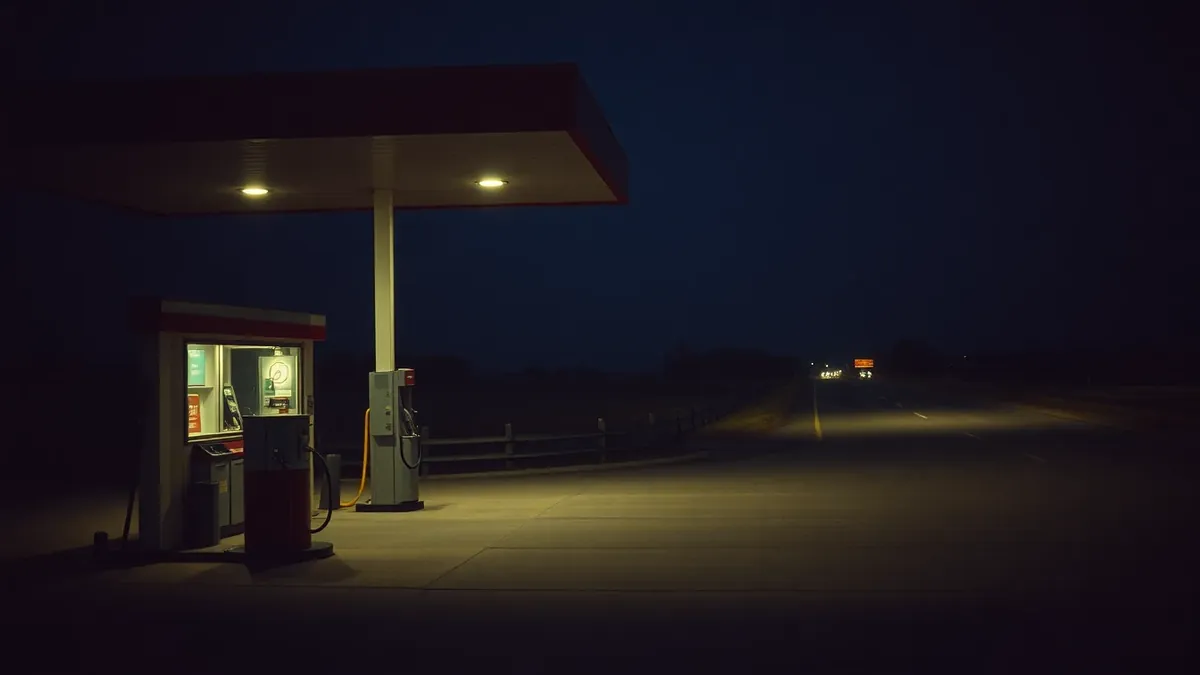
The testing of this durable young fellow came at about four o’clock in the morning. For a long, strenuous, and seemingly unending train of tasks awaited him. He had to empty the trash cans outside near the gas pumps, one of which began leaking through a tiny hole in the black plastic garbage bag as he dragged it to the dumpster behind the service station. It left a long trail of grime across the concrete foundation beneath which the car fuel was stored. The screech of tires pulled his attention away from his toss of the garbage bags into the dumpster and towards a semi-truck pulling up to the station. Attached to it was an oil tanker, the economic base of the service station.
As the trucker descended from the high perch of the driver side door of his semi-truck, he hollered, “’T’sure is cold, ain’ it? Y’oughta fin’ a place real warm in’ere. I ain’ ne seen such col’ weather’in a long time.”
He had a jaunty spring in his step, but his face was grim-like. Serious yet light-hearted, he continued,
“Y’oughta fin’ a warm room in the station to keep warm. Hide away somewher’ yer boss’ll ne’er find ya.”
William grinned warily at the middle aged man who was just under six feet tall, built real stocky. He wished to follow the wise trucker’s advice but thought ill of it. To do so might cost him a pretty penny—his new livelihood.
The trucker stood in front of the young man in the brisk air of south central Wisconsin mornings. Next, he opened the vaults beneath the gas station that contained the fuel. His muscular arms smoothly controlled the heavy doors with a strength gained from years of experience in repeating the motion. He did not grimace, and he spoke to William.
“You new aroun’ here? I ain’t ne’er seen ya before. How do you find it, the work,
I mean?”
“I dunno as o’ yet. It ain’t too easy. I gotta a long list o’ tasks and haven’t figured it out.”
“You’ll do a’right, I’m sure. Hold ona minute.”
He engrossed himself in the attachment of the hose coming down from his truck to the tanks beneath the station. He connected the equipment together, and the sound of the rapid movement of liquid through a narrow passage swooshed. The hair on the trucker’s arms stood on end in the cold. His jaw muscle twitched as he held it all steady. His demeanor was one of inner strength manifesting itself in the work. He did not swerve, nor budge in his work.
“Have you been a trucker a long time?” William asked hesitatingly.
“A long time, eh? You betcha. A long, long time—twenty three years,” he answered slowly.
Steadily, he unhooked the first hose, then prepared the second for emptying into the tanks beneath the station. He hovered over his work, his hands gloved to protect them from the hurt of abrasion. His heart beat rhythmically. Like a pendulum, his body kept to the beat of the work. It was a humdrum morning.
Back inside the service station, William was now to brew the coffee, verify the arrival of the daily food shipment, and man the busy service station counter. A man he was proving himself to be, handling the cash deftly and with speed. Speed, the cornerstone of modern economy and its exploitation of intensified labor done by the human body in all of its senses—spiritually bereft at that—ran its course through the veins of William. He felt it pressing down on him. He felt it pushing in on him. He felt the sinewy grasp upon his thoracic plexus. His muscles tensed with the reverberation of the call of the industrial pursuit of his livelihood and, therefore, happiness. But what entitles him to happiness via his livelihood? To be sure, the poorest and scantiest means might feed the monkey. But is that all that is the human being?
As the shift ended, he looked at the clock on the wall. Eight o’clock. Walking outside into the fresh air, his eyes were blurry and would not easily focus. The concentration it took to focus on something within his field of vision was immense, giving him a headache. His shirt, ruffled and unkept, he wore crooked. Without a car, he began his three-mile trudge home. Barely seeing or feeling anything as he lumbered home, his consciousness was elsewhere. The service station left his body buzzing with the lightning activity of mechanical livelihoods. Although, for the moment, he felt secure in his job. However, very soon the night shift would be upon him again in all of its automatic and mundane torpor. But first he returned home.
“Where’veya been?” his baby sister Alvina howled out at him.
“Workin’ all night.”
“Mom’s been waitin’ for y’all mornin’.”
“I’m here now.”
“Oh, William,” his childish mother Kristine cooed, “I’ve been waitin’ for y’all mornin’. How’s the new job?”
“It’s alright, I guess,” William answered lethargically.
“I suppose you’re tir’d?” She stupidly asked. He did not answer her.
“Why don’tchya answer me?” She bitingly inquired.
“Of course I’m tir’d. I work’d all night.” He drew out the a and the l in the word all to emphasize his point.
“Well, off to bed with ya, then.” Without sufficient energy to respond, he stumbled through the corridor of their small house. The small house was divided into two floors. At the back entrance was the stairwell leading to the basement. Next to the kitchen, into which the back entrance led, were the stairs going up to the second floor where William and Alvina’s parents had their room. On the first floor were two bedrooms and a small bathroom. There was also a sun-room and a living room on the first floor. The front entrance opened into the living room.
When William awoke in the early afternoon, his legs hurt—both his thighs and his calves. In only a few hours, he would have to stand again for eight straight hours. Nestled amidst the smooth sheet and comfortable blanket, William winced at this thought. Not a fear, but a sort of angst arose in him. He could not describe it, nor could he find a reason for it. Thus, the angst of an approaching job duty. He felt a growing confidence in doing the work tasks, so why this gnawing sense of dread? From whence it came, he did not know. He could feel it—the outside mechanical world—fastening onto his inner blood flow, his inner workings. To help, he closed his eyes to fall back asleep. But no sleep came. His insides, his source of feeling, had become contorted. His sore muscles reflected the angst in rigid knots. Tap tap; his mother knocked on the door.
“Yes?”
“May I come in?”
“Come in.” As she entered, he opened his eyes and saw her in the muffled sunlight of the closed blinds.
“Are you hungry? I’ve made a beef stew for you to eat now and there should be plenty left for your lunch at work tonight.” He relaxed.
“I feel bound up, my muscles and nerves, Mom, this new job makes me tense.”
“It’s no easy task, working the night shift at a service station. Let me rub your back, William. It’s only temporary, you know that right?”
“I know, but at so little pay, it’s easy to think about leaving.”
“It’s better than nothing.”
“Yeah, better than nothing . . .” he trailed off. After relaxing him, Kristine made her way back into the kitchen.
William laid back down for a few moments before getting up, lingering on without the protection of a sheet or a blanket. He felt exposed without them. But under them, he felt nourished in his affective soul. It returned to him the strength that he needed to confront the modern click clack of the roaring economy’s rigid fist, pounding down on the unfortunate, the poor, and the hungry. He pulled on his work clothes from the night before and opened the door of his room.
“Been sleepin’?” Alvina took him from his inner thoughts as he made his way into the kitchen. “I’m so hungry,” he brought his hand down to his stomach to reinstate the fact.
“Why’ve ya been sleepin’ all day?”
“Cuz I work all night long.”
“All night?”
“Yup . . . all night.”
“Why?”
“Because I must have a job.”
“What’s a job?” William smiled wickedly to her question.
“A job is duty. It’s what makes the world go round.”
“What makes the world go round? I don’t get it.” He laughed at her unintentional play on words. “Money, that’s what makes the world go round.”
“Money?” William was starting to get annoyed. Her naïve questions irked him.
“Why don’tchya go ask mom about it. I’m hungry, I wanna eat without all your questions.” Alvina became angry,
“I hope your beef stew . . . I hope you choke on it.” Ignoring her caustic remark, he began to eat. “Just go ask mom and leave me alone.” Hurt, Alvina left the kitchen.
As the time arrived for William to leave for work, he sipped on a hot coffee while nosing through a book, Anna Karenina. He felt the deep love Tolstoy had in the marrow of his rattling bones for an agrarian lifestyle. His trunk of nerves in the stomach of his body awoke as he read. For William, reading was the emotional experience that feeds the gut with the spiritual nourishment of by gone epochs and dead men. In William, they were not dead. They lived again in his affective soul. But the beating of the drum of Business by the hands of the American god-king Money silenced them all as he entered the Service Station.

“Service Station” was printed in Harvest Time, No. 5 of Inwood Indiana. Pick up the paperback from Prolific Press; the stories and poems published online are free to read here.
Get the paperback