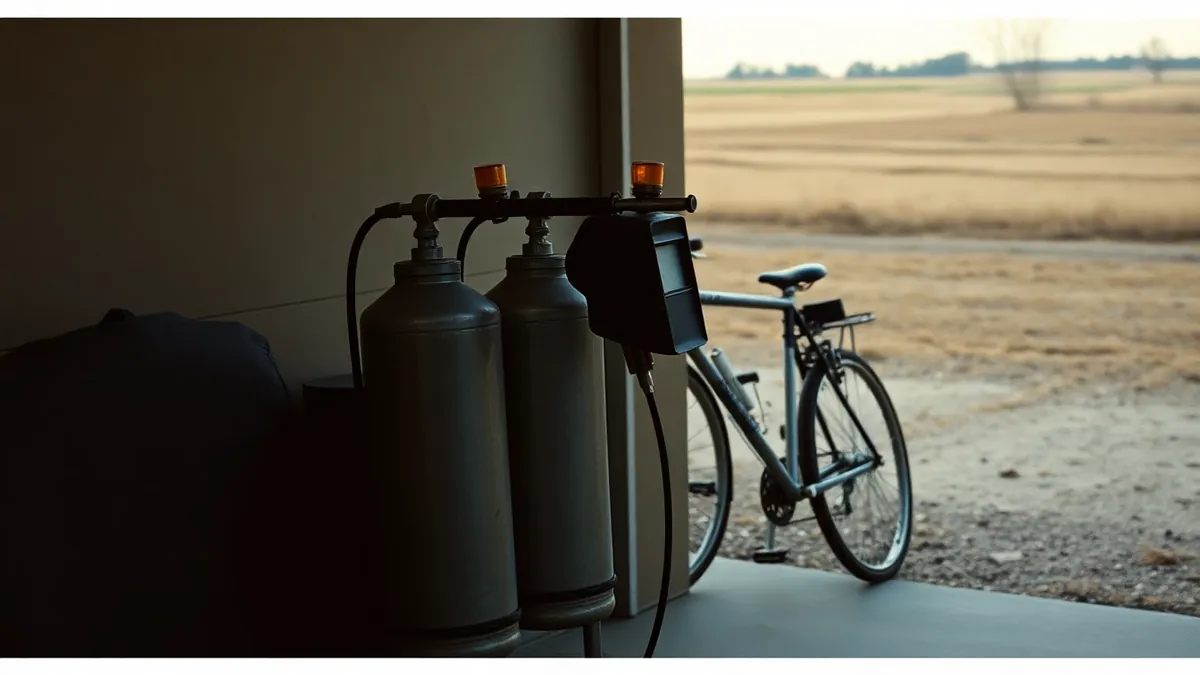
Someone gave Randy a homemade blowtorch for his birthday. It was well constructed, looked almost commercial-grade: a steel frame--with straps so that it could be worn over one’s shoulders- -supported an oxygen tank and an acetylene tank side by side. Hoses ran from the tanks to the torch itself. Though I knew that he was taking a welding class, I was shocked to discover that someone had gifted Randy such a potentially dangerous toy. Randy talked a big game, but his biggest aspiration with metalwork was to create an enormous barbeque from a steel drum. Not only did his dreams of welding strike me as fleeting, but, and more importantly, Randy wasn’t the most responsible guy on the face of the planet. For example, he had been in nearly a dozen car accidents. I’d been with him when he’d run into things, gotten stuck on high curbs, stalled in water far too deep for his tiny Civic. Because of an inherent strangeness that drove him to inexplicable acts, I never put anything past the guy. So, in my mind, giving Randy a blowtorch was tantamount to giving a small child a paper bag full of broken light bulbs--it was cruel precisely because he might choose to play with it. I remember that he walked into Hector’s kitchen wearing the thing, goggles suctioned to his eye sockets, looking like Exterminator #2 from Naked Lunch. “You guys want to go try it out?” Randy was thrilled with his new toy.
“What the fuck are we gonna do with a blowtorch?” Hector demanded.
“Yeah, Randy,” I said, “I don’t want to end up in the hospital tonight.”
When fire and Randy united, it was a combustible marriage. I wouldn’t say that he was a firebug in the traditional sense: he wasn’t compelled by some irresistible and internal force to set the world aflame, though I cannot say that he wasn’t empowered by the witnessing of destruction. So, though his vandalistic tendencies were not compulsive, though they were not necessitated by some psychological drive against which Randy was powerless, they were nevertheless satisfying. Because this was the case, he dedicated himself to destructive vandalism of all kinds, considered them something akin to acts of recreation. And because of his eccentricities, because of a clear cut difference between him and other specimens of humankind, a difference that he’d been made aware of since emergence into cognitive thought, Randy had a grudge against civilization, and against our hometown of Petaluma. That said, if he got an opportunity to evacuate our little city and ignite one gigantic and celebratory bonfire, he wouldn’t hesitate to strike that match. It was a weeknight and we were sitting around the counter in Hector’s kitchen. I was on pills, opiates, and Hector and I were trading shots of tequila when Randy walked in. We knew that we’d probably be leaving the house, if for no other reason than to pacify Hector’s father, Miguel, who didn’t exactly approve of a bunch of teenagers sitting in his kitchen drinking every night--although he tolerated it.
“I’m fucking tired, dude,” I complained.
“Well, this’ll wake your ass up,” Randy said.
“Seriously, Randy, what do you think we’re going to do with a blowtorch?” Hector asked.
“We’re gonna weld Corbit’s gate shut.”
“You've gotta be kidding me,” I groaned. “Besides, don’t you guys think you’ve fucked with Corbit enough?” Jim Corbit was a childhood friend of Hector and Randy’s. They’d turned his grief into a pastime.
“Man, he’s the perfect chump. We gotta do this,” Andy insisted.
Corbit lived with his folks, Mr. and Mrs. Corbit, in a nice home out in the Petaluma hills, off of Skillman Lane. There weren’t any street lights out there, and the sparse countryside development left acres of land between residences. I’d never been to his house, I didn’t know him socially, but Jim Corbit always struck me as a pretty standup person, if a bit of a dufus. Nevertheless, Hector and Randy were relentless in their persecution--and they considered him a friend.
We pulled off of the road and into the mouth of the driveway. The gate was closed and locked, and beyond it the driveway curved uphill for another two hundred yards or so. I viewed Corbit’s house silhouetted in moonlight and could discern no signs of waking life. There was enough of a gap between the gate and the main road that Randy’s car remained out of sight and provided some cover from any traffic that might happen to pass at that hour. A pronged latch held the gate in place on its frame. The latch itself wasn’t locked. Rather, the Corbits strung a chain through the slats of the gate and around the bar of the frame, a padlock held the chain closed, and traffic to or from the Corbit household was thereby discouraged.
“So what’s the big plan Randy?” I asked.
“I’m going to actually weld the links of the chain together so that it’s one continuous loop holding the gate closed. They’re gonna have to get bolt cutters down here to go to work tomorrow.” “I wish I could see Corbit’s dad when he tries to unlock the fucker,” Hector chuckled. “Could you imagine them climbing the gate to get out of here?” Hector savored the image, “Corbit’s dad all decked out in his work clothes.”
Hector and I watched as Randy hauled the blow torch from the trunk of his car. He had dismantled the entire thing before putting it into the trunk, tanks of gas stored at opposite sides of the car. Any safety precautions taken by Randy were reassuring. He inserted the tanks into the steel frame, reattached the hoses and the torch itself, and began adjusting the pressures of the gas tanks, allowing a certain ratio of oxygen to acetylene. He then turned a few knobs at the base of the torch. The igniter consisted of two steel prongs and looked like a huge safety pin. At the free ends of the prongs were a disk of corrugated steel and a nub of flint. The apparatus created a spark. Randy ignited the torch, which burned orange red. As he continued to adjust the gas ratio, the flame grew, narrowed, and deepened in color to a hazy blue. He looked enchanted as he stared into that intense blade of flame, the blue reflecting the blue of his rapt irises. He was a Promethean supplicant.
Hector and I took our places beside Randy as he attacked first the pad lock, then the chain links themselves. When Randy was done, he stood back. “Well, gentlemen, what do you think?” We inspected the welding job. “Little sloppy, don’t you think?” Hector asked.
“Hey look, this isn’t precision welding.”
“Good God, Randy, I had my doubts.” I tugged at the chain. The weld was solid. “But you did it. Corbit’s definitely gonna need bolt cutters to get out of here tomorrow.”
“Goddamn right, he will,” Randy said.
Petaluma Junior High is located on the edge of town. Skirted on the northern side by sparsely developed wilderness, flanked on the south by expansive fields, the school offered an expectation of privacy. The one thing we had to worry about was security guards: the junior high employed a security agency, and they sent one of their cars on a round through the junior high school campus several times a night. Lucky for us, since both entrances to the roundabout at the front of the school were visible from any exposed area on the campus proper, we’d be able to see security coming from a mile away. When we got to the junior high, Randy drove through the dirt lots at the side of campus. He pulled onto one of the paved walkways between classroom buildings so that the car wouldn’t be seen during a routine drive through.
“So what the fuck do you plan to do here?” Hector asked.
“We’re gonna burn through the change box of the pay phone,” Randy announced.
I groaned. “Oh, you’ve got to be shitting me Randy. That’ll take all night.”
The payphone was located at the front of the school, on the trespassing side of a chain link fence that marked the school’s entrance. Randy ignited the torch. Once he had the ideal flame, he got to work on the thick steel of the chrome coin box at the base of the payphone. It took an eternity for Randy to pierce the metal itself. Hector and I watched him work for what seemed like hours. Randy crouched, goggles affixed to his bony face, reflecting the fountain of sparks and flame that danced away from the point where heat and metal collided, and he looked mad in his intensity, a man consumed by a project demanding complete devotion. He refused to let us take turns at the blow torch, and when he got tired he turned off the flame, sat with us for a minute or two, shared a smoke, and then got back to work. Security drove by once while we were working. Randy extinguished the flame, and we all ran down into the quad, where we knelt behind a wall until the headlights had scrolled the empty space above us, and continued on their way.
When he was getting close to cutting the face off of the change box, Randy screamed for us. “Well boys, our hard work is about to pay off.” Moments later, a chunk of steel about three inches square fell to the ground. Because the change box was red hot, we had to wait for it to cool, anxiously hovering around it like a trinity of alchemists before a cauldron sure to produce gold. We could see the change glowing inside.
“You better not have fucked up the coins, Randy,” Hector said. He had gloves on, and was the first to reach into the box. “Ow, fuck, my Isotoners!!” The leather blistered on two fingers of the glove. “Fuck it,” Randy announced as he put the torch on his back and reignited the flame. He walked to the chain link gate at the front entrance of the school and began welding the hinges on the latch.
“Give ‘em a couple of surprises for the morning.”
“Oh man, that’s the best.” I was thrilled with Randy’s boredom. “That’s so fucked. How do you think they’re gonna get it open tomorrow?”
“The latch is gone. They’ll probably either hammer through the welding, you know, smash the hinge so hard that the weld breaks. But if the weld holds they’re going to have to break the prongs off the latch itself.”
I imagined the administrators, the adults who had suspended me, who had been my sworn nemeses in junior high, all standing around a welded gate, baffled. Imagining them getting onto the campus, seeing the face burned away from the pay phone's coin box, I was satisfied. Despite the fact that it was a destruction I partook in only as a witness, I felt as if I had accomplished something that night. A fleeting and strange mark, an annoyance, a hindrance, had been struck, and I laughed and laughed to think of its making. Indiscernible among time's millions and millions of fleeting little pranks, that evening's undertakings nevertheless had the potency to make me feel that I could exert some force upon the universe, and, though itself fleeting, I clung to that cherished moment of empowerment.
We smoked together while I counted the change at Hector’s kitchen counter.
“How much we get?” he asked.
“A little over forty bucks rolled,” I told him.
“Well, I know where beer’s coming from tomorrow.” Hector smiled, satisfied.
“Get a pint too, or a quart or something, whiskey,” I requested.
“Will do,” Hector promised.
“We getting together tomorrow then?” I asked Randy.
“Damn right.”

“Pyromaniacs, Bored and Young” was printed in Harvest Time, No. 5 of Inwood Indiana. Pick up the paperback from Prolific Press; the stories and poems published online are free to read here.
Get the paperback