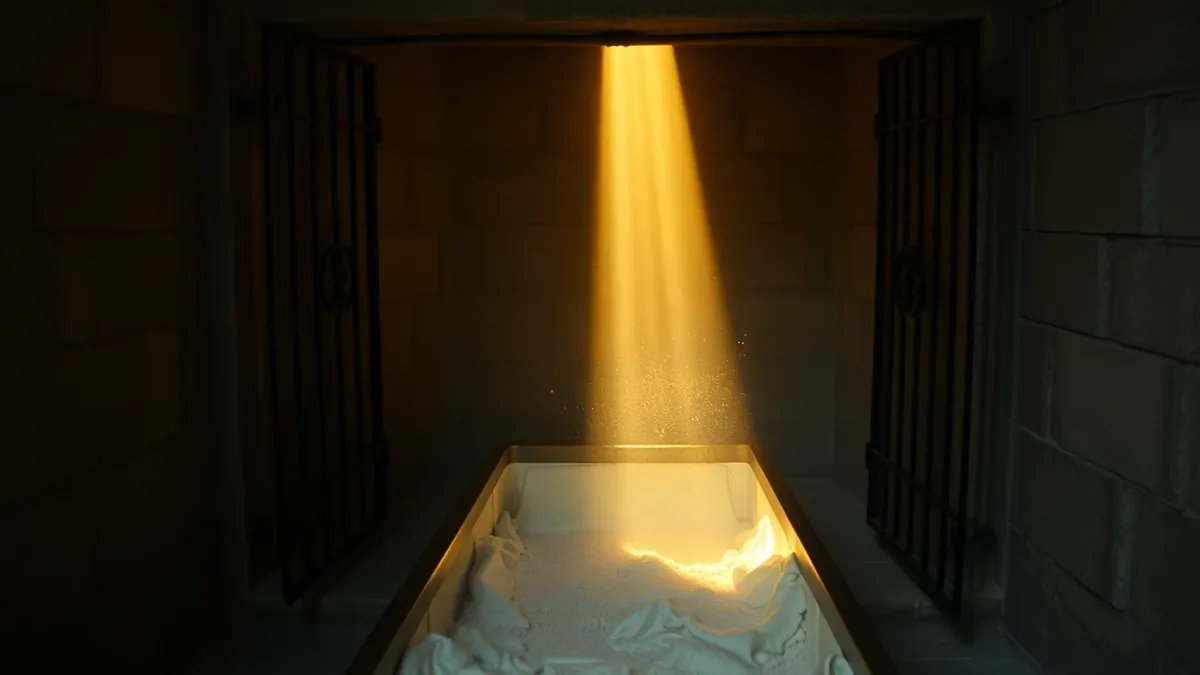
A shaft of sunlight passed through the crack between the thick iron doors of the McGrath family mausoleum. It cast a golden streak across Edward’s open coffin. He scrubbed at his bearded face and climbed from the satin-lined box. The morning air felt warm inside the musty room built of huge granite blocks. He retrieved his trousers, shirt, waistcoat and jacket from the top of his brother’s sarcophagus and dressed quickly, fumbling with the ascot. Donning his bowler, he passed through the doors and stood on the grass near the edge of the Odd Fellows Cemetery.
At the time of his death in 1906, the graveyard lay south of San Luis. He’d been carried there in a black hearse pulled by four dark horses, its windows trimmed with fancy acid-etched designs. His parents, brother Matt, and the minister had followed in a carriage that led a dozen others filled with mourners. But more than a hundred years had passed. Now, a broad boulevard choked with traffic bordered the cemetery. The noisy town had swallowed up the open fields where he and Matt used to hunt ground squirrels.
Edward burnished his shoes on the backs of his trouser legs and walked north toward downtown. At a busy intersection he strolled into traffic, smiling to himself. As semis and automobiles passed through him, their drivers’ faces flashed momentary panic as they collided with his cold spirit. He used to have fun doing the same thing with teams of horses. But he’d stopped after too many people got hurt when their steeds spooked.
He continued toward the town’s center. For two thirds of the 20th century, except during Prohibition, Edward had spent his days at the Golden West Saloon. He’d perch on the corner barstool and listen to local merchants and ranch hands swap lies and debate the issues of the day. Around the time of World War I, most of the men still stuffed six shooters into their belts or hid pistols inside their jackets. On a sultry afternoon, he watched Big Mike McCluskey take aim and blow a quarter-sized hole in Allen Tuttle’s chest. They’d been arguing about a busted land deal. Al died of the single shot from Joe’s .44.
The bar’s owners eventually demolished the ramshackle saloon and put up a toy store. Edward had moved up the street to the Blue Diamond Lounge and a new corner stool. A few times, some jerk would try sitting in his spot. They’d complain about a wave of intense nausea and move quickly. Once, a hung-over blonde in a mini skirt and huge earrings sat on his lap. She shrieked and jumped off, splashing her Corpse Reviver across the counter. Laughing, the bartender taped a sign to the stool that read, “Ghosts Only.”
In late afternoons when the three-martini lunch crowds had left and the after-work patrons hadn’t yet arrived, Edward left the Blue Diamond and walked north to the University, backed up against the Santa Lucia foothills in California’s coastal mountains. It had started as a tiny agriculture school a few years before his death. The campus now felt like a city. Edward wandered its streets, attended lectures, and sat next to pretty women. He loved the smell of their perfumes, their young skin, and their willingness to display so much of it. But every so often he’d come across a girl that looked like Helen, his long-dead fiancée, and the pain of missing her made his chest ache. As the decades passed, he couldn’t help but question his existence, the reason why he stayed in the world, alone, unable to touch people or speak with them, unable to eat or sleep, and never aging. The remains of his parents, brother, aunts and uncles all decayed happily in their crypts. So why was he left behind? What mortal sin had he committed to deserve being marooned in a life as visible as the wind?
On Valentine’s Day, the year the Teapot Dome Scandal broke, he had holed up in the Carnegie Library next to the Old Mission and sorted through the Tribune newspaper files. He’d found a front page article about his death, felt numb while reading the few short paragraphs: Edward McGrath, age 20, killed in an accident at the Central Coast Granary. He’d been smothered by tons of winter wheat when he fell into a grain bin. It had taken the crew two days to dig his body out. His father’s bank had closed for the funeral.
Edward enjoyed his quiet hours in the library, except when Miss Clayton manned the front counter. She’d scold children and adults alike for turning in their books late. Her tirades were so severe that many of the little tykes left the building in tears. Small, round-shouldered with a hawk-like nose and white hair, she sniffed loudly whenever Edward passed and stared into his face. Of all the townsfolk, she seemed the most capable of divining his presence.
But he had put his invisibility to the ultimate test on a hot August afternoon, shortly after the Korean War. Edward stripped naked, except for his shoes and socks, and walked into town. He spent the afternoon on a bench outside the J.C. Penney’s store, watching the women come and go. He got no reaction, although they seemed to pick up the pace whenever they passed close, and a few had chuckled.
In the 1960’s, he laughed at the strange clothes the young people wore, marveled at how many of them played guitars, and sniffed at the strong smell of hemp burning in backroom coffeehouses. It reminded him of the scent he’d smelled as a kid, from Chinatown boarding houses where railroad workers spent their off hours. One quiet afternoon, he strolled along a shady downtown street. A young man with long hair and a beard approached. He wore denim dungarees, sandals, and a paisley shirt, carried a leather shoulder bag filled with books. Edward stood on the sidewalk, directly in the man’s path, and waited for the pass-through. But instead of the slight tingle that he normally felt, they collided head on. With a yelp, Edward fell to the concrete. The man sprawled beside him. The books scattered.
Edward scrambled to his feet, his face burning. He retrieved his bowler and offered the man his hand, stuttering, “I…I can feel…you are…”
The stranger seemed equally astonished. “Hey man, are you a spook?”
“I must be. I’ve been roaming this town for sixty years. You are the first that I’ve…”
“Yeah, I’m a ghost too. I OD’d five years back on some bad acid. But I’m just passin’ through – thought I’d take these books and…”
“But why are you…real?”
“Heavy question, man. What’s real anyway?”
“Do you have any idea why we can’t…die?”
“Beats the hell outta me.” The man laughed.
“I’m still tryin’ to return this stuff.” He pointed to the books. “Ya know, like that song says, ‘…everything's been returned which was owed’.” He hummed a few notes that Edward didn’t recognize.
“So are you staying here someplace? Maybe we can talk more about…”
“Nah, man, I gotta keep movin’. I’ve been up and down this coast dozens of times. Maybe I’ll run into ya next time through.”
Edward smiled and helped him pick up his books, strange titles by an author named Richard Brautigan. He watched him wander along the boulevard, heading south toward the gap in the coastal hills and the sea. He wished he had stayed…with so much to talk about and nobody to listen.
Edward smiled when he remembered that chance meeting and thought about the books he’d read so long ago. He camped on his corner bar stool in the Blue Diamond and watched the incoming tide of office workers from the Courthouse, the men and women in slick suits. The ranch hands and local shopkeepers had disappeared from downtown saloons long ago, except for a scattering of weathered old men hunched over their drinks.
That afternoon he returned to the mausoleum early and rummaged through the things his mother and father had stored near his casket. His father had been impressed with the writings of the British archaeologist Howard Carter and his discovery of the Pharaohs’ tombs in Egypt. His parents had stored some of Edward’s possessions in the mausoleum, hoping they might help him in the afterlife. He peeled back the canvas tarp. Among the small mound of articles he found a book titled, “The Open Boat and Other Tales of Adventure” by Stephen Crane. He had read it right before he died but never quite understood the meaning of the title story.
He opened the book and flipped through its pages. At mid-volume he found a small sheet of paper. At the top was stamped “San Luis Public Library” and below, written in tight cursive, “Return by 16 May, 1906.”
Edward shuddered. What would Miss Clayton have done if someone had returned a book 106 years late? He grasped the volume and hurried downtown to the new library built in the 1980s. Inside, he watched a gray haired woman with a kind face check out books and take in returns. A sign on the counter read, “Overdue Fines: 25¢ per day to a maximum of $8.00.”
He took out his wallet and extracted eight folded bills, large silver certificates with ornate artwork, and slipped them inside the book cover along with the return notice.
When the woman turned away, Edward laid Stephen Crane’s collection on the counter. When she turned back, her mouth fell open. She picked up the thick volume with its illustrated cover and inspected the slip of paper and the old dollars.
“Hey Ellie, get over here,” she called, her voice shaking.
A few library patrons looked up from their reading and glared. A woman in a tight-fitting suit joined the librarian and they both stared at the sheet and money. The suited lady grabbed a telephone and pressed its numbered buttons. In a few minutes a crowd gathered and the clatter increased to a low roar. A pretty woman followed by a man toting a television camera pushed through the growing crowd and began interviewing Ellie.
“Yes, this goes to show that even after all this time, our patrons…and their decedents…are honest enough to return their books.”
“But what would the fine be for 106 years overdue?” the reporter asked.
“Well, if we charged the daily rate for the entire time, it would be almost ten thousand dollars. Fortunately for that patron, our fines max out at $8.”
“But is that real money they paid with?”
“Oh yes, each of these bills are collectible and might be worth much more than their face values.”
Edward grinned sheepishly when he heard Ellie’s comment about his honesty as a library patron. The crowd’s chatter followed him as he slipped out of the building. He walked slowly back to the family mausoleum and entered just before sunset. In the cool evening, the day’s events flashed through his mind. As he lay in his coffin, the man’s words came back to him from the 1960s, “Everything’s been returned which was owed.” He felt his eyelids grow heavy for the first time in over a century and wondered what would have happened if Miss Clayton had been a kind and gentle soul. Edward smiled, tugged the coffin lid shut, and drifted into the long deep sleep.
“Overdue” was printed in Harvest Time, No. 5 of Inwood Indiana. Pick up the paperback from Prolific Press; the stories and poems published online are free to read here.
Get the paperback