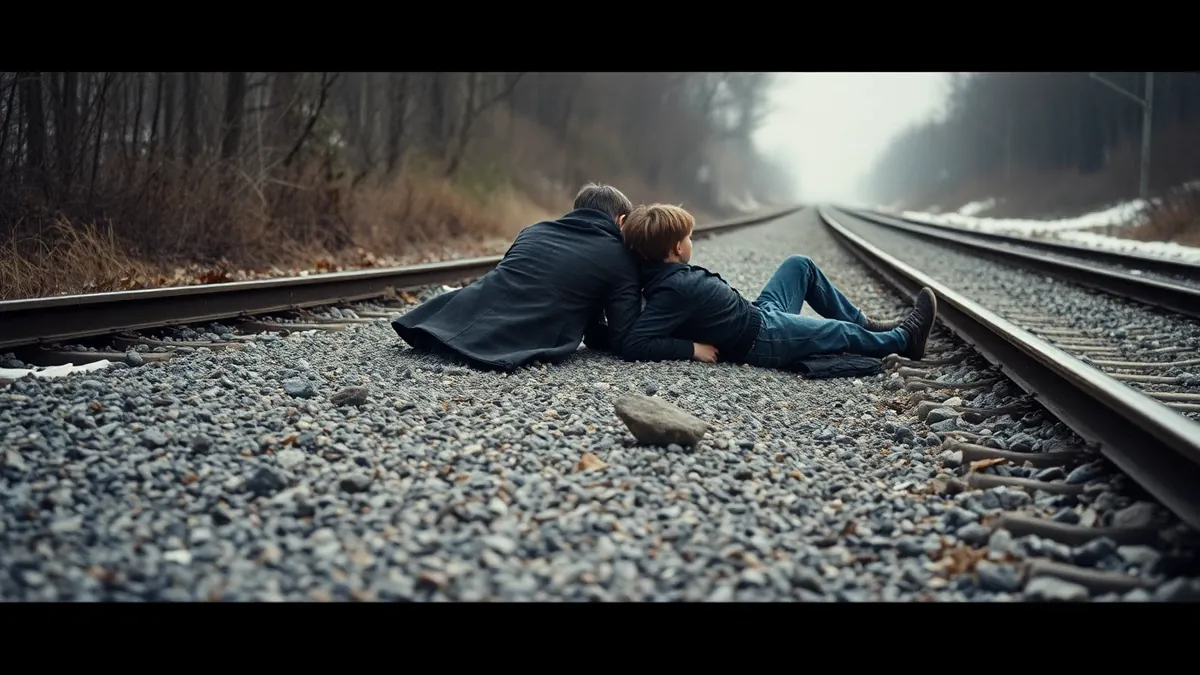
“I have big dreams,” she said, tossing a stone toward the tracks. “I'm going places.”
Her thick, wool overcoat couldn't protect her from the gravel that gouged at her back any more than it warded off winter's dry sting.
“What places?” asked Eugene. “The movies? Friday school?”
She adjusted her position, folded her arms behind her head to form a cradle above the ground.
“Maybe,” she said. “For now.”
“And always.”
Eugene was not tall, but scrawny with eyes like manga and hair that waffled between frizz and dreads. No matter how much he ate or how many trips to the gym, he couldn't seem to bulk up. To the school, he was Crack Baby.
“Can't go to Friday school forever, stupid. They kick me out once I turn twenty-one.”
They were both on their backs, looking into the sky like there was something more up there than the flat iron grey of November. The clouds were motionless. Sometimes a bird flew far away across the world.
Helen didn't know the last time a train had chugged along these tracks. Not in her life. There were ties missing and lengths of railing. People took them for art projects or shanties or to melt down the metal, and no one seemed to care. Helen didn't see why they should. The same old unconnected cargo car had been sitting on this spot two miles from her house for at least sixteen years. It wasn't going anywhere.
“It's funny how you said that,” Eugene spoke after a while. “'I have big dreams. I'm going places.' People don't talk like that.”
“Well, I'm probably stoned,” said Helen. “It's making my words weird.”
They both started laughing, and Helen choked on her tongue because she was laying on her back, so she rolled to her side in the rocks and dirt and that made them laugh harder until tears filled their eyes and their stomachs cramped.
“I don't even know why that was funny,” said Helen after a minute. “Just that something needed to be.”
She worried that she wasn't making sense, but then she saw Eugene nodding in a way that relaxed the knots from her shoulders. He got her. Even in the unforgiving starkness of their first high. Even when the yard lay so silent that the only sound was crystallizing frost, she thought he still heard her and agreed.
There were so many things that it was almost impossible to say out loud. Helen's dreams, for example, were so perfectly cloudy that moving them from her head too quickly might burst them into invisible, wispy strings.
“I read in class,” she said because it was only an interesting fact and not the swirling sounds and colors that represented her innermost desires, “that three-thousand people died in New York on nine-eleven.”
She paused and thought about how many people made three-thousand.
“That's, like, one out of every seven people in Ashland. That's, like, almost the whole college.” “There's only three-thousand students at the college?” asked Eugene. “That is so sad.”
“Yeah, well, I don't think it's a very good school or anything, but that's not the point.”
She sat up and crossed her arms around her knees.
“I mean, I don't even remember it happening. My mom said she'll never forget listening to the radio that morning. How at first it sounded like it was just an accident, like the plane had lost contact with its tower or something, then, just a piece at a time, it was like everyone started to realize. The reporters and my mom and people at her work, and it was, I don't know, this huge shock or something. Like, how could this happen here? In America, right? And suddenly everyone realizes there's a whole world out there, and we're only a part of it, at least that's how my mom tells the story, and I don't even remember it happening at all.”
Eugene stayed on his back.
“My dad's there,” he said.
“I know,” she told him.
“He's already reenlisted twice.”
They'd smoked over an hour ago now. Stalled by the abandoned car on their walk home from school.
“Please, Eugene?” Helen had asked.
“I just don't know why you want to. It's not really like you at all.”
“I wish I could explain,” she said, but since she couldn't, she didn't say any more.
The weed hadn't been very strong. There was too much in the bag, and it was loose like herbs, not like the sticky, crystallized balls she'd seen kids smoke in the park. The boy she bought it from laughed when she smelled it.
“It's cool,” he told her. “Not oregano.”
“Nope. Smells like skunk cabbage to me.”
She paid him twenty dollars.
“Forty-five,” he said.
“This is crap,” she told him, pretending to know for sure.
The English teacher came whistling out her door, balancing a cup of coffee on a stack of papers.
“Helen,” she called, “give me a hand?”
“Hope you choke on your crap, then,” he whispered and disappeared down the hall.
She was glad she hadn't gotten something better because this was already too much. She didn't hallucinate like she'd worried, and she didn't feel crazy or pee her pants or anything. But she couldn't stop thinking about things. The footage of the World Trade Center had re-aired on all the news channels in September. She'd never seen it before. The people falling from the sky. It seemed like a long time ago then, still glowing from the tail end of summer, safe at school, inside the unreality of textbooks, but the smoke made those tiny business men and women three dimensional. She wondered what it had been like to stand on the street while they fell around you like rain.
Her pocket started buzzing, probably her mom calling to ask when she'd be home. She let three rings pass before she hit ignore through her jeans.
“When you're old enough, do you think you'll go with him?” she asked, but when Eugene didn't answer, she realized she'd forgotten to say it out loud.
“Can you or can you not read my thoughts?” she asked. “If you can, I just want you to tell me. It won't freak me out. I promise.”
“That is, by far, the weirdest thing you've ever asked me.”
“Except the time in first grade when I asked you to lick my eyeball,” she said, “but just answer me anyway. It will make me feel better to know.”
“I can't read your thoughts,” said Eugene. “And I think I'm glad about that.”
“Okay,” she said.
“Okay.”
They stood up, one unit, and started walking toward the center of town. She thought it might be four. Or five. It was getting dark already. There was an ice cream shop they liked to go to, and she hoped it would be open when they got there.
“I'll probably join,” said Eugene. “When I'm eighteen.”
You liar, Helen thought at him loudly, but he didn't even blink.
“I don't want to be here forever either, and I probably won't get into any schools. Not like you. You'll be able to go anywhere. I lied when I said you couldn't leave.”
“My dad's in Italy. I visited him there once when I was thirteen. He let me drink wine.” “You drank with your dad? When you were thirteen?”
“Yeah, well, he was living with some lady that I'd never even heard about. She was super young and was always hugging and kissing me and say how capital “B,” Beautiful I was in her loud, look at me, accent. Whenever she got close, I smelled pool cleaner. It was actually pretty crappy.” “Oh.”
“I'm only saying because I can't go there. You said I could go anywhere, but I can't go there. It's off limits.”
“I can't go to Delaware,” said Eugene. “My dad's parents live there and they totally disowned him when he married my mom. We're too black for their money.”
“Whatever,” said Helen. “You should show up at their house just to spit in their faces.” Eugene laughed. “Nah,” he said. “What's in Delaware, anyway? I don't really see the point in taking it back.”
The ice cream shop was still open. Its fluorescent lights ricocheted around white tile and made Helen feel uncomfortably normal, like she really was just living another pointless day. The weight of it pressed the breath from her lungs, and she stopped talking as soon as they stepped through the door.
“Helen?” Eugene said, and she shook her head.
He took her hand and led her to the counter where they looked down at the tubs full of color. She couldn't read any of the names. The letters kept running into each other. She couldn't remember what she normally bought. She pointed at something white with purple streaks, and when the woman behind the counter asked if she'd like a bowl or cone Helen didn't even look up.
“Waffle cone,” she heard Eugene say for her.
She wanted to crawl under his arm and lean against his chest in thanks. He paid at the register while Helen stood behind him, staring at the reassuring slimness of his back.
“Want to eat outside?” he asked, turning and folding her hand around the cone.
They stepped back out the door.
“I didn't like it in there,” she said.
“So I noticed.”
“It was too much like my life.”
They almost sat down at a small metal table.
“Look at this,” said a voice from behind. “Crap Eater and Crack Baby.”
They went to the same school, but Helen didn't know his name either. After asking around, she had been pointed in his direction only by description. The built kid with the baseball hat. They'd neglected to exchange pleasantries.
“Fancy meeting you,” she lilted. “Always a pleasure, I'm sure.”
“I'm sure,” he smiled.
He stood with another boy who smiled too.
“Ice cream,” he said. “That's sweet.”
“Isn’t it?”
Helen struggled against the desire to back away, to turn and run. She couldn't tell what territorial line she'd crossed, which parts of her fear were paranoia, but speaking now seemed strange when they'd dismissed each other so quickly earlier that day. She noticed Eugene adjusting his position so he stood in front of her, and she knew he felt it too. The snarling dogs that bristled under windbreakers and Polos, their slavering, snapping jaws, the sensation of being circled, assessed for weakness. It shivered through her.
“I was thinking,” said the boy, “looking at your ice cream, that maybe you owe me another twenty-five after all. What do you think? Crack Baby?”
She sensed, more than saw, Eugene tense and clench his fist. It made her afraid that he always felt bigger than he was. Invincible. That inside he was already a soldier.
“I think you need to back the fuck off,” he said, pushing Helen behind him. Stepping up. “This your boyfriend?”
One hit and Eugene was down.
The swing had come so quickly after the question that Helen almost missed it. But she heard the crack of fist on jaw. The too real, non sound bite, smack of skin on bone. The joint dislocating, giving way to absorb a fraction of the impact.
Eugene began to stand almost immediately, and she knew the shame of falling would not let him walk away. She did not need to brace herself for the next blow. Her body had already frozen in place, crystallized in a moment of panic as the world around her raced on.
Eugene fell again.
The boy in front of her said something, but Helen could not hear what it was.
“What?” she wanted to ask, not because she cared, but from her desperation to catch up. He grabbed her wrist and Eugene's arm shot out to break the hold.
Then, suddenly, they were gone.
Something popped in Helen's ears.
“Get the hell off my property. I already called the police.”
The woman from the ice cream shop towered over them, her bust jutting like an awning, hands on ample hips. Eugene was standing again, but blood streamed from where the skin on his cheek had split. His nose looked broken.
“This wasn't our fault.”
“Get. Out.” the woman repeated.
They walked in silence for a moment before Helen reached for his arm.
“You don't have to join the army,” she said. “You could get into a school.”
“Yeah,” said Eugene, noncommittal, still dabbing at his cheek with his sleeve. His shirt front was ruined with blood, but she pulled his hand away and used her own jacket instead.
“I'm so sorry.”
“That guy was an asshole. Not your fault.”
“It was all my idea, and it was a stupid one. I just froze.”
“You were in shock.”
“I don't know what I was,” she said. “Am. A mess.”
He stopped and took her by the shoulders.
“You're not a mess,” he said. “And this is fine.” He flicked his already purpling jaw with just the slightest wince. “Passing. Just a stupid high-school memory.”
Helen shivered as a body fell to the pavement in front of her eyes. It was Eugene's father, spine snapped backwards, rifle in his hand.
“My mom's sick,” she said.
Eugene let her go. “What do you mean?” he asked. “Like, a cold, or something?”
“No,” said Helen. “Like, Parkinson's, or something. She was having this tremor. It seemed weird so I made her go to the doctor, and next thing you know she's going to have trouble walking and talking and peeing and whatever. Not now, but, you know, someday.”
“Someday when?” asked Eugene. “Then what?”
“Well,” said Helen. “It's just us, so she could go into a home.” She looked down at the already darkening blood on her sleeve. “Or I could stay here with her.”
They passed the movie theater, and Helen led him down its alley. Hidden behind the bulk of the dumpster, she cracked the loosely chained lid and tossed what was left of the bag inside.
“I don't think I'll ever do that again,” she said.
Eugene shook his head.
“But I think I had to today.”
He put his arms around her and kissed her on the mouth.
“I don't need anything,” he told her. “I just love you.”
“Thank you,” said Helen. “I love you too.”
She started laughing, though she didn’t know why.
“If you want, I'll take you around the world,” he said.
“That's all I want,” she told him. “Let's leave tonight.”
If Helen could go anywhere, she didn't know where she would choose. She really liked curry, so Thailand seemed good, but she liked sushi too. She didn't know anything about Hungary, except that it had a cool name. Africa was a whole continent of frightening animals and burning hot mystery. She took Spanish in school, and that seemed to apply to a good portion of the world, but she'd also had, for the last year or two, since she had discovered her unquenchable love for Nabokov and Anton, the exchange student's, East Slavic accent, a great desire to learn Russian. She wanted to study art, and it seemed like Chicago might be a good place for that, or Seattle. She hated her father for claiming Italy, but she thought China might have something worth knowing. She liked the idea of transferring from school to school, sucking in technique like a fountain pen. Then she would become a master of craft, an oil on canvas ninja.
Eugene pulled Helen close and she huddled to his chest, sending her most private, unformed thoughts straight to his heart. The ones filled with red and blue, gunfire and smoke. The pictures of his father home for Christmas and others where his brain leaked out onto desert sand. The flavors of coconut milk mixed with lime. Her fear and dreams of the future. The rattle of wheelchairs. Trains creaking back to life and pulling away down long abandoned tracks.
“Like Rain” was printed in Harvest Time, No. 5 of Inwood Indiana. Pick up the paperback from Prolific Press; the stories and poems published online are free to read here.
Get the paperback