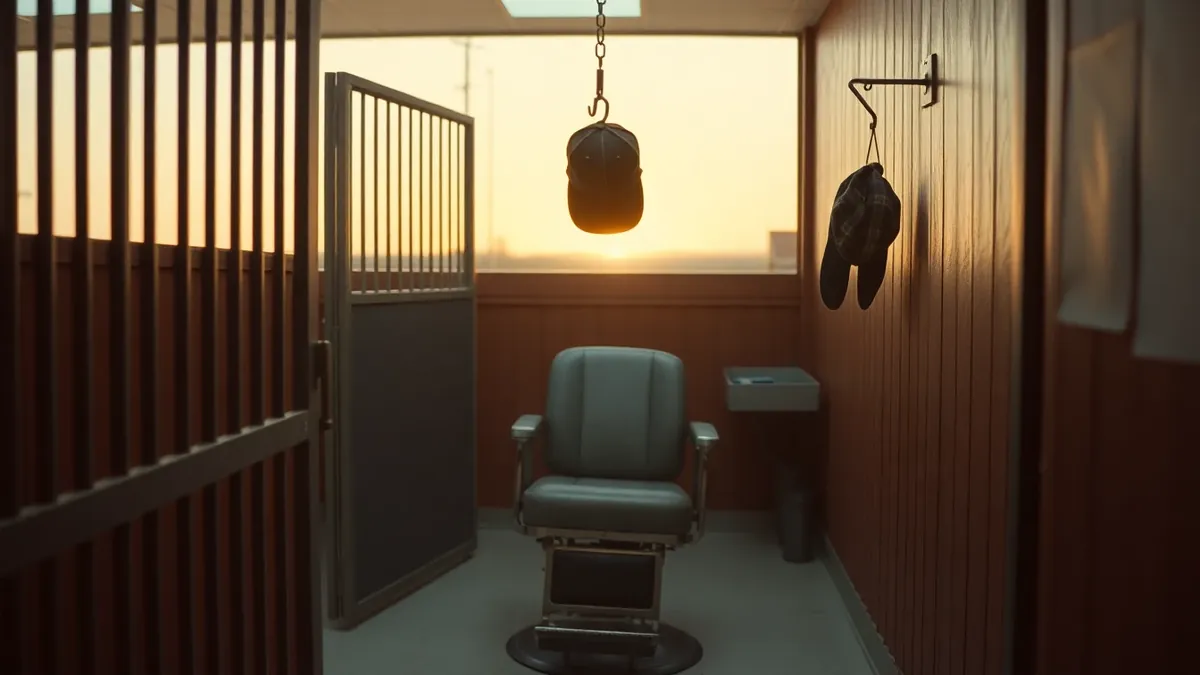
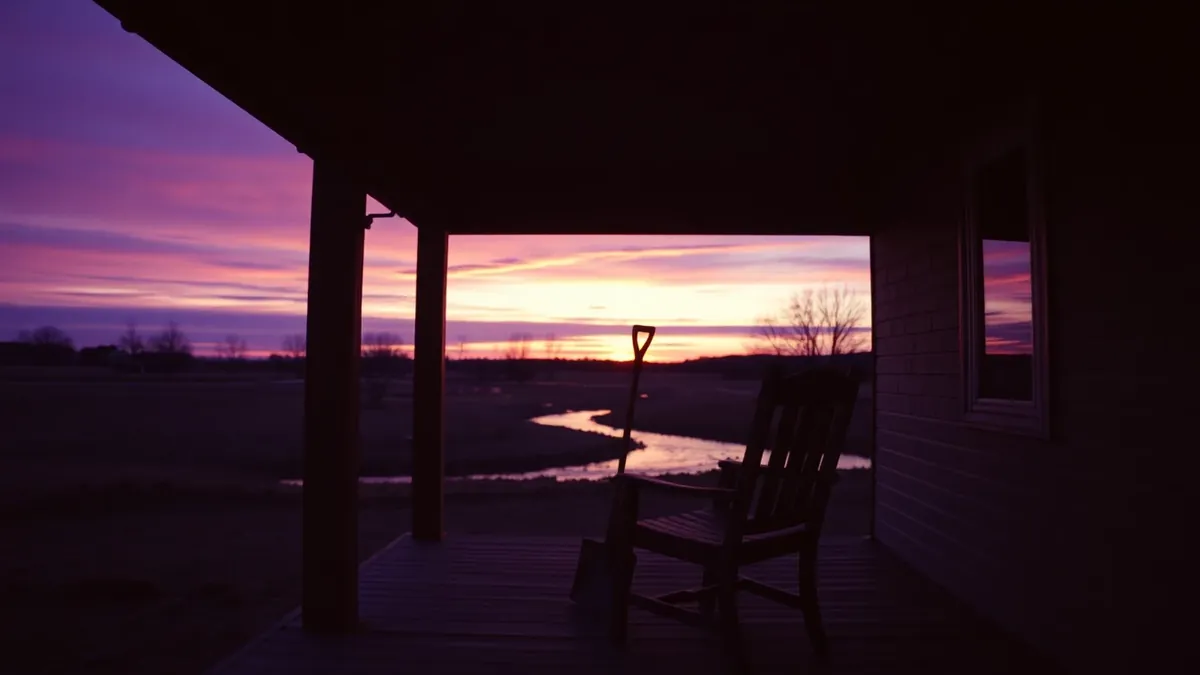
He sat in the old wooden chair, watching the fading sun change the color of the sky from a deep purple in the east to bright red in the west between the white posts of his wrap-around porch. He thought about the day he buried his wife, a day he remembered whenever his hands ached and were sore, because he remembered clutching the shovel's notched wooden handle until his knuckles were white as he fed the tip of the spade into the earth piled seven feet long and three feet high next to her grave. "I'll be damned. They're stuck again." He looked down to his legs at the thick, rubber waders that were shiny even in the early evening as the sun dipped below the trees that lined the pasture in front of his house. He sat back into the chair, taking off his cap to rest a minute.
He rubbed his hands, sore from fishing most of the day, submerged in the river up to his knees. The old man saw it as his work rather than leisure, tying flies and ripping the eight-foot rod back and forth. The cold water sent life into his veins. Life he wished to share.
He remembered her in a bed at the county hospital where their three children were born and nearly died, and where he took her the night he found her sprawled on the bathroom floor unconscious. Once they stuck tubes in her and woke her up, she said, "Now Jacob, honey, you never were too strong on your own, but you're gonna have to be strong now. You are.
The kids are here now while I'm dying, but they're gonna be gone back to their own lives shortly and leave you alone in that house you so adore." She coughed violently, and it looked as if she would die right there, the way her body convulsed and tried to throw away the sickness. All he could do was hold her hand and nod at what she said. He didn't really hear.
There was a part of him that believed she would make it out of that bed, a part that couldn't and wouldn't accept that she was dying. That part of him woke early every morning and danced, turning in circles as a man does who tries to make his wife laugh, and hummed parts of songs when he brought muffins and coffee to the plastic tray hovering over her chest. He told her everything would be all right, that this would be over soon, and he told her that he was sorry for all the trouble he brought on the family, and all the pain he put them through. He told her that once she was out, he would make everything good, and he would go to church again, and pay more respect to her and their children—and he told her that God would give him another chance to change. But that part of him died the day he woke up stiff from the chair in her room, pulled out of his dreams by the beeping of a machine. Two or three or twenty or thirty people rushed in and bent over her and wheeled her away.
They brought her back after some time, and he was still hunched with his elbows on his knees staring at the floor—they said she was going to be fine. He sat by her bed, holding her hand for fourteen days, watching her cough the life out of her lungs. "You've just got to be strong. There ain't no other way to be."
Jacob struggled with the waders, trying to lower them without having to stand up again. He felt he had stood up his whole life, and now it was time to sit down. He leaned his head into the wall of the house and closed his eyes—she appears, standing on the end of a roaring train, barreling through a sunny afternoon. She stands there, young again in her hospital gown, poised like a ballerina, singing with her mouth wide but he cannot hear her over the roar. She stands wide and breathes deeply between measures, red in the face from trying to reach him with her voice, and he leans closer, watching the sleeves of her gown extending straight behind her, as if held up by wires, and the train of her gown does the same as her chest heaves.
He leans closer but she becomes smaller and smaller as he stretches further and further; he reaches toward her—he opened his eyes to see his hand raised toward the ceiling of the porch. He took a deep breath and scratched his bare head, looking out to the fading light and the moon that was just beginning to show. He looked down at his legs and the waders were still there. "I hate these damned things," he said aloud, stomping the floor with his rubber heel.
A red pick-up rounded the corner of the driveway at the end of the pasture, and he saw the silhouette of his oldest son bouncing in the cab. Jacob knew this wasn't going to be a pleasant visit by the speed of the truck, and the way it left a pillar of dust behind it. His son had nearly died the same day he was born; the umbilical cord was wrapped around his neck so tightly he couldn't breathe at all, and his right lung collapsed as his tiny body seized, trying to protect the heart and mind. Jacob wasn't there in the hospital that day, and the only hand his wife had to hold was her sister's. Through the six hours of labor and the next day of constant updates from the doctor and nurses, she told anyone who would listen to call Jacob so that he could be there when they named their son. For years afterward, and even now, he imagined what happened that day. "You've gotta pick out a name, hon," her sister said holding the birth papers. "No, we wait ‘til he gets here."
Her sister looked down to the floor. "Honestly, I don't think he's comin’, but you can stay with me at the house until you've rested a bit. This whole thing has been hard on all of us. Hell, I thought so many times that we were gonna lose him. But you got a fighter there," she nodded to the baby in her sister's arms, "a real fighter."
His oldest son slammed the door of his truck, walked up to the porch, and stood on the top step staring at his father. He was a short, thin man, but with broad shoulders that hunched forward when he walked, and he always wore a short-sleeved collared shirt tucked into dark jeans. He held a white envelope in his right hand, and the left was in his pocket.
"Where were you today?"
"Fishin’. Where were you?"
The younger man laughed to himself. "Of course you were fishin’. I don't really know why we expected you, but we did." He turned to the side and leaned his elbow on the porch rail.
"Was everyone there?"
"Tom and Margie were. Debbie, Matt, and Ashley were all workin’, and the kids in school. They wouldn't have wanted to come anyways."
"No. I reckon not."
"Why didn't you?" He faced his father again.
"Because. I don't need to make my peace or mourn her death or anything else. ‘Sides, that ain't her in the ground, just her body. I don't know why y'all are so obsessed with it anyhow. She died long before that machine stopped beepin’, and I don't see the point of draggin’ it out any longer." He looked past his son into the field. "She didn't even say anything that whole time she was in the hospital. I buried her long ago, and I'm done thinkin’ about it. You oughtta learn a lesson there son."
"Well, maybe." They listened for a while.
"What you got there?" The old man gestured toward the envelope.
"It's a letter she gave me, and she told me not to open it until after she was dead—gave it to me about two weeks before." "Well, what's it say?" He leaned toward his son, eyes narrow.
"I dunno, haven't read it yet."
The old man sat back. "Really? Why?"
"She told me not to ‘til she was gone, and I just haven't got to it yet."
"Haven't got to it, or haven't wanted to get to it?"
"Yeah." He sat back and scratched his head. They were silent for a moment as the cicadas started to rise in that song that only means summer. The final light of day was quickly disappearing as darkness rose up from the ground.
"You got a drink on ya?"
"What? No. Why the hell would I have a drink on me?" The young man's foot kicked an empty bottle on the floor.
"I see you've finished yours."
"You gonna open that damn letter or not?" He looked his son in the face and saw his own. The younger man crossed the porch to the front door, reached inside the house, flipped on the porch light, and sat back down. "Dammit son." Jacob held his hand to his eyes and shifted in his seat; the waders made it difficult to move, but he made a show of getting comfortable. "No need to get pissy." He reached into his shirt pocket for a cigarette and a lighter.
"What're you always so mad about anyways?" He lit the tip and blew a cloud into the still air where it hung and turned slowly.
"Who says I'm mad all the time?" He held the closed envelope.
"Well, I do. If you give two shits about that. But, your mother did as well."
"Well, I'm a grown man, have been for a while. So, if I'm mad, I'm probably just pissed off at life y'know? You of all should know about that."
"Yeah. You've got a point there kid." He shifted again and tapped the ash into a beer can on the small table beside him. "Dammit these are hot. You gonna open that or are we gonna have to wait for the light of day?"
"You need help getting’ out of those waders?"
"No, no. I'll just leave ‘em on."
"Whatever."
He turned the envelope over in his hand, tapped it on his knee, and tore it open with a quick pull at the flap. Jacob could see the letter was only a few words on a small piece of lined paper. He leaned forward, dropping the cigarette into the empty can. His son looked over the page, his dark eyes darting back and forth, and he looked his father in the face with a sigh. "It just says that I need to take care of you." "Really? That's it? Take care of me?" He tugged at the top of his waders and scratched his head. "That sure beats all. Shit boy, can you even take care of yourself? Take care of me…" His voice trailed off as he fumbled through both shirt pockets to pull out another cigarette. Once he had it lit, he stared as his son folded the letter and shoved it into his jean pocket. "What do you think she meant by that?" The younger man leaned back in his chair.
"If I were to guess," he smiled, "I'd say it means I'm supposed to keep you from drinkin’ yourself to death." He chuckled. "Looks like you're tryin’ to beat me to it though."
Jacob rubbed his temples with both hands and started to laugh. He leaned back and knocked ash into the can. "I guess she knew me pretty well then. Shit, boy, pretty damn well."
"I'll say she did."
"Y'know, those words there in that letter were the last ones she said. She never said a thing the whole time she was in that hospital. For three weeks, only time I left her bed was when I had to piss. None of the nurses said they heard her say anything, and none of the doctors either."
"Well, I guess that shows how much she was worried about you."
"I guess so."
They both looked for a moment out into the night. Fireflies floated in the grass, disappearing and reappearing across the open pasture in front of the house. The gravel drive that ran between the woods and the field on the right was just visible. A whippoorwill perched somewhere at the edge of the trees sang out in quick bursts. It was her favorite bird, he thought. She never could wait for spring and summer evenings, when the whippoorwills would call back and forth across the field. She would sit just to listen, and perhaps to escape from him and his hands—the same hands that pulled at the waders once throttled her neck against the wall.
He stared at them; they were wrinkled now, still sore from fishing, with cracked skin and swollen veins that rose to the top as if they would burst— she is there beyond the porch rail, standing just inside the light, wearing the hospital gown, but hanging at her side this time in the windless night. He smiles but her face is stiff, not in death but in anger, and she reaches out her hand but she is far away and moving backwards.
"Hey, can you hear me?"
"What? Yeah. What did you say?"
"Did you pass out or somethin’? Dammit."
"No, I was just thinkin’. What were you sayin’?"
"I was just sayin’ that I think Ashley is gonna leave me." He had his chin in his hand, leaning on the arm of the chair.
Jacob leaned forward and his throat tightened up as he took a final pull from the short cigarette. The weight of his son's admission pulled him from the clouds swimming in his mind. "Well, why would she do a thing like that?"
"Hell if I know." He scratched his head. "I really don't know what happened. It's like," he paused, "like we're in two boats on a river, and we're caught in different currents, y'know?"
"Yeah, I know. Have you told Margie, or Tom?"
"Not yet. It's so damn embarrassing really."
They sat quietly for several minutes, until the young man pulled out his own cigarette and broke the silence. "I mean, I'm the oldest, right? So I should have my shit together more than anyone." The old man lit another cigarette, and they sat for a moment smoking. She would've hated this, he thought, her son and husband sharing a smoke on her front porch. Jacob nearly smiled, but he stopped himself and took a deep breath. He said, "I wish I knew of somethin’ more to say. Somethin’ more profound or, or wise, but I don't. Marriage is tough, and I wasn't no example to follow. It's probably the hardest thing a man can do in this world. Tryin’ to provide for a family while buttin’ heads with a woman hard as a mule; and tryin’ to make your own kids into strong men or women so they can provide for themselves one day; and doin’ it all at the same time. Shit, hard don’t even begin to describe it." He coughed. "Some people learn to get along, and some don't."
"Yeah. I see that now. You don't really think about it much at first, then it just sneaks up on you and all of a sudden you're sleeping in different beds and not talkin’ to each other." The old man shifted again, pulling at the top of the waders. "Here," his son set the cigarette down on the edge of the table and stood up," let me help you get those damned things off. You really need to get a lighter pair. No one wears these rubber ones anymore."
"Well, they work fine for me."
With the waders hung over the porch rail, they spoke for another hour, and after their pauses stretched longer than their words, they said their goodbyes. The old man moved inside to sit alone at his kitchen table—just the faint light from the porch bending in through the windows. He finished his last cigarette, and began drinking from a new bottle. He usually didn't bother turning on the lights inside the house. A .40 caliber pistol was on the table in front of him, as it was every night since her death, and he leaned forward to pick it up, his cigarette dangling from the corner of his mouth. He popped the magazine to see if it was loaded, and then shoved it flush with the grip.
He looked through the dining room window, and saw a half moon behind the silhouette of a black cloud. A steady stream of smoke curled up as he clutched the gun with both hands. He could only see his children as adults now, all with salted hair and round stomachs, sitting on the couch in his living room, talking about what they wouldn't do for a long vacation. He waited for her to appear, but only the walls and windows stared back at him.
He picked up the bottle and drank again. His hands started to shake, and his knuckles were stark white against the blackness of the gun.
Jacob slammed the pistol on the table, snuffed his cigarette in the ashtray, and stood up. His knees were sore, but he shuffled himself to his bedroom, grabbing the wall for support. He fell into his bed, still fully clothed, rolled over on his back, and fell asleep.

“Waders” was printed in Crossroads, No. 8 of Inwood Indiana. Pick up the paperback from Prolific Press; the stories and poems published online are free to read here.
Get the paperback