
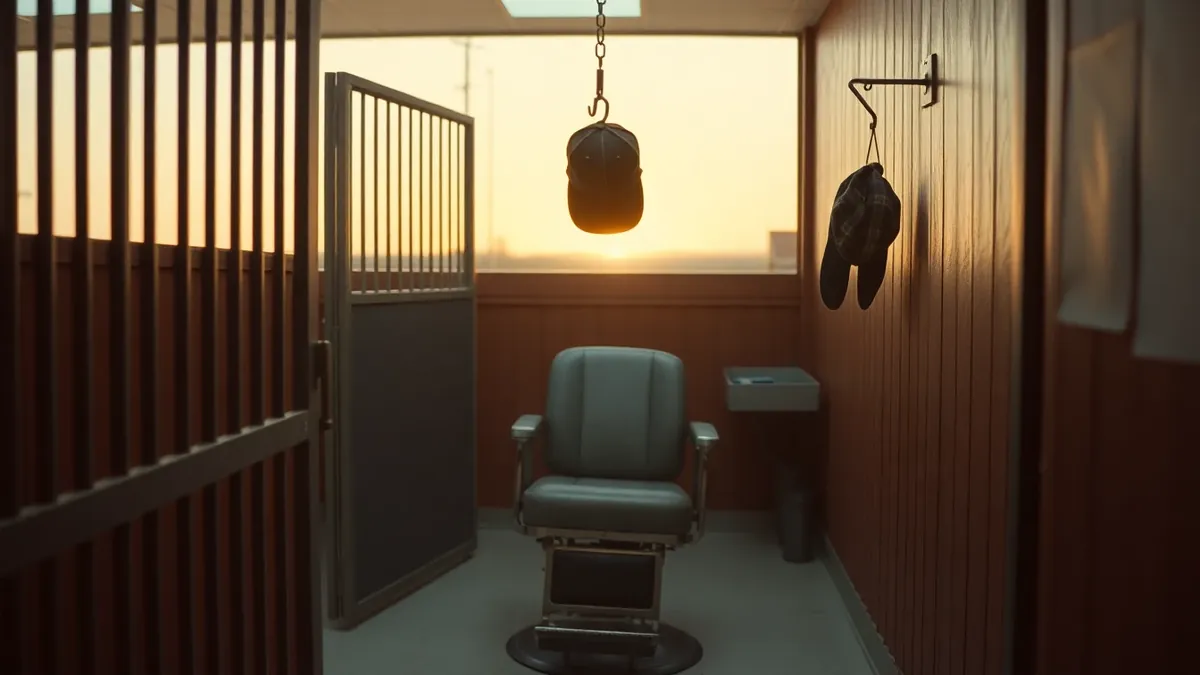
Sam Turner sat in Ginny Jackson's barber chair with a sigh so loud it seemed as if he were shaking off a lifetime’s worth of trouble. She cut hair in a salon built into the walls of the Granville Wal-Mart. For five years, she’d slid back the metal gates that separated the salon from the store at nine in the morning to allow in the old men, unwilling to help their wives shop for groceries, and who didn’t truly need a haircut but just a trim they’d say. They always seemed annoyed that she was able to shorten their wispy white hairs so quickly. It was there she met and lost her first and only boyfriend, who left her with a son and a rental house too expensive for her to keep along with a new car she never should’ve bought—and it was there that he left her, walking off in the same worn jeans, t-shirt, and boots he showed up in, saying that he was meant for a different life, and that he couldn't stay this way, that he couldn't stay here.
Ginny wanted a man willing to be a little sweet on her at times, and who would work hard just as her father worked hard day after day until he was buried on the job; and the father of her son was that man for a while. She thought about it all after he left. He said he had a right to go to all the same movies, eat at the same Olive Garden, watch the same satellite television, and buy the same beer and cars as everyone else because it was America and everyone was the same.
It didn't matter to him that they kept getting phone calls from the credit card companies who yelled at her on the phone, and she didn't know that every line of credit was in her name until he was gone. Her mother told her when he left that all a woman needed in this world was just a small amount of respect, and she could get by on that—just a reassurance that her life was of some value to someone else. You can deal with all the rest, but you have to have that. Even so, Ginny didn't believe her mother any more than she believed he would come back to her one day wanting to move back in, and provide for their son in the way only a father can.
After a few years, she realized that what she believed didn't matter anymore because beliefs didn't change anything. They only hid the thorns of day-today life when she should be thinking about picking up extra hours and tips, and were nothing more than wishful thinking.
Turner had a face darkened from the sun, with a long, thick nose sitting below two dark eyes. Sweat was starting to bubble beneath his eyes from the mid-summer heat outside. He was tall and thin, but his stomach stuck out, rounded and wide from under his shirt. Ginny was a short, large woman as heavy in voice as in body; she flung out the black cape and draped the man in front of her.
“What kind a cut you want?” She was breathing heavily, and she threw her long, reddish brown curls away from her face.
“Well, I just like the buzz cut. Y’know, like a military look." He had a raspy drawl hidden beneath his thick, black mustache. "I wasn’t ever in the military, but I do like the way they cut their hair. Nothin’ to mess with, y’know? I ain’t got time to be messin’ with my hair.”
“Yeah, I gotcha. You like to look good, but you don’t want to put out any effort to get there. I’ll fix you up. And it’s so damn hot outside, it’ll help you keep cool."
“At’s just what I’m hopin’ for young lady.” She had the clippers in her hand and went to work. “You got any siblings hon?”
“Naw, it was just me. Only child.”
“I’ve just been to see my oldest brother is why I ask. Six kids my parents pushed out, born one right after the other. Boy, girl, boy, girl, boy, girl. I’s the last boy born, but I didn’t get no special treatment; no ma’am. My brother though, he couldn’t do a damn thing wrong when he was growin’ up. My poor mother would fix him whatever in the world he wanted to eat, and she was always getting’ him new clothes, and tellin’ him he was so special. I swear, when he took a shit, she picked his turds out of the toilet with a napkin to show the whole damn town. Couldn’t do nothin’ wrong. He’s dead now though--blew his head off with a revolver. I really don’t know what got into him to where he didn’t feel like livin’ any more, but I suppose he had a reason.” Ginny stopped her clippers.
“I thought you said you just went to see him.”
“I did. I visit his grave every day almost. For the past month, I’ve been going there just to shoot the shit with him, talk to him about the girls I’m wanting to see, even though he’s dead. I feel like he can hear me sometimes. I used to tell him he was an idiot for doing such a dumbass thing like killing himself, but now I just talk about the things we used to do together. My poor mother was devastated; still is.” She started working the clippers again.
“I’ll bet she is. Hell, it would tear me up if my boy shoved a gun in his mouth and pulled the trigger. He’s only four years old. I hope he never gets so sad as to do a thing like that. Good Lord.”
“I sure hope not. We don’t even really know what got into Billy. He never seemed too sad, and he never went to the doctor for depression or anything like it. He was a big guy, tough and strong as a damn bear. But y’know, it’s the littlest things that kill us sometimes. Some little voice in our heads that tell us that nothin’s worth shit anyways, so why go on?”
He tilted his head to the side as she continued her work. “Bout the only thing wrong with him is that he would get so damn angry sometimes. It wasn’t all the time, just when little things wouldn’t happen the way he wanted them to. One time I was over at his house watchin’ the Razorbacks—football, we were getting stomped, but anyways I was just sittin’ there drinkin’ my beer, rockin’ back and forth in his rockin’ chair, and he kept tellin’ me to quit rockin’. I thought he was just bein’ stupid, so I kept it up. After a while though, he stood up without sayin’ a word, walked over to me, and slapped me right across the face—real hard. I couldn’t believe it—just smacked me.”
“Look down.”
“He did that a few times to a few different people, and we never could figure out what set him off so bad,” he said towards his chest.
“Sounds like a crazy sonofabitch to me. Haulin’ off and hittin’ people for no reason.”
“Well. Crazy maybe, but he was a helluva car salesman. Made tons of money up there at the Toyota lot just up the street, and he never had to share it with anyone. He never got married or had kids or nothin’, and he’d be damned if he gave one cent to any of us. He barely even bought us Christmas presents, but hell, his money ain’t none of my business. He didn’t leave a will or nothin’, so I guess everything just goes to the government or the bank or somethin’.” Turner laughed softly at the thought of that. “He always had the best lookin’ girls money could buy, and he even tried to set me up with this Asian chick who couldn’t speak a lick of English. It was pretty weird, so I just left the bar we was at and went home.”
Ginny faked a chuckle as she finished the man's hair. He was one of the easier ones who actually had something to say.
At 3:30 that afternoon, Turner pulled his small sedan into his garage, shut off the engine, slapped the button to lower the rumbling door, and went inside. He moved his head to the left and right, in front of the bathroom mirror, inspecting how well Ginny did the job. “Not bad, not bad.” He turned on the tap, wet his face in the sink, and dried it with a towel on a hook to the right of the mirror. “Not bad at all.” Whistling softly to himself, he made his way to the kitchen and pulled a beer from the fridge. Popping the top, he stared out the window above the sink and sipped. Billy really was a crazy son of a bitch. The tread marks were still in Turner’s front yard from when his older brother drove his truck through the wet grass in a drunken rage just a few weeks before his death.
Turner struck a match on the box, lit a cigarette from the pocket in his shirt, and threw the burning match in the sink. He blew out the smoke, and it drifted up to the ceiling in a thick cloud. It was raining that night, and they’d left a bar in Fort Smith with Turner driving his small sedan behind Billy’s truck so he could keep any curious policemen from tailing his brother. His wipers could barely keep up with the rain. Billy talked all that night about wanting a wife and kids, and how he needed to settle down and take his life seriously and stop throwing it away, but Sam knew it was all for not. It was just the alcohol raging through his brother’s blood, loosening his tongue to say the words their mother would want to hear. To point himself in a new direction would simply require too much effort, too much reconsideration, too much planning, too much of everything Sam saw him try to do time and time again, but everything Billy never seemed to be capable of. Sam knew this, but he listened to Billy anyways, reassuring him that he could settle down if he wanted to, and that it would be a good thing to break the cycle of girlfriends and bar hopping, and bigger tires for the truck that never left the pavement.
Instead of driving to his own house outside of Granville, Billy turned down Maine Street and pulled into Sam’s driveway. He kept the wheels to the left and stepped hard on the gas, spinning his tires in the wet grass. He drove through the small empty lawn, dropped off the curb onto the street, and pulled into the driveway again to continue the destructive circle three times before finally turning to the right and gunning the engine back down to Center Street and into the storming night.
Sam watched this desperation from his car, wipers still marking time, and somewhere inside himself, he could feel that this was the end. He couldn’t understand why someone with all his brother’s advantages would still be so angry and sad. Sam was angry because things in life never seemed to go his way, the way he planned them. Everything, from his car breaking down just before he left for a vacation two years ago, to being fired from Whirlpool a year later, to women refusing to date him throughout his entire life. The way he saw it, Sam was the one who should be driving circles on the lawn of their childhood home, not Billy.
A week later, Sam found Billy’s body floating in his hot tub. The water was still swirling in a gory, brown mess around his brother’s swollen carcass. Their father’s .357 revolver was at the bottom with its shiny nickel finish and dark walnut grips. The cop who responded to Sam’s call fished it out with a long metal rod after the men from the funeral home wrestled Billy’s body onto a stretcher. “It sure is a tragedy. I bought my wife’s car from Billy a few years ago. It’s a damn shame to see him like this.”
Turner moved into the living room and eased on to the couch, propping his leg on the coffee table and setting his beer in front of him. He picked up the remote from the table, and turned through the channels. Each image flashed a second’s worth of color and sound, entire worlds cut to a fleeting moment. He didn’t know what he was looking for, but he knew it wasn’t there so he left it on a news channel and sat back to drink his beer. The phone on the side table rang.
Turner listened to the caller’s persistence four or five times before muting the television, and picking up the cordless receiver; it was his mother.
“Sam? What’re you doin’?”
“Hi momma. I was just flippin’, just flippin’ through the paper lookin’ at the jobs – ”
“How many times have I told you that all of the jobs are online nowadays? No one puts the real jobs in the paper anymore. They’ve got tons of websites out there that’re advertisin’ all sorts of openin’s, and that’s where you gotta look. Jiminy Christmas, Sam. When’re you gonna get serious about this? It’s been over a year since you were fired, and you ain’t getting any younger.”
“I’m tryin’, I really am. I just haven’t found the right one yet.” She sighed into the phone, and he leaned his head backwards into the couch. “Besides, every time I go into the library, all of the computers are taken.”
“What’re you so afraid of?”
“What? Afraid? I’m not afraid of anything.” He paused, “And, I was let go; I wasn’t fired.”
“Oh, well that makes all the difference don’t it. Y’know, I was always afraid you’d be the one most like your father—too scared to try anything because you think you might fail.” She trailed off a bit before coming back. “Listen, Sam, I’m not tryin’ to be mean here, I just want you to get back on your feet is all. That unemployment don’t last forever, and you’ll soon be without any sort of monthly check at all. Then what’ll you do?”
Sam watched the newswoman bobbing her head up and down with a serious look of concern carved into her face. “I know, I know. I’ll find somethin’.”
Turner straightened his legs on the coffee table. His cigarette had burned down to the filter sitting in the ashtray. He never smoked while on the phone with his mother. “Is that all you called about Mom?”
“No, no." She sighed again. "I called to let you know that Janey is pregnant again.”
“Again? And I reckon the father is her jackass husband–”
“Hey! Don’t talk about him that way; he’s your brother.”
“In-law. I don’t claim no relation to him. How far along is she?”
“About two months I reckon.”
“Well, tell her congrats for me.” He tipped back the beer can. “If that’s all momma, I’ve got to make a few phone calls.”
“Who’re you callin’?”
“There’s a few employment agencies that I need to make appointments with to fill out applications and stuff.”
“I thought you already did that.”
“These are different ones. I just haven’t gotten around to these yet.”
“Alright, well, I’ll let you get to it. Bye.”
“Bye.”
Turner set the phone on the arm of the couch and picked up the remote to turn the volume back up. His mother had never goaded him the way she had since he lost that job. Until then, he felt she never gave him much attention at all. So long as he steered clear of any criminal charges, and respected her, she didn’t ask him any questions. The word came when he was forty-three years old that he was soon to be unemployed after just a year of attaching handles to refrigerator doors, and he believed himself too old to start over, but too young to retire. The company offered to pay for a two-year degree, and Turner thought about pursuing it. He saw himself as an electrician, or a plumber, driving around in a van with his company name painted on the side, TURNER’S PLUMBING, and how he could call his mother and Billy to tell them he was a business owner now, his own boss, and he don’t have to listen to nobody. He saw himself as a man taking control of his own destiny, making enough money to stop renting from his parents and buy his own house, making enough to take some girl to that fancy Italian restaurant he could never remember or pronounce the name of in downtown Fort Smith, and making enough to vacation in the Caribbean whenever he needed a break.
The application forms sat in a neat pile on the corner of the coffee table for two months while he shuffled around them, lived around them, careful to set his beer and ashtray at the farthest edge away from the papers so he wouldn’t ruin their crisp, white pages cramped full with words and blanks asking every detail of his life. He picked up the packet a few times, reading over the top lines, but he told himself that he would fill them out later and that there wasn’t any rush. He missed the deadline to sign up for the courses because he couldn’t bring himself to complete those application forms. He convinced himself later that they asked him too many questions, so he trashed the papers and didn't have to worry about achieving anything anymore.
Turner picked up the phone again and punched in a number on a slip of paper he pulled from his pocket. He muted the television again.
"Hello?"
"Hey Ginny, it's Sam; you ‘bout off yet?"
"Yeah, but I just got home and I'm waitin’ on momma to come over and watch my boy. She should be here in about fifteen minutes; then I'll come over there."
"Sounds good. I'll see y'then."
"Bye."
Ginny set the phone down on the edge of the side table, took a deep drag on her cigarette, and blew the smoke toward the ceiling of her living room.
"Good Lord, it's hot." She wiped underneath her eyes with her thumb and leaned her head back into the cushion. "Ain't it, Jimmy?" The young boy on the floor nodded and kept pushing his small toy cars across the worn carpet, making sputtering noises higher and lower as the tiny drivers changed gears. A large, white fan on a pedestal blew air back and forth across the room.
Sam was the first man she agreed to have supper with since the father of her son stepped out four years ago. Several had asked her, but whether they were in her chair, at church, or where she dropped Jimmy off at daycare, she wouldn't accept it. They all had the same looks in their eyes, trying to put on a soft, innocent gleam, but Ginny could see the storms behind their words. They would all just be like before, and before wasn't any place to be. She felt she was just fine, if not better, on her own. A summer afternoon shower opened up over her house right as her mother walked through the front door.
"Hi kids." She wiped her feet on the rug as she shut the door, and tugged out of her raincoat.
"Hi granny," said Jimmy.
"Hi momma," said Ginny as she put out her cigarette and stood up from the chair. "Thanks for comin’ over."
"You got a date or somethin’?"
"Somethin’. I ain't sure what to call it. Just goin’ to eat."
"Well, alright. Just don't stay out too late. I'll put him to bed at seven." She stepped to Ginny and hugged her. "And don't be nervous. Just be yourself.
OK?"
"Ok momma. Jimmy be good for granny. I'll see you tomorrow mornin’."
The Panther Diner had low ceilings and even lower lighting. Over the past five years it had been four different restaurants, and each one shut down quicker than the one before, unable to keep customers from going to the Mexican places two miles down the road. Turner told Ginny that the place always made him feel like he was in an old speakeasy sipping whiskey from some professional bootlegger. "Then the girls would come out an start dancin’ real sweet-like, and some old boys would get in a fist fight over a card game. Those were the days now, livin’ life free." They met each other there at the diner instead of Turner picking her up, and he rightfully assumed it was so she could leave when she wanted without relying on him to take her home.
They stepped through the glass doors together, and blinked to adjust their eyes to the darkness. There were only two other couples seated, talking in hushed voices. A large American flag hung from the opposite wall, and on either side were pieces of Panther memorabilia: jerseys, pictures of old football teams, and a baseball autographed by the state champions of 1988 encased in a glass box sat on a shelf attached to the wall. They shuffled their way around the center tables, and sat at a corner booth. A thin woman weathered by cigarettes and sun asked what they wanted to drink.
"Y'all got Coke?" Ginny asked.
"Yeah, Coke, Diet Coke - "
"Coke for me."
"I'll have a sweet tea."
"Special tonight is the fried catfish. You get two filets, coleslaw, hushpuppies, and fries. I'll go get your drinks."
After they placed their orders and ate halfway through their meals, Ginny asked Turner what sort of new job he was looking for.
"Well, really just anything that'll pay the bills. I shore's hell been tryin’, but there just ain't much out there for a man like me. Old and laid off." He paused for a moment, staring at his plate.
"Yeah. That's really bout all you can hope for these days." She talked around a mouth full of food. "Just somethin’ to make sure y'don't starve to death. Cuttin’ hair pays pretty good, but it shore don't stretch far enough at times."
"I know what you mean."
They kept eating without talking. A sitcom was on the small television in the corner, and Turner looked up at it a few times out of habit. Ginny put down her fork, and cleared her throat. "My mother said, when my last boyfriend left - "
"The father of your son?"
"Yeah, him. Now, you've been real sweet to me, an I 'preciate it, but it's always made me wonder. Is that really all there is to life? Besides tryin’ to do right by God, an raisin’ your kids to be good people, just a little respect and findin’ a job doesn't seem to be a good life."
"For most of us, yeah, I think this is it. Some people go on adventures and shit, but most of us just got to do right to each other, believe in God so that one day we'll die and go to heaven. Doin’ fun shit just costs money, and there ain't enough of that to go around." He set down his own fork, and leaned back into the seat. "But even with money, that ain't no guarantee. Just look at my brother, the dead one. He had all the money he could ever need, but it still didn't seem to help him. He hated life so much he put a bullet through his brain. Most of us just aren't meant for anything more than the daily grind. It's when we try to go out past that, that's when we get in trouble."
They ate in silence for a few moments, and Ginny said, "Y'know Sam, you sure are honest." She laughed, and he smiled. "I mean, hell, this mornin’ you were talkin’ about him in my chair right after you'd gone to see his grave. I was a total stranger—still am really."
"It's the only way to live if you ask me." He wiped his mouth with his napkin and pushed his plate away. "I've got some beers at the house. You wanna come over for a bit? Just watch some TV or somethin’?"
"Yeah, I'd like that."
After a few beers, several hours of television, and some comments about the shows, Turner leaned his head back into the cushion of his couch and fell into a light snore. Ginny Jackson looked over when she heard him, and studied his face. He looked kind, and he was honest, she thought. She bent over, and fumbled through her purse at the foot of the couch and came up with her pack of cigarettes. She stuck one between her lips and flicked the lighter from his coffee table, blowing the smoke into the hot, still air. Ginny got up to go into the kitchen for water. She saw a full moon hanging low and shining its pale light on the street and lawn outside the window over the sink. Was it enough? Standing in Sam Turner's kitchen, for the first time in a long time, she sunk her head into her hands, and cried.

“The Panther's Diner” was printed in Crossroads, No. 8 of Inwood Indiana. Pick up the paperback from Prolific Press; the stories and poems published online are free to read here.
Get the paperback