
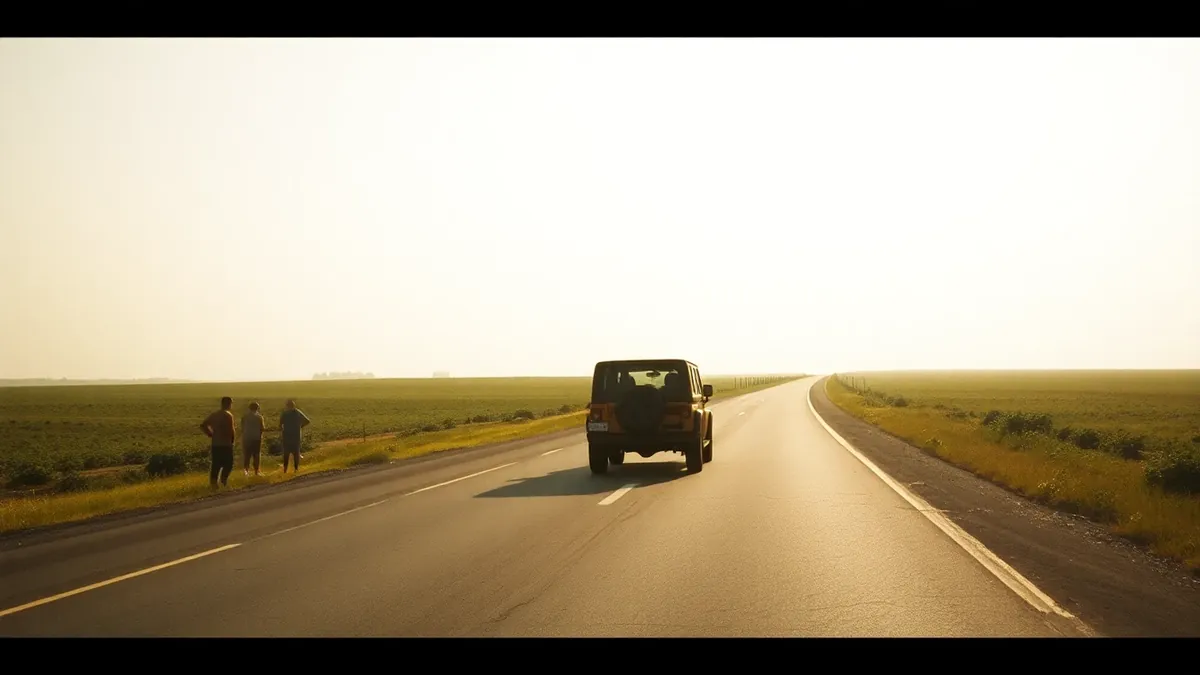
Humming along with Patsy Cline on the radio, his voice too wretched even for him to listen to, Mayo cruised down the highway in his air-conditioned Jeep Cherokee. Scarcely anyone else was out on the road. It was just too hot, likely to reach a hundred by late afternoon according to the last forecast he heard on the radio. About the only people he noticed the past couple of miles were strawberry pickers, all hunched over in the bright red fields with their cartons and baskets beside them. He smiled, remembering all the summers he had picked berries with his grandparents, wearing one of Pa's stained straw hats that was two sizes too big for his grapefruit-sized head.
"You might look like a scarecrow," Pa laughed the first time he gave him a hat to wear. "But you don't want to get heat stroke, do you?"
"No, sir."
"Take it from me, boyo, it's always better to feel good than look good."
"I guess."
"No guessing about it, boyo. That's a flat out fact."
A little farther on, winding through a tight curve, he approached a road sign that made him cringe. "Seven Oaks," it said. "Next Exit." Urgently he clamped his eyes shut until he was sure he had passed the faded sign. He wished he had not seen it but he knew he would, sooner or later, because where he was headed was in the same direction as Seven Oaks.
As a roving hitting instructor for the Detroit Tigers, he went where he was assigned, and this weekend he was told to report to their affiliate in Winchester---the Winchester Tigers. This was the first season they had been associated with the Class A club. Desperately he tried to wriggle out of the assignment but Mr. Hedgecock, the Director of Player Development, was adamant that he go because the ball club had, by fifteen points, the worst team batting average in the league.
"I'm not a miracle worker," he told Hedgecock.
"No, Mayo, you're not, and I'm not expecting you to be one. But you've got a sharp enough eye to bring up their average three or four points and that'll do for now."
He didn't disagree, convinced he could improve just about any batter's average a few points, but still he didn't want to go to Winchester. It was only twenty-six miles from Seven Oaks, which was definitely the last place he wanted to see again.
Mayo, a fungo bat poised on his right shoulder, stood a few feet behind the chipped plate and watched a young outfielder swing at balls thrown by the rickety pitching machine. The kid had what an old manager of his called "a spidery swing" because it was all over the place. He watched him take less than a dozen swings but that was enough for him to conclude the kid would not advance beyond Class A ball. Still, he had to offer some advice, which he suspected the kid would take as encouragement, because that was his job.
"You're very busy in the box," he told him as a ball boy reloaded the pitching machine. "So if I were you I'd be a little quieter. More relaxed, if you will."
The kid, knocking some dirt from his cleats, appeared confused by his comment.
"Don't be so fidgety when you're in the batter's box. Be like you are in church. Be still. Stillness is what'll give you results."
"I am still."
"No, son, you're not. You're moving around as if you've got an itch you can't scratch. Just stand still and be ready to swing and you'll get more wood on the ball."
"If you say so," he sighed, urgently tapping the plate with the head of his bat.
Mayo had earned a living in baseball almost half his life. He signed with the Tigers straight out of high school. A catcher in school, he was soon converted to a first baseman, and there he played for four and a half seasons until he tore a tendon sliding into home and subsequently was released. He got as far as Double A ball. His career in baseball seemingly was through before he was twenty-three but one of his managers appreciated his knack for analyzing the strengths and weaknesses of batters and recommended him for a scouting position. Eager to stay in the game, he took it and slowly advanced through the organization, scouting mainly but also for the past two years working as a hitting instructor. He never hit very well himself, batting scarcely above his weight with six home runs in a total of 182 games, but for some reason he was adept at identifying the flaws in other swings and suggesting corrections.
Other than hitting a ball what he liked most about baseball was talking about hitting with young prospects. So he was always excited when he was sent out to one of the farm clubs to offer some instruction, but not this time. Not here in Winchester. He'd rather be anywhere but here, even in Alaska if the team had an affiliation there.
Mayo stood with Clete Holcomb, the manager of the Winchester club, behind the batting cage and watched a lanky kid line balls deep into the corner of left field. As usual, a cigarette hung from his lower lip, dribbling ashes across the front of his atrocious Hawaiian shirt.
"So what do you think of Earl?" Clete asked after the young slugger crushed a ball off the left field wall.
"Oh, he's got the tools all right," Mayo answered. "His wrists are lightning fast so he can definitely get around on the ball. And they're strong, too, though he's thin as a toothpick."
"He leads the club in home runs."
Mayo, silent, watched the kid take a couple more cuts.
"I bet he has twenty in another month."
"He can pound the ball. No doubt about it," Mayo conceded. "What concerns me, though, are his hands. They should be closer to his body so he can reach the low, inside pitch. Right now, his are too far away, and a good pitcher will see that and really bottle him up."
"I don't know, Mayo. He's pretty quick with the stick."
"He is, but it's much easier to swing inside out than it is to go outside in. You know that, skipper."
The manager frowned, spitting out a stream of tobacco juice.
"There are so damn many things a person has to think about when he's up to bat it's a wonder he can make contact at all."
Mayo grinned. "The best hitting advice Ted Williams ever got, he claimed, was from Rogers Hornsby who told him 'Get a good ball to hit!'"
"Ain't that the truth."
"It must be close to ninety in the shade," a catcher complained as Mayo tossed him a rosin bag to dry off his slick hands so he could get a better grip on his bat.
"About that, yeah."
"I've been here almost six weeks and the heat just seems to get worse. I wonder if it'll ever cool off."
"Not likely. Not in this valley."
The catcher took a couple of easy swings, making sure he didn't lose his grip again. "You from around these parts, coach?"
He nodded. "I grew up in Seven Oaks."
"I've heard of it."
"It's a little ways east of here."
"I bet you're glad you got this assignment so you can see some of your family."
He didn't reply but watched Clete chop ground balls to some infielders.
"You still got some family there, don't you?"
"I don't know, to be honest. I haven't been back in a while."
"You going over there to see?"
He shrugged, wiping a bead of sweat from the tip of his nose with a thumbnail.
That evening, after dinner, Mayo started to drive back to his motel but on an impulse stayed on the highway and headed toward Seven Oaks. Oddly, he felt as if someone else were behind the wheel, and he was a passenger in his Jeep, unable to persuade the driver to turn around.
Half an hour later, still looming over the town like a dark cloud, appeared the old water tower that he and his cousin climbed one night on a mutual dare. And across it was the feed store, and farther on the bus depot and the library and in front of it the sullen Lincoln statue. Slowly he proceeded down the shaded street past the beauty parlor and Shell station and the bank and candy-striped candy store. There were a few places he didn't remember but otherwise the town remained pretty much as it was when he left to play for the Tigers.
Soon, as he knew he would, he saw Mullins Market, its weathered sign even larger than he remembered. At once, his heart banged against his ribs, causing his whole body to shudder for an instant. Tightly he gripped the steering wheel, not wanting to lose control of the Jeep as he drove past the market. He made a right at the corner and circled the block and approached the market again. Then, abruptly, he pulled into the nearly empty parking lot and turned off the engine, his hands still clutching the wheel.
He wondered if the Mullins family still owned the market. If so, he was sure he would remember them because, often at night, he still saw them glaring at him with the same fierce eyes at the inquest. Late one summer night, shortly after he signed with the Tigers, he and his cousin were tooling around in his uncle's El Dorado, racing through the back streets at the east end of town, when they struck and killed the Mullins' youngest daughter, April, who was out riding her bicycle. Neither of them saw her but knew they were at fault because they were going much too fast. Earnestly, at the inquest, he apologized to her family, but he knew from their eyes they didn't believe him. Maybe someone would tonight, he thought, climbing out of his Jeep.
In another moment, he was inside the market, and right away spotted a cashier who had the familiar round pale face of a Mullins. He took a deep breath, and as he approached her, he told himself to stay calm, not to fidget around, but to be absolutely still, just as he always instructed batters when they were at the plate.

“Up at the Plate” was printed in Esther, No. 1 of Inwood Indiana. Pick up the paperback from Prolific Press; the stories and poems published online are free to read here.
Get the paperback