
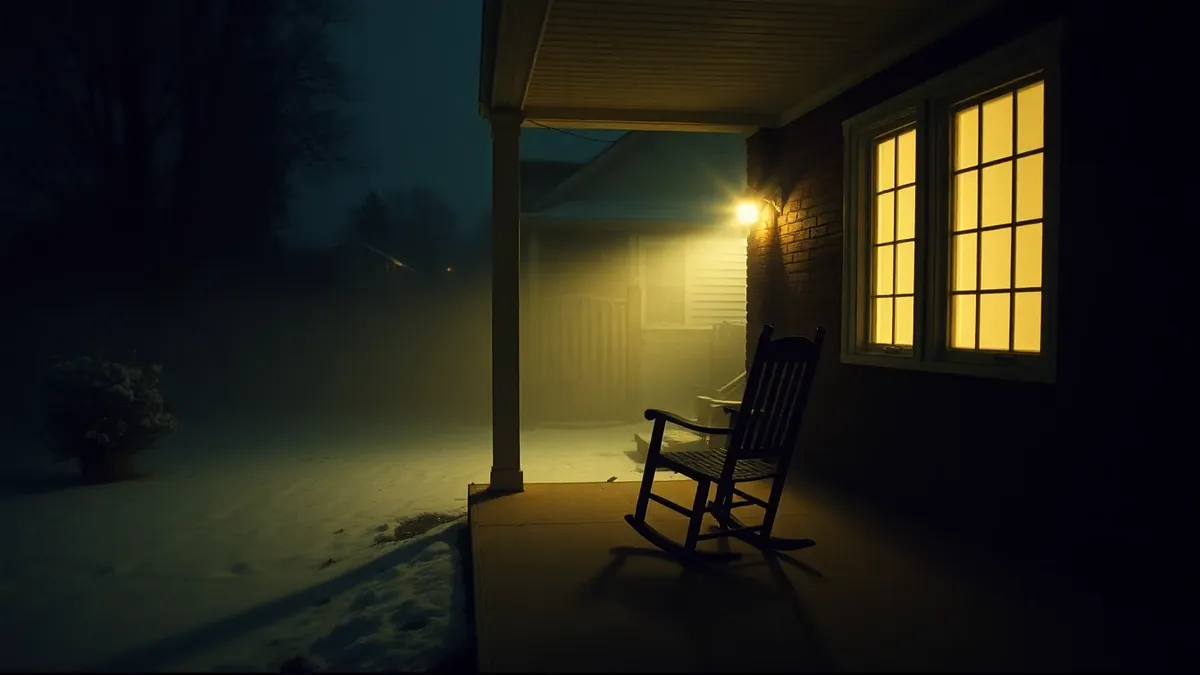
It is well known that in our world there can only be two absolutes: Death, and Inhalation. In order to be alive, one must breathe. But to be dead, simply put, is to cease to inhale, stop breathing, vanish, dry up, and blow away. Never before has a man continued to breath after his death. Nor has he ceased to breathe, while still alive.
By the time our story unfolds, it was Mr. and Mrs.
Jonathan Carol's thirty-ninth anniversary. Mrs. Carol, being a small town lady of wondrous expectations, did not suspect the reason Mr. Carol had not made his way home yet as ill; her mind was on dinner (Mr. Carol would have agreed rather fondly that Mrs. Carol was a wonderful cook), and flowers, and blue skies, and the clouds. She was not your ordinary housewife, one might say. Mrs. Carol was not put down by the Way of the World or the Ordinaries which happened to occur right outside her kitchen window. Nothing had ever gone wrong with her life, and as far as the Carols could be concerned, they lived a perfectly happy existence. And she, unlike the other housewives on her street in little Lestenburough, was quite fond of the hour in which her husband was expected to arrive.
His work was at odds a half hour's drive away; by four-thirty, he would usually be getting off, and sometime around five he would pull into the garage. Mrs. Carol religiously sets the table before her husband could even reach the garage door. She was right fast in her art of being a house wife. Unfortunately this day, a Friday, resolved to be different than the rest. Dinner went cold.
At five thirty she began to worry. She thought to call the office, but decided against it, thinking that perhaps her husband had been delayed in some big-businessman like project. Mrs. Carol was not very keen on the lingo of business talk and business making, so she kept things simple, chose to be simple minded about her husband's work and his relations outside the home thereof. So she worried until the food was cold and the sound of Mr. Carol's car could be heard out in the garage, only an hour late. She went through the washroom to meet him, and begged him to tell her why he was late and if anything was the matter.
He shook his head, and smiled. "Lot of work. And I fell asleep at the desk. It was rough."
Mrs. Carol could not believe the sound of it. An Up man falling asleep on the job? Was this a joke? "Won't they fire you for sleeping? Were you being serious or just kidding around with me about sleeping?"
"I don't know if they'd just fire anyone for sleeping." His voice was sluggish and lazier than usual. "I've never thought about it." He leaned over and kissed Mrs. Carol; she was awfully short compared to his slender frame and stature. "How was your day?"
"It was all right, I guess," she said.
"Something smells good. What is it?"
"Don't you think it's your favorite, honey? Happy anniversary. Where are my flowers?"
Mr. Carol snapped his fingers. "Where's my mind? It's been slipping me all day." He made a walk back to the car.
"You forgot to pick me up flowers?" She hadn't meant to sound rude, but the thought of his forgetting something so traditional to their marriage bothered her.
"No, no. They're just here. Did you think I would forget?" He went back out to his car and brought her the dozen roses freshly bought. Perhaps they were the reason Mr. Carol was late. "Would you like to go out and eat tonight?"
Mrs. Carol flinched when her husband leaned over for another kiss. "But I just told you I cooked you your favorite! Yes, they're lovely. Thank you. But what are you talking about?"
"Oh nothing. I just thought you might want to do something different for our birthday."
Mrs. Carol let him pass into the kitchen without saying a word. It is true that Mr. Carol was acting quite strange; in fact, even his voice had changed. It somehow seemed a bit more hollow than it had the day before. Perhaps it was just her imagination playing tricks on her. The day, after all, had been an awfully cold, miserable, winter day. The mist and weather, it seemed, was the mortal enemy of a near perfect existence.
Mr. Carol was standing over the crock pot, his car keys still in hand. It looked as though maybe he were absorbing the contents of the pot, but upon further glance Mrs. Carol noticed that he was staring in a sort of morbid way at the food, rather than smelling it. "Is something wrong, Jonathan?"
It took a moment for his trance to break, and his eyes to fall back on Mrs. Carol. "Everything is fine, so far as I can tell. I can't wait to eat this. It looks delicious." He took a step back and walked to their bedroom. He usually changed into casual ware when home from work. This, perhaps, was the least unusual things he had done since arriving late.
"I thought you said you wanted to go out tonight?"
"No. I decided that since you cooked, it would be better for us to stay. Besides, it's pretty cold outside. I wouldn't want to get sick. Old people get sick. You know how it is when someone gets old."
"Yeah," said Mrs. Carol, an empty gloom rising slowly over her. "I think I do."
The evening passed rather quietly, and soon after dinner, and near bed time, and an unusually unsuccessful attempt at love making with Mr. Carol, they both went to bed. Mr. Carol didn't say a word after his head touched the pillow. Mrs. Carol, however, was awake most of the night, troubled about her husband in too many ways to accept. She tried to listen to his breathing. It seemed normal. Rather quick, actually, but nothing too unusual to get a start out of. She listened, and listened, and listened, until she fell asleep herself.
The next morning, she found him lying awake with his eyes up on the ceiling. "You 'right, Mr. Carol?"
“‘malright," he said with that odd, dreamy, lazy voice.
"I'm afraid I may be late for work."
"It's Saturday," she said. "Are you sure you're alright?"
Jonathan Carol's eyes still focused hard on the ceiling. Once or twice Mrs. Carol looked up to see what he saw. Just little shapes in the textures of white paint, like shapes of animals and objects in the clouds. "I didn't know it was Saturday," he said. "I think I'll just lie here then, if it's alright. I don't mean to be a bother."
"No bother honey," she said, rubbing Mr. Carol's forehead like she was checking his temperature. "I'll stay here with you. Don't mind getting a bit extra sleep if I can…" She looked up at the alarm clock. "It's too early for a Saturday anyway."
"I don't mind being alone," said Mr. Carol.
Mrs. Carol roused herself from the covers. "You want me to go somewhere else?"
"It doesn't matter," he said. "I didn't get much sleep last night."
"You were awake?"
"Yes. I was thinking about work today."
Mrs. Carol stepped out of bed. Her night gown was in a wad at first; she fixed it quickly, like Mr. Carol was a stranger and had no business being in the room with her while she was so unwound. "I'll leave you to it, then," she said. She went to the kitchen, started coffee, and tried hard not to cry.
At nine-thirty, she went to check on Mr. Carol. He was up now; the bathroom door was shut. She could hear him brushing his teeth. Soon after, she could hear water running in the shower. She picked up the kitchen phone and dialed her sister's number. A woman answered on the other side, "Hello?"
"It's me," said Mrs. Carol. "I'm sorry to call so early. How are you and Luther?"
"We're fine. What time is it?"
"Early, I know," she said again. "I'm just having a problem—well I don't know if it's a problem or not, but I was a little worried about Jonathan."
"I've always been worried about Jonathan," said the voice on the other side.
"He's just been acting really strange since he got in yesterday evening," said Mrs. Carol. "I was just wondering if you knew anything about Luther's Father?"
"He died before we married."
"Well, I know," said Mrs. Carol, "But I know Luther talked a lot about his father's Alzheimer's. What's that kind of thing like?"
"I think Jonathan's a little too young for it," said the voice on the other side.
"I don't know," said Mrs. Carol. "May be a little too early to tell, anyway. But what kind of things did Luther's Father do?"
"Well, nothing too interesting," said the voice. "He did tell me this one really funny story about how his daddy would pee in the gas heater, right there in a den full of people. I didn't tell him I thought it was funny, I just figured he already knew it, and might have already had a laugh about it, but that's not the kind of thing you want to go on about, especially when the man you're laughing at's dead, and he's your husband's daddy…"
"That doesn't sound good at all," said Mrs. Carol. "So you don't think I should call Dr. Beck just yet? That's all I wanted to know. Jonathan was staring at the ceiling all night. He said he didn't get any sleep."
"Don't call just yet. Give it a little time. If he does anything weird, give me a call and we'll both have a laugh. Remember I'm right here!"
By Wednesday, when the cold had thickened and the pounding wind and rain coming on and going off had become unbearable, Mrs. Carol had still not felt it absolutely necessary to call and speak with Dr. Beck about her husband. Perhaps he had been acting odd, talking about work on mornings when he'd not be inclined to go in—Sunday had been the same as the day before—but on the days he did work, he talked about working, likewise; therefore it deemed less odd than the weekend prior. It was not until the late afternoon that she received a phone call from an unusual voice, a man, someone Mrs. Carol hardly recognized as a fellow employee of Jonathan Carol.
"Hello?" she answered. It was not very common that her voice answer with such hostility, but her husband had proven late again, and for the sixth day now she had been a bit more worried than the last.
"Hello?" said the voice on the other side. "Is this Mrs. Carol?" "Speaking."
"Oh, hmm, I was just wondering if Jonathan had made it home alright. He's been a bit ill lately, I was just wondering how he's been doing at home?"
"Who wants to know?"
"Mr. Kenner," he said. "He's been sleeping a lot at the office. Just letting his head fall onto his desk face flat. I haven't seen behavior like that from 'em before. Have you noticed anything? Why's he not getting any sleep at home?"
"Can't say that's any of your business why," she said. "But I'll take note of it. He's been a little unusual, lately, yes. Thank you. If it goes on I'm going to call a doctor. I'm afraid he may have a touch of Alzheimer's.
"I doubt it, given his age. Tell him to take the rest of the week off. I hate seeing him like this; he needs a break, anyway. Both of you do."
Mrs. Carol thanked Mr. Kenner again, and said goodbye. She wondered what he meant by his last statement; perhaps he thought that she had been behaving the same way—that being a house wife made you tired, or behave oddly, or both; this, in turn, made her assume Mr. Kenner was blaming her for her husband's behavior. Mrs. Carol had never been so assuming of anyone!
This time running two hours late, Jonathan Carol trudged in, his eyes fixed on the floor as he walked. Though his body seemed to misstep, his legs like rubber, he glided across the floor in a mystic fashion. He did not speak to Mrs. Carol, just went to the den to sit in the overstuffed chair, and stare at the blank television screen.
She sat on the sofa nearby, not daring to be any closer. "I heard you fell asleep at work," she said. "Do I need to get you some help?"
"Help?" he said. He looked up at her, his face blank as a pale slate. "Thank you. But I have a feeling everything is going to be just fine."
Mrs. Carol imagined herself asking him what was the matter with his voice, then continued aloud as though she had actually inquired: "And what do you mean by 'just fine?' I'm trying to tell you you're not looking and actin' right, don't you know? I'm scared!"
Mr. Carol's glare stayed fixed on the blank television screen. It was an empty shell, and so were his eyes. They were the deepest of pits, nothing like Mrs. Carol had ever seen in her dear, sweet husband. "You shouldn't be scared," he said. "Everything is going to be alright."
Mrs. Carol cooked a small meal for them to eat, but her husband passed on his portion. It was starting to look as though he had passed on many. The next day was the same. Despite Mr. Kenner's suggesting that Jonathan stay away from work for the remainder of the week, he got up in the morning and left anyway. He came in a bit late—not quite as late as the day before— skipped a meal, then a conversation, and went to bed. Mrs. Carol had been sleeping on the couch since Tuesday.
Friday was perhaps the most unusual day of the transformation. Mr. Carol was no less than three hours late coming home, when a different car pulled into the driveway. A knock at the front door always means bad news, especially when a loved one is away for so long. Three hours is a lifetime for a small town woman like Mrs. Carol. She opened the door to an unfamiliar face. The man didn't smile, nor did he look in any way pleased to see her: "Can I help you?" she asked.
"I'm Mr. Kenner," said the man. A glum look on his face spoke ill of Jonathan Carol. "Are you doing well this evening, Mrs. Carol?" "I'm fine," she said. "But where is my husband? What's the matter?"
"Well," said Mr. Kenner. He looked slightly nervous about what he was about to say. "We had an ambulance come and get him. He fell asleep again, and we couldn't wake him up."
Mrs. Carol's insides went numb.
"He did eventually come around. We asked if he needed a doctor…"
"You hadn't already called one?"
"Well, no," he said. "We'd gotten so used to him acting strange and sleeping, we just figured he was an awful lot more tuckered out than usual. Like I said, we asked if he needed a doctor. We insisted, actually."
"Did he tell you it'd be alright?"
"He said Everything would be alright. Don't know what he was getting at. But a few minutes later he went to the restroom, and we heard a great deal of screamin' and fightin.' I went to check… I called the hospital and an ambulance came to pick him up. He's alright now. I figured I'd pick you up and bring you out there; maybe you can talk to a doctor before they send him home. It's all just happened; I would have called sooner…"
"It's fine, really, it is." She reassured Mr. Kenner, nervous as he was, and had him take her to the hospital, where she would find him sitting in a waiting room as though he had not even seen a doctor. He was looking quite hollow, and barely noticed his wife as she came in and took a seat next to him.
"Mr. Kenner brought me up, said you were doing just fine," she said to him. He was cold. Not fine. She knew her husband better than that. "Where's your doctor?"
It was a while before she could speak to Dr. Beck. He was a small man, much shorter than Mrs. Carol, with buzzed grey hair and a curly little mustache like a magician. She didn't like him, even before he spoke. He tried, and may have succeeded, to convince Mrs. Carol that Jonathan did not have Alzheimer's.
"Possibly, if anything," he said, "anger issues. He'd broken all the mirrors in the restroom where he works. I can prescribe him medication, or find him a psychologist. If it's a domestic issue, it's treatable. Otherwise, I can't say that anything's wrong with Jonathan Carol at all."
Dr. Beck made Mrs. Carol so angry, she swore that if she ever became sick to the point of death in need of medical attention, she would certainly rather stay home and die.
Mr. Carol did not get any better; nor did he return to work the week after. Mr. Kenner promised that if the couple needed anything, he would be more than happy to help. Mrs. Carol began to lose weight; she's stopped eating dinner, being so used to Mr. Carol passing on meals. But then, one day, he stopped eating altogether. He barely spoke. When he did speak, his voice frightened Mrs. Carol. "Do not worry," he would say, "Everything will be alright." His voice had changed, his grammar, the way he looked at Mrs. Carol when he spoke. Sometimes, he didn't look at all.
She missed the way Mr. Carol would bring her flowers from time to time. Their recent anniversary had been the last time; this thought stayed with her mind, usually as she tried to fall asleep at night. It was hurting her, having to sleep in a different place, away from her darling, laughing, humble husband. She could not help but to be afraid of him. But it hurt so terribly bad, that one night she decided to go back to sleep with him. "I love you, Mr. Carol," she said. "I love you too," he replied with a dreamy, uneasy voice. She felt calm again, but his body was so cold, she could not be too near him. He moved around a lot in his sleep. She thought he must have been sleeping… he had not been to work, and had not fallen asleep any during the day.
She wondered about what Dr. Beck said about domestic issues. Was she a bad wife? Was it her fault that Mr. Carol was acting so strange? Then she thought about the last time he had brought her flowers again. Not necessarily the fact that he had remembered to buy them or that he had been sweet enough to do so, but simply that he had forgotten them in the car, and given them to her so casually as though it didn't really matter at all.
Mr. Carol sat up in bed, and remained still thereafter. Mrs. Carol watched him; perhaps he was dreaming. His eyes were focused on something across the way. The mirror on the dresser; it was too large not to see. Mr. Carol seemed empty again, but his wife tried hard to ignore it. It couldn't be domestic issues. Something was certainly the matter. His top half lowered slowly, silently to the bed and his head touched the pillow and rested as it had done so before. A good while into the night, just before Mrs. Carol could fall asleep, he threw himself up again, his voice rattled a bit like he was trying to talk. This startled Mrs. Carol; she had herself as far away from him on her side of the bed as she could be. If she left the covers, would he notice?
Or would he attack her?
Or would he say anything at all?
When he did finally lie back down, Mrs. Carol left the bed, and returned to the den to sleep once again. The next morning, she went to check on him in the bedroom. The mirror on the dresser had been taken apart and was resting reflection-down against the wall behind the bed's headboard. She could hear him brushing his teeth in the bathroom; he was making odd, mechanical strokes, quick, organized. She didn't go in to see him. After the night before, she wondered whether it would be wise to speak with him at all.
Another week ended, another began. So the days went by in pain, and Mrs. Carol's darling, laughing, humble husband grew stranger by the hour. He would not allow her to replace the mirrors in the house. He barely had to demand their absence; a whisper or too was enough to convince Mrs. Carol to leave them be. "They make me think a lot," he said to her in that hollow, misty voice. "I have been thinking a lot. Do people have souls?"
Mrs. Carol could feel her face flush red. They were the church going type (though neither of the two had been in ages), and Mr. Carol was not the sort to ask such a ridiculous question. "Yeah," she said. "I think they do."
"Where do they go?"
This was the most he had said in several days. It frightened Mrs. Carol a little to hear his words. "I guess they go to heaven. Sometimes they don't, but I don't think you need to worry about that."
Mr. Carol gave a nod, and stared into the nothingness of space. Over the next several days Mrs. Carol thought to call back Dr. Beck. She considered a psychologist, but what with the fact that Mr. Carol was out of work with hardly a way to pay the bills, they had better just not go on with such nonsense. Then she thought about calling a priest. Would he tell her that her husband was possessed? Or would he tell her that Jonathan Carol was an empty shell? The face is the window to the soul. When Mrs. Carol looked into her husband's eyes, she saw that the windows were empty. His body was an empty, breathing, soulless machine. A practical dead man, walking through the wintertime. She would not like being told that. But at long last, it wouldn't matter. Nobody would come. There was no use in even considering it.
His began to turn pale. Then it turned gray. Mrs. Carol didn't consider his malnutrition to be the cause. It was something else, something deep, dark, unexplainable. His eyes sunk into his head. Around them, his skin pulled tight, not like a corpse, but like a fine young man lying cold in a funeral parlor. One night, just before getting off to bed, he said to her: "I'm afraid." His voice was empty, yet so childlike that it brought Mrs. Carol to tears. "Don't leave me alone."
"I won't," she said, and went to bed with him. All the night she could feel him breathing, watching the little textures in the ceiling covered in shadow. He must have been looking for shapes in the clouds, hoping to find something good, beautiful enough to endure a smile.
He threw himself upright, just as he had done before; he was looking at the blank wall where the mirror had once existed. Some while later, he stood up and walked quietly to the bathroom. Mrs. Carol tried to watch him in the darkness. He seemed to just stand there, still as a board, watching back. The more uneasy Mrs. Carol felt, the more she wanted to flee the room. Run, and never come back. She wasn't Mrs. Carol anymore, and Jonathan Carol was not her husband. She reached for the lamp, and let the light flow in.
He gave a cry of pain, lifted his arms to his eyes to deflect the light. He fell backward over a pair of slippers; his skull crashed against the toilet lid, made a loud, cracking sound. His feet kicked and twisted, then his hands flew up along with his torso, like he was trying to get up. Trying to dance his way up, as though nothing had ever destroyed him in the first place.
Then he managed to fling himself up, never making a sound, expect for the things his dancing arms smashed wildly against. Mrs. Carol saw that his eyes had rolled behind his head, the whites were bloodshot. He danced. Mrs. Carol screamed. Mr. Carol, stopping his feet, twirled around then fell to his knees. He flung his head and torso back as though crying out to God for mercy. But no sound came out of his mouth. His arms danced. Then he didn't move.
At the funeral, Mr. Kenner sat with Ms. Carol. He had been good to her, and though she still had not gotten over her husband's strange goodbye, appreciated with the warmness of Mr. Kenner's sympathy. "It was good to meet your children," he said to her. "I didn't even know their names. Jonathan always talked about them. But I'm never really good with names."
Ms. Carol found it hard to pay attention to anything Mr. Kenner said. She'd just as well not have any children. "What do you think it means to die?" she asked.
Mr. Kenner shook his head. He wasn't very good with these things, and had not expected it. "I don't think it means anything to die, unless you're a religious person. I guess it means more to be alive than anything. I don't really know. Not even sure about what it means to be alive, if you want to know the truth." "He asked me if people have souls," she said. "It was the worst question anyone's ever asked me. I kind of started to wonder that myself over the past few weeks."
"What do you think?"
Ms. Carol whispered so that only she and Mr. Kenner could understand. "I think they do," she said. "Jonathan did. You should have seen him die. It was the worst thing I've ever seen in my life."
"You don't have to think of that," said Mr. Kenner. "It was an accident, that's all."
"It was going to be our thirty-ninth anniversary," she said, no longer paying attention to the man sitting inches away from her. "Something happened to him that day. Something I'll never be able to explain. I wonder if it's ever happened to anyone else."
Mr. Kenner put his arm around Ms. Carol. She looked over at her husband's body. Jonathan Carol was himself again; it looked as though he were smiling. His skin color had returned, though he was the same size as the day he stopped moving. She imagined him smiling at her. Then she imagined him jumping up and out of the coffin, dancing, twirling, twisting, never crying out, never saying goodbye, never making an effort to sound at all. Then she remembered that the dead don't dance. They can't breathe, so they don't dance. "Do you think he knew?" she said.

“The Dead Dance All Winter Long” was printed in Esther, No. 1 of Inwood Indiana. Pick up the paperback from Prolific Press; the stories and poems published online are free to read here.
Get the paperback