
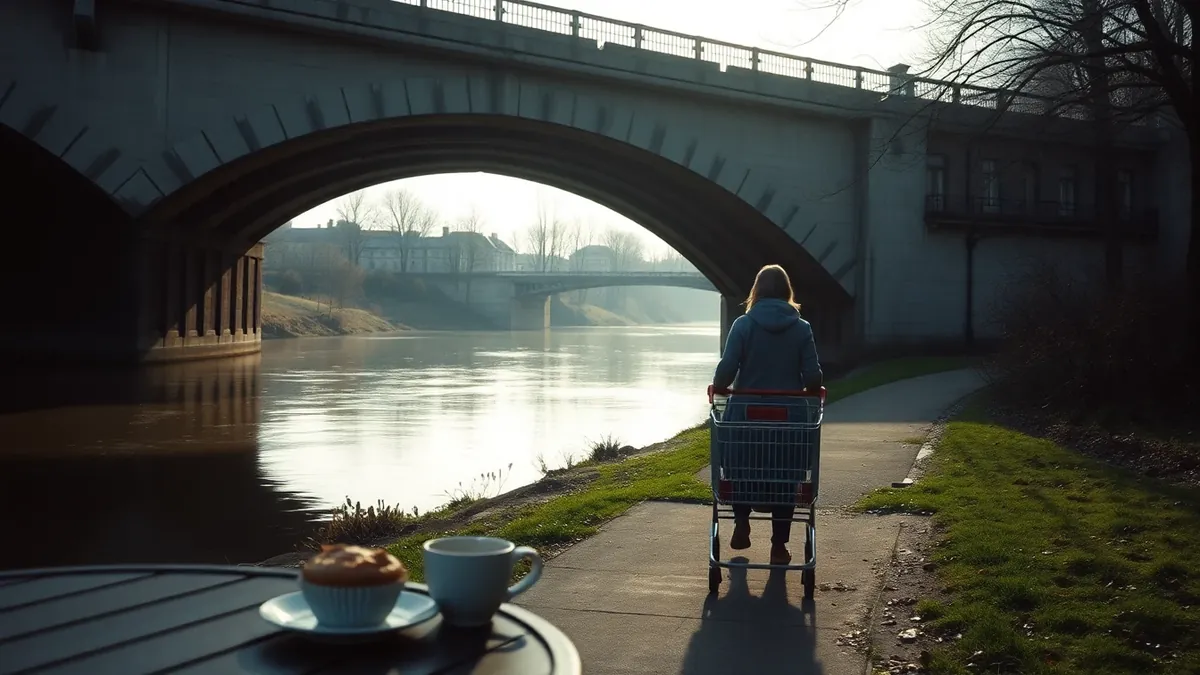
Georgia Williams left the grocery store on her usual daily walk from home to the store to the river. In front of her was a grocery cart she kept balance on, filled with her lunch and dinner. Every morning she bought a muffin and coffee that she ate at a table in the shopping center and a newspaper she read on the shore of the nearby river. She liked mornings because the light was best and watching the world come alive reinforced the awe and wonder of every single day. These mornings were necessary to everything, a natural order, she believed, recreated every day, a new day within the architecture of all days. Although she couldn’t depend on one of her steps coming after another, she could depend on the sun rising again and again into a future as distant as to be unimaginable, imbuing each day with its own vitality.
“I didn’t see him yesterday,” said one of the guys outside the store sitting at a table with others. “Every day, like clockwork since he got here, but not yesterday.”
“He’s done the same thing every day for a year. He’s a loner, so where would he go? No family, no job,” said another.
“He has that look, you know. Stone cold face, slow movements. You can tell he doesn’t know anyone, doesn’t do anything. You see sketchy guys like that on CSI; he could be a child molester that had to relocate,” said another.
“He could also be in a witness protection program. Or maybe his mother is old and he needs to take care of her ‘cause she can’t leave the house,” said the last of the group.
“He could’ve worked for the mob. He looks like someone from New Jersey or New York. So, he squealed and got out of the business.”
“Dude, that guy wouldn’t hurt a fly. He always lets others go first, says ‘please’ and ‘thank you’—“ “Some people like that are really messed up. They’re hiding something.” “Have you ever seen what food he buys? He spends loads of money every time he shops.”
“You think he’s rich?”
“Maybe. Lots of people get burned out at those jobs on Wall Street or Silicon Valley, then don’t know what to do with themselves.”
“Marcie said he gave her a look when she went past; practically made her puke. He’s like forty and she’s still in high school.”
“Clare said he made a pass at her.”
“Yeah right, she makes shit up.”
Georgia took one bite after another of her muffin, keeping an ear open to the conversation. She remembered when the town was smaller decades ago. Everyone knew everyone else; people were always kind to each other and kept track of each other. It gave people a feeling of home; a place where they belong.
“You know Donny accidently bumped into him when the guy left the store. He didn’t say a word, just kneeled down and picked up his things. He didn’t even look at Donny. Donny said he got this really eerie feeling after he said, ‘sorry sir,’ and watched him put each thing really slowly back into his bag. Something’s wrong with him, just don’t know what.” “He’s crazy. I’m sure of it. He probably lived most of his life in an institution or maybe he was homeless. Now he’s probably got social security or something. No one who does the same thing, same time every day, doesn’t talk to anyone and is never around anyone is normal.”
“Why doesn’t someone talk to him? To feel him out.”
“Be my guest, but I’d stay away from guys like him. I’ll keep an eye out for you if you do.”
“Next time he comes by I will. Then we’ll find out we’re making a big deal of nothing.”
Georgia had crossed the man’s path once a couple of months ago. Her cart broke on the path to the river and he passed by in his usual rhythmic, uneasy march. His knees seemed to wobble a little and he took long bowl-legged strides, as if he were marching. He always looked downcast in a way that seemed he watched everything in the corners of his eyes.
Georgia sighed and took her lunch and dinner out of the cart before inspecting the cart. A moment later she felt soft pressure on her shoulder and heard, ‘let me help you with that.’ She looked up, startled, and saw the man who seemed enormous in size towering above her. She was surprised to hear his deep voice and make eye contact with his sullen sky blue eyes. He had a calming smile.
“Oh, that’s not necessary. It happens all the time. A little latch comes undone. The old thing is as good as useless now. I’ve had it for years. The frame is falling apart. I’ll have to get another soon.”
“I can work on it if you’d like. I’ll make it as good as new. I’m sure it has some years left in it.”
“Don’t bother. But you could flip that little latch back on for now…by the way, you’re new in town. I’m Georgia,” she addressed him with as much as a smile as she could muster.
“Nice to meet you, Georgia,” he said without saying his name.
“And you are?”
“I’m sorry,” he said befuddled. “I haven’t met anyone in a while. I’m Mason, nice to meet you,” Mason said as he took Georgia’s outstretched hand. Then he picked up the cart from the ground, holding the handlebar with one hand and fixing the latch with the other.
“Enjoy the beautiful day, Mason,” she said as he waved and walked further down the path.
As she sat near the group outside of the grocery store she realized she too had developed some suspicion of Mason, but nothing like what the group talked about. He seemed like a man who had experienced severe pain, enough that he would cut himself off from others and the world. There was a tragedy within him, maybe many. She kept an eye on him and sure enough, just like Georgia, he did the same thing every day, but he was older than his years. Georgia knew other women in the town and they would talk with each other about everyday things, the weather, children, who became ill, if anyone got sick or passed away. Most of the women had family in the area to talk to, but not Georgia. She had never married nor had children.
There was a sense of independence Georgia enjoyed as opposed to the feeling of involvement that women with families had. She lived in a space of being able to make decisions, have beliefs and thoughts of her own, to do whatever she pleased without approval, or caring what people thought. The emotional demands of a family would have been too much. She enjoyed getting updated from the other women in town to keep a tally on the town regulars, but this was as much engagement as she needed. What she loved most was to eat her breakfast in the shopping center and read the news by the river. The air, water and sky told her story.
Georgia got up from her seat and started walking towards the river. A cool chill pressed against her from the late summer wind. She took deep breaths to fill her lungs with air as a way to invigorate herself. The same mowed grass lay on both sides of the path, then she passed the playground and about two hundred meters later she came to Randam River. The force of the overflow from the dam above reminded her of the passion and energy of when she was a young woman, but every morning she reminded herself that those days were gone. Now she enjoyed the cool spray of mist as the water tumbled down the dam and steadily flowed under Randam Bridge, something non temporal, a somewhat eternal course of nature not measurable in human time.
The dam overflow roared as it cascaded down to the river several hundred meters below. About a hundred meters towards the dam from where Georgia walked was Randam Bridge, which passed over the river and into a park after it flowed from the dam. She was alone this morning, as usual. Most people came to eat lunch or fish in the afternoon. Georgia felt the cool mist created by the overflow against her face, as she earnestly persisted to walk to the park. A strong smell afflicted her nose, like sewage. As she walked along the riverbank the smell grew stronger. Then she saw the body of Mason, flaccid and bloated, caught in a lull of water surrounded by rocks underneath Randam Bridge.
Georgia was saddened, but not surprised. Death was something she faced every day. She only felt deep sadness for someone she thought was a kindred soul. In her mind, she believed the world had taken too much of a toll on Mason; that he couldn’t keep the reality of life’s disappointments, terrors and tragedies outside of himself; that he finally gave in to the pull to get away from it all. She watched the body rise and fall with the motion of the river stoically, as if a great story had been told, then went across the bridge to a table and read the news.
Mason sat in his armchair reading in his dining room after eating his breakfast and taking his medication. He had come to his mother’s house after she died to inherit the estate which was left to Mason, the only son. Before his mother’s death, he needed to take time off from his job as a mailman in a city hundreds of miles away because of coming down with Lupus. Every movement he made caused him extreme pain, but he was determined to keep moving, no matter what the doctors said. To walk to the grocery store and up above the dam every day was all he could manage. He liked the city. It was large enough that he could remain anonymous and small enough that the luxuries of suburban life like many parks and a high standard of living were available.
During his treatment and time off he decided to read a list of classics he had wanted to pour through since graduating college. The words filling the pages he read described what he previously believed life would be like for him. When the bands he played with wasted more time talking, smoking cigarettes and drinking than practiced performing, and when he lost interest in writing because he realized he didn’t have anything to say, he gave up believing in his dreams of a life he always thought he’d have. Every couple of weeks he finished another book; the books were as close to him as the dreams he had as a young teenager. However, he knew he would not get entangled in a passionate war-time love affair, explore the oceans on a yacht, go into space or spend years on an uninhabited island with nothing but him and nature.
He read several chapters before his walk every morning and by ten, he was out the door. The house was out of the way at the end of a long driveway surrounded by trees. He brought his backpack to hold the groceries with a fishing line and book in it as he went about a mile to the grocery store. Money was never an issue for him, but since his mother’s death he now had more money than he could spend. He planned on giving much of it to charity and still keep a sizable amount for retirement and possible medical expenses.
His mother was a miser. She had been an artist, gaining recognition in elite circles, collecting art, and investing money carefully. When she got pregnant by a man who she loved, but was married, she stopped participating in the art culture and spent her time painting and raising Mason. Mason found her detached and aloof, but not uncaring. She wanted to give him what he wanted for himself, even though it meant leaving her after school, trying out being a musician, then a writer and then ending up as a mailman hundreds of miles away from her. By that time, Mason needed the stability and security of working as a civil servant. Time went by quickly and before he had a chance to know his mother, Mason was contacted by law enforcement to tell him his mother had died from cardiac arrest.
Now, Mason was organizing his mother’s possessions, digging up news articles, letters and photographs she kept over the years. He asked his mother who his father was, but the most he got out of her was that he was a friend from many years ago that she loved, but didn’t love her back. Mason accepted this and didn’t need more; it was more evidence of an implacable life unable to satiate his most essential needs; a disappointment that life as an unsuccessful musician and writer gave to him frequently. He wondered who among the many men she had pictures taken of, many with her in the picture as well, was his father. Many were well to do gentlemen and socialites. Mason had been with enough women that commitment seemed out of the question and marriage was too pristine and structured. He understood his mother’s aversion to marriage and close relationships as time went on, so he didn’t blame her for not telling him about his father.
He found dozens of contemporary paintings from the early to mid-20th century in her studio, many painted by other people. He knew they could be worth hundreds of thousands of dollars, but he wouldn’t sell them. He already had enough to never work again.
On his walk, the air was cool and, as usual, he felt throbbing and sharp pains in his legs and hips, but he still trudged on. He saw the usual group of young men outside of the grocery store, then went inside, feeling each step. He picked up a couple of pastries and a coffee, some cheese, bread and a bottle of wine, and things for dinner. He didn’t want others to see him as handicapped. He didn’t want other people’s pity, but his pain might have been obvious. Sometimes he stopped to rest, away from where others could see him.
He left the store and continued along the path to the dam, then up the steep incline to the road above the cascading water. Then he walked along the reservoir and found a projecting rock above the reservoir that he routinely fished on. He reached into his backpack and took out the fishing rod and cast the line into the water. One cast after another cast, the line came up empty. Mason assumed the current was too strong where he was because of rainstorms over the past couple of nights. He stood up to find a better place as pain shot through his leg. He stumbled, then fell against the slope of the rock and into the water. He couldn’t fight the current.
“I think the mob found their guy,” said one of the group outside the grocery store the following week.
“He could’ve been a terrorist.”
“Dude, he obviously committed suicide. He had no life. Didn’t know anyone.”
The group spoke for a couple of minutes about the obituary in the local paper: “Mason Dexter, died at age 42. Born in New York, NY to the late Margaret Dexter. No known surviving relatives. The estate has been given to a distant cousin, George Almund, once close to Margaret Dexter, Mason Dexter’s deceased mother. The cause of death is uncertain.”
Then the group talked about baseball and the new kid at school; and exclaimed about a couple of girls that passed by.
Georgia read the article and imagined her obituary being read and talked about. She visualized the article with her life summed up in six sentences. She suddenly panicked and needed to reach out to someone; to tell someone about her life, her beliefs, her feelings and leave behind a story that was more lasting than a note in a newspaper. She needed to leave an anchor to keep her from disappearing under Randam Bridge.
“Underneath Randam Bridge” was printed in Tracks, No. 9 of Inwood Indiana. Pick up the paperback from Prolific Press; the stories and poems published online are free to read here.
Get the paperback