
Father Rose can only stand to hear about Letha Banks for so long after he takes over at St. Mary Magdalene's on 5th Street. His small town parishioners speak vaguely of her in confession, and he catches things at potlucks or while he strolls the blooming city in the morning. She is a constant disruption to the peace and metronome rhythm of his plain black shoes hitting the sidewalks.
People whisper about Letha at the Grand Coeur Diner, where Father Rose eats his modest breakfast: two eggs over medium, wheat toast, and weak tea. As he chews, he hears Letha, Letha Banks, over and over again. Go see Letha, the cream pot suggests.
Finishing the last tepid sips of his orange pekoe tea, no lemon, Father Rose considers what the men and women of his parish call Sweetness, when they do talk about it. Letha has given them Sweetness, they sigh, bodies languid as warm milk. They say Letha is a never-ending cup of relief and thirst all at once. You’ll drink from Letha’s hollows and bends and never want to stop, they promise each other.
The pleasures that one might receive from Letha, they must be wicked beyond reason. He gathers that she eschews money, but requires offerings nonetheless.
Father Rose doesn’t leave his small but customary tip when he exits the diner. He isn’t feeling well, having tossed and turned through the night, terrors riding him at breathtaking speed over and off memory-sharp cliffs until daylight.
Turning in the direction of St. Magdalene’s and still ruminating on what his flock might be paying for this so-called Sweetness, Father Rose hears the brick cobbled street swear Letha won’t take wrinkled bills or coffee-lacquered coins dug out of a cup holder. She doesn’t have a website where you can observe her curves and mysteries before using PayPal to make a discreet, password-protected appointment. Letha doesn’t make appointments. No. Letha Banks waits at the old Orman Tower, the tallest, oldest building in East Grand Coeur. She allows patrons to arrive as they are bidden by fate, on their own time.
Something must be done. Father Rose turns back around and proceeds to walk in straight lines and angles on his way to Letha, cutting through yards and across parking lots. The East Grand Coeur layout of curving avenues that circle and radiate out from Orman Tower -- from Letha!-- offends the priest deeply and he will not compromise a single step. Not one step he barks, startling a young woman on a bench. Pardon me he mumbles and walks quickly on.
Overhead, the Sun says Letha is soft, and certainly shapely. Letha’s tongue must have the crisp taste of an apple. Brother priest, perhaps you can make yourself into an altar, if you’d like. Or better yet, a sacrifice.
Even though praying to the Queen of Heaven has always seemed a lesser sort of worship, Father Rose clicks smooth rosary beads together in his pocket. One shouldn’t have to implore a man’s mother to intercede; Father Rose’s own mother never interceded on behalf of her children. Rather she orbited his handsome father - a large volatile sun, while he and his sisters revolved like distant moons.
Father Rose’s step is brisk, serious, like his sermons. He moves with intent towards the brick building spiring out of a ring of blushing pink dogwood trees. Massive stained-glass windows rival only St. Mary Magdalene’s. The arches are high, the doors are ornately carved and heavy, and that Orman Tower dare compete with the holy beauty of his church brings a predictable bout of acid reflux. Father Rose hastily digs a roll of antacids out of his pocket and crunches two of the chalky pills between his teeth.
He stands for a moment and observes the hand painted sign out front.
Navy blue text boasts occupation by a law office, a used bookstore that specializes in antiquities and the occult, and high-end apartments. Father Rose takes a deep breath and pushes both doors open, though he is disappointed when they gently click shut behind him, rather than rewarding him with a proper slam.
Inside, the lobby carpet is plush, sea foam green. It absorbs his footprints. Every wood surface from the trim to the elevator is polished to a luster. It takes a moment for the building to speak to him in its many voices.
Wait until you see her, the lushly draped balustrade booms. Letha Banks’s thighs are so creamy that you could drink from them for days, shout the entryway portraits. Her breasts are mountains; her dimples are valleys!
In the elevator Father Rose adjusts his collar. He checks that the length of his shoelace bows and ends are equal. His pockets are flat and smooth, his hair is recently trimmed and neatly combed. He meets his own eyes in the mirrored doors and tells himself that, in this den of profligacy, he alone is there with the spirit of the Lord standing beside. The intricately gated elevator says, in its low hum, that Letha’s hands can smooth all those wrinkles you wear on your soul, they can pick you up and shake you out, snap you like a shirt or a pair of trousers. She can lay you out across her huge bed with a brand new belt, right and ready for Sunday.
At the end of the narrow hallway where he steps out, a plain door waits. The corridor is freshly painted a pale blue. The windows lining the corridor are narrow lead glass and shaped like arrowheads at the top. Come on in, they rasp, come in and see our girl. Father Rose walks slowly, eyes on the knotty, potted vines sitting on each side of the door, their tangled lace climbing the walls and growing along the ceiling towards the elevator. Leaves rustle, but he can’t pick out the words until he stops at the door.
Knock and see, knock and see. Knock and see, they whisper.
He knocks just below the Janitor sign. He waits with his hands folded carefully together. His feet are shoulder width apart.
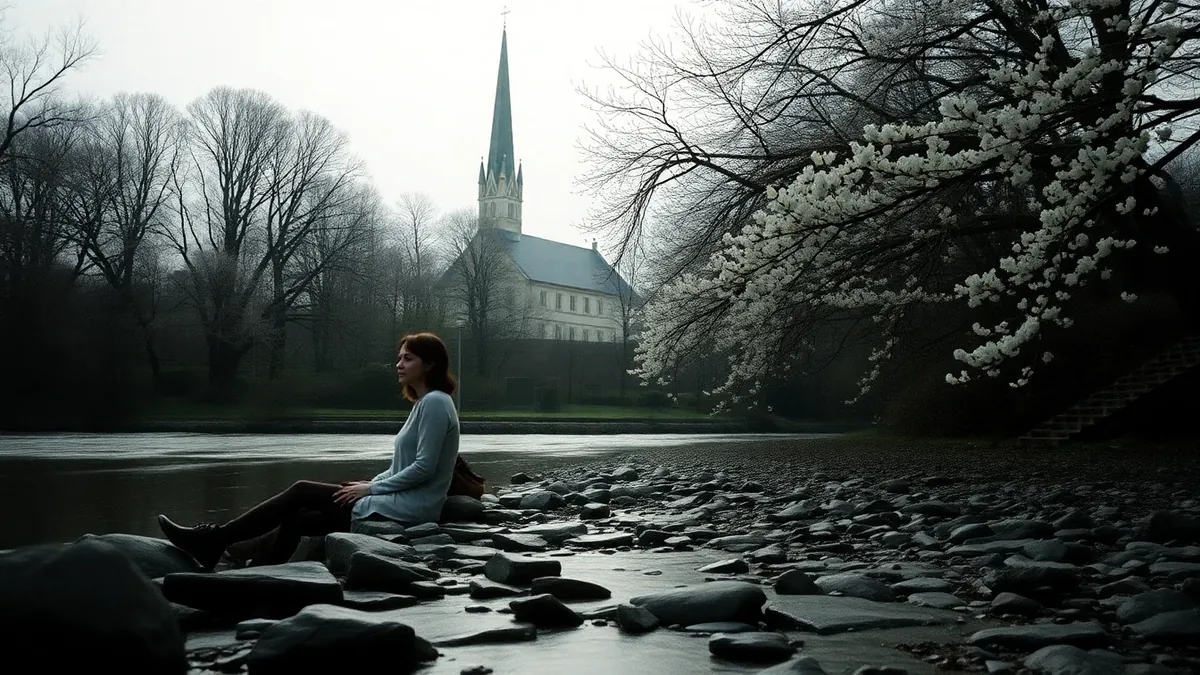
The door opens and the faint scent of river water flows out in the hallway to pull him inside. Peeking around the door he sees a slight woman with brown hair and thick glasses waiting for him to enter.
Father Rose steps all the way into the room so she can close the door. Where sumptuous throws and candles are expected there are a few brownish afghans folded on a pea soup colored couch. Father Rose is reminded of the den where he lived in his grandmother’s house after his mother died.
It is so quiet.
Neither the refrigerator nor the stove proclaim Letha’s beauty and skill. The teapot doesn’t whistle the syllables of her name. Birds chirp outside the open windows, and maple leaves rustle in the wind, but they do not sing Letha, Letha Banks over and over until it is all he can hear. In this austere little apartment there is silence.
The priest clears his throat and tries not to fidget. Sweat dampens his collar now that confrontation is certain. What will he say? Why is he so nervous? He asks is Letha here? I’d like to speak to her please. He straightens his shirt cuffs again.
I’m Letha Banks, the woman says, please have a seat. I’ve been expecting you.
It takes an embarrassing amount of time for Father Rose to recover and stammer yes, of course you are. I mean, why wouldn’t you be she? Her, Letha, I mean.
Two cups of tea already wait for their attention. Letha sits first, taking the chair closest to the door. Father Rose sits across from her, mouth dry while he studies the plainness of her face. A slender grey cat winds around his legs before settling onto the floor in a wide patch of light. Watching him reach for his cup of tea, Letha says Michael, that’ll cost you the last time you cried over your mother. And if you’d like a bit of cake, you can put the time your father broke your arm right here in this jar as well.
Why would you want those things asks Father Rose, hand hovering over the steaming cup of Earl Grey. Letha cups his cheek in her small hand, runs her thumb along the dark fringe of his eyelashes and says because you don’t want them anymore. You don’t need them. You have other pains now, don’t you?
Pain is a part of life he says, but his voice wavers a little. Her touch is gentle and she smells like vanilla extract. He remembers when his mother would rub vanilla extract on her wrists just before church. He would wind around his mother’s legs like that skinny grey cat. She wore plain dresses with tiny flowers and when he was very small she would let him try to spin around her, hands sometimes snagging her stockings. Father Rose feels like he is a ball of cotton yarn, unraveling on the floor. Peach-colored, like the washcloths his grandmother would knit. He loosens his collar, rests his head on the table.
Letha strokes his hand and says I don’t think you need those sad old things anymore, do you, Michael? Small price to pay for a cup of tea and a slice of cake. I could take your broken collarbone, too, from when you fell out of the big willow tree where you were hiding from your father. Or your skinned knee, from the time you ran away from home and fell down on the sidewalk in the dark. Or all that pain in your belly from being so terribly hungry. It’s still there, isn’t it, even when you’re full. What if I want something more, he murmurs into the table.
She says I can give you more than cake and tea, I can give you what you need.
I don’t know what I need, he sighs, and swallows the rest of his tea. Letha says don’t worry, I do. She sets an old jelly jar next to his cup and saucer. There are scraps of bright, patterned paper and frayed fabric nesting in the bottom. Buttons old enough to be made from bone compete with faded ribbons still tied in bows. The glass is chilly to touch, chillier than it should be in the warm room. He ignores the pain in his fingertips while he grips the jar and brings it to his nose. He smells the hot iron spark of summer, then underneath that, damp leaves, then finally sharp, cold February snow.
Yes, he says. Yes, OK. Father Rose sets the jar down on the table, but does not look away from it for a long time. Father Rose clears his throat again. He looks around the room at the beige refrigerator, and the neatly stacked teacups and saucers next to the empty sink. Across from him Letha sits without moving, her hands folded as she waits for payment.
To the contents of the chipped blue Mason jar he adds the pain of great, yawning silence -- all he hears when he is bent over in the chapel, heart on fire, begging but always waiting to forgive. He also offers the bitter taste left behind by providing absolution he has not himself tasted.
When he looks in after his sorrows he sees a baby tooth, a square of blue velvet that matches his mother’s burial dress, and the corner of a photo with his father’s face. A single rosary bead nestles in with the other buttons and scraps. Father Rose smells lemon, lavender, and mint when he inhales once again.
Letha pours steaming water over the contents. Barehanded, she takes the jar and pours the liquid into his cup through a mesh strainer. Ink black and thick, the surface doesn’t ripple when Letha drops two sugar cubes into the brew.
He drinks with caution, tasting cold, deep river water: iron and stone, and the first hint of Sweetness. It fills his mouth, coats his tongue and teeth, trickles into his belly where it turns from cold to hot and swells through him until he feels like he is radiating Sweetness itself.
He sets the cup back on table, white inside as if it has never been used. Letha takes Father Rose by the hand and leads him to the scratchy green couch. Michael, are you ready she asks.
I think I am, he replies.
Letha’s face is solemn as she sits in the center of the couch and spreads an afghan Father Rose will swear came from the bed he slept on as a child over her legs. She says lay your head down now, Michael.
Father Rose sinks to his knees and rests his head in her lap. He closes his eyes involuntarily as she strokes his hair and face yet again. The weight of familiarity in that touch seems to seat itself between his shoulder blades at first, and then all the heaviness remaining from his now freely-given memories, and the ones he’s held back lifts up and away. He thinks he might fall asleep easily, even in this awkward position.
Sweetness pulses inside and around the priest as Letha says it wasn’t your fault, Michael Rose, you were only a child. She strokes his hair until the world quiets and night falls.
“Cast Your Cares into the River” was printed in Tracks, No. 9 of Inwood Indiana. Pick up the paperback from Prolific Press; the stories and poems published online are free to read here.
Get the paperback