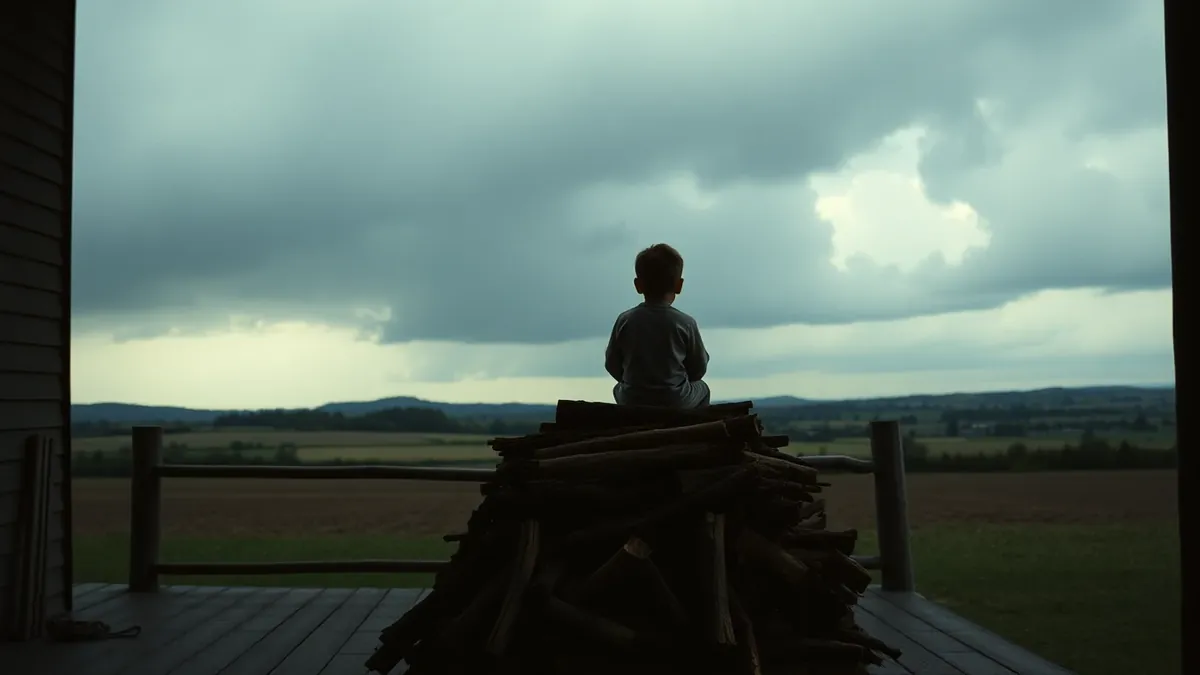
I tried memorizing my father’s life, the morning he left for Texas, like some Baptists do The Bible. I sat atop a pile of kindling on the front porch; the sky a gross tinder, slathered with the bulging smokes of old cumulonimbus. Upon that heap, I recited what I could remember of the man: his life before me, then, what came after. In those touchstones that were my recollections of the man, his face always had the same mien: a venal countenance blurring whether anything had ever really been good.
For hours, I traced the mud of memory where his boot-prints showed in the slough: first, the toothless boy wearing a leather motorcycle jacket, searching street corners, left alone his first day of Kindergarten, then faced with his mother who came to walk him home three hours late with two apologies to serve as ample expiation; the bow-legged teenager who broke his collarbone in a back-yard football game; the Marine who met mom in a bowling alley, the evening before he leaves for a New Mexico Navajo reservation to learn the art of apothecary from a shaman. His legend dies there. Now, my sky is the color of umber, ferns and coal: a near onyx; a rodent left too long on the spit. The clouds wheeled out of their huddle, now whittled down to narrow ligatures, and framed the sky within crozzled borders. A hawk’s siren bawled; the sky soon was bedighted with the outline of its slowly oscillating wings.
I watched the systole beat out across the sky, winking like candle smoke. The Stations soon followed, dying by diminishing degrees until they were but a susurrus in my mind and little was left of the man within me.
Meridians are imaginary tools employed by astronomers to measure and divide the Earth and Her systems. I am not a figment; my father told me, in various mutations on the theme, that it was my birth that divided his life into hemispheres, measuring his triumphs, and his failures. He thanked me often for reminding him how useless his life was destined to become.
Meridians don’t move; I do.
My father taught me to ride a bike, throw a football, and fix an alternator; he showed me the rudiments of carpentry, how a septic tank works and the means to construct a retaining wall. As I formed out of his cobbling, I found a propinquity to Michelangelo did not exist within me: I built a fort while I was twelve years old; twenty minutes later, I received a tetanus shot after plunging my bare foot through one of about forty nail-points in the floor-boards. My aim was hardly true.
My errant precision also gives cause to replace the spark plugs and wires on a car that only necessitates its oil changed.
My father’s nickname for me, which became my portmanteau while I was just thirteen years old, is “asshole.”
Three days before he left for Texas, he called.
I said “Hello.”
That is the last word I spoke to him for five months.
He said, “I was a great man – you think I’m a pile of shit because I lost the house and have no money, but let me tell you, before you, I was a great man. I did everything I could to make you like me. You just don’t give a fuck; you could care less whether I live or die. The man I was before you- -” He paused, then, went on, “--I am what I am now because of you, asshole. Do you hear me? If I am a piece of shit, then it is because of you, pigfucker. You are a fucking plague. You shrunk me to nothing, asshole. You good for nothing sonovabitch.”
He execrated one last ‘fuck’ as he, undoubtedly, slammed the telephone down on the cradle. The distance of it, the echo and the muddled dissonance rang stagnant against my own breathing, throttling in my ear, sounded as if he was talking to someone else, other than his son.
Not me.
Perhaps, he was.
I went on for those five months; sifting through everything I could to thwart my notion that I had indeed cursed the man. The drought of that recanting ossified the man into something I could now see and touch, more animate than when I lived in the same house with he and my mother. It was as if, while I grew older, retracted myself into my own life, and gained distance from his tirades, our lives somehow tangled, as much as the bear’s survival is reliefed against the hunter’s immitigable proclivity that conquest over his wilderness is remittance towards his humanity. My father and I talked only when I called mom or drove out to their house, but the man loomed over me as an albatross, though I gainsay ever having the desire to extirpate my father from my life – should he be a cross to bear, then let him be mine and mine alone. There is no other who should carry that stone.
He is my father and the child I was, ordained to his keep, now was the man who was to fortify him. I found neither tablets nor tacit covenant adumbrating this theory; my own life seemed to deign it as such for me.
Summer did pass into Autumn and it was Winter before I quit cobbling my father out of his gospels. The inky branches of Pin Oaks and Sugar Maples, dappled with a glaze of snow, stood loosed of all their leaves. A wind rattled about in the boughs. The snow swarmed about me like moths as I stepped through the ditch’s slough. It was a Saturday and my wife was at work, finishing up what redacting of correspondence the day before had not allowed. I needed cigarettes. My phone rang in my pocket and I lifted it out, hoping she was calling. I read the telephone number on the screen as he had given it to me: 216- Matt Bahr/Don Strock – Lou Groza/Vince Costello. Perhaps he envisioned it his ‘charm” that he should recite telephone numbers in concord with retired Cleveland Browns’ jersey numbers. I remember our family’s first telephone number as being 216-Al Gross/Max Runager – Dick Schafrath/Dick Schafrath. He kept with him these jersey numbers of old Browns players as was his wont to eschew my mother’s three suicide attempts during the better seasons of weal.
Her first two suicide attempts were through an overdose of Synthroid, a medication prescribed to balance her levels of protein. The last, three years ago, was razor blades drug perpendicularly across her wrist. She hadn’t the heart to plunge the blade that deep. I drove my mom to the hospital that morning, after wrapping each of her wrists wrapped in tourniquets made of Ace bandages. As we drove, she kept her head bowed; her body crumpled in the seat next to mine. A dot of blood stained the towelings like a stigmata or the meager hemorrhage of a beheaded tit-mouse. The thrums of her pule, chiming in tune to our trundling. She intoned an unceasing liturgy of “I’m sorry” as if she were canting to a God who was about to cauterize the sun and depart from it. My own road blurred. I wiped tears from her cheeks with my forefinger. I left my own. Her head lolled onto my shoulder. She wailed. I wrapped my free arm around her, then, drove blind.
I brought mom home two mornings later. She slept for hours and I sat in her bedside rocking chair while she did so, watching her. My father stayed in the basement through it all; I learned to stop hailing him after the first time I found my mother: you don’t get a second chance to look up. I wondered why mom stayed with him; she had a better chance of survival if she got out on her own. The scar on each of her wrists healed into the shape of a cross. She quit saying her Rosary. She left my father and went to live with her brother, Anthony, in Newton Falls after my father hurled a chamber pot through the kitchen window, proclaiming, “You are fucking lucky you stepped out of my way.”
My wife and I spent the following Christmas in Newton Falls, Ohio, an hour of drivetime into the east. Come Christmas Eve, while Sophia and Anthony slept on the living room floor, my mom, wrapped with an afghan and ensconced in a fauteuil she had skinned with foam padding and brown leather, broached the reason with me as to why she cut herself the last time.
“May I tell you something?”
“Anything.”
She groped about in the darkness between us, the darkness that fell upon her.
“Do you mind if I turn the sound down?”
I nodded.
“I love Mario Lanza, but I can’t think when he’s singing, and I need to think right now.”
“Ok.”
“Ok.”
Her eyes began to tear; her lips quivered. Lanza’s vibrato dimmed and my mother’s hands fell with the drift of feathers into the center of a shape on the afghan that looked like an axe-head. A crown of pale ringed her left finger. The cords of her metatarsals flexed in her feet.
“I answered the doorbell and a policeman was standing on the front porch. He took off his hat; I thought he was coming to tell us you died, Daniel. You weren’t home – I didn’t know what to think.
“I don’t know why, but I kept the storm door shut. What did I think he was going to do? I had no idea…I had no idea.”
My hands and feet went numb.
“He asked if I was Mrs. Marie Soris. Of course, I said ‘yes.’ He told me that a woman was reported missing to the Chillicothe police by her daughter. He told me this woman was evidently engaged – engaged, that’s how he put it – in a relationship with my husband. He told me the daughter found a suicide note that mentioned your father. He told me the woman was missing for fifty-two hours and they were concerned she might be ‘en route’ to our house.”
“Where was dad?”
She didn’t answer my question. She didn’t need to.
My mother went on to say the officer gave her his personal cell phone number. There was already a squad car scheduled to make routine checks on my parents’ house every thirty minutes.
“I didn’t even think to be upset about him having an affair; I was almost relieved that he had.”
My mother grew up Catholic; I kept to Buddhism. She told me it was a Friday that found the police on her doorstep in the morning, and her brother setting her bags in his Jeep that evening. She said she began that Friday as all other Friday mornings save for one: the day of my birth. She began to recite her rosaries as she always had: in the bathroom, beginning with marking upon her forehead the sign of the Cross; an Our Father on the first rose-bead, a Hail Mary on the next three rose-beads; then, she gave glory to The Father, The Son, and The Holy Spirit, thereupon, she was to mark the Mystery, then give another Our Father.
She said, “Daniel, I could not for the life of me remember the Mystery. Whether it was The Agony, The Scourge, The Crown, I could not say. I had been offering rosary since I was confirmed, Daniel – why that day I did not have it in my mind, the Mystery, I still can’t say. It burns me, even now. Tuesdays and Fridays are always the Sorrows; I don’t know which Sorrow is today. I’ve lost it all. I can’t remember The Joyful, The Luminous, or The Glorious, either. Maybe that’s a good thing, but I don’t know. All I can say is, that day, I was happy I had the strength to leave. I’m sorry Daniel, so sorry, that I could not have had that strength for both of us and leave sooner. I will never…”
Again, her awful puling and into it I raised, then walked over to her, stooping to kiss her eyes, which were lidded by trembling veils of skin, as sheer as muslin. She touched the top of my crown. I sat at her feet. That night, we both were blind.
She told me the police called my father later that same Friday afternoon – before he threw the chamber pot, and before she had the resolve to walk away from him - to say the Highway Patrol found the woman. She was asleep in her car on I-271, just outside of Granger Township. In her possession was a pistol and directions to mom and dad’s house.
I crossed the highway and walked to the lee side of the convenient store. I let his phone-call go to voice mail, then retrieved it after lighting a cigarette. His message was brief, but decisive, “The Texas thing didn’t work out so well. I’m in Tennessee. I need to stop by your house. I’ll see you sometime tomorrow.”
I bought a pack of his Marlboros along with my own Pall Malls.
My wife arrived home before I did. The pane of the sliding glass patio door was fogged with steam. I stepped down the cinder blocks, then bent to the concrete floor. I dumped my cigarette in the water-logged garbanzo bean can, full of floating tarred cigarette butts and two acorns. The snow throttled harder, then melted when it touched the concrete. The wind galled such a maelstrom, the trees bent in our front yard, bowed, and touched the earth. I crouched within the theatre of the retaining walls, erected on three sides, to stave off the sloping of earth’s natural inclination. I unlaced my steel-toed boots and hulled my feet out of their hold. Under a folding chair I set them, and in my socks, I then stood and stepped to the door whereupon, with my forefinger, I etched “I love you” into the steam and knocked on the glass. The clatter of tin upon the linoleum and her laughter preceded her eyes that, through the dark of the living room, dilated, until they set between the borders of the warped chevron. Her cheeks swelled like the bladder of a football filling with air; the chestnut of her eyes softened. She unlocked the door. She slid it open with both hands upon the handle. “I missed you,” she said. I put a foot through the threshold and she coiled herself around me, kissing my neck. Her soft mewling.
“Hi.”
“Hi. Where were you?”
“I’m sorry. I thought I’d be back before you came home”
Her breath pooled around my nape and chilled me. She sat her chin on my shoulder, her hands clasped over my coccyx. In the corner of the room, a wicket of spider webs laced their silk. Taken together, they had the dimensions of a hornet’s nest.
The warmth of her stoked my bones. I slipped my hand inside her sweater and traced the articulation of her tailbone through her skin.
She shivered, then giggled.
She stepped back and I followed. Reaching behind me with a free hand, I grabbed the door handle and sealed us off from the cold.
Her father’s refurbished antique General Electric wood-cabinet radio played that afternoon’s Ohio State football game. The amber glow of the shortwave dial shone below the spider webs.
She kissed me on the cheek, then looked at my feet. “Your socks are ridiculous. It’s actually that you’re wearing holes, connected by patches of wool.”
“My feet stay warm. They must be doing something down there.”
The essence of squash, mushrooms, peppers and onions wafted out of the kitchen. The boiling water warbled like pinnipeds.
I hung her father’s wool coat in the closet, then walked into the kitchen.
“May I help you?”
“Nope. I’m just stirring this and waiting for the kettle to blow. How was your day?”
“Fine. Yours?”
“I worked on a Saturday,” she raised an eyebrow and curled a half-grin at me, “so I think that says everything about how my day went.”
My father came to our wedding last September alone, wearing cowboy boots and a red tie. I told him he looked good and healthy while lending my hand for him to shake. He shoved his hands in his trouser pockets, looked quizzically at me and said, “Are you fucking serious?”
He stayed through supper at our reception, and was the first to leave. He said Ohio State was playing USC in a half an hour and we offered no television for our guests. I apologized for our effrontery and impudence. He said, “It’s alright.”
Sophia and I finished her stew; leaving our dishes and glasses on the floor, we stretched out on the couch, turning on the television. We stayed through the night on the couch, she, lulled to sleep by my heartbeat which bled into her through the ear that lay upon my chest. Her hair smelled of persimmon and cloves; her pale fingers tucked under her chin. I wanted so to tell her about the old man and his impending visit. The television ran flickering scenes of a black and white film we hadn’t been watching, but that I should become interested in it, when all I wanted was to sleep. I drifted into a last, latent remembrance of my father and wrapped my arms around my wife, praying I might find rest.
My father and I had spent that morning in the long ago chopping wood. The strata of fog was layered about us, thick and dense, like iron. The hilt of the ax bloomed such a semé of callous on my hand palms, I could not close my hands into a fist once we finished. I was thirteen years old. When we had enough firewood, the old man and I transferred our attention to the oil pan on his car. He gave me a tool-kit to hold, asking if I remembered each tool’s name as he had termed them . I told him I did. He said, “When I ask for a crescent wrench, I better get a crescent wrench, asshole.” He slipped under the car, mewling like a dog cursed with its ardor. I set the tools at my feet and stepped back.
With my feet, I slid him the tools as he asked for them; I was right every time. He was wrong in his calculations. He put a crescent wrench, socket wrench and hacksaw through the three windows in the garage; he broke the drywall with his fist. We drove out to the parts store, he, keeping to his "fucks," "shits" and "cunts" as my mother once kept her faith. En route the second time, he throttled with such fury and disdain, that, while driving the highway, he wrought his hand into a fist and began pummeling his temple with the shorn knuckles of his right hand. He steered the car with his left hand, swerving through the empty lanes of the road. I thanked him, silently, for having the mind to not alternate hands, as a skilled pugilist would. A vent opened in his skull skin; blood hemorrhaged from it. A poultice of oil and blood splattered on the windshield.
His face paled and his eyelids fluttered. I don’t know why, but I slid to the floor mat and gripped the seatbelt. His foot sunk the accelerator and the car roared. I closed my eyes.
The claxon of a car-horn seared my mind as its squealing bloomed about my dad and me, then, died out. He set the car on the road-side. I watched him twist his body so he could look out the rear window, forgetting he was still buckled in to his seat. He thrust his fist between the headrests while his middle finger went rigid and snapped to attention. He yelled, “Mother fucker.”
Sweat lathered his face; a bulb of spittle oozed down his lip. He turned back, then spotted me on the floor. His eyes narrowed. A spangle of teeth ruptured out from under his lip and sunk into his chin flesh; a crackle as they pushed through stubble.
“Nothing fucking happened. Why are you fucking cowering like that?. I never would have hurt you; if you tell your mother about this, then I’ll have a fucking reason.”
Mother, I remember the Sorrow.
After we woke the next morning, Sophia and I sat at the kitchen table, drinking tea. Her eyes peered out over the rim of the cup that blocked out her face; loose veins of steam lifted as if from séance.
“I’m not leaving here today.”
“Just go on and I’ll drive out later if I can.”
“No,” she said, “I won’t do to that. You need me here today. I’ll call them and say we had a change of plans.”
“I don’t want to do that, Sophia.”
“That’s fine, honey; you won’t do it. I will.”
Through the Christmas ferns he came: gaunt shouldered, tanned through to his weathervane trellis of a skeleton, elbows sharp and unhinged. A white t-shirt gone yellow, watermarked by sweat. His eyes were pale as cut bone. The bloat of his gut with soda and tar made him look malnourished. He trundled, in battered leather brogans that opened their stitch-work around the toes, through the glaze of snow and fieldstones in the yard. The smoke from his cigarette plumed alongside his skull like a shouldered sword. He stepped down the cinder blocks. The crunch of dead leaves underfoot.
“Hey.”
“Hi.”
“I thought I could make it back from Columbus. I ran out of money in Chillicothe.”
“Ok.”
“Is that all?”
“Meaning what?”
“You sure are some kind of asshole. Do you want me to get down on my fucking knees and beg you for fifty bucks? Is that what you want?
“I didn’t ask you to cadge for anything.”
“What the fuck? Speak like a god damn human being for once - fool yourself.”
He threw his cigarette on the concrete, hacking into his fist. The hiss of embers dying in the snow.
“Where’s your coat?”
“I was in fucking Texas, asshole. Do you think I needed a winter coat down there?”
I slipped my old field-coat off and passed it to him. He took it without a word.
“Where is she?” I stepped aside as I saw him peering through patio door. He lowered his head, stuffing his hands in his coat pockets.
“She doesn’t want see her old father-in-law?” he said, laughing as if he were a relict of vaudeville.
I didn’t answer.
“She was a lunatic. I had to come back.”
“Ok.”
“Do you want to know what she did?”
“No.”
“Why?”
“I won’t brook your including me in talking about her.”
“You are a fuckin’ piece of work.”
“Mom’s fine by the way.”
“I didn’t ask”
“I know.”
Before he took out another cigarette, I pulled a one-hundred dollar bill, balled up like a hedge-hog, from my pants pocket, and stuffed it in the chest pocket of his coat.
Handing him the pack of Marlboros, I asked, “Do you need food?”
“No. You know the house was sold at auction?”
“Yeah, I know.”
“I don’t know where I’m going now.”
Do any of us, I whispered to myself.
“What the fuck did you say, asshole?”
“Nothing.”
His right shoulder went into a spasm, then stilled. He balanced on his right foot, then stepped with his left. His little hand curled into a fist alongside his knee, the sclera healing into a jaundiced crimson.
He stopped and said, “I crucify myself everyday – everyday. I’ve failed at being a father, thanks to you; I’ve failed at being a husband, thanks to your mother. What else is there now for me? I gave up everything thanks to you and your mother. What can I return to right now? There is nothing, nothing about me that can defend against anything - nothing that I can do will set up defense against a life that is designed to kill me.”
“Life does that dad – it kills everyone.”
“Don’t you fucking dare lump yourself in with me, asshole.”
“I’m surely not; trust me, I’m not. My life is far different from yours, so too, will be my death.”
“You are a fucking asshole.”
“I take that as a compliment coming from you.”
His rage wore him. Sophia’s shadow fell upon the man and he looked past me.
“I was a Marine and a fucking great man before your mother fucked that up. I wanted to go and do something worthy of adulation with my life; instead, I married a bitch and fathered an asshole. You could do nothing like I showed you; you just fucked everything I gave you up. You two are plagues on me – absolute plagues.”
He was gone before I turned back around to face him.
The faint impression of his boot-prints in the yard, dimmed under the snow.
It is now seven moons of this year since we spoke last. I don’t know where my father sleeps; I don’t know if he sleeps at all. His phone number is disconnected. If he is in this world, I will never know. I can’t find him in my own face that is hirsute, overgrown with whiskers and unkempt hair. My eyes are my own. My hands are my own. My feet are my mother’s.
I will never know the hurt of a wife, the hurt of a woman trespassed against, but I understand the woe incurred upon one whose world entire is abandoned by he who avows to protect it. I understand why my mother quit her praying and Rosary canticles: God occupied myth in that moment as much as did Lot, Cain, and my father, who is Allen James Soris, Junior.
The awful liturgy that I retained from his vespers: my father is more a myth than Jonah and The Whale; Moses and his Ark; Cain and Abel; Lazarus, and the Four Horsemen. They dwell in artifact, emblem, and hyperbole, ostensibly, standing in for something that can not be measured and recounted within the dimensions of this environ, an ineffability that only parable may act as apt summation. If the life of that man is a myth, than what becomes of my life, of my mother’s life? Are we as much allegory and lore as he? Perhaps it is easier to make a fable out of our collected and joined lives, than assail myself in keeping to that tenet – he is my father – or ever asking the simple question to my mother: why?
Father, when we are drowning, we do not sprout gills; when we are falling, we do not sprout wings. Why do you stand as a meadowlark while the sky is on fire? Why do you crawl like a gudgeon when the rivers have all run dry? Why do you not gird against the fury with your gaunt shoulders, your sallow eyes, and bowed legs?
Why will you never trust that to be enough?
Now, I know why.
Alight off the Cross, old man. I could use the wood for the stove.
*lyric from William Blake’s The Marriage of Heaven and Hell
“The Wrath Of The Lion Is The Wisdom Of God” was printed in Harvest Time, No. 5 of Inwood Indiana. Pick up the paperback from Prolific Press; the stories and poems published online are free to read here.
Get the paperback