
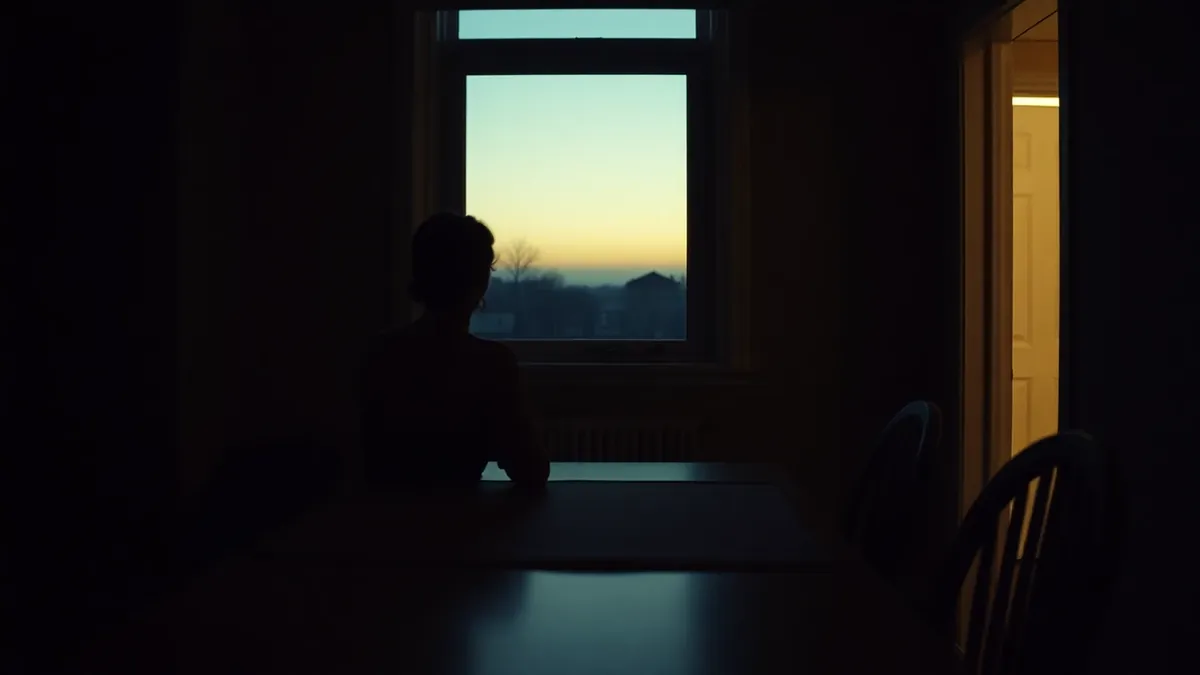
Were it not for Peter’s sudden slide away from himself, Maggie would have eluded the voices for the rest of her life. But when Peter was lost to her, and the scaffolding that they had erected together collapsed, her carefully constructed life, not strong enough to stand on its own, crumbled to dust.
She had forgotten about the voices when Peter first fell sick. She thought her fear was that of the faithful and devoted wife who sees her husband lying in bed and prays for his healing and well-being; that the dread sinking into her stomach was for his death, not for the silence that swirled around the room. But her apprehension was for herself. She knew, though she had forgotten, that the silence held memories, held voices, and when Peter’s voice vanished, when he no longer held back the emptiness with his laughter and easy, endless talk, then it began to fill with the other voices.
The illness struck like an earthquake: he was talking and laughing when suddenly he dropped to his knees, then lay upon the ground, all curled around himself. At first the doctors thought he would recover, that he would slowly improve until one day he would get out of bed and resume his life as it had been. But though his body healed, he was no longer Peter: he was changed, altered, removed from her. Everything that made Peter, Peter, was taken from him, from her, and the little that remained was silent and staring. Sometimes she could see a glimmer of him; he might raise one hand in a familiar gesture, or quirk an eyebrow in just the same way he used to. But always it dropped away and he subsided again into a child who was a man, Peter who was not Peter. His face lay slack upon his skull: his eyes vacant. And he was silent. For years he had filled their lives with talking and laughter and noise. He had filled any room he entered with himself -- loud, laughing, big -- but now he didn’t talk, didn’t look at her. He just drifted, looking at things beyond the walls, staring at the stable, at the barn, gazing beyond the herd of cattle to something only he could see. All that was Peter had vanished and regardless of whether he had retreated behind a wall that neither he nor she could breach, or whether the waves of his illness had wiped clean the sands of his mind, there was no difference to her. She was neither wife nor widow, left alone in the great silence.
Even the farm, barn and fields and flocks visible from his bedroom window, failed to rouse him. When he bought it, several decades of farming by those who cared only for what could be raised for a profit had stripped the soil and left it little more than a delicate skin through which erupted, here and there, weeds, wiry and thin. Guided more by intuition and an affinity for growing things than by knowledge, he had slowly restored the land. All of the farm responded to his love: the earth grew black and rich; the crops bent toward him as he walked by, as flowers grow toward the sun; the cows gave more milk for him than for anyone else, and they lowed peacefully as he walked among them. He knew when to cut the wheat and how to prune the apple trees, just as he knew how to move his own hand to lift a glass of water. Without him, though, the crops withered and the livestock wasted. Perhaps they were mourning him. Perhaps they just weren’t as well cared for without him. Perhaps both: the farm felt his absence keenly.
His absence cut her more sharply yet, for still more than the soil and the crops and the animals, his patient attention had restored her, half a lifetime ago. After their tragedy, he had been isolated by his own grief, stripped bare of any sense of her. But even more than the farm had, Maggie had once responded to his touch by growing in fertility, and his connection to her, still strong despite his sorrow, drew his attention irresistibly. When he looked at her a few months later, her skin had grown so thin that it seemed her spirit erupted through in scraggly patches, the wiry ropes of suffering pulsating about her. The change in her, the pain of her, shocked him from his mourning. He knew, even without her telling him, that something greater underlay her portion of their shared grief. He reached out to her with fingers that knew how to tend the frightened and the weak, and he worked to remove the great coils of pain that encircled her. She whispered to him, her voice thick and slow in her darkness, and he saw that the voices had come to her, that they came into the emptiness, the silence. He grasped her tightly, for she wanted to surrender to them, to walk off into that blackness. He realized that when the two of them spoke together, when they put away their reserve and reluctance to break the silence so newly laid upon their home, when they talked the voices fell silent. He dedicated himself to filling the emptiness with words, with laughter, with music, with anything that would protect her and hide her from them.
So the voices had receded, they had waned until not even the memory of their cries existed for her. But the fear remained, and the thinness of her skin: she shied from quiet and stillness, though she craved the peace of a room with no talk. As a child, she had loved to stand in the middle of the forest and feel the weight of that stillness pressing upon her, the breath of the trees filling her ears. But the woods frightened her now, though she did not know why. Or perhaps she thought she was simply too busy to seek them out, though she missed them and longed to return. It was a strange life; surrounded by words and thoughts and music while she felt herself overfull, unable to find her own thoughts, her own memories in the flood. She yearned for that emptiness and yet part of her knew that within it lay death. She could not have it, though she longed for it.
Had she allowed herself to remember the voices, she would have thought they had gone away for good, so completely had she and Peter locked them from her life. But when the first quiet echo surfaced after Peter finally fell silent, so too did some of the memories, and she knew that the ragged chorus would return to cry for her again.
They crept in around the edges, calling to her quietly. She might hear a whisper in the moment of stillness before she fell asleep, or a distant echo while she fed the chickens. In time they grew louder, bolder. They didn’t scuttle around in the shadows but came and went as they pleased. There was nothing left that was untouched by their grasping fingers. She had nothing left of herself. She felt that everyone around her must hear those voices emanating from her like a miasma, a stench. They must hear her get up in the morning and go to bed at night, and when she walked through town, the voices preceded her and followed her and surrounded her, warning all those who would come close. Meals were made and clothes washed though she had no awareness of doing either. They were there every moment, calling for her, drawing her to them.
Her days and nights were filled with the calling and the crying and the unbridled wailing of children gripped by pain and fear. Children lost without their mother, a mother who could not come to them, who did not come, who now can never come to them. “Mommy, Mommy, please Mommy. I need you. Mommy, where are you? Mommy, help me. Mommy? Mommy!”
Three days before the wheat was to be harvested, Maggie was in her bedroom trying to sing. It used to be that she and Peter would spend most of their evenings singing together, his heavy baritone rumbling below her reedy soprano. They sang hymns mostly, and some other old songs they each learned in childhood. Maggie had tried to keep up the singing in the recent months, for she had found that singing and reciting great swaths from the Bible were the only way to block out the voices now that she had no one to talk with. But this evening the four walls seemed to press together and the light felt thin, filtered through the muslin curtains. Her lungs cried out for fresh air, air that had not been trapped in that one room for years, filling slowly with dust. She found herself on her feet, fumbling with the front door and then finally out, pelting down the path and across the lane as if she were pursued by something real. In the middle of the wheat field she paused, panting, when a sudden gust of wind struck her full in the face and stifled her breath. Her running had jogged loose her hair so that instead of being pinned tightly to her head it whipped and swirled around her, lifting above her like tongues of fire leaping about her head.
And everything stopped.
Even the voices were stilled for a moment, as if the wind held open a space for her where only she existed and where she could share in some of its freedom. In that time, she knew that she could not go on as she had been, and rather than hopelessness or despair, she instead felt the freedom of the wind settle peacefully upon her. The only way forward was through the voices. She could fight them no longer. If they wanted to drown her in their cries, then so be it.
She let her eyes close and allowed her mind to empty into silence. And the voices came.
The glistening wheat rustled quietly and filled the air with the warm scent of bread and grass. The voices began to sing and to cry and to call for her. They filled every corner, every instant of her being. They swirled around her, they rubbed against her, they filled her ears and her nose and her mouth and her eyes until she could no longer hear anything else, she could not speak or breathe or see. There was only the voices, the voices, the endlessly crying voices. And with the voices came the memories.
Spring was in the offing if they could just get through mud season. Most years it didn’t bother her so much, but somehow the endless mud seemed to adhere even to her mind, pressing upon her and requiring her constant attention. It lay deep around the farm, with broad lakes of it all up the lane to the house. Winter had been a season of wet, heavy snow that melted to leave frosty, thick ridges of mud which only froze again under more heavy, wet snow. It had been a season of storms and blizzards, whole weeks when the snow fell too thickly for travel anywhere but the barn, and only then with one hand firmly clasped to the guide rope leading from the house door to the barn door. It had been a season of sickness; first one child began sniffling, and soon they all fell ill, sniffing and sneezing and coughing. No sooner had one recovered from her runny nose and sore throat than another developed chills and a fever. Now that the weather had warmed up and there was a break in all the illness, the children spent as much time outdoors as they could. But that mud. The children loved it, of course. Even Susan, at twelve, could hardly pull herself away from it to come inside, even when her shoes and tights and skirts were caked with the yellow-gray water. Sarah and Jimmy abandoned themselves to it with the delight of the newly fledged chick, flying free after weeks confined in the small nest. She scolded and threatened and raged and pleaded, but to no avail. The children covered themselves in the cold mud within moments of going out the door to help with chores. She washed the steps, the porch, the front hall, their clothes, their shoes. She washed and washed, each day growing more and more frustrated. Not only because she dreaded another round of colds, but also because she loathed the endless and useless washing and cleaning. She tried to remember prior years. Surely they had not encrusted everything in their vicinity in mud last year. Before that, Jimmy would have been just two, too little to do much puddle-stomping without his mother holding his hand, and the girls certainly never covered themselves in mud, not since they were Jimmy’s age. Susan was too old for it now, and even Sarah, at eight, usually avoided anything which might get her dirty. She hated to muss her dress or get dirt caked into her boots.
But not this season. And so Maggie, with the help of the children, scrubbed the interminable mud. One afternoon as he sat cleaning mud from the buttonholes of his sister’s brown shoes, Jimmy began coughing. It was quiet, but drew her attention as much as a shout. He didn’t complain when she tucked him into bed shortly after dinner, itself a sign that he was indeed sick. In the morning he remained in his bed where she brought him broth which he drank obediently. Though his forehead was warm, it was not hot, and though he coughed, he did not have the dreadful whoop she feared. But there were other illnesses that could steal in. Susan and Sarah had been forbidden to go near Jimmy, but they began coughing soon after him, despite her precautions.
The house fell still and silent for several days. She thought that at least she was done cleaning the ubiquitous mud and perhaps a bit of a cold for a few days would keep them from splashing back into the puddles when they recovered. The children lay docilely in their beds and Maggie tended them -- brought them broth and porridge and toast, sang to them, wiped their faces with a cool cloth.
In the darkness before the dawn of the fifth day, Jimmy began to call for her. It was a wild cry, loud and frightened. Though she rushed to him and held him in her arms, still he called for her. She rocked him, sang to him, but his distress remained. She could not convince him that she was with him. Discontented murmurs and restlessness from Susan and Sarah soon grew into cries and Maggie set herself on the girls’ shared bed with Jimmy in her arms. She could neither calm nor comfort them, and soon she realized this and gave up. They did not know she was there; they were far too sick to be aware of anything.
She continued to nurse them the best she could, wiping their hot, sweaty faces with a cool cloth, spooning a few drops of broth into their mouths, and always singing lullabies, hoping the memories of peace and safety would reach them when she could not. But still they called for her, and their cries stung her. She could not sleep, she could not block out their voices long enough, even though she knew she must rest, she knew they did not know whether she was with them or not. She became dizzy and felt heavy-limbed and her hands seemed like they were made of cotton-wool. She could see the children finally sleeping silently, at peace after their hours of distress. But still the crying continued, buffeting her ears. “Mommy, Mommy. Please, Mommy. I need you Mommy. Mommy, where are you? Mommy, help me. Mommy? Mommy!”
She must have cried out herself, for Peter came to the door, brow furrowed. She slipped from her chair and fell to the floor.
When she woke, hours later, even days later, perhaps, the house was silent. It might simply have been that everyone else was sleeping, but the silence was deeper, heavier. There were footsteps in the hall, but slow and deliberate. Peter came into the room and sat on the chair beside her. A cup rattled onto the table near the bed and for a long time Peter sat still, his warm bulk filling the room. The scent of hay and grain and cattle clung to him and he seemed to carry the quiet barn with him.
Maggie opened her eyes once more, finding herself in the field of wheat. The wind had died and the air was perfectly still. She sat crouched within the wheat, her arms tightly wrapped around her knees like a child playing hide-and-seek, hiding from It. The stalks stood around her and remained silent. She lay back and looked at the sky through the opening in which she lay. Dark shadows of the wheat encircled her. Low over the horizon hung the moon. The stars she could no longer see in the lightening sky, save one or two toward the far horizon. But the fine curve of the moon remained suspended from the arch of the heavens like a single stem of thistledown resting in a spider’s web.
Nothing had changed. When she went back inside Peter would still be silent and strange. The house too would still be silent. And she would still be alone. The dawn would break on this morning as it had on every morning before and would on every morning yet to come. Nothing had changed.
And yet as Maggie stood up and brushed bits of soil and wheat her skirts, she suddenly remembered how Susan would try to help Jimmy dust off his pants, though he wanted to do it himself. Sarah would giggle as Jimmy ran off, Susan giving chase and all of them shouting and chortling. Maggie laughed at the memory and walked lightly back to the house to begin her chores.

“The Fine Curve of the Moon” was printed in Harvest Time, No. 5 of Inwood Indiana. Pick up the paperback from Prolific Press; the stories and poems published online are free to read here.
Get the paperback