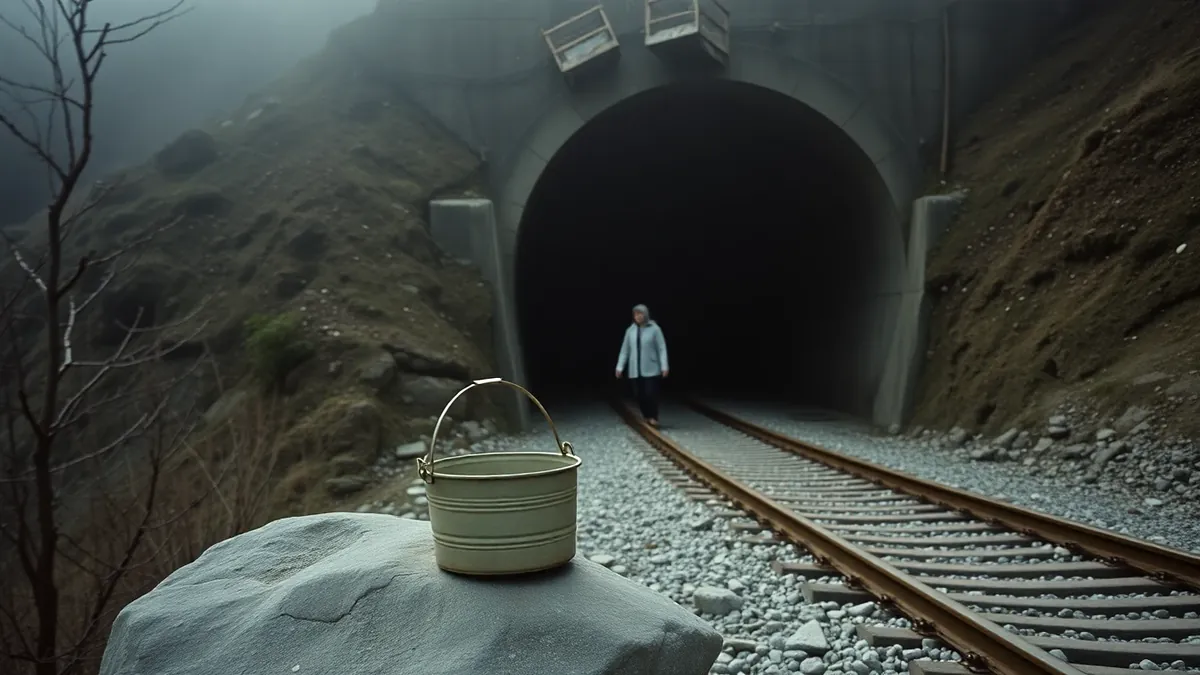
By the end of the third year of their marriage, Charles Taylor had at last found work at the mountain tunnel and Mrs. Taylor began to think more often of her husband’s death. Until then she had thought only fleetingly of it. His death like many years past or many, many years down the road of life. Now this was a freshly death, and she imagined herself in the moment of its realization.
Your death? She would think. How can that be with all your mannerisms still fluttering like dust in our home? Your creature-like way of sitting. Your facial jerks, although I never quite understood them. How can we have death when our air is still thick with your ways? The sounds of your night-blindness knocking into the sofa as you feel your way to a glass of water. Keys on the table just where you set them, just in the way you set them.
Charles’ death was unfathomable, and it begged to be fathomed by Mrs. Taylor. She could not help but envision it, envision herself in the shock of it: My husband. Cut up in the machine. Parts of him are. Other parts not. Or crushed by loose stone. Or a man standing awkward in the doorway saying, “There were gasses, ma’am. Toxic ones. We didn’t anticipate.”
In the evenings she would look up from her quilt project and watch Charles sitting in his chair from across the room. His eyes low-cast on yesterday’s newspaper. Finger-tracing the words. His head rhythmic to the finger work as if music played. She would stare at that space between his eyes and think, but if he were dead. If a bullet shot through the window just now and took him. This is him right here. But what if he were not?
All these thoughts steeped through Mrs. Taylor’s mind as spring bled into summer and the hours at the tunnel increased. Each day Charles began the two-mile walk just as the sun appeared, his brown sack already grungy in his hand, an undecorated biscuit in the other. It wasn’t until that sun had about set, when his figure would appear again over the only hill on that idle horizon like a black and faceless apparition. They ate their suppers with the crickets and sat at the small table in the kitchen because it was just the two of them. A platter of boiled dinner and a half-loaf of sourdough. Him talking about the fields and what the farmers should be doing, negro shenanigans and how oddly textured this particular bushel of potatoes was.
Whenever it was dark, Charles was there in the usual sense. Present and solid with the quarter of a potato on his upright fork, the elbow squat on the table’s edge. Huffing as the bites went down his veinous neck. He was the most living of living things, thought Mrs. Taylor. Yet she was not quite able to forget the prospect of his death, how fleeting this stability. Of this, she was becoming expectant. As if Charles’ death was a wanting of another kind, and her luck that he would die early. As for Charles, he did not think of her death. Charles did not think of his wife two days to come.
There were times when these visions all seemed put into their righteous perspective. Of course Charles would not really die. Of course he would live many, many years. It was the idea of death which chipped at Mrs. Taylor all the long day on the quiet patio or standing in the grayer parts of the sunlit kitchen. Not death actually.
But even if life or death. Charles in his chair or not in it. The sounds of him or the mutters of an old house made audible in his absence. She would sit alone in the pew at the women’s worship service, her legs crossed. Sit with her warm lap-hands while the women rose and sang.
The stationary hymnal on the shelf in front like a bookmark to her stillness. And she would think of how the idea of death is not so fleeting. Every soul wastes a dark night yammering himself hoarse at the frightfulness of it. But death itself? Now that is fleeting. The fear unjustified. For what is death, if heaven is? Nothing more than moving on to the inevitable and lovely. On to the big city where there are many lights and there is no married. How could she sit in the pew and just breathe and not feel the impossible warmth around her as another sign?
So she took it as His witness. His indication, that her husband would die, and soon. Charles on his way to that lofty city and space on that fragrant road for his boots only. She had never known a conviction this strong. Not at the moment of her mother’s death when she witnessed the seeming glow of the woman’s dying skin. Not on the day it became certain that she and Charles would marry, although it was like no option in life would know its fullness if they did not. Strange when a conviction morphs more than it withers. Any day and Charles would be called to meet up with everyone else in that great city who wasn’t married. The men with their new bodies who weren’t married. All the women with their new bodies who weren’t married.
She thought of herself sitting in the church pew just like this. Forty years and an installation of new pews and another some decades after. Sitting just like this as the times grew into better methods of the progressing world. Except her shoulders would be low into her bowing back, her hair more white than gray, her dry hands always cold. Forty years and longer with the doctors doing what they do, and will you still go to heaven if you don’t let them?
Deviant thoughts have a way of becoming usual. Acceptances brewing out of old disbeliefs. The probable and common is a matured outlandishness. Mrs. Taylor had begun to picture herself as a widow. Waking up in the quiet. Bedding down in that absolute stillness with Quiet’s own melodic moans. Widow as if it were an occupation. Like being a florist. Becoming a teacher. Live and dress as a widow. Wear widow on your face. Charity and availability and charity and charity. The Widow Taylor.
What was fearful was how accessible this vision had started to become.
The ground settling as the earth reaccepted Charles and fertile grass on that lot like no gravedigger's shovel had tried. Her life, alone again and for the long rest of it. Was this so different as it had been or was nothing different? The house was her house before it was his, and it would be her tired house again with all its need and want. Because it was she who had plucked Charles from his mother’s home. Placed him in the center of her life already. Bid him stretch out his limbs and stamp his residency into her systems. For three years he hadn’t worked, hardly, and it was Mrs. Taylor making certain they ate. Mrs. Taylor going away for a night—once in a handful of moons—and making sure there was something warm in the pot.
The afternoons ticked, and it got to where she didn’t know if news of her husband’s death would surprise her more than his return. Gasses, Ma’am. Toxic ones. Each morning Charles would go off as if nothing mattered this moment more than any, and she would wipe away his crumbs and wonder if they were the last of him. Then it was dark and Charles was back in the evening with his finger tracing, his legs bent creaturely in his chair, breath hard and mechanical and robust. She felt injected with the icons of his presence and yet denied of it. The prospect of his death was once something she couldn’t believe, and now his life felt equally astonishing and impossible. Charles is here. But suddenly he may not be. And here I will be still thinking as I do. My thoughts and his image. My thoughts and his image gone away. My thoughts.
Whether Mrs. Taylor shared these anticipations with anyone is uncertain. Perhaps there was a friend in the church on that day, to whom the wife had expressed her musings. A woman sitting silent in the pew as Mrs. Taylor had often sat. One who could not help but shake her head at the sour odds as she passed the wife’s closed casket.
As for Charles, the accident made it now very easy to continue what had been occurring with a Mary Clarkson. So good these days to be working and young and unmarried with a house already. Or could he even think, these days. The glasses dinging and the bottle pulsing out its purple on the sheets.
“The Accident” was printed in Tracks, No. 9 of Inwood Indiana. Pick up the paperback from Prolific Press; the stories and poems published online are free to read here.
Get the paperback