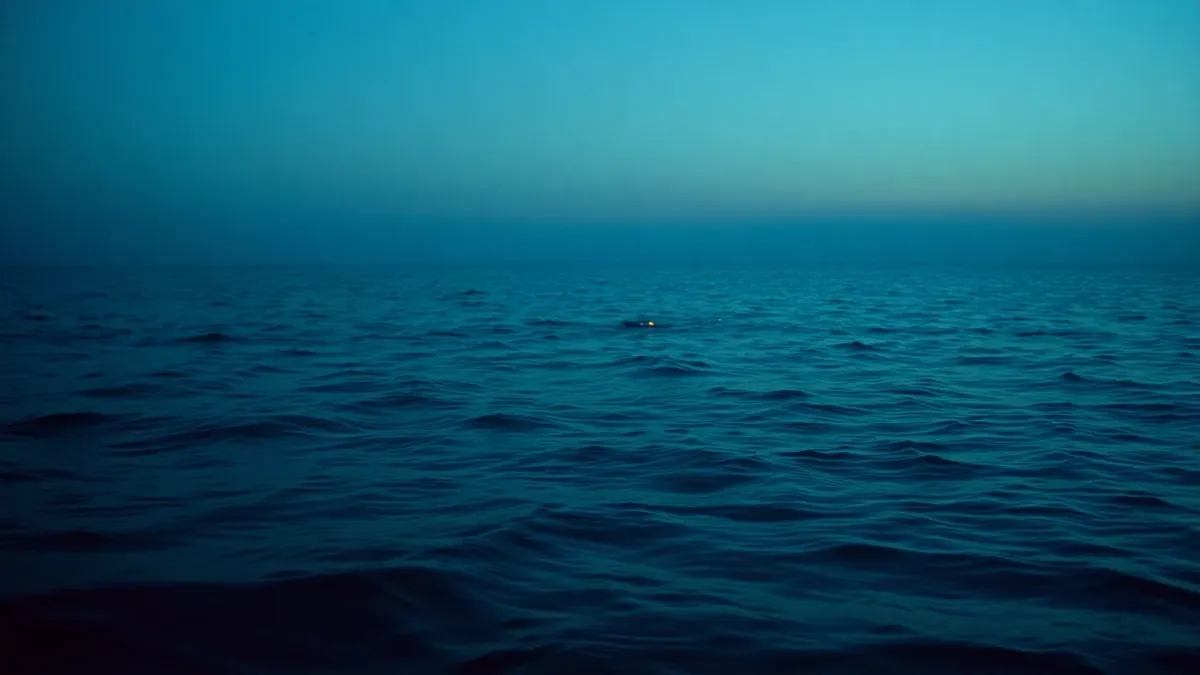
The bottom of the sea is not black, it is a dark teal color with some turquoise and chartreuse thrown in. It’s cold, but somehow strangely comforting; like standing in front of the open refrigerator on a hot day. The dim light is not from the sun, but a mixture of luminescence from the strange life that exists there. The sheer power of bio luminescence wouldn't be enough to light up the bottom of the ocean, but I'm not sure how else to explain how I can see down there. The atmosphere is a cloudy, misty, silky texture that moves like the particles in a snow globe. Rocks peppered with bits of crustaceans, seaweed, and sea lichens scatter the bottom and in some places tall cliffs rise up towards air or deep chasms dip into depths at which it is truly black.
That far down, there is no sound. If one were to venture down, there would only be pressure on the ear drums, if you could theoretically withstand the pressure. There would be no merry sounds of bubbles escaping to the surface, or muffled tappings as little crabs scuttled across their mountain vistas. The emptiness of it would alarm anyone, regardless of whether you were claustrophobic or feared open spaces. It is both vast and closed in at once. One would walk soundlessly across the expanses, as small puffs of sand would expel upwards and outwards from a slow moving foot.
Most terrifying of all would be the occasional sighting of something larger and more complex than the typical invertebrates. Several feet of scales, spines, teeth, cartilage, and bulbous blinking eyes would slither and scuttle past, dipping down towards the darker colorless chasms. The water would feel even colder as these beasts pushed by; even the molecules of the water would shudder to be in contact with such hideousness that could only have been squeezed out from someone's abscessed pockets of their semiconscious. I know about this because I dream about it every night.
The surreal landscape that exists far past where natural sunlight penetrates through the water frightens me, yet I am drawn to it as I sit in my kayak while the sun leaves it's partially cloudy sky to tuck in behind the mountains. It turns the cumulonimbus and the waves shades of pink and orange. The technicolored waves aren't very deceptive. I know that past their rainbow surface lie the vast and lonely expanses; they are all I've thought of for some time.
Looking down, I remember being curled up with Reid watching TV late one night. We had fought that day, and had made up mostly so we wouldn't go to bed fuming. Nothing was resolved. He fell asleep and I kept up in front of the glowing box. It was the discovery channel doing a piece on the sunken Titanic and the strange sea life that had found it hospitable. The little yellow mini subs, specially designed to withstand tons and tons of pressure whirred and sent out clicks like dolphins as they cast a greenish whitish glow over what could have been the surface of the moon.
At one point, the documentary, though mostly about the ocean life around the wreck spent some gratuitous time shelling out on the morose and romantic deaths that occurred almost a hundred years ago in another era, another culture. The sub passed through doorways, walkways, rooms. The one image that stuck with me was that of a pair of men’s shoes, resting on the floor in such a way that one could imagine the feet, legs, body that had once been attached to them. The body had managed to sink with the ship and had rotted away, eaten slowly by small alien creatures, leaving the shoes untouched and in a relatively small state of decay.
I look down at myself, my sweatshirt, my jeans covering my legs, which disappear into the belly of the kayak. I am wearing rubber boots. If I found myself in darkness, with only brief brilliant bits of luminescence to light the way, and if my boots didn't float to the top, they too might rest where I would sink, as a reminder to anyone who found me. The only thing is, I'm in a kayak that I affectionately call the “Scuppy” and I am an average Jane from a small town in Alaska. There would be a brief search for me, and if my body did not wash up onto shore or wind up in a fishing net, my family would perhaps nail a small brass plaque on the lost at sea memorial near the harbor. Too many average Joes and Janes swim among the fishes and the beasts here. There's an unspoken protocol for those lost at sea. After about a year of being quietly whispered about they become part of the local lore, and then forgotten. The only one that is still widely remembered by the public to my knowledge is the brutal story about the young girl who was murdered. Her body was found stuck under the docks. Some say the trooper did it, others say it was a passing group of stoner hippies. And in any case, the story has probably changed and evolved overtime so that it no longer resembles anything close to what it used to be.
I pick up my paddle and round the point. It is called Tess Point, and according to Native legend, people who did bad things were rowed out in the strong canoes and lashed to the rocks that are only above water during low tide. Primal capital punishment. I don't know how true the story is. A white man who once attempted to ride a snow mobile across the inlet told me the story; not the most credible source. It sounds a lot like the Tigerlilly story from Peter Pan if you ask me.
However, it's an interesting tale, and about ten feet directly down from where I now paddle is the formidable rock. Were these stories to be true I imagine that there might be a few bones left from all of the abandoned; some trickling all the way down to the soft sand, landing in puffs, others catching in the cracks in the undersea cliffs. The bones of the dead Tlingets look up at me in my kayak and I think about feeling the water creep up past my waist, numbing my legs, past my chest, hands tied, feet tied. Would they have died of hypothermia and shock before their lungs filled with water? Probably depended on the season and the weather.
I realize that I have stopped paddling again, and wonder if I am being inappropriate in possibly making up stories about another culture for my own amusement. Amusement is not the right word though. Far from it; I'm trying to remember all deaths in the ocean, trying to understand what company I might hold. Perhaps the Chilkoot rowed their criminals and their embarrassments out to the rock, and perhaps they didn't.
My hands grip the paddle, my fingers refolding themselves over the aluminum shaft. I make my arms strong again and I move forward, with purpose. I am heading towards Takanaka bay, where there are the remnants of a cannery and an old barge is dead, gutted and rotting on the beach. The Chinese used to run the cannery, but then gave up on it like so many other fishery and cannery workers did back in the day. I don't know details or legends about this place. It is ghostly though, and as a child I would dig in the sand when Dad would take me and my brothers out to cruise the far beaches. I was looking for something, anything old that would be of value to me. Pieces of glass imprinted with letters or numbers, rusted tools. In my childish way I hoped that perhaps in some weather protected nook I would find an old book or a newspaper or a letter. A letter would be best. Though it would not be addressed to me, it would be for me. Of course I never found anything distinctive.
Once again I stop. I have come to an area in the ocean where the tides are mixing. Because of their different movements, I stay more or less in one place without having to steer. The sun is now nothing but a thin brilliant strip over the jagged far mountains, it's dragging the technicolor-ed clouds down with it, like a toddler pulling at a large sheet on a clothesline. Then with a silent clap, the slivered sun is gone and the sky is completely bathed in dusk. The colors are still there, but more muted, and the dark creeps in peacefully. The waves cup the sides of the kayak, making soft sucking and snapping noises. A few seagulls fly overhead and land nearby, curious as to what I'm doing. The air is cool but pleasant, and I can feel that my lips are chapped.
I had been busy boiling water during last summer's kayak trip when Reid went exploring on his own. The same ferry Reid and I had seen the day before happened upon his kayak a week later, empty except for his sleeping bag and a tarp, which had managed to stay clipped to the back of the flipped kayak.
Rowing around the coast, looking for Reid that night, I was frantic. I radioed in the coast guard after it became obvious that I had no idea where he was. I don't know why I didn't just jump in then. The last thing he had said to me was something along the lines of, “thanks for getting dinner started”, with a smile. I had nothing else, not even a marriage proposal after four years together. We didn't even have a dog.
I am aware now that I had come out here intending to jump. I am not one who normally approves of suicide, and after a year of Reid being dead, I was adjusting well enough. But I cannot think of going in to work tomorrow. To the same restaurant, the same people. I cannot think of going back to my house, which suddenly, miles away, feels hostile. My diving equipment is in the back compartment of the kayak, and I wonder if I should have noticed last week when I put them back in their place after being repaired that the action was ominous and foreshadowing. With some difficult maneuvering I am able to pull out the bag which has my weighted belt in it and my ankle weights. I put both on and take my boots off. They would be too buoyant. The kayak is still in a pretty good position. I know from fishing out here hundreds of times with a depth-sounder that it is over four thousand feet deep here. This is the deepest fjord in North America.
I have not really thought about finding Reid at the bottom of the sea, among the beasts and bones and shoes safe from decay. For some reason I can't seem to comprehend that he would be there. I am not sure where else he would go, but I like to think that he lives on in something smaller and more personal. If I were dead and could inhabit where I wished, I would perhaps live in my favorite tea mug, or the strong birch tree in my yard. I am not sure where Reid would go, and so I assume he is walking the ocean floor, but I don't know how I will find him in the dark in that great expanse. After a whole year of missing him, after the minuets that I first realized that Reid was gone and the funeral and the empty bed and the anniversary of his death, I realize that this is what needs to be done. I cannot look at a wedding band on my finger or at growing children we might have had to remember what I know was the most legitimate thing in my existence. I have only the acknowledgment of the death. I want to be like the Indian women who threw themselves into fires for their dead husbands.
The weighted belt starts to press against me as if it were impatient and wants me out of the boat. Wearing all that lead reminds me of the lead apron at the dentist’s office and with some bleak humor I wonder which would be a better place to be in; the dentist chair or alone on the ocean. The belt knows that there is only a thin plastic structure keeping it from utilizing gravity against my life, and becomes impatient. The flashing light from the buoy on Tess Point blinks out into the almost complete dark. I take a deep breath, trying to memorize what air in my lungs feels like. I think I am crying. Then I shift my weight, holding my hands out in front of me as I balance on my seat. I push up, and then I lose my balance. Rather than just recognizing this as what I want, my human survival instincts kick in and I fall back into the seat, probably bruising my right hip. I crouch, not moving, holding onto the sides. The breeze on my head is cold, and my ears feel too naked in the wind without a hat. I can hear the sounds of nature sharply. It is as if somewhere someone has turned up the volume knob.
The bottom is waiting patiently, like a huge purring cat laying near it's food dish. I think of the greens and blues and sparks of luminescence and the soft clouds of sand that I can see so vividly despite never having personally visited. I think of the quiet. I wonder if I am being selfish. I push the thought away from the forefront of my mind.
Then I jump. Not as gracefully as I planned, but I land feet first. The water is so cold that I gasp and my arms flail before I force myself with difficulty into a human torpedo, feet down. I wish I had something to steady myself and add to the downward torque. The moment doesn’t happen in slow motion as I thought it might. I look up in time to see part of the moon shining through the first few inches of water. It's lost its smooth circular shape and wiggles like bad television reception. Then under a few feet, it's a dim beam, like a flashlight in the fog. And then it is dark, and I am dropping. I've pulled my feet together and my hands are at my sides. Gliding swiftly down towards my destination, I close my eyes because it hurts to keep them open and there is nothing to see anyway.
I am holding my breath instinctively. Now I am very scared of the bottom. I do not want to be alive when I hit bottom. I feel like a little kid again, too afraid to let my feet touch the floor when I get out of bed because the monsters might grab me. I am almost out of air anyway, and the pressure has made my ears hurt immensely. I am numb from cold, and the farther away from light and oxygen and warmth that I get, the more stricken I become. I am now sure I am crying but I can't physically tell. Suddenly there is a huge pain in my ears as the drums burst. It is the last great sensation I feel, because I am now drowning. I feel an ache in my chest as the lungs fill with water and reach bursting point. I wonder if Reid felt these same sensations, or if something else happened to him so that he was unconscious. I hope he had been unconscious.
Then my heart stops. I am dead. My body is still falling. I follow it. I cannot see it but I feel the water displaced by its movement. Things begin to materialize slowly, like audience members in the lights at the end of a theater production. The light surrounding me is grainy and a dark mossy tint. My body hits the sandy bottom, and for a moment stands as if I am about to go walking, due to the weight around my ankles. But then the heavier belt wins, and I slowly fall, the impact slow: a crash test dummy on the replay. My body is face down, one arm outstretched to the left. My face is obscured by the sand it lies in and my hair whorls out like a halo of kelp. For a long time I watch myself in the greenish glow, not moving. I notice my car keys, with the little float attached to them, are hovering over my body because the lanyard is clipped to my belt. It undulates with the small changes in current, a little marker.
Sometime later I see a movement in the sand. Then another. Two crabs, small ones, not like the large dungeness that people leave pots out for, creep their way towards my body and investigate. I turn my gaze away when I see one burrow into a space near my neck. It doesn't take long for nature to realize it's meal time.
As I look around, my eyes adjust. It is hard to see farther than twenty feet ahead of me. I am not sure how I am able to see in the first place, but then again, I am not sure why I am somehow conscious. I think that maybe this is a dream and decide to just go with it, for lack of any better options. I take a few steps, languid and smooth like a person in space. I dodge a small patch of seaweed; the feeling of seaweed on my legs always freaked me out. For some reason I can't swim, I can only walk slowly despite being apparently out of my body.
I walk for a long time. I am not sure how long. I run into very few things worth telling about, mostly small crustaceans and smaller fish. Once something larger passed above me, casting an amorphous and ambiguous shadow over me. I was afraid to look up. The thing didn't bother me. Maybe it couldn't see me. I wonder, as I walk, if I will find another person like myself. I doubt it though. There is no sign of human life anywhere, except for a few random bits of detritus too heavy to be carried by the tide: a rusted propeller, a hammer, twisted bits of indistinguishable metal. There are no shipwrecks or buried treasure chests sticking halfway out of the sand. It is only me, walking. I do not grow tired. I walk over silty dunes, over rocky formations, and avoid deep chasms by walking all the way around them.
Eventually, I find something. It must be days, even weeks, since I left my body behind with the crabs. While picking my way over some small, oblong rocks that slide as I move over them, I see something shiny. I almost move past it, since I am tired of finding stray quarters and old fishing lures. I decide to pick it up anyway.
It is a ring. A standard gold band, probably a man's wedding ring. I rub it to make it shine better. It probably fell off the side of a fishing boat recently; someone took it off while gutting a fish or while handling nets. I put it on my thumb, the only finger it will stay on, and even then it is loose. I feel bad that the man won't ever find his wedding ring. I hope his wife will understand and not be too upset at him.
It is now, only now after wandering for weeks, cold, tired, alone, forlorn, lonely, that I realize I have made a terrible mistake. Suddenly, as if I have never heard of the concept before, I think how amazing it would be to fall asleep. I walk to the end of the gravel plot to some softer sand, and lie down. My entire being sighs and flashes of the green luminescence blink as I think about how air feels. Inexplicably, more than anything I want to eat a plate of pancakes, stacked high and golden with ribbons of syrup flowing down the sides.

“Sea Monster” was printed in Harvest Time, No. 5 of Inwood Indiana. Pick up the paperback from Prolific Press; the stories and poems published online are free to read here.
Get the paperback