
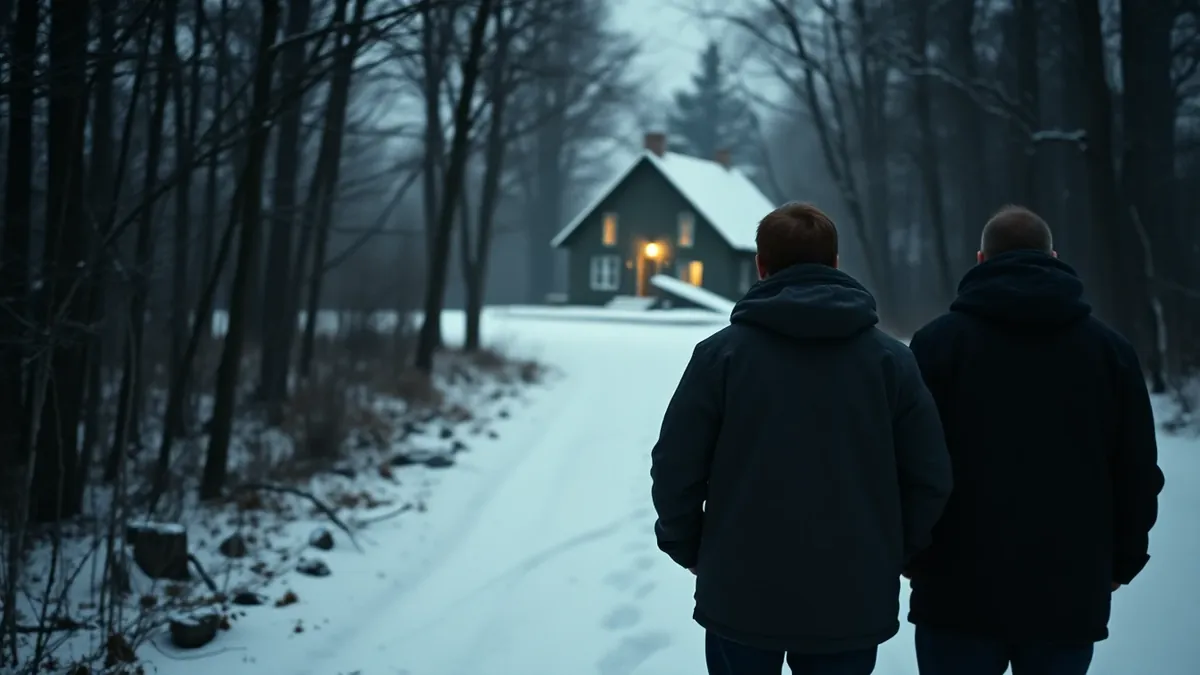
“I thought you boys were going home.” Their mother spoke without concern, as though she’d been forgetful and only just now caught herself. She called them boys, but they’d been old enough to hunt for many years and would have scorned protection if it were offered. Their father had taught them that before he died—you got to take care of yourself; it was probably the one lesson they recalled best, though growing up in the middle of the country almost meant the middle of lots of conflicting ideas. Sometimes it was better to live by the folktales and the ways others forgot. That got results.
The woman said nothing about the body they dragged behind them.
The two men took the corpse behind the shed and their mother went back to digging. She had potatoes coming already.
The body had a little bit of life in it. Enough to apologize or to beg for mercy, but it did neither.
“Still got ya,” it said, grinning before death. Hugo flinched; it was not enough to let time run unhurriedly to this expiration. Without consulting his brother, Hugo moved to step on the body’s neck. He leant all his weight to the task a few seconds, until the flesh no longer breathed or smiled, except in rictus.
“He wasn’t going to say anything else,” Hugo said. Freddie, his brother, nodded, though secretly he did not agree. And even if no more words were forthcoming, Freddie wanted time. He wanted to watch the body pass, to consult with that fading light. Seeing the light dim in the eyes would give him an interim for thinking.
Hugo had given the first apples to Lilith last year, and nothing came from it. She had not grown with child. Not until…Freddie looked down at the body again, wondering if death was the outcome when people intervened for themselves instead of trusting the old lore.
Freddie looked away. There was nothing to do now. He heard their mother calling the pigs, two of which were named for he and his brother. She was not a woman given to comedy, and Freddie felt certain she had not bestowed the names as a joke.
His brother was staring at the still body. Hugo often looked menacing, and his mouth, missing more than a fistful of teeth, added to the effect. Hugo sensed Freddie’s stare.
“What?”
“Your mouth. I mean, your teeth. You don’t track them when they fall out. Could Lilith have gotten one somehow?”
“I don’t know.”
“Not that it would have mattered, I suppose,” sad Freddie. “Teeth have never been—”
“You don’t know!” screamed Hugo. “Nobody can tell, right. There might be some kind of spell we ain’t heard of.”
Freddie only nodded. He did that a lot around Hugo, around everyone. It was a world to watch. He didn’t believe most of the old folkways, least not the way Hugo believed, like he might become some kind of supernal entity. Freddie was beginning to think belief was only valuable if it helped you get along without trouble.
Their mother called. Though the names were the same as some of the animals, there was an inflection in her voice superfluous to pigs. Hugo and Freddie returned to the house. Their mother was done with the chickens and stared at her boys as they approached.
“You take care of him?”
Hugo said yes, but Freddie added, “We still have to bury the body.”
They went in to lunch. If they had left him alive, Hugo would have set his shoes near the fire, so when the soles warmed, not quite burning or melting, their victim would feel it. He would never know for sure how much suffering the superstition caused—if any, Freddie thought—but he would feel a continuation of his power, the ability to make someone suffer.
One of the chickens furnished the lunch. Freddie almost laughed at such consideration, but their house was not one for jocund moments, and certainly not today on the heels of another death. He thought about all the insects Hugo’s boot had smashed, those thousand little deaths. Did warm heels hasten their end, too? Though perhaps immolation was preferable, or at least quicker than the way most men died.
After lunch they each had chores and Freddie was grateful. He wanted a span to himself. Hugo usually went hunting, and while his brother should be the one to bury the body, Freddie volunteered for the task.
“We still need to eat,” he said. It was explanation enough. Life belonged to the living. Hugo stormed away from the table, which was almost a ritual, too. Freddie did not know if his brother needed to build his anger up for hunting, or if he never quite settled down from some prior fury. Their mother accepted the dirty dishes left on the table as part of her duty.
Freddie began to remove his plate, but she stopped him. “You need to go get a shovel.” Her husband had never let her miss cleaning them, not without paying for it, and she wasn’t about to test her sons.
She was right of course. Even if Hugo’s reasons for the body were a problem, the body itself was simple. It would attract flies and animals before long, but mainly scavengers, not the kind that had much meat. We’re like that, too, Freddie considered as he got the shovel from the shed.
He lugged the body from behind the shed. In the midday sun, bright, it looked more terrible yet. Things grotesque should be hidden, like excrement. But the body had to be buried.
“Where now?” Freddie asked himself. They had rid themselves of dogs in the past, and insects were easily smashed into the very dirt. This was something else.
The woods around the property, though not extensive, were large enough for further concealment. He began to drag the body, careless of sticks and rocks, and thought of the days when he was in school.
He had been a different person then, willing to speak to, even to argue with fate. He remembered one essay where he’d sought to prove that Clytemnestra did not deserve to die, even after she made Agamemnon a cuckold and then a corpse. He’d gone as far as to argue that she was the original feminist, but the teacher, who seemed to believe in Olympian gods and justice as much as anything, dismissed the argument, telling Freddie that the woman’s guilt condemned her, even if her faults, the death of a husband, paled in comparison to that of Helen, who started a war. Seeing how little the earth moved when he spoke, when he commanded minds to open, Freddie gave up. He no longer bothered with Latin or reading ancient texts. What did they have to do with his laden mother or his absent father?
He stopped, listening for Hugo elsewhere in the woods.
Though he was a few years younger, Hugo probably missed their father more. The old man had been swallowed up by war, which was a sand dune eternally hungry.
When his marks at school slipped, Freddie’s mother did not fuss. There were no choruses or councils to appeal. He simply became a bit more like everyone else. Regression to mean, concluded Freddie. In the end, scavengers got everyone.
“You’ve always got a place here,” his mother told him. And she meant it. He could stay beyond her passing, whenever it came.
But in the woods it was easy to slip back into forgotten thoughts. Tempora nostra nunc sunt mala; vitia nostra, magna.
Freddie knew it was true. Times were bad and likely to get worse with their sins. They couldn’t go on like this forever: Hugo hunting, but letting things get to him more, and their mother, happy that she only had to tend the land and the animals, that most things were paid for, but never thinking about what you couldn’t just pay for and forget. Fratrēs nihil cum ratiōne herī gerēbant.
Yes, that was more like it, because he did not worry too greatly about his mother. She was just one of yesterday’s thoughts. But Hugo, that was a different story. Even if he forgot the brother’s keeper stuff they fed you in church, which he wasn’t sure he could do, Hugo had to be watched. Ignoring him, and leaving Hugo alone with their mother was a kind of matricide. It was the reason Freddie had stayed longer than he’d intended, and the recognition, like the body he dragged behind him, was ugly.
He found a space where the trees weren’t too close together, so there wouldn’t be countless roots to avoid or cut through while he interred this man. Hugo had not wanted to recognize Tanner as a man, but he was.
That was the problem for Hugo, so many people were.
“About half the population,” Freddie said softly to himself, slumping Tanner’s body against a tree and grabbing his shovel.
The ground was stiff. Hard. He dug and dug. Fortunately, the earth, once broken, did not resist too much. Looking around, Freddie guessed there weren’t many more places in the woods where the ground would give way. No, they couldn’t go on like this forever.
“Poor Tanner,” he said, laying the other man in the hole he had created. It was as much a eulogy as he could offer, for Tanner had simply been decent when Hugo was riled up, which made him unlucky.
Freddie had been present when Hugo had found out Lilith was pregnant, and had threatened to kill her, moving as if to hit her. Tanner stepped between Hugo and the woman, and the intervention looked like a confession to Hugo, who bided his time.
When Freddie finished putting the dirt over the grave, hoping it was deep enough to hold until the first frost, he looked up and saw Hugo. “You finished then?”
Freddie started to nod, but said, “Almost. I want to make sure it will hold him.”
Hugo laughed at this. “I’ve caught some meat,” Hugo said. Freddie didn’t bother looking. He did not need to see another carcass.
“And I’ve got great news!” Hugo’s excitement was almost as frightening as his wrath. “Lilith’s lost the baby.”
Freddie pushed his shovel against the ground, but not hard enough to break the surface again. A miscarriage, then. He did not like to calculate how many people were lost because of him, for loving Lilith like he did and being unable to restrain himself, despite knowing how angry Hugo would be. That was another hole he had dug “I hope you didn’t scare her,” he said, looking at Hugo running his hands along the barrel of the rifle.
“No,” his brother replied, shaking his head. “But I’m glad. I just don’t want her to do it again. And it will be easier for us to be together if she doesn’t have some bastard kid.”
“Uh huh. I want to finish here, then I’ll move along.”
Hugo did not wait.
When he was alone again, Freddie pushed idly at the loose ground where he had put Tanner’s body. Everything was wrong. When Lilith had come to him, Freddie let her cry, seeing that she needed it, and knowing that sometimes tears helped people heal. He could not recall seeing his mother cry, but she was a hard woman, who adapted herself to the circumstance of her life. Lilith did not cry long—perhaps she was on her way to becoming another hard woman. Freddie kept his arm around, too long it seemed. For then Lilith kissed him, and he kissed back, and they devoured each other in a need they hadn’t known existed until then.
Only when Hugo found her pregnant, he had wanted to punish Lilith.
And Freddie, despite being the cause of the new life in her, felt angry at the woman, as though she had failed to keep a secret. When Tanner stepped forward to protect her, Freddie felt all the more cowardly in his silence. It was not the first time he had beaten his younger brother to a prize, but the first when the consequences went beyond simple injury.
He saw, too, that the old beliefs, the superstitions that he never discouraged in Hugo, were just another means of controlling him, and blinding him so Freddie could feel superior, like he had at school.
He stepped back cautiously. The ground over the body would smooth itself under the wind and harden into a whole, one the rain might soften but never obliterate.
Freddie looked in the opposite direction of the farm and the house where Hugo would be showing off the animal he had killed. That was the last thought he gave to his mother before turning his back on the home.
If he kept walking, there might be people he could impress just by talking. And if he cleaned up a splash before he spoke, that would be even better. Freddie might eventually find another woman. He saw that he did not love Lilith, but he must have a companion. Staying here would make that impossible; Hugo and he were both too jealous. It was best to leave. When Freddie did not return, Hugo might hunt him, might even start that night, but Freddie would keep on walking. The woods did not go on forever. Still, he would bring the shovel, because it was something he could believe in. A man could always use a shovel, to make tracks or cover them, even as a courtesy to the next fellow.
“Scavengers” was printed in Tracks, No. 9 of Inwood Indiana. Pick up the paperback from Prolific Press; the stories and poems published online are free to read here.
Get the paperback