
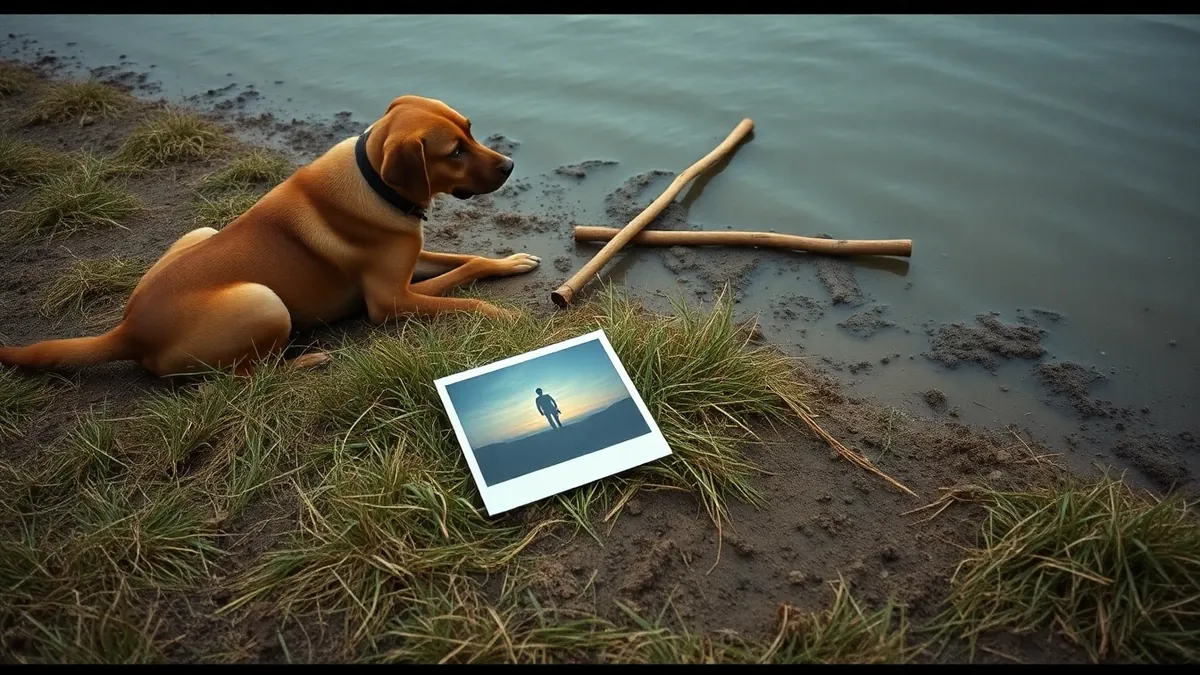
The boy had tamed the Labrador with his new stick, and now looked to change the direction of the wind. He had found the stick at the edge of a creek between his street and the woods, and he knew from the way it stood, smooth and straight in the grainy mush, that it was special. It had not been there the day before. The boy stood behind the picket fence of the Braun Street ghost house and watched the old swing rock into a lull. The house, glazed over by a bleak, country orange, looked out into the setting afternoon and offered no remarks.
He whistled the beginning of his favorite song again and again, starting over if he missed any notes. It was a glad little tune, and though he did not know its name, he always asked his father to play it on mornings before school. He spun the stick in his hand. He hoped to bless it with bath water and a prayer once he got home.
The boy looked back from the fence, toward Edwin’s front door, hoping he would not see him rumble out of his house and onto the street. Today he took the far sidewalk, running past Edwin’s house, eyes on the concrete. He did not want to see him again after what had happened.
Their shoes had stuttered in the earth as they trudged over the old, fallen branches the day before. Edwin complained about the mud on his shoes and threatened to tell his mom it was all the boy’s fault. Edwin’s mother had once gotten a boy at school sent to the office after he had accidentally taken a bite out of Edwin’s sandwich, thinking it was his own. The boy did not like to think of Edwin’s mother knocking at his door because sometimes adults believed other adults more than kids, even when the kids were telling the truth.
“Where is it?” Edwin’s breath sounded like wind over bottles, but ugly because of the phlegm in his throat.
“Almost there.” The boy wished that Edwin could be quiet and wait. He liked seeing new faces in the bark every time but Edwin didn’t and was probably just coming so he could burp and laugh like a big hippopotamus.
Whenever Edwin ran, even a little, his face got red and sweaty and he started to smell like the hippo cage at the zoo. Edwin leaned toward the boy, bumping into him with his damp shoulder.
“Did you know that killer clowns live in basements and closets and in the ghost house?”
“That’s not true.”
“Yeah-huh. And they’ll eat you. I saw a movie about them on TV the other night. My parents let me stay up late if I want to.”
Edwin’s parents let him drink Coca-Cola for breakfast and play in the rain, and the boy did not understand how Edwin’s mother never called him in for dinner or drove him to school. As they hopped over a root and onto a grave of leaves, the boy wished that Edwin’s mother would call him back home.
Snapping a weed under his foot, the boy cleared a branch from his face and pointed at the timid stream whispering between the rocks. Edwin stumbled behind him and made a horrible noise, like an angry vacuum cleaner, and stomped his foot into the mush.
“You said it was a river!”
The boy didn’t understand. It was a river. There was flowing water and dragonflies and, on sunnier days, the tadpoles shot out of the moss and nibbled on the floating leaves. It didn’t have to be big to be a river. As long as there was life in it and it was deep enough to walk into, it was a river.
“It’s a river. There’s tadpoles and stuff.”
“So? Tadpoles suck.” Edwin laughed but it sounded made-up, like the way The Horned King did in the movie about the black cauldron.
“What’s that?”
Edwin pointed at a small dam in the stream that rose neatly over a glassy, bronze puddle. The boy had spent a whole Saturday picking out the smoothest stones in the woods. He had found crickets and worms under the stones and promised to make them a great lake in return. He had found the best branches around a log and alongside them, hundreds of gray, spindly urchins that had fallen from the trees. The boy had taken his things to the base of the stream and built his dam for all the tadpoles and dragonflies and leaves and, maybe one day, even real fish. He had come to visit it for the past two days and watched the trees above him waver on the surface.
“Hey! What is that?” Edwin pointed at it again.
The boy crossed his arms and looked at his shoes.
“That’s my dam.”
Edwin hollered and peeled his eyes at the boy.
“I’m gonna tell my mom you said that!”
“What?”
“You’re lucky I’m your friend.”
Edwin ran to the edge of the stream and stood over the dam. He studied his face and leaned over to see if he could find anything else. Then, scraping his breath, he spat out a pale, foamy glob into the boy’s pond. “Hey!” The boy stood in his place, hands crawling towards his pockets. “Stop! Please. Please stop!”
Edwin laughed his made up laugh, and spat with his whole body at the puddle. The boy watched the spit spin and spread through the water. He wondered if the tadpoles would be alright. The boy felt like a ball rolling in a gutter. He stood in place as Edwin reached for the stones on the dam and began throwing them at his pond. The stones ripped through the water and splattered on the shore, wetting the tips of the boy’s sneakers.
The boy balanced himself on his toes and peered over the picket fence into the yard. The swing whined for him. He planted his elbows between the spades and studied its slow, perfect movement. It reminded him of his father's breaths when he'd nap on Sundays after lunch, with an issue of TIME rising and sighing over his chest. A crow dropped onto the yard, scanned, and left hastily, scattering behind a brief flutter to coat the creaks.
The peeling old house did not intimidate the boy like it did his friends. It summoned in him a vague feeling of home, as if he had lived there before. He felt as if he could imagine its familiar smell, although he could not find any wisp of it in his memory. The house had become the focus of his bike rides around the neighborhood since last Halloween, when his mother had sharpened her pace past its chipped and sullen fences. Its windows whispered secrets to him, and though he could not express them, even to himself, he cherished the private feelings that they invoked within him.
He asked his mother about the house the next night. She took a few meditative breaths and placed her hands on his chest.
“Not all families love each other. Sometimes they treat each other very badly.” The boy’s mother grazed through the roots of his hair.
“How?”
The boy’s mother pressed her hand over his hair and pushed it down, sliding back to his neck.
“Some families just don’t love each other.”
“But why?”
The boy’s mother sighed and leaned away, dropping her hands on her lap.
“Your Popo was their dentist so he knew them well. He gave the girls their braces and fixed their cavities.” She kissed the boy’s forehead. “But their daddy drank very much. When you’re a grown up, it’s okay to drink grown up drinks - but only a little bit. Their daddy drank very much and would get angry at the mommy and the girls for no reason. Then they all stopped going to church and no one from the neighborhood really saw them anymore. One of the daughters put her things into a backpack and ran away one morning, and no one ever saw her again. And one day their daddy drank a lot and ended up driving into a little canal off the side of the road. After that the mommy was very upset and she left with the other daughter to another town far away.”
She kissed the boy’s forehead again.
“And the daddy?”
The boy’s mother opened her mouth and said nothing. She squeezed his palm and kissed his knuckles. She smiled but the boy knew that smiles were only real when people smiled with their eyes. Her eyes looked worried. He held her hand tighter.
“What happened to the daddy?”
The boy’s mother offered the same smile again, and she placed her hand over the boy’s waltzing chest.
“Their daddy stayed in the house and kept drinking. And one day his body could not take any more drinking so he passed away.”
“By himself? In that house?”
She looked past him and said, “Yes, sweetheart. But that’s only--”
“He died all alone? Without anyone else?”
“Yes, but that’s why it’s important for families to love and take care of each other, so we can be there for each--”
Her voice began to float away and blend with the whir of the fan. The boy felt heavy in his insides, like he had just swallowed a rock. He imagined the father’s ghost, all alone in that house, floating between the rooms, wailing for his family to finally come back. He could see it, tired and crying, checking its watch and looking out the window like his mother would when his cousins came over for Easter. The boy felt a touch on his shoulder.
“Sweetheart, you know I would never let that happen to you. You know that, right?”
The boy watched her eyes sharpen, like she had just seen a killer clown. “Do you understand, honey? I would never, ever let that happen to you, or your father, or anyone else. This just happens when families don’t love each other. You trust me, don’t you?”
The boy nodded.
“I’m sorry,” she sighed, kissing him on the forehead, “some things are better understood when you are older. But I just want you to know that I will always be there for you. You know that, right?”
The boy nodded again, confused by the glaze over her eyes.
He knew that he would be okay and that his mother would always love him, even if he died one day. He also knew that the ghost in the house would be okay and that one day his family would come back—that he would go back to being a person and the grass in their yard would come back too. But the boy didn’t know why his mother’s grip teetered over his own and why her breath shook through her gown and into the bed.
The boy thought that heartbeats made people real, but now, in the dry, distended moonlight, his mother’s heartbeat frightened him and he wished it would stop. The boy kissed her hand.
“I love you, mommy.”
“I love you too, sweetheart,” she laughed like it hurt. “But it’s just sometimes – you just have to know that sometimes even mommy and daddy don’t know everything. Mommy and daddy have as many questions as you do about things, and a lot of times we don’t have someone to tell us – but as long as we love each other, like I love you, it’s okay. You know that, right?
“Mhm.” The boy gripped her fingers and nodded.
“I love you, sweetheart.”
The boy felt like his river when his mother said she loved him. He loved his mother, and wished to marry her until his father had laughed and patted his back, telling him that he would have to find a pretty girl of his own to marry. But the boy wanted to feel like a river and when his mother passed by to say goodnight he always felt most real, like his spirit had been sleeping the whole day and just now rose to burn through his fingers as he’d play with her hair. But the way his mother spoke worried him and now she lay on him, her hair flooding over his chest. He could feel her heartbeat knocking on his belly. Maybe her heartbeat was looking for his.
“You know what’s the best thing to do when you’re scared, honey?”
The boy shook his head.
“Pray. You pray by yourself don’t you?”
The boy nodded.
“You know that your guardian angel is always there for you, right?”
The boy nodded and kissed her head, hoping that she would feel better.
If he kissed her and held her hand she would be okay again. He decided to ask about the daughter who had run away, and she said that she did not know her well. The daughter was much older than her, but she was known for wandering the trails behind the neighborhood and for playing her guitar in the yard, singing for the neighbors and the dogs. His mother said that her voice was the best in the church choir and that she was very pretty with hair like a mermaid. The boy flittered. He loved reading about mermaids and hoped to take to the sea one day when he was old like his father—and find one to marry.
His mother’s sleeping breaths whistled toward the moonlight as he wove his fingers through her hair. Her arm slung over him and dangled over the edge of the bed. The boy thought that his mother was the prettiest girl in the world. He loved her hair and her face and the way she loved him. But the boy kept wondering about the mermaid girl and her guitar.
He imagined that she never wore shoes and that she was out somewhere in the night, maybe even in the woods, walking barefoot across his river. The boy counted his mother’s breaths and thought of the mermaid girl until she appeared to him, singing.
He imagined her skin glowing in the darkness as they’d kneel together to pray a Hail Mary every night. For weeks, she’d take him to the ocean when his parents fell asleep—they’d swim with dolphins and hear the soft voices of all the other mermaids. She’d teach him how to breathe underwater and talk to fish. Once the moon sank in the sky, he’d take her back home and hide her in the bathtub where she would wait until he returned from school.
He made many names for her, and changed the color of her eyes, drawing her in the back of his old notebook where no one else could ever find her. He felt her living in him when he was at school and at the grocery store until, after Christmas, he forgot her song.
The boy, touching the gaps between the fence posts, felt that this house was more of a home than his own. The yard was wild in a way his was not and, feeling the sun drift behind the roof, he knew that his guardian angel had sent him there. The boy felt this in the space between his stomach and his heart, where he imagined the cove of his soul.
Thumping his belly with the magic stick, he opened the chipped gate and entered the yard.
The tree on which the swing hung was strong and gorgeous. Its branches looked like the arms of God, though only in the way the boy imagined God to himself. He looked up into the twining wood, making out shapes and words like “why” and “Him.” His neck began to hurt and he looked back in front of him, approaching the creaky swing as if it were a sleeping wolf. He reached for the worn chain and caressed it carefully. The rust nibbled at his fingers. He gripped the chain and pulled. The swing wobbled and stayed in place, squealing a frail cry. Exhaling, he sat on the swing and let the breeze push him toward the house.
The house had a worn, gray patio, the color of a summer day hesitant to rain. Several isles of peeled wood lay scattered across the patio, guarded by whittled, uneven columns. The door was battered and bent on its hinges. Even if it were open, the boy had a bad feeling about going through it, for he was sure he’d find a killer clown or maybe even the lonely ghost. The boy hopped off the swing and headed toward the backyard, holding his stick like a sword. His palms began to sweat.
The sky slid into a thick, bloody pink, and dripped its tired hue over the remains of the back garden. Between the clumps of dirt lay a few scattered cacti. The boy squatted to examine the dusty soil, sifting with the stick for new stems or seeds. Finding nothing, he reached over one of the cactuses, a stout, proud plant, hovering just enough to avoid being prickled. He found it sad that only the mean plants lived long.
The boy walked through the weeds. A tennis ball lay cracked and gray, nestled between several tufts of wild grass. He found it best to leave it as it was. He stepped toward the back patio. One of the windows hung open, revealing an incredible darkness, the kind of darkness that only existed in the Horned King’s cave. His heart rolled down like a ball toward a gutter. The boy dragged his hand over his shirt and gripped the stick with the other.
Though the slanted window scared the boy, the secret feelings that the house had whispered to him spun and slowed his heart. The stick would guide him and keep him safe. The house made him feel things he only ever felt when his mother’s voice would sing to him, or when he would thank God and the Angels for so many things at once that he felt misty, full, and no longer human. The boy knelt into the grass, kissed his stick, and stepped towards the open window.
The glass on the window was riddled with dust, and the rust on the railing spread past the boy’s sight. He impaled the dark with his stick and swung it between the frames and into the house. Feeling nothing, the boy climbed onto the sill and slid over, stamping the floor with his magic stick.
The house smelled of forgotten fruit, and of the old library by the town plaza. The boy trudged through the darkness, following a single, tepid stream of light. There was not much daylight left now, and the boy’s mother would be out looking for him at any moment.
There were chairs strewn throughout the house. A box holding a hump of clothes sat tucked into a dark corner. A floorboard screeched and he jumped, nearly dropping his stick into the murk.
In the dark, the fireplace looked like a face. The boy wondered if that was where the old ghost waited, and whether he had left the window open for the boy. The boy poked inside the hearth. The ash smelled like Thanksgiving and, closing his eyes, the boy imagined the ghost and his family having a big dinner together and eating lots of mashed potatoes.
The ceiling rose and folded above him, high like the one at the movie theater. He felt safe in the house now and was sure that if there were a ghost, he would be nice and happy to have a visitor. If the ghost really missed his family, he could use the boy’s stick to bring them back. All he had to do was kiss it and whisper his wish and his family would come back right away. The boy would just find another one at the creek tomorrow, and maybe one day he’d come back to see if the ghost had used it. He spun a circle with the stick and brought it to his chest. The boy kissed the stick and set it on the floor.
He looked back at the open window, watching the light thin and recede into the yard. It wouldn’t be long before dark. He stepped toward the window, keeping his eyes on the stairs. Whatever strange, sacred air flowed from the house, the boy felt that it came from upstairs.
He ran up and, expecting to fall through the loose wood, leapt onto the second floor, stumbling onto a hard red rug. He shot up and followed it, passing the empty rooms and musty walls. He reached a dead end where an empty bookshelf stood caked to the wall like a thick scab. He ran his hands over the wood, even though he believed it held nothing for him. He skimmed the surface of the three shelves twice before he felt something in the right corner of the bottom shelf.
He drew it out carefully and rushed to the window. Turning it perfectly under the ebbing light, the boy squinted into his palm. It was a stale, brittle paper, faded and smudged—in elegant and swooping writing, the bottom corner read, “Tamalpais, 1973”. Tenderly pinching the top of the paper, he flipped it over. The boy’s heart swooned.
It was a picture of a young woman, and immediately he knew that he loved her. She stood at the edge of a lake under a gentle morning sun. She wore a small white blouse and jeans. The boy turned the picture, hoping to somehow see the shape of her feet. Her collarbones curved and melted into her warm shoulders; her delicate neck hid half of itself in the flow of her mermaid hair. Her brows stood thick and woven like his mother’s, and her eyes, ardent and hazel, looked through the picture and into the boy, as if she knew that the photograph was for him. Her lips promised love in a way that a normal smile could not, and upon understanding the angle of her mouth, a bolt of hot shivers swept through him.
The boy loved her and fought with his memory to retrieve her name.
The picture rattled in his hands as he stared back into her, attempting to recall her name, her voice, her song. Embarrassed by the sudden awareness of his actions and thoughts, the boy descended swiftly into numbness, only to feel his heart swoon again at the sight of her subtle smile. Her name hung on his tongue like a forgotten prayer and he could not find the strength to muster it through.
The light had almost gone, and the thought of curfew dug into the boy’s frenzied heart. He imagined marrying her by their river in the woods—he pictured his lips thawing into her forehead. He imagined the joy of tangling his fingers in her hair and the prospect of her name, her forgotten name, as the focus of all his whispered prayers. He kissed the photograph.
The boy’s mother called him from the street. Swallowing hard, he shot up and galloped down the stairs. He hurdled through the open window and hustled through the yard, nearly tripping into the wild grass and its singing crickets. He heard his mother call again. He ran forward and stopped under a street lamp momentarily to glimpse her picture once more. The cove of his heart could no longer contain his emotions—he ran towards his mother at the end of the street, burning through the asphalt night. He had remembered her name.
“Polaroid” was printed in Tracks, No. 9 of Inwood Indiana. Pick up the paperback from Prolific Press; the stories and poems published online are free to read here.
Get the paperback