
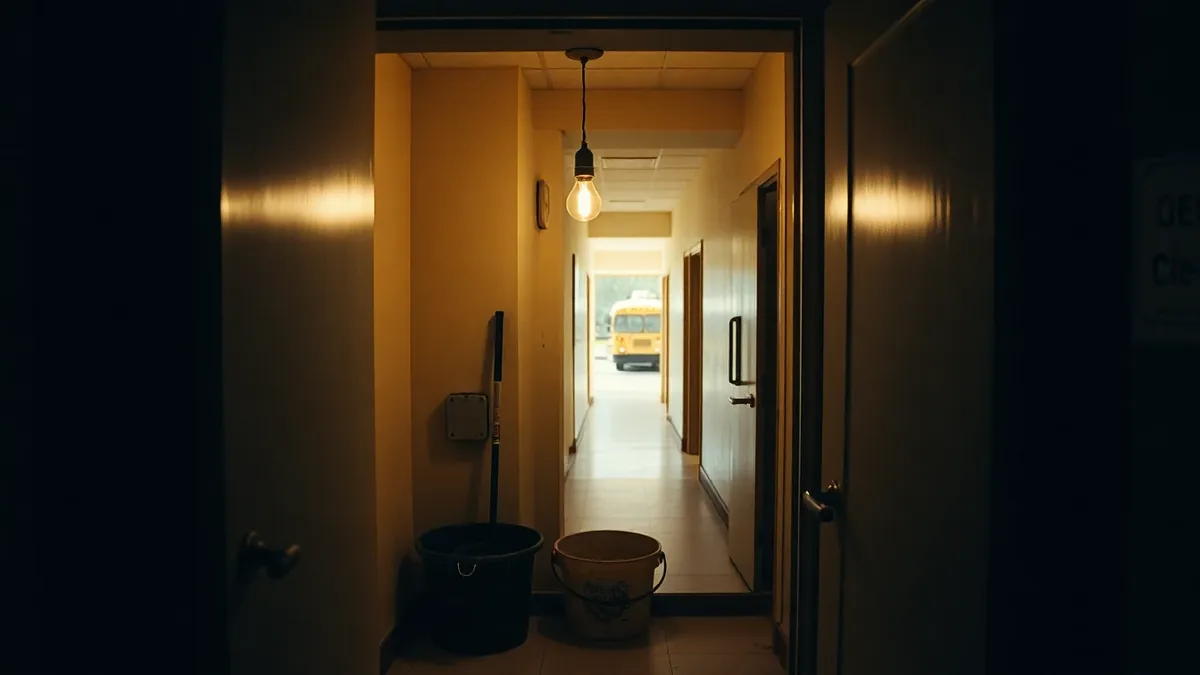
Her shift at Jefferson Elementary had finished, but instead of stepping out the side door to the playground and walking the five blocks home, Emma Kinder clocked out, bided some time in the women’s restroom (the damp one the size of a closet, which other custodians called the spider pit), and after the children had all filed out to the diesel-spewing buses, leaving a smell of sticky milk and sour child-sweat in the hallways, she descended the stairs to the basement boiler room, where she would hide out until the principal was gone.
A bulb dangled over a wooden table. The table was knife-scratched and abandoned by the janitor who’d worked there before. The dim-yellow forty watts couldn’t cast light up the stairs. It didn’t matter. Nobody would notice her. Nobody, it seemed, ever did. Except of course for Ramsay. Her husband. He was the reason she wouldn’t be going home.
The night before, Ramsay had returned from work at ten o’clock. He would have stayed out later, she knew, but he had lived in Jefferson Village long enough to know that even in the north, white towns weren’t places to be getting drunk after midnight. Also, Emma knew, Ramsay would be anxious to return home. He’d be anxious to attend to her. That’s how he put it. Attend to her.
Ramsay had lost his job. Since Emma was the one who paid the bills and balanced the checkbooks, she knew that, unless some pack of angels wired thousands into their joint account, they would miss yet another payment on the mortgage, and soon, inevitably, they would forfeit the house. It had been a long time coming, and even though Ramsay had never talked about it, she knew the rumors of impending lay-offs at the tool and die had transformed into more than anxious whispers and indignant diatribes at the local manor. For one thing, over these last weeks, the injuries she suffered had been getting worse—from fist-bruises on the hammy meat of her shoulder, to teeth indentations in her neck. But nothing could have prepared her for last night. While she’d been washing dishes, Ramsay had clamored up behind and heel-kicked her in the hip with one of his grease-smoothed leather boots.
“You did this to me,” he’d slurred. He’d held his hands up to his face as if some gash or burns tore across his skin. They lived in a one-story, three-room ranch out on Mills Road. No neighbors, if they’d heard, had bothered to call the cops. Ramsay had torn the work slacks down from her waist, his voice jagged and deep behind her, and dug his hands into the soft flab around her hips.
“That ripping,” he’d said, his lips against her ear, “that ripping that’s there is death.” Then his hands were mashing her face into the linoleum kitchen floor. “That’s all there is now. That’s all that’s coming next.”
When Emma was a girl, she was the first of her family who’d come from Georgia to Ohio and gone to school.
She was a cocoa-skinned, wiry girl among mostly freckled, floppy-haired farm kids. Sometimes when she thought back to it, she laughed: with her speed and powerful voice (you had to learn to move quickly, to shout like the devil was behind you, growing up with three older brothers), she must’ve overwhelmed the subdued, mechanical movements of hay-baling, tractor-driving kids. In spite of it all, in elementary school, she’d blended in as part of the sensual pungency of early, public school socialization, and everything from the milk-sticky cafeteria floors to the waxy crayon residue underneath fingernails—it all had belonged to her. Emma, back in the 1960s, was Jefferson Elementary School’s rapid heart beat.
Maybe because she had never gone to high school, painful memories had never spoiled the ones she’d kept from Jefferson El. And really aside from drive-by shouts of nigger from cars (shouts aimed at her family house down on East Elm, or aimed at her as she stepped from the convenience store or, once, from church), nobody in Jefferson was cruel. In the end, she thought, that was all anyone could really ask for. Yes. She knew the town’s excessive politeness—opening doors for her when she went to the post office, or the burger girl with thick black eye shadow smiling and maintaining the polite grin and eye contact a little longer than was called for—reminded her she wasn’t white. They were adults, after all. No more selfless exuberance or child-sweat jubilation on playgrounds.
Some hours later, when she was sure all the children had boarded the buses and were gone, Emma lifted her head from the table. The light bulb was flickering. It would soon die. She had drifted off and didn’t know what time it was. A sour taste of sleep coated her mouth.
The flashing light threw a shadow on the cinderblock wall across from her. Rope, crusty with time and damp with basement mold, coiled down from a nail angled into a wooden support beam. She knew that rope, its fibers frayed and rough around her skin, wouldn’t snap.
Before she could balance herself up from the chair, the light bulb slowly dimmed until it was a glowing worm of light. The ember persisted but eventually extinguished itself.
She felt her way to the stairs. The door to the basement could be locked from the outside. If she had slept too long, Mister Walter, the elementary school principal, might have walked past the boiler room, noticed the unlocked door, and thrown the bolt. The wooden railing was smooth in her hand as she scaled up. Boards wobbled and creaked under the weight of her steps. As she’d feared, the door was fastened closed, and no light slanted through. In case anyone was still in the building, she stopped at the top of the staircase and pushed her body against the door. She laid her hand around the brass knob but didn’t turn it. Instead, she eased her ear against the wood, and listened.
She strained to catch any stray echo, of clacking shoes or Mister Walter’s jangling keys. She couldn’t be sure what time it was but guessed she’d slept until eight. That darkness oozing in around the door happened only after the sun had sunk behind the line of Jefferson’s black oak woodlands it prided itself on. The best deer and wild turkey hunting in Ashtabula County, some said. Just last year, a stray bullet from some hunter’s rifle had ricocheted crooked off a tree in those woods and hurtled through the wall of their lawnmower shed out back.
Ramsay had gone out to the shed and stood in there for a long time. He’d poked his finger through the bullet’s entry point. A jagged edge had ripped through the pad of one finger. That night in bed, he’d said that he’d been unable to hunt down the place where the mangled bullet had buried itself. He hadn’t slept. He’d gone out at night with a flashlight and come back smelling of bitter soil: he’d been digging. In his imagination, the lost round that had probably been meant for a turkey or deer or coyote may as well have been a land mine.
That hidden damage, some quiet vitiation, penetrated both their lives, and Emma knew that, if she were to go home now, Ramsay would be the one to explode. He might not kill her, or mean to kill her, but he would attack, and that ripping pain was something she would not be going home to.
Emma pushed on the door. It was locked. She tightened her jaw, with the blackness of the yawning basement behind her (the shadow of the rope coil, its anodyne roughness, was still etched in her eyes), and bumped it with her shoulder. The latch jiggled. Mister Walter must’ve thrown it closed during his final check of the building before going home.
Pressed up against the door, she lifted her face toward the blackened, spider-webbed ceiling and shut her eyes.
She’d be locked down here all night. Maybe she could use this as an excuse—if Ramsay asked—but Ramsay-from-before was dead, and after last night, she was sure there’d be no more sentimental making up, followed by sometimes weeks of relative peace, before his fist shattered her jaw or knocked the breath out of her. No, she wasn’t going home as long as she was alive. Her resolve, though, didn’t erase the feeling she would have when someone, maybe Mister Walter, found out she’d been locked in the basement all night. She murmured a plea to the absent shadow of the boiler basement, closed her eyes, and laid her forehead against the surface of the door.
The sound that reverberated through the wood, of metal clicking and grinding as the door latch opened, was icy water over her shoulders.
She knew what she’d heard, and all at once she knew what had happened (the door had opened), but she paused for a moment, knowing at the same time that it couldn’t be true. The door swung open to ash-gray student lockers, no taller than child caskets, and the swirling darkness of the hallway.
The decades old, outdated public-announcement system, with its dials and sliding buttons, hulked against the wall in Mister Walter’s office. On top stood a silver microphone, a fat shiny ribbon mike that reminded Emma of the ones all the blues and rock singers once clasped in ecstasy as if pulling girls in to kiss. Each morning, Mister Walter stood here and made morning announcements.
Streetlights along Elm Street glowed in blurry globes outside. The light seeped into fabric night shadows. The only sheriff cruiser in Ashtabula County, the one the county could afford after budget cuts, coasted by, slow, the officer leaning forward over the wheel to check on the building. Emma froze. She waited for the cop to glimpse her as she stood there in the principal’s office. Maybe Ramsay had reported her missing. She’d be arrested, maybe even charged with something like trespassing, but the cruiser rolled on. Once again, nobody had noticed her. While she was standing there, an electric hum of white noise crackled from the speakers of the PA system.
At first she thought she’d bumped something, switched over some dial. She watched the machine. The sound from the two round, screened speakers flickered. She neared it and leaned over. No lights glowed to indicate how she’d accidentally turned the thing on.
She opened her mouth to mutter a self-admonishing, “Oh, Emma,” and her voice crashed down around her from wall-mounted speakers. It echoed down the hall—Oh, Emma, emma, emma—reverberating, she knew, through every room of the empty school, echoing down the hallways that, during the day, she swept, mopped, and scraped free of bubble gum. “It’s open,” she said, meaning the microphone, but her voice must’ve missed the mike that time. Instead of booming through the school, those words perished on her lips.
Her voice quieted around her. It evaporated outward, its final tremor pulsating in some upstairs corner. She was alone with herself again, divided, a person in a dark room who nobody, even police officers trained to notice, could see, while the sound of her escaped voice lingered. It persisted somewhere, past the sweet-smelling wooden floorboards of the auditorium stage, through the narrow staircases and lime-green painted walls. Somewhere in the far rooms of the school, past rows of smudged, miniature spider-harboring lockers, a wisp of that echo still stirred. The thought of following it made her shiver. Mister Walter had flipped off all the lights. She’d have to grope blindly through the corridors.
The machine in front of her, if she pushed buttons, could monitor those rooms. She’d seen teachers do it before, come to speak with Mister Walter and, almost as an experiment, listen in on their students. A kid would shush the rest of them, the nervous boy whose parents had instilled anxiety and competition, but crayon scribblings and long division were eventually pushed aside and the kids would flap open an umbrella of noise, a kind of stratosphere multiplying some central childhood impulse. I’m no teacher, Emma thought, but she reached a finger and pushed the button to what she thought was an upstairs room. Crackling returned through the speakers. She stabbed her finger into the button again to shut it off. She opened her eyes, wide, and looked around the room—at Mister Walter’s family photos, his son and daughter smudged out in the night, the corners of books and papers, a stapler, hole-puncher, and paper-cutter on the counter where parents, when they came, sometimes rested their arms. If her mother could see her now, she thought.
Her mother, who’d ridden that Greyhound in 1953 from that plot of chocolate-rich soil and stones in Morbin, Georgia, to the station in Ashtabula City, stomach cushioning Emma inside. Her mother, who’d worked twenty-nine years sweeping coal dust off hundreds of yards of docks and sidewalk in Ashtabula Harbor. Who’d died of stomach cancer that devoured through to her kidneys, liver, and outer-lining of the heart, and who’d walked with Emma, every morning, down blocks of Jefferson Village to the elementary school, because she loved her daughter too much to shoulder away that shield between Emma and the rest of the town.
Emma raised another finger, and as she pushed the button a second time, she closed her eyes and felt her mother’s tough-tendon fingers squeeze.
The noise from before crackled through the speakers.
Emma withdrew her hand and hugged herself. She tilted her head toward the machine’s speakers. It was time to go home, whether she liked it or not. The classrooms were empty. All of them.
What came next through the PA system’s speakers, though she thought she’d turned the thing off, were murmurings at first. Emma held still, straining to hear. She leaned closer, then jerked back.
“No,” she said. “It can’t be.” It was almost the sound of children’s laughter.
It’s open, she thought. Oh, Emma.
She stood, unable to move in the growing noise. It was impossible, but still she heard them. The children’s voices gathered. The sound peaked into crashing jubilation, then changed.
It distorted through the speakers. Emma backed away.
It should be beautiful. Not like this.
She tore away from the room and ran out the door. Her shoes squeaked over the waxed floor tiles, and the blinding swirl of the hallways spread like smoke around her. The children’s lockers blurred by on both sides. The room that beckoned was on the second floor, at the end of the hall. A balloon lifted and bounced from the door. She walked closer.
It was a party. They’d been waiting. A girl ran forward and clasped Emma’s hands and pulled her in. The light in the room was orange but grainy. It would lighten up. She knew it would. There were cookies to eat, red punch to sip from paper cups.
It’s your party, Emma, and it was the voice of her mother. And it was true. Emma’s name sagged across the chalkboard. It hung from a string noosed around paper letters snipped free by children’s hands.

“Grateful Lives” was printed in Derailed, No. 3 of Inwood Indiana. Pick up the paperback from Prolific Press; the stories and poems published online are free to read here.
Get the paperback