What you saw first were their wings.
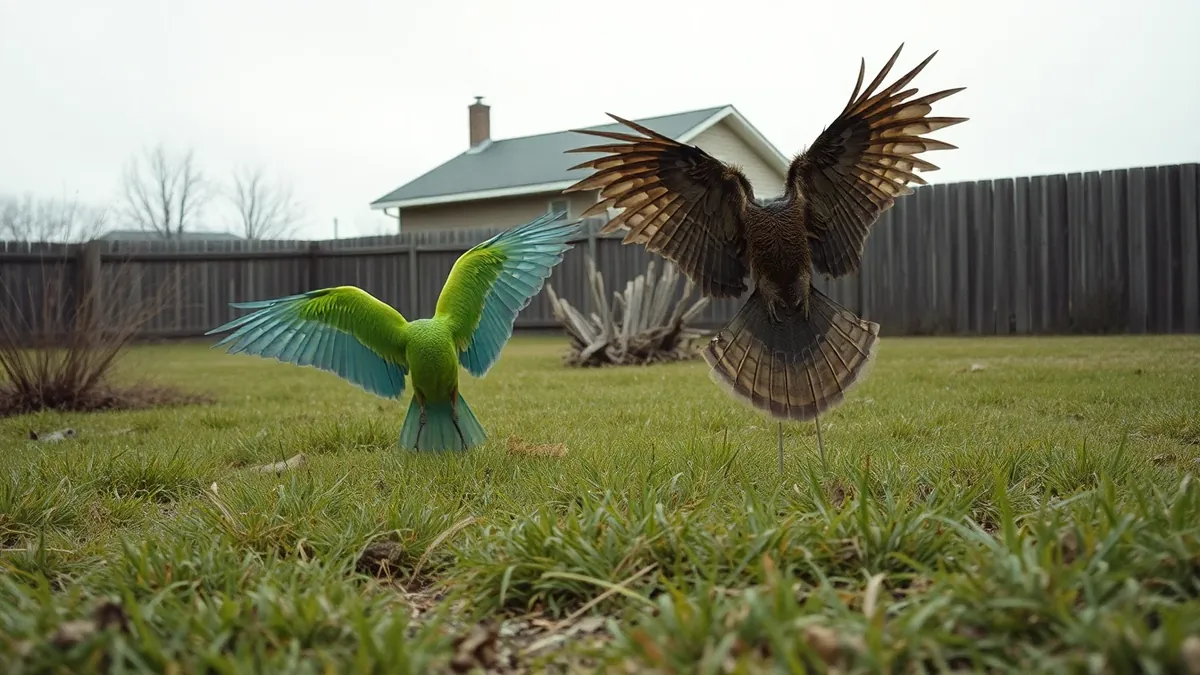
They were splayed out, pinned to the scrub grass of the back yard. Looking for all the world like a huge hand had swatted them out of the sky and flattened them there. I saw an owl, two terns, a couple of bright green parakeets, the sad blue smear of a budgerigar and even a southern royal albatross.
I counted at least ten of them lying in the yard. Wings outstretched. Heads turned to greet the weak morning sun. The wind blew a silent downy snowstorm of tiny feathers into the air.
The next thing that you noticed was the smell. A terrible rotten smell that leached up your nose and wouldn’t leave. I walked into the yard, my new shoes slung over my neck. They were a size too big for me. My feet throbbed from the packed soil and the wet, red welts the shoes had worn into them.
Ana Maria stood on the broad stone step of the house. She smoked a cigarette and pulled her silk robe around her body. The wind blew golden twists of her hair over her eyes. She looked into the distance, far over the piñero trees and out towards the cliffs and the sea.
I picked my way past six dead racing pigeons arranged in a circle. The sight of pigeons made me panic. I dropped my satchel and ran to Ana-Maria’s son, Lucho. He knelt in the thin grass. A small, bony figure short for his ten years. He had tucked his red hair under an outsize woolly hat.
He fluttered in the wind like paper, shivering in his thin cotton shirt and threadbare shorts. His glasses lay in the dust smeared with tears. The lenses were as thick as soda bottles. Ana-Maria’s Uncle, Carlos stood a few steps behind him. Lucho’s eyes were screwed shut and his face contorted as he pressed it against the small, grey bird in his hands.
Paloma.
Attached to her was a square of school notebook paper.
“BIRDBOY” it said in red biro.
“Those bastard Gallos,” muttered Carlos.
* The day before, as part of our preparation for the race, Lucho and I had taken Paloma for a training toss. We’d each grasped one of the handles on her wicker basket and carried it to the fields far outside of town. After walking for an hour, we set down the basket in the middle of a copse and opened the lid. Lucho leant into the basket and whispered. Paloma hopped onto the lip.
She was a handsome dark-check hen with gunmetal plumage and dark mottled wings. Her eyes were bright, black and ringed with a band of scarlet. The thin aluminium tag on her left leg marked her out as a racing pigeon. She looked at Lucho and cocked her head. He nodded and she streaked upwards. A ribbon of silver against the rolling clouds.
They had always been like this, even in the delicate days when Paloma resembled nothing more than a ball of fluff drenched in albumen. Lucho had hand-fed her on maize. As soon as she’d grown into a squab, she’d hop onto his shoulders and peck at his hair. After we were sure she’d gone, we walked back towards the town swinging the empty basket between us.
From the road, Paraíso was little more than a huddle of metal-lidded buildings that perched on steep cliffs. British nitrate traders had founded the town in the 18th century. Its fortunes had flourished and withered along with the mining business.
Now, it was a small collection of houses and shops that baked hard like a rock in summer and whose cracked roads were pelted by salt rain during the long, dark Pacific winter.
Carlos always claimed that it was this heritage and the extremes of weather that invested the populace of Paraíso with their twin obsessions: dancing the Cueca on Patriot’s day and pigeon racing.
“They dance to keep warm in the winter,” he’d say, ”and then they sit on their lardy arses watching the pigeons all through summer.”
Carlos was waiting for us in the pigeon loft when we arrived. He had built it from pieces of driftwood that he’d sawn into regular shapes and then nailed together. It was painted with an uneven coat of whitewash and its broad opening was covered with a double layer of chicken wire. He sat inside it. An old, raggedy figure perched on one of the three plastic chairs he had rescued from a rubbish tip. Behind him, row upon row of wooden coops lined the wall. Paloma’s was in pride of place at the right hand side.
Carlos wore his usual rubber fishing waders and roll-neck sweater. A peaked British naval cap decorated with braid and two intertwined anchors covered his white hair. When I’d asked Lucho how long his Uncle had been at sea for, he’d told me that Carlos had never been to sea in his life, and that the one time that they’d taken the ferry across Lake Rapel his uncle had been sea-sick the whole time. Carlos pushed back the cap. He scratched the beak of his nose and blew through his drooping moustache.
“She get off, then?” he said.
Lucho nodded and plopped himself down in the chair closest to Paloma’s still vacant coop.
“She’s the fastest ever, that one,” said Carlos. “She’s going to beat the Gallo’s feathery monsters again. For. Sure.” He punctuated the last two words with a clack of his dentures.
“They’re bricks. With. Wings”
“Those Gallo’s don’t respect anyone though. Nasty buggers,” Carlos said.
“You’re too young to remember this, Augosto,” he said, clacking merrily, “but back when Gallo senior was a lad, he and his arseholes broke into Mundez’s loft and fed the birds with apples laced with rat poison.”
“Some of us have heard this before, you know,” said Lucho, affecting a world-weary air and checking the water in the other coops.
Carlos cleared his throat and continued unfazed.
“Thing was, Augosto,” he said nodding towards me, “the birds were fine with the apple pieces, but when the rat poison hit the birds bellies, uff! They swelled up like balloons and shrieked like they were on fire. They fell faster than lumps. Of. Rock.”
“I tell you, that day it was like it was raining pigeons,” said Carlos, with a final clack.
“Yeah, if you believe that sort of thing,” said Lucho, winking.
“Why, you cheeky little toad,” said Carlos, “that’s God’s honest truth.” He pantomimed boxing Lucho’s ears.
* They had killed Paloma the day before the Copper Company Sweep-stake. The biggest race in the Paraíso calendar. There was still a week to go before the race and without Paloma the Gallos were certain to win.
That evening Lucho and I lay on his roof. Our clothes soaked up the meagre heat from the sheet metal. He wasn’t crying anymore, but he wasn’t talking much either. The sky was a deep, rich velvet. It was one of those nights when you see the red, gold and blue of the stars. The sort of night where you can scare yourself that you might fall upwards into nothing.
Lucho’s cigarette zigged and zagged through the dark. A column of smoke drifted out of his mouth against the broken spine of the Milky Way.
He was not a natural smoker but I had taught him after we’d watched Rooster Cogburn in “True Grit”. I’d shown him how to draw the plumes into his lungs without choking. It was a technique I’d perfected after watching Ana-Maria’s disconsolate smoking every morning.
“What’s with the hat?” I said, prodding the wool that hid Lucho’s long, red hair.
“I’m cold that’s all,” he said Lucho shut his eyes and sighed. The stars above vibrated.
“Did you see the note they put on Paloma’s body?” he said.
“Yes,” I said.
* I hadn’t been there when the thunderbird had come for Lucho in the summer.
My family and I had been on holiday at Valle del Mar when it had happened. I’d arrived home a week after the event, sunburned and full of a strange new energy. I had kissed a girl, while we were away. She’d only been the daughter of the vendedor ambulante who sold ice-creams down at the beach, but I was still eager to get over to Lucho’s to smoke illicit cigarettes and relive my conquest.
I unpacked my bag and ran downstairs and tried to slip out of the back door. My mother and the local busybodies huddled around our kitchen-table chattering like monkeys. They were discussing an article in Triunfo. My mother looked up from the paper and glared at me. I wasn’t going over to Lucho’s. Not today.
After dinner, I slunk upstairs with the paper. The article was in the corner of the front page. I lay on my bed and read the paper, picking my teeth in the way that I’d seen Carlos do with a wooden tooth-pick.
It told of a boy in our street who had been attacked by a large flying creature while hanging out the laundry. The description of the boy resembled Lucho.
According to the article, the bird had grabbed the boy in its claws and carried him for several streets before releasing him. He’d fallen to earth in a nearby orchard where a tree had broken his fall.
The attack caused much consternation and confusion in the town. And although the Gallos protested that the whole incident was a scam, they seemed to be gripped by primal anger and fear.
It wasn’t long after that they’d started calling Lucho ‘Birdboy’.
* I looked across at him now, lying on the roof. He stared up at the sky, trying to be brave. Below we heard the sound of Carlos as he struggled upstairs impeded by his stiff joints and the evening’s rum ration.
“What really happened, with the bird?” I said. Lucho screwed up his eyes and shook his head like he always did.
“This cigarette’s going out,” he said, passing it to me. I spat on my fingers and pressed them against the tip, daring myself to hold it until they burned.
“Time to go,” Lucho said.
We sat up and slid across the roof. As I did so, I saw a large white cross chalked onto its surface.
“What’s that?” I said.
Lucho shrugged and pulled his hat down. He levered himself through the window and back inside.
* Monday was cold, full of salt sea-mist and gusts of Pacific wind. Lucho was already waiting outside with Ana-Maria when I arrived to walk him to school.
Ana-Maria was younger than the other mothers in our street. She styled her hair into a golden bob that traced the line of her square jaw and thin red lips. For me, her rare smiles possessed felt like the sun coming out.
That morning, like every morning, she stood in the doorway wrapped in her dressing gown. The smell of peppermints on her breath mixed together with cigarettes and another odour, something adult and sour.
“‘Alo Augusto,” she said as I walked through the gate and up the path.
Lucho stood on his toes to kiss his mother good-bye. She offered him a cheek but gazed past him. As she turned, her gown gaped to show a pale sliver of breast that ricocheted guiltily around my head. I blushed. It reminded me of what I’d overheard my mother saying. That Ana- Maria had arrived in the town in a state of ‘disgrace’ and that Carlos was a lunatic and a Trotskyite spy.
Lucho and I left the yard and walked to school through a curtain of mist. I looked sidelong at him. His eyes were ruddy and bloodshot. His hat was still in place. I didn’t want to talk about Paloma. He reached into his shorts and pulled out a marble. It was his “lucky special”. A dollop of clear glass the size of an eyeball. It was shot through with twists of silver. Carlos had given it to him. He polished it on his shirt.
“What’s a Trotskyite?” I asked.
He stowed the marble and rifled through his satchel. He pulled out a banana and peeled it, squinting at each stringy piece of skin.
“I think it’s a bad person.” he said.
“At least, the carabineros don’t like them. Ana-Maria says that before I was born the carabineros took Carlos away one night ’cos they thought he was one. When they brought him back he wasn’t right in the head. They said that he’d fallen down the stairs trying to escape. They took her away too. They did other things to her.”
The school was a single-story prefabricated building with a flat metal roof. The heat of summer and the cold of winter had turned its walls into a patchwork of grey concrete and peeling yellow paint.
Each interior wall of the classrooms were decorated with portraits of winners of the Copper Company sweep-stake. The ruddy faces of winning breeders stared down from the walls. Each owner puffed out their chest and clutched their impassive prize bird.
Lucho’s name produced a chorus of chicken noises, when attendance was called. The loudest clucks came from behind me, from Eduardo Gallo Junior. I looked round. A wad of chewed paper stung me between the eyes and plopped onto my desk.
Profesora Reyes kicked Gallo out of class. “Hijo de Puta!” he hissed as he passed by, tossing a piece of paper at Lucho.
Our first lesson of the day was Biology. This was my favourite lesson, ever since I’d been given an atlas of extinct animals for Christmas years before.
I used to take the book to bed with me and read it under the blankets with a torch. I’d run my tongue around the exotic names, sounding them out. I’d absorb the embossed pictures with my fingertips.
Eo-hip-pus: a horse the size of a dog. A-ep-yor-nis: a flightless bird the size of an elephant. Ars-in-othe-ri-um: a hoofed animal, like a rhinoceros, with horns that protruded from its nose like twin mountains of bone. Lucho normally sat in science lessons soaking up each point. He’d write notes and draw diagrams with his tongue protruding from the corner of his mouth like a pink slug. Today though, he spent the lesson looking out of the window as though waiting for something.
At lunchtime, we played marbles. The clouds licked at the school roof and rolled down into the fields beyond. Lucho sniffed at the air and pulled down his hat. He lost the game but I let him keep his marble. It was his favourite, after all.
Profesora Reyes appeared in the yard and sounded a triangle to mark the start of afternoon classes. Lucho pulled out the paper Gallo had thrown at him and unfolded it. It showed a stick figure being snapped in half by a huge bird. It was drawn in the same red ink as the note on Paloma’s body.
Beneath the picture, it said: “Dear lieing HIJO DE PUTA! Did you have a NICE weakend? YOU and ME today at 4 oclok. By the old roble tree in the PARK.”
Lucho screwed the paper into a ball.
“Are you going?” I said.
He looked at me.
“What’s the point?” he said.
* After school, we took the long way home. We walked along a path of hard-packed, red earth littered with dried pine needles.
At its edge, the trees nestled in dense clusters. They were good for climbing in the summer and the best pine cones fell there in the autumn.
We played paratroopers. Lucho had watched the ‘The Longest Day” on telly the previous Sunday. He had worn his rubber-soled plimsoles ever since, so that he could jump out of a tree and land with his feet wide apart. He clambered up to where two thick branches split in a ‘y’ shape.
He readied himself to jump - “Oye, birdboy!” Gallo bellowed, “I bet you thought you’d got away didn’t you, you weedy little shit-head.”
“You’re a coward,” he continued, “and my Dad says that you’re a liar, a bastard and your mum is a filthy puta … a whore!”
Lucho looked down. He pushed his glasses up to hook them under his hat. He swallowed.
Gallo was large and heavy. He had a tree-trunk of a body and wore long trousers. His face was the colour and texture of a pork pie. Before moving to Paraíso, his father had worked in a mine in the interior as a boy. All of the family were heavyset with short legs, long muscular arms and fists like cannonballs.
“Fuck off! You fuckin’ nitwit!” shouted Lucho.
I had never heard Lucho swear before.
Carmino Marquez, the tallest and dirtiest of Gallo’s troupe materialised from behind one of the trees.
“What the fuck are you laughing at you fuckin’ puto! Faggot!” he shouted at me and swung a potato-sized fist at my head. The blow struck my temple. Everything went purple. The next thing he was straddling my chest and pinning my arms over my head. Carmino hawked and let a long, dark spindle of drool drip towards my face.
“Get off him, you fucker!”
I didn’t see Lucho jump but I felt the impact of his rubber shoes as they hit the dirt.
He rocketed towards Gallo, whistling like a steam engine and windmilling his arms as he smacked into him. Gallo, stunned by the ferocity of the attack, staggered. One of Lucho’s whirling fists connected with Gallo’s flat nose. There was a cracking sound and Gallo struck the ground. Lucho hopped onto Gallo’s chest and levered a bony knee across one of his arms.
Gallo swung his free arm at Lucho’s head. He missed. Carmino and I watched.
Gallo wriggled beneath his opponent. Each time he tried to sit up Lucho thumped him to the ground. Gallo’s face erupted into tears.
Lucho was crying too. A trail of snot and spit began a slow elastic journey from the tip of his nose towards Gallo’s face. He punctuated each blow with a sobbed “Paloma”.
“Your friend’s a fuckin’ loony!” said Carmino hopping off me and running away into the trees. The rest of Gallo’s goon-squad followed.
I ran over and grabbed Lucho’s thin wrists.
“Ya basta,” I said, “that’s enough now.”
He emerged from his trance. Gallo lay unmoving beneath him. I got Lucho to his feet and together we walked back to the path. We were both shaking from the fight. I brushed dirt and pine needles from his face.
I looked at him and gasped. At first, I thought that his hat had been coated in mud. Instead, I realised that it had been pushed back from his forehead. In place of his red hair were thick tufts the colour of ash.
Lucho looked at the ground.
“I tried to cut it,” he said, pulling his hat back over his eyebrows,” … but after … it came… all my hair went this colour.”
We walked a few steps. He sniffled and rubbed his nose.
“What really happened?” I said.
We walked for minutes then he swallowed. He closed his eyes and shuddered.
“It was afternoon. I’d been out in the back. Ana-Maria asked me to hang out the washing.”
He closed his eyes and smoothed the hat down on his head with both hands.
“Then I heard it. The flapping noise. At first I thought it was the sheets. But it was lower and slower.”
“The sky went black and the wind stopped. The flapping got louder and then I smelt something. It was like when Taracena’s puppy brought home that dead cat.”
A cold gust stirred the pine needles on the path.
“And then something wonderful happened,” he said.
“I was flying.”
He looked at his hands.
“I saw my house, and the trees in your yard. Then Ana- Maria came running out, screaming and yelling and waving.”
“‘Don’t worry,’ I shouted, but I don’t think she heard me ’cos she just kept yelling and screaming.”
“Then I felt this pain in my shoulder. It was sharp and pinching and I thought it must be like in ‘The Alamo’ when John Wayne gets stabbed.”
“And I tried looking up but all I could see was a black cloud. The pain in my shoulder was getting worse and it felt like someone had put their fingers in my ears, but I wasn’t frightened. I remember worrying that, Ana-Maria would be angry if I’d ruined my jumper.”
He leant forward and started to draw spirals in the earth with his toe.
“Then there was a popping sound and my toes hurt like they’d been shut in a door. Then there was another pop and I went lower and lower.”
He felt in his pocket and drew out a cigarette. It was one of the singles I bought from the almacén. The fight had bent it into an ‘L’ shape. He passed it to me and I broke off the stump and lit it.
“and then I heard ‘Arre! Arre!’ from the backyard and saw Carlos running around. He was waving his blunderbuss. Then I felt sick in my stomach and I was falling.”
Lucho coughed as the smoke clutched his lungs. He looked green and tears filled his eyes.
“I don’t remember much else. Ana-Maria says they found me in Saucedo’s orchard at the foot of one of the almendros. There were nuts and leaves and feathers everywhere. He was furious.”
He spluttered and passed me the cigarette. The clouds had cleared and the edge of the sky was purple.
“C’mon, we’ve got to get home,” he said. “Your mum will be worrying.”
* The carabineros, the pacos, were waiting for us outside Lucho’s house when we arrived. I discovered later that Carmino Marquez had told his mother that Lucho had murdered Gallo. She had phoned the police.
The pacos, one fat, one thin, leant against their patrol car in their green military uniforms. Their pistol grips and badges glinted red in the setting sun.
Lucho pulled a face and waved me back with a thin arm. He raised a finger to his mouth.
Ana-Maria sat on the front-door step, her head in her hands. She looked pale and scared. Carlos stood guard in the yard midway between Ana-Maria and the police. A streak of bright blue light from the patrol car slid across the house. Lucho sank to his haunches. His face lined with worry. He sniffed and his eyes filled with water. He looked up at the sky.
“I can’t cause more trouble,” he said.
I wanted to hug him at that moment. I wanted to hug him and tell him not to worry. That it was all going to be all right. That things would work out.
There was a flicker of warm wind. He breathed in and stood up. He looked taller and older. He reached into his pocket and pulled out his marble.
“Here,” he said, handing it to me, and then he tucked his glasses under the rim of his hat and sprinted across the yard.
The pacos spotted him as he was halfway across. They both ran full pelt towards him.
Ana-Maria’s face lit up. She opened her arms wide.
“Stop them!” squealed Lucho. He ducked and slipped under her. His hat dangled in her hand. She turned and ran after him.
Hearing Lucho’s words, Carlos launched himself at the fat paco.
“Hasta la victoria para siempre!” he shouted as they collided and rolled through the scrub. The paco’s baton whipped into a bush. A few steps behind, the thin one leapt over his partner and into the doorway. I knew what I had to do.
The paco galloped up two or three stairs at a time. I reached the staircase and threw myself at his boot. I hugged the shiny leather and hung on.
The paco fell onto the stairs face-down with an “Oof!” He wriggled and kicked as though wiping something off of his shoe. Above us, I heard Lucho’s feet scramble for purchase on the metal roof. Ana-Maria screamed his name.
The paco swore and kicked at me again. I looked at his face. I pulled on his leg keeping him off balance. He worked himself upright and freed his truncheon. Lucho’s voice echoed through the yard.
“Ahora! Ahora! Now! I’m here! Estoy Aqui!”
I shut my eyes and grimaced, gripping the paco’s foot till my knuckles went white. And for the second time that day. Lucho saved me from a beating.
The paco and I both heard it. The low throated throb of something old and unimaginably heavy in motion. A sound so deep that you felt it rather than heard it. The paco’s night-stick paused mid-strike. Then it came again. Higher this time and closer. A rumbling flap somewhere between low, distant thunder and the sound of the waves when a storm blew in from the sea.
“A-ha! Ya viene! Something’s coming!” shouted Carlos. The paco kicked free, jumped over me and ran out onto the front yard. I followed him, jumping the last few stairs and cannon-balling through the door. I stumbled over the step and fell into the dirt of the yard. Both pacos stood facing the roof. Carlos sat handcuffed to the wooden gate. His mouth smeared with blood.
“Here!” shouted Lucho.
I twisted round, but he wasn’t talking to me. He stood on the roof with his back to us. His plimsoles slung over his neck. He straddled the corrugated metal and raised both his hands. The wind tousled his tufts of silver hair. Then behind him, I saw it.
An enormous velvet shape gliding in with the encroaching night. It blocked out the stars as it came, riding along the spur of the milky way. It swallowed stars with each flap of its wings. The trees in my back yard shuddered as the downdraft tore their leaves away.
“Thar she blows!” shouted Carlos, hopping up and down and laughing.
The monolithic winged-shape swooped down behind Lucho. It was the size of a plane. The size of a moon-rocket. Each colossal wing-beat brought it closer, driving a bow-wave of smells ahead of it.
Lucho was right. It did smell like the odour that Taracena’s dog had brought home with it, but that was only one of the smells. It was earthy. It carried the perfume of the rain and the trees and the mountains. Its aroma carried traces of the dark moonless nights before speech or thought or history. It was the smell of something older than man. Older than the world.
The pacos were rooted to the spot. Lucho stood on tiptoes, his grey hair standing on end. Each wing-beat felt like a blow and then there was a monumental rustling sound. I couldn’t hear Carlos’s yelps of glee or Lucho’s incantations. But as I looked up, Lucho turned to face us and smiled. Behind him, Ana-Maria swung onto the roof clinging to its surface. She shuffled forwards. Lucho took two steps to the edge of roof, breathed in, and leapt off. Ana-Maria screamed and lunged after him. They fell into space.
For a second they hung there, suspended in the night and the sudden silence. And then something wonderful happened.
Lucho and Ana-Maria flew.
Lucho’s feet kicked and his arms stretched out beneath the wing-shaped eclipse that held them. Ana-Maria giggled. I had never heard her giggle.
I looked up with my mouth open. The creature’s plumage seemed to swallow the street-lights and pale blue pulse of the police car.
Its feathers were larger than my body. They were as black as coal and tipped with velvet. Its body was as long and dark as a whale and each wing was long enough to span the yard. I caught a glimpse of a glistening hooked beak and an eye like a black dinner plate.
They soared so low over the yard that Lucho’s toes dragged parallel tracks in the dirt of the yard. He grabbed the thin paco’s cap as he passed and then they swooped up, up and over the street. Carlos whooped as they passed over the Gallo’s house. They turned back towards the cliffs and flew far out to sea. The pacos left without a word. The fat one had pissed himself.
* Sometimes now, I go over to Carlos’s and I help him with his rum rations. We sit on his roof and talk about Lucho and Ana-Maria. We talk about how Gallo recovered from his beating and how he never bullied anyone again. And then we sit and wonder if Lucho and his mother will come back.
“Maybe they never will,” Carlos says, clacking his plates. And sometimes on those evenings he’ll sing a sea-shanty and I will take Lucho’s marble out of the pocket that I keep it in and hold it to my eye and squint at the moon. And sometimes, if the light is right and the breeze is earthy and warm, I’ll see a tiny boy dangling in the sky beneath a bird the size of plane. A bird so big that it eclipses the sun.
And I’ll know, as much as I know anything, that he and Ana-Maria are happy and safe and glad to be gone from Paraíso.
If you believe that sort of thing, that is.
“An Unnatural History” was printed in Derailed, No. 3 of Inwood Indiana. Pick up the paperback from Prolific Press; the stories and poems published online are free to read here.
Get the paperback