
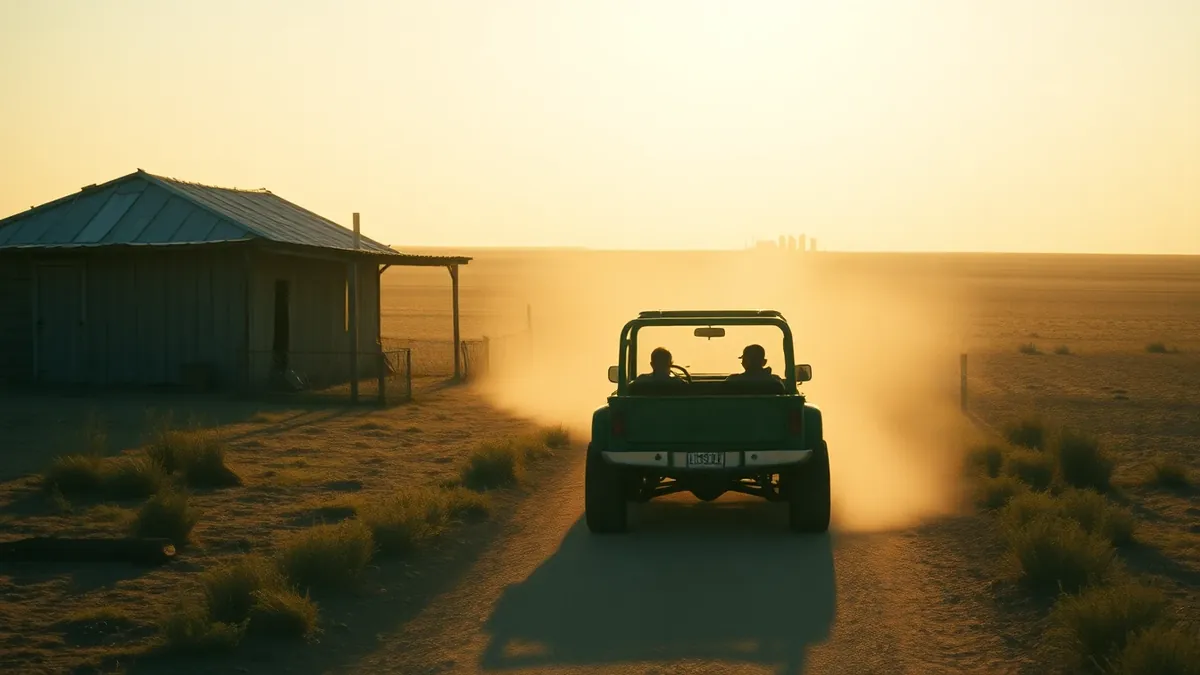
Three miles out of the little town, the road dwindled to a dust track and followed the line of an irrigation ditch between endless dusty acres. Greg Duvalier drove in the single seat of his dune buggy past a broken sluice gate and a tumbledown shack whose open roof allowed dappled light to fall on jumbles of crates and piles of sacking inside. At one point a piece of farm machinery blocked the path completely, and Greg had to back the buggy up to make a detour across the meagre ditch and out through untidy bales of alfalfa.
The purple haze on the field and the crunch of the buggy’s tires on the hard earth only added to the sense of dereliction and loneliness. It reminded him of the day, four summers back, he’d buried Mary Rose and the twins. Dune Fever, the doctors called it. Either it killed you or left you untouched.
When he reached the Peyton homestead a gust of wind blew desert grit into his face. He pulled the peak of his cap down and glowered off into the wasteland. Shallow, ochre dunes blended with the dust-filled sky. He winced and turned back towards the farmhouse, glad that he didn’t have to live out here on the edge of nothingness.
The house was timber-built with four symmetrical front windows beneath a rusty roof. As a centrepiece, it boasted a dilapidated wooden porch, bearing a tired chair and an iron swing seat. A low table stood between the seats, on it a pile of books and an empty jug beside a three-quarters empty tumbler. Its residual burgundy-red liquid made the only break in the monochrome scene.
Greg stopped the motor and climbed off the buggy. He was drying his palms on the seat of his jeans when a woman appeared on the porch.
She shielded her eyes against the beat of the sun. “Lewis?” she said in a thin voice that seemed much older than the woman herself.
Compared with Mary Rose, she was slender, almost brittle.
She held her arms folded across the midriff like strips of twine binding kindling. Yet her hair was golden brown, and her breasts stood pert against the blue and white gingham of her dress.
“I’m not Lewis. I’m Greg Duvalier, ma’am. I was sent out to look at your irrigation system?”
She bent to pick up the jug and glass, then straightened and smiled at him with her head tilted to one side before disappearing wordlessly back into the house. The door remained open. Greg followed.
His eyes adjusted to the gloom of a large room with sparse furnishings. The woman had already passed through a door at the rear. Sounds came of water running. He caught sight of her blue and white dress swaying as she swished the jug and glass under a tap.
He looked away, disconcerted by the woman’s rhythmic motion. He found himself thinking four years was such a long time – an eternity.
He shook his head, refusing to feed his desire. Instead he focused on the stone hearth, and after that on the narrow stairway that led up one side of the room. Somewhere upstairs a floorboard creaked.
“Mrs. Peyton?” he said. “I couldn’t help noticing on the way over, most of your fields are bone dry. You need me to look into your water supply, right away?”
She entered the room with two full highball glasses of red-colored liquid. She handed him one. The glass was cool.
When he looked into her eyes she was studying his face. She showed no sign of answering his question.
“The thing is, I’m certain the main inlet ditch by the road is faulty. You’re not extracting all the water you have a right to. On top of which you’re losing most of the rest at that broken sluice back there.”
She took a sip of her drink, eyes hovering over the rim.
He continued. “Maybe you’d rather I spoke about it to Mr. Peyton?”
Her face flew upward. “Him? He’s no longer concerned by irrigation ditches.”
Another creak came from above, accompanied by a frail voice calling, “Eileen? Come up here will you? I need you to…”
Coughing drowned the sentence.
“Would you like me to come over another time, Mrs. Peyton?” said Greg. “If it’s inconvenient.”
She crossed her arms beneath her breasts. The mounds were smaller then Mary Rose’s had been, but tighter too, her shoulders sparser, eyes greyer, hair lighter. He forced himself to look out of the window at the rolling desert dunes.
“Oh, ignore him upstairs,” she said. “And drink up your pomegranate juice. It will refresh you. Come on, let’s sit outside in the breeze.”
They went out to the shade of the porch. Mrs. Peyton sat on the swing seat and waved him into the chair on the opposite side of the small table.
“I really need to get out into the fields to check where the irrigation fault is, Mrs. Peyton. Have you got any crops other than that cattle feed you’re growing along by the track?”
The coughing from upstairs was still audible even outside.
“Well, the watermelons failed,” she said. “Stupid place to try to grow them. He wouldn’t listen. Apart from that I keep a few low-growing pomegranates out the back. Water them myself using a can and a trough.”
A louder cough made Greg shudder.
“Shouldn’t we check on your husband? What’s he suffering from? Maybe a doctor could help?”
She shook her head. “No, no doctors. It’s Dune Fever.
Nothing to be done. I know it. He knows it.” She paused, staring out over the desert dunes. “You want a refill?”
The red liquid had tasted pleasant and it was cooling as she’d said. He was about to accept when a crash came from inside the house – a dead weight falling.
“My Lord,” she said and rushed indoors.
Greg stood and followed her blue and white hips up the stairs. They found the man lying face down on the floor of the landing. He wore pyjama bottoms but was naked from the waist up. The skin of his back was covered in a pebbledash of angry-looking swellings.
Mrs. Peyton stood beside him wailing. Greg knelt and checked his neck for a pulse.
“He’s gone, I’m afraid, Mrs. Peyton,” he said, looking up at the slim woman silhouetted in the light from a high landing window.
She began swaying, standing at the head of the stairs. Greg lunged and grabbed her waist just as she was about to topple over. She hung limp in his grasp.
She weighed less even that he’d expected as he whisked her up and took her into a bedroom.
The room was dimly lit, tattered pale green curtains drawn over the window. He laid the woman softly on the double bed that dominated the room. As he stood over her a shaft of light shone on her cheek and neck. He noticed a couple of gritty swellings there. Heat rash or the first signs of the Fever? Impossible to tell.
He was about to leave her and ride the buggy back to town when she stirred.
She opened her eyes and then her mouth. It seemed an effort to speak. She cleared her throat. “Lewis, honey?”
“No, I’m Greg Duvalier, ma’am,” he said.
She ignored his correction. “Listen Lew, could you fetch me some pills from the box in the jacket hanging behind the door. I swear they help a little against the Fever.”
“You’re sick too?”
“Maybe. Or maybe it’s just the shock. Fetch the pills.”
He crossed to the door and searched the jacket. It was a man’s jacket, doubtless Mr. Peyton’s. Hunting for a pill bottle, the first thing he found was a piece of card. He pulled it out to find it was a driving licence. In the gloom he made out the photo of the dead man who lay on the landing. Beside his picture was the name: Moses Albert Laboite. Greg rechecked the photo. No denying it was a snap of the dead man. And he wasn’t any Lewis Peyton, that was for sure.
“Honey, don’t bother with those pills now,” said Mrs. Peyton.
He returned the licence to the jacket pocket, and swung around to face the bed. Mrs. Peyton was sitting up.
“Are you sure, ma’am?”
“I was just shocked and fell faint.”
He wondered if he ought to sit on the chair beside the bed till she was fully recovered, but decided to remain standing by the door.
“I’m really quite fine now,” she said. “I’ll be back on my feet in a moment.”
Greg glanced out of the room at the pyjama-clad legs of the dead man, Moses Albert Laboite. “Mrs. Peyton, you’ll need to call a doctor.”
She tried to stand but sat back again. “No, I’m fine. Really.”
“I meant for your – husband.” He couldn’t avoid the pause.
“You need a certificate. A confirmed cause of death.”
“Cause of death?” She laughed. “Are you serious? I can’t afford to pay out to be told what I already know. Dune Fever killed him. You yourself must have seen victims before.”
Pebbledash rash. Weakness. Coughing. Breathlessness. Final collapse. He nodded. “My family.”
She cocked her head to one side. “But not you?”
“I was untouched.”
“Me too,” she said. “So far.”
“Okay, so no doctor, then,” he said. “But what do you suggest? We can’t leave him lying on the landing in this heat.”
“We’ll move him, Lew. I’ll show you where.”
He touched the woman’s shoulder. “I told you, Mrs. Peyton, I’m not your husband, Lewis. My name is Greg Duvalier.”
Her eyes cleared for a moment, but then clouded with tears.
She fell into his arms sobbing. He allowed himself to stroke her hair and mumble her name – Eileen – a couple of times.
The word felt strange on his lips after all those times whispering “Mary Rose” with his face nuzzling darker brown hair.
After a while Mrs. Peyton pulled away. “Do you think we can manage to get the body into your dune buggy?”
“Yes.”
“Will there be room for us to ride in it too?”
“It’ll be a squeeze.”
“Come on. We don’t need to go far.”
She stood and brushed passed him, the breeze she generated accentuating her frailness. On the landing, she stepped over the corpse and passed downstairs. Greg lugged the dead man over his shoulder and made his way awkwardly down the narrow stairway. Before he reached the bottom she had opened the front door and gone outside. He paused, caught his breath and followed her into the sun. It was getting late but the day was still hot, the air dusty and stale.
He loaded the body onto the rear rack of the buggy. There was barely room for him and Mrs. Peyton in the driving seat designed for one. She nestled against him and directed a course across a field of parched alfalfa to a spot where a lone thorn tree had managed to grow out of the caked earth. In the shade beneath it stood two wooden crosses.
“My family,” she said without looking at the graves.
He took a shovel and a pick from the tool box in the rear of the buggy and dug a three foot deep grave beside the existing ones. Any deeper and he would have hit solid rock. He dried his brow and manhandled the corpse, still in pyjama bottoms, into the hole in the ground.
They stood over it in silence for a moment. Mrs. Peyton crouched and scooped up a handful of dirt. She weighed it in her hand before tossing it into the hole. Then she picked up the shovel and began ladling dust over the dead man. Greg grabbed her wrist, took the tool from her and finished the job.
In the meantime she had fashioned a cross by tying together two twigs from the tree. Now she planted it and turned away.
He helped her climb onto the rear rack of the buggy, and she rode back in place of the corpse.
Night was falling fast as they arrived at the farmhouse.
“It’s become too dark to ride the buggy back to town now,” he said. “It doesn’t have running lights and I can’t afford to wreck it. I’ll sleep out in the yard, if I may. Drive home in the morning.”
“Stay in the spare room,” she said. It seemed a plea as much as an invitation.
For the third time that day he followed the blue and white dress indoors.
They drank more pomegranate juice, and ate a silent supper of mutton stew strongly flavored with thyme and rosemary.
In sympathy with his jaws, words chewed in his mind.
Rosemary. Mary Rose. Touched. Untouched.
Afterwards they did the dishes together and Mrs. Peyton showed where he could sleep. It was a child’s nursery with toys escaping from a box at the foot of the single bed, and pictures of windmills and steam trains on the wallpaper.
He fell asleep thinking of his own lost children, but when he dreamed it was of Mary Rose. He had just come home from working on a particularly difficult irrigation job. A sluice had broken and a farmer’s whole crop was going to waste in the sun. He’d worked all day to fix the sluice, and now he was exhausted. But Mary Rose just smiled and ignored his protests as she pulled off his work clothes and filed him towards the shower.
He half-woke in a state of arousal. A woman lay tight beside him in the tiny bed, her breasts and stomach against his side.
His hand explored. The woman was naked. He woke enough to remember where he was. At first he wanted to push the woman away, but her hand grasped him between his legs.
He stirred and sought out the woman’s face with his own hand. Her skin wasn’t as smooth as he remembered Mary Rose’s. In fact, it was more like sandpaper. As he explored he realised the woman’s neck and shoulders were covered in a small hard rash. Like pebbledash.
Regardless, he bent and kissed her right nipple. It had been forever since he had made love to Mary Rose. His hand wandered back and forth over her breasts, exploring avidly.
But these breasts were wrong. Different. They weren’t Mary Rose’s at all. His hand recoiled.
“Oh, don’t stop, Lew,” said the woman, using Eileen Peyton’s voice. “Promise you won’t ever stop touching me.”
Fully awake now, he was going to correct his name, but it didn’t seem important any more. No one could mind if he pretended to be Lewis Peyton, as the man in the pyjama bottoms had before him, the man who now lay alone beneath three feet of dust and a thorn tree.
Greg Duvalier clasped the frail woman to him and smiled into the darkness. “Mary Rose,” he said, “I promise I won’t ever stop touching you. No one should ever be untouched.”

“Untouched” was printed in Breaking Curfew, No. 4 of Inwood Indiana. Pick up the paperback from Prolific Press; the stories and poems published online are free to read here.
Get the paperback