
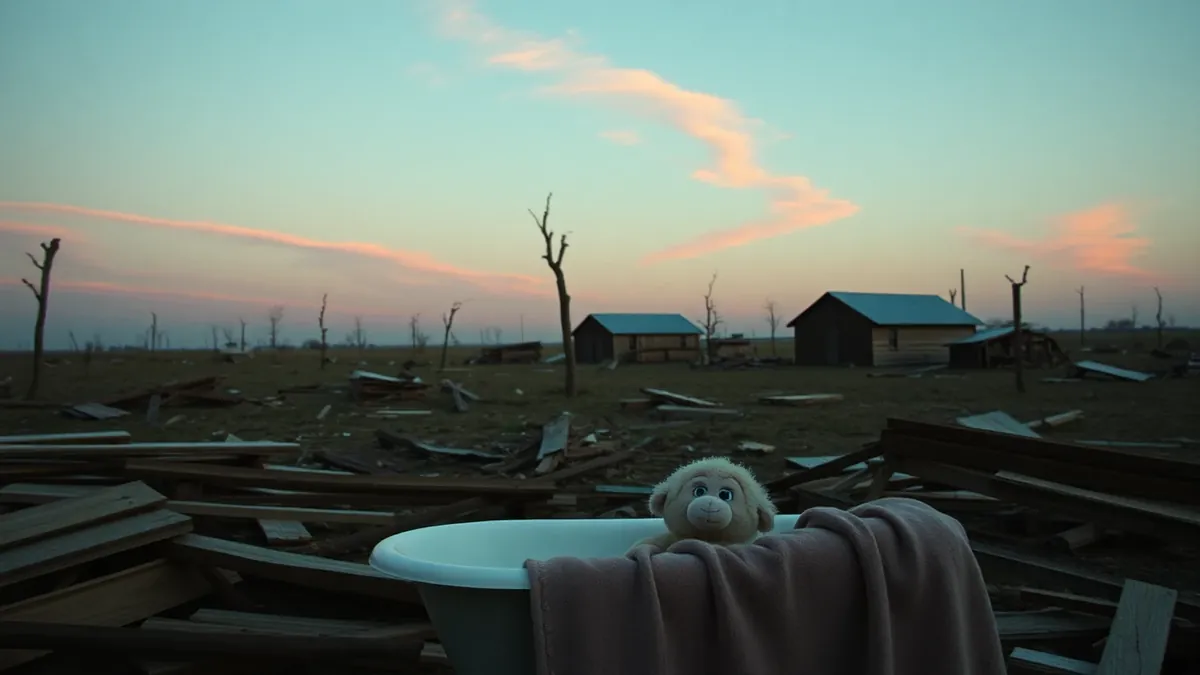
As the tiny town of Broken Creek, Oklahoma slept, a plague of tornadoes struck in the night. Some people were swept away, some were crushed, and some were felled by flying debris. Few were left to bear witness. Chancey du Plessis was one of them.
From beneath a mattress in a bathtub she emerged, holding in one hand Mr. Winkles, wrapped in his blanket, and in the other the grubby paw of baby brother Remi, picking his barefoot way among shards of glass, glittering forms cleaved along unseen lines of stress, and around nails, long consigned to the darkness of wooden planks, now exposed to the clarity of morning light. They were joined by Critter, who had been sniffing around for the dog food to which he was accustomed, before finally allowing more primal instincts to take over in foraging for the edibles hidden beneath the rubble.
Chancey looked around, wondering where, in the midst of the flattened landscape, her parents might be. They had gone to Mr. and Mrs. Jackson's house for the evening, but Chancey had no idea where the Jacksons lived. The evidence suggested it was a moot point anyway. She tried to find the driveway, but the blue van that had been there when the babysitter, Daisy, had gone out to it to visit with her boyfriend Joey after dinner, was nowhere in sight. While the moment could have been a tipping point into panic, Chancey's mind slid instead down a slope toward more practical considerations. She was thirsty, Mr. Winkles was hungry, and Remi had personal hygiene issues below the waist. As Chancey looked around, she saw the sign for the giant retail/grocery/home improvement store where her mother shopped. While Chancey was fairly certain that the store was not located near where the sign sat on the ground a mere hundred or so yards away, she decided they would head in that direction anyway.
The gutted refrigerator had come to rest neatly next to the sign for the store from which it had come. Within, Dolores Quartermain lay curled up around a two-and-a-half gallon bottle of water, and held clutched in her hands a half dozen chocolate bars, with nine more stuffed in the pockets of her cargo pants. As the band of survivors led by Chancey du Plessis approached, Dolores pushed open the refrigerator door and stood up, presenting herself to Chancey as a figure of substantial possibility: savior, guide, fellow traveler, or foe, each bearing for Chancey an excitement peculiar to the role.
Dolores peered, eyes hand-shaded against a light she did not foresee ever returning, at the group approaching. She studied them dispassionately as they picked their way toward her, finding it easier to concentrate on the awkward, hesitant movements of two children and a dog than on the destruction around her which, on a good day, would be well nigh incomprehensible. And this was not shaping up to be a good day.
“Hey,” Dolores said as Chancey got within conversational distance.
“Mama says I ain't supposed to talk to strangers,” Chancey replied. She looked around. “But Mama ain't around. So, hey.”
“Name's Penny,” Dolores said.
“Name tag says 'Dolores',” Chancey said, leaving the obvious question implied, if set jaw and narrowing eyes are any kind of indicators.
At twenty-eight Dolores Quartermain felt too young to be named Dolores, so she went by Penny in all but the most legally and professionally necessary situations.
“What's your name?” she asked Chancey by way of diversion.
“Name's Chancey. This here's my brother Remi, that there dog's Critter, and this,” she said, holding him out toward Dolores, “is Mr. Winkles.”
“Nice to meet you all. Any idea where your folks are?”
“They went to the Jackson's house last night, but I don't know where that's at.”
“Well,” Dolores said with a smile she hoped the youngster could not interpret, “I doubt the Jacksons know anymore either.”
“This ain't where the store's usually at, is it?” Chancey asked, gesturing to the sign.
“No,” said Dolores, “I don't think so. Then again, I don't know where anything is at the moment.”
Everyone but the dog sat down and leaned back against the refrigerator. Dolores broke out candy bars and water so that, aside from diaper problems, Chancey's immediate concerns were addressed. Most of the next hour was spent discussing how they had all ended up here, and where 'here' might be.
Dolores Quartermain, it turned out, was the Assets Protection Manager at the retail/grocery/home improvement store where Mrs. du Plessis shopped. She had begun working there fresh out of college, where she had majored in marketing, and minored in philosophy with a course load that listed toward comparative religious studies, whereupon at the age of twenty-five a bachelor's degree had been conferred upon her. She was on the fast track into management from the start. With her drive, intelligence, and ability to think, in corporate-speak, 'outside the box', she had risen quickly. What she understood from the outset was that, though a degree was a managerial requirement, there existed no necessary correlation between education and the ability to perform the job. This had become apparent when the storms hit. While degreed professionals ran in panicked circles, Dolores gathered customers and coworkers and ushered them to the safety of an interior hallway in the backroom. When the twister struck, she was caught doing a final check of the sales floor for stragglers in the appliance department. She pulled the racks out of a display refrigerator, and as walls came down and the roof began to lift away, she grabbed candy bars and bottled water from a nearby end cap and leaped inside. Dolores Quartermain was a young woman of resourcefulness, a survivor, someone who had honed the ability to think quickly and act decisively, not in college, but after she dropped out as a sophomore, took the name 'Penelope Nichols', and began a two year career as an actress in adult films. A year after quitting, when the money and cocaine had run out, she went back to college, transferring from the insular world of College of the Surf to the anonymity of the University of Oklahoma. Gone were the big hair, blue mascara, and stripper wear; she now wore a pony tail, no make up, horn-rimmed glasses, and clothes that would have made Mae West appear vaguely Amish. And that is how she came to be here, wherever 'here' might be.
As a relative newcomer to the stage of history, Chancey du Plessis had arrived at this juncture endowed with what was known in the folk parlance of her ancestors as 'horse sense'. Weather Channel tornado specials and repeated drills at school had sharpened and focused an innate decisiveness, sometimes misinterpreted by elders as stubbornness, to such a degree that the instant the lights went out and civil defense sirens came on, she wrangled a mattress with one hand, Remi in mid-poop with the other, and got them all, along with Mr. Winkles, into the tub.
It quickly became clear to both Dolores and Chancey that thinking-outside-the-box-horse-sense was, at this point, a necessity for survival. A slight breeze, timid cousin of the previous night's visitors, fluttered, able to stir only slight remnants of the works of Man. Every movement seemed a pale and impotent response to some judgment, a choked appeal at this undeserved sentence. The chirps and songs of returning birds mixed with an occasional moan or cry that seemed to come from a distance, as if what remained of yesterday's world had slipped into a universe, parallel in Gaussian spacetime to that of Chancey and Dolores, polar points of intersection becoming the ghosts of a former reality. Clearly, no one was coming to help them any time soon.
Thirst quenched and hunger at bay, the first order of business was to strip Remi from the waist down and seat him in a clean-looking puddle of water, where his natural inclination to thrash around contributed to his cleansing. All agreed that he could remain in a state of nature for the time being. As Remi air-dried, Chancey stepped over what appeared to have once been the contents of a storage shed—bent and twisted garden tools, deceased weed-whacker, decapitated lawn mower (rear leaf bag still miraculously attached)--to sit beside Dolores and stare off across a flatness that gave them both, woman and child, the same unobstructed view of what was left of the town.
“Food, clothing, shelter,” Chancey said, as if reciting a grocery list or set of chores.
You read my mind, kid,” Dolores replied. She stood up, looked around, and began putting her world back together, beginning with an overturned grocery cart. Its wheels were bent, but as far as Dolores could tell, that did not matter; there existed no clear path down which to push it anyway. But it gave them somewhere to put supplies. The operation took on the aspect of a shopping spree in some piece of surrealist cinema, Chancey completing the picture by finding a small fiber glass boat, with a length of rope attached, into which they could put the cart and drag it with them across the blasted landscape.
Dolores soon got her bearings. They were on the eastern edge of town, and the damage was almost total. Dolores reasoned, if only by the process of elimination, that their best chance for help lay westward, where some part of town might have escaped annihilation. In addition, most of the larger structures, such as the high school, with its gym, auditorium, and football field, were there. Dolores figured that any relief efforts would be based in and emanate from that area.
By mid-morning, they were moving, starting, stopping, back-tracking, sifting through wreckage for items to add to their cart. A traveling polis, each member of this body public moved independently, at his or her own pace, choosing the path most befitting character and capacity, yet with only minor fluctuations in relative distance and position among the members. It was slow going, and difficult to tell if one was following a road or cutting through someone's dining room; place settings and traffic lights lay hopelessly jumbled together in places. Still, Dolores liked to know where she stood and where she was headed. She developed a method for doing just that. If one followed what seemed to be a road until one came to what seemed to be an intersection, one might find a street sign which would yield a pair of names. At the next intersection, if one found another street sign with a name that matched one of the previous ones, one could be relatively certain that was the street being followed. Though not infallible, the results were within the acceptable range as far as Dolores was concerned. She soon felt much better about where they were going, if for no other reason than that she now had names to attach to places once again.
By noon, the grocery cart held: three dented cans of pink salmon, two whistles, a jar of instant coffee, six cans of still-pressurized spray cheese, a bicycle air pump, two bags of hard candy, a box of half-inch wood screws, an undamaged three-pack of cigarette lighters, a canister of protein powder, an assortment of plastic dinnerware, and a claw hammer qua can opener, which Dolores presently began using to pry into lunch, a can of CorpMart brand Low-Fat Caffeine-Free No Gluten Low Sodium Sugar-Free Vegetarian Turkey Chili Without Beans.
“You're not going to use that, are you?” Chancey protested as Dolores began working on the can with what Chancey felt was an implement of suspect cleanliness. “You don't know where that thing's been.”
“Kid,” Dolores laughed, “this thing doesn't know where I've been.”
The group also managed to procure a box of size 3T disposable diapers, but they were so saturated with water that it was apparent there was no point in getting Remi to wear one. It was agreed that in the interest of his lower half, exposed as it was to full afternoon sun, a water-logged towel fastened at the waist was sufficient. Remi could still swing free and let loose, much like the unhousebroken version of Critter, who was beginning to forget his former training in the new found freedom of what for him was a return to an antelapsarian Eden in the land of Canine.
“I don't know much about little kids,” Dolores said. “What does Remi eat?”
Chancey shrugged. “Handful of dirt now and then.”
As they pushed westward, encounters with the living were few and far between. Most passed by in the quietude of shock and despair, eyes averted, never to be raised in recognition of shared suffering. Dolores realized that there were simply not enough people left to achieve the critical mass necessary for a good communal cry. What had once been rescue teams wandered past occasionally, betraying blunt sorrow and shattered sense of purpose, lethargic in the knowledge of their own irrelevance. Even the small bands of looters, who no doubt began the day with the enthusiasm of future war criminals in basic training, seemed listless and misdirected, one group of teenage boys forgoing the price-gouging opportunities offered by an overturned truck filled with unbroken five gallon carboys of fresh water in favor of attempting to get high by inhaling the contents of a case of canned compressed air. Though Dolores tried to lead her companions past them at a discrete distance, one of the boys glanced up from his frustrated exertions and saw them.
“Hey baby!” he shouted, “what do you got in the cart?”
“Ooh,” said another, “check out the cute little piece she's got with her.”
The entire group of perhaps a dozen put by their revels and approached the girls with what to Chancey was palpable menace.
“Give them what they want,” she whispered.
“I don't think so,” Dolores said, knowing, as Chancey did not, that what these boys wanted extended beyond the confines of the cart. “I don't fucking think so.”
Certain lessons of her past served Dolores well. As everyone who works in retail knows, lower rungs on the corporate ladder hold most company rules, procedures, and policies somewhere between utter contempt and complete indifference. It was an innocuous form of hazing for Sal Chatman, Produce Manager (or “Head of Lettuce” as he was known to his underlings), to get new managers to attempt to enforce some silly rule no one followed. One day, he wandered over to Dolores as she was watching the replenishment team stock the floor in the early morning hours.
“You know, Dolores,” Sal said, sounding somehow both off-handed and officious, “that guy over there is using a box cutter on cases clearly labeled otherwise.”
Dolores sighed. She knew sending the hot-shot young manager to tell a man how to do his job, one that, moreover, she had never done, was a childish way of reinforcing the power structures and mistrust of superiors that are at the core of how corporate America works. She could only hope the guy was smart enough to catch that, by tone of voice and body language, neither of them should take this seriously.
“You do know that symbol on the box means you're not supposed to use that thing on it, right?” Dolores asked.
“Technically that's true,” he replied, “but you see, what it really means is that you need to take care,” and here he turned upon her a lurid smile haunted by the ghosts of teeth long departed, his undecipherable neck tattoo throbbing into life with his quickening pulse, “to pay attention to angle of entry and...depth of penetration.”
Obviously she had been set up. Dealing on a daily basis with the likes of Kenny Wayne Pennebaker was a major factor in the departure of her two predecessors after only a combined four months on the job. But Dolores had learned how to handle his kind in far harsher work environments than this. Poor Kenny Wayne Pennebaker. She turned upon him the full force of what came to be known among co-workers as the Withering Glance, which, when prolonged past the point of endurance, became the Petrifying Stare. What had simply kept her alive and sane in the world of porn made her a legend in retail.
This bunch of dickweeds didn't stand a chance. Disposed of and dispersed, they were henceforth a threat to none but themselves.
From his privileged perch in the child seat of the cart, Mr. Winkles alerted Chancey to the presence of a woman, partially obscured to them at the moment by an intact chimney, a free-standing objective correlative difficult to surpass in conveying a sense of irrevocable loss and isolation. Chancey tugged at Dolores' sleeve and pointed toward the woman, whose movements were as aimless as those of everyone else they had seen, but whose eyes shone with a faith-based tenacity held in place by a zeal Dolores found unmistakable.
“Lost everything,” she said as the group approached her, “but praise be to God for saving my life.”
“Yeah, it's a miracle all right,”Dolores replied. The woman knelt and looked up at her.
“Would you like to join me in a prayer of thanks for His mercy?” she asked.
“I'll tell you what,” Dolores replied, “you stay down there and give thanks to God for the great gifts He has bestowed upon you this day, while I stand here and think up some way to thank Him for killing all these people, maybe come up with a prayer on behalf of those who are unable to do so at the moment because they are too busy sifting through, no doubt gratefully, all the destruction He so mercifully graced them with last night.”
As Dolores turned and led the others away, Chancey glanced back at the woman, still kneeling and unmoving, with an expression Chancey thought looked part angry, part not understanding what had just occurred. Chancey felt no anger, but did find the episode beyond her understanding.
As for Dolores, she had first become interested in religion as a fit subject for serious study as a junior in high school. She had attracted the attention of a local college student, one of those young men who tries to define his public image by the book people will see him reading. She also understood his attempts to manipulate her by flattering her on the sharpness of her mind on the one hand, while gently denigrating the uneducated naivete of her thinking on the other. On a dare from him she read, in two weeks, a difficult book of intimidating length, one which he himself had never been able to finish. It was there she was startled into fascination by a quote on page 266, which she later learned came from the Bhagavad Gita: “Even those who worship other gods worship me although they know it not.” From then on she had little use for and less patience with dogmatic narrow-mindedness. In addition, her suitor lost interest.
The sign sat like a giant toe-tag atop the rubble: Ka Chang's Donut Shop and Video. Chancey watched Dolores absent-mindedly shift around a pile of DVD's with her foot. Dolores knelt down, picking up a DVD case. She looked at it for a few moments before tossing it away with a smile that, to Chancey, did not seem to mean what she thought a smile meant, as if the lips and eyes were parts from two different faces feeling two different emotions. As Dolores resumed her search for useful items, Chancey wandered over and looked at the cover:
CAITLIN O'GASM & PENELOPE NICHOLS in Cock Less Monster 5 HOT Highland Lassie Lezzie Munch Fest!
Two girls in plaid bikinis sharing a loose embrace faced outward. Chancey thought one of them could easily be taken for Penny's younger sister. Perhaps, thought Chancey, she was, that she and Penny were on a shared quest to recover a lost family. Chancey felt a new tenderness toward Penny, as if their roles had been reversed and she, Chancey du Plessis, was the keeper of Penny, lost little girl.
Dolores turned over the large wooden sign. The bottom half was broken off. “Whispering Pines”--the signifier remained, but the signified had been torn away. Dolores and Chancey began looking around, each of their heads the center point of an ever-widening circumference in search of its limit.
“Do you see any tombstones around here?” Dolores asked.
“No,” Chancey replied, undistracted by the randomness of the question. “My granny should be around here somewhere.”
“Your granny is buried in Whispering Pines?”
“No, silly, Whispering Pines is the name of the old folks home where she lives now since Pawpaw died.”
Dolores gave the half-chuckle and smile that Chancey could never seem to connect with mirth. The girl could see that Penny had made a realization. Chancey did not understand, but instead of responding with her usual curiosity, which often struck adults as a cute but annoying form of interrogation, Chancey gave Penny space to work her way through the moment.
As if to repay this courtesy, Dolores offered, without the armature of emotional distance, “My mom is buried in Whispering Pines Cemetery.”
In what seemed to Chancey a spasm of impracticality and superhuman strength, Dolores wrestled the sign into the boat. When she wiped her upper lip with the back of her hand, Chancey was not sure if Penny was wiping away sweat, or if it was the reflex following a quick sniffle.
Chancey sat down to rest and began picking through the twisted frame of a picture postcard rack. Dolores wound her way over debris that had once been a dollar store and stood behind the child, who had found a postcard that was in surprisingly good condition and depicted some part of Oklahoma that was much more scenic than Broken Creek even during the town's better days. Chancey sat still, her only motion her right forefinger moving over the surface of the photo, tracing some figure, invisible and meaningless except to Chancey, the ephemeral mandala that mapped her universe and was beyond paraphrase. After a few moments, Chancey stood up, walked over to the cart, and put in the postcard. In the beginning, thought Dolores.
As the leading edge of the sun touched the jagged western horizon, a contour shaped perhaps by trees, perhaps by buildings, perhaps merely by further evidence of God's indifference or death, Dolores realized they would not reach conventional habitation, temporary or otherwise, before darkness fell, relieving the pain of present sight and cursing them with blindness to future dangers. She spotted ready-made shelter, a panel truck rolled over onto its side. Close inspection revealed it to have been a newspaper delivery truck, still filled with bundled, predominantly dry copies of the Sittaway County Statesman.
“Listen up, troops,” Dolores said, “we need to gather up as much of the largest, driest pieces of wood we can find. We'll warm up, dry out, and start out in the morning.”
Minutes later, Dolores had piles of newspapers blazing, adding kindling, then larger bits of wood, always at the ready with more paper as needed to help dry out and ignite the oft-times still damp boards and sticks. A stable, steady blaze was soon achieved, with plenty of fuel set nearby to dry and add. Dolores went through the cart and pulled out a few bits of clothing, two damp towels, and a torn blanket. She and Chancey strung the boat's tow rope from the rear view mirror bracket on the van's driver side door to a metal fence post that, though bent, retained enough verticality to hang up and dry what would be used for bedding.
Earlier, Chancey had found a large pot, a skillet, and three chipped, though usable, mugs. Dolores filled the pot from one of their three recently acquired five gallon jugs of water and set it on the fire, along with the skillet. Dinner was served. Dolores had instant coffee and a protein shake, while the kids ate hot canned salmon, spray cheese, and hard candy. They all shared the spiderwort/chickweed stir fry Dolores had prepared. Critter and Mr. Winkles were left to fend for themselves, which seemed to suit them just fine, Critter seeming especially happy to relieve Remi of a portion of his salmon.
As Chancey got the others ready for bed, Dolores put more water on the fire and began shelling acorns she had been gathering throughout the day. It was deep in the night by the time she had boiled the tannin out of the acorns, ground them into meal, added water to form a mush, and set the mush out to sour overnight. The others were fast asleep, Chancey curled up under a large towel with Mr. Winkles, Remi, in a tangle of mismatched clothing, using Critter as a pillow. Dolores looked at Chancey, an expression of fierce resolve on the girl's face even in sleep. Though her experience around young children was limited, Dolores believed that when confronted with this kind of destruction and the loss, probably permanently, of both parents, most would succumb to the paralysis of hysterical fear. Chancey, however, pushed ever forward with a faith that, if misplaced, was not blind, because it was chosen with eyes wide open on a reality willfully conjured. Dolores, swearing to herself to protect that faith, tried to stay awake, to watch over them, but she soon began to drift off. As if by design, Chancey woke up.
“You can go to sleep, Penny,” she said, “I'll stay up and watch a while.”
Without a word, Dolores gave her a nod, perceptible only to tried, trusted friends. As she dropped off, she had the sudden thought, why or what it meant she would never know: life is not brutal for someone who has no word for brutality. Fatigue overcame confusion, and she entered the deep, dreamless sleep of the truly exhausted. Chancey, who took her responsibilities seriously, remained at her post as long as she could, at which point she was relieved by the ever-vigilant Mr. Winkles.
When Chancey woke, Dolores was up, grinding freshly roasted dandelion root into coffee and cooking piles of acorn sourdough flapjacks. Before setting out, they took the Whispering Pines sign from the boat, along with a can of red spray-paint they had found. On the back of the sign they left a message for any who might come behind them, and leaned it against the side of the truck:
StiLL Alive HeadEd WEST D. QuaRtERmaiN C.&R du Plessis CriTTEr&MR WiNKLEs P.S. wateR in Truck
The taut and severe flatness of the land began giving way to a series of dips and swells, undulations not far enough removed from flatland prairie to be called rolling hills, but intervals of slight change in elevation nonetheless. The effect was invigorating, each new prospect bringing fresh hope in spite of whatever new horrors they might find over the next rise. As they moved westward, they realized that those heading back the other way, in search of survivors or the repair of personal losses, were more upbeat the further west they were encountered.
Chancey found this heartening; Dolores saw in it the best moment these people would have all day, as they headed east toward increasing waste, death, and savagery.
As they descended a gentle slope, free of debris and covered in grass that seemed unaware of catastrophe, a figure, tall, broad, erect as no other encountered thus far, rose from the summit before them and walked down, long, confident strides sending his unbuttoned overcoat billowing out behind him, broad-brimmed hat shading his face, paradoxically focusing attention on his eyes, so blue they seemed to generate their own light.
“Well hello there!” he said, his deep voice at once reassuring and slightly incongruous. Chancey stepped forward, thrusting out a hand.
“Howdy,” she said, “my name is Chancey. Her real name's Dolores, but you can call her Penny. Those two rolling around on the ground are Remi and Critter. Critter is the dog. And this is Mr. Winkles. He don't talk much, so don't take it personal.”
Amused and momentarily at ease, Dolores stood back and let Chancey carry the conversation. Chancey told the man about the people they had met, and he told her, while casting his glance at Dolores to make sure she was getting the information, that the Red Cross had arrived and a tent city for temporary shelter had been set up on the high school football field.
“By the way,” he said, reaching into a coat pocket from which he pulled a thermos that seemed far too large ever to have fit there, “got some coffee here if you'd like some.”
“God yes,” Dolores said, taking the proffered cup with gratitude too profound for expression, but which the man seemed to understand nonetheless.
“As of right now,” he continued, enunciating each word so it could bear the full weight of his conviction, “every single person in back of me is at that field. I am the leading edge of the survival front, people. You all hurry on there. I've got to go on. We'll meet again soon, once everyone's gathered safely home.”
“How do you know we'll make it?” Chancey asked.
“I wouldn't pass you by if you couldn't,” was the last thing they heard him say as he walked with steady purpose over the rise they had just descended.
“You heard the man,” Dolores said. “Every living soul this side of him is at the Red Cross camp; let's go.”
As if filled with the energy of the stranger's absolute certitude, all fatigue left them, and they marched on, freed from the burden of worry for their fate.
“Come on, Remi,” Chancey said, “we're almost to Mama and Daddy.”
Of course, thought Dolores, where else could they be in the mind of Chancey du Plessis?
Around midday, they topped a rise made taller by the remains of a semi-trailer left there carelessly by the storm. In the distance stood, like a vertical miracle, a single light standard, several hours away, but a standing promise nonetheless that a measure of publicly sanctioned relief was this day within reach. Dolores looked at all they had gathered, cared for, preserved, and protected. Soon they would no longer need any of it, nor even have to use most of it. If we had to, thought Dolores, we could have rebuilt the town ourselves.
Meanwhile, as Chancey sifted through the effects of someone who had never existed for her, and who probably no longer existed for anyone else as well, she came across something which made her heart skip a beat.
“Look!” she cried out. “A phone!”
“Used to be maybe,” Dolores said, “probably trash now.” “It turns on!”
“Okay, kid, but you're not going to get...”
“A signal!”
“Alright, kid, but that doesn't mean...”
“It's dialing Mama's number!”
“But kid, the circuits are all going to be...”
“It's ringing!”
“Look, kid, just don't get your...”
“Hello...Mama?”
“I'll be damned.”
“Mommy! Daddy!” the girl squealed, the long suppressed, unspoken doubt finally acknowledged in extinction.
Dolores Quartermain smiled, the now unambiguous clarity of bright sun and blue sky reflected in her face. It was left to Remi to spoil the moment.
“Sweet Jesus!” gasped Dolores. “Ask them if the Red Cross brought along any diapers.”

“To Begin With” was printed in Ditch'em, No. 7 of Inwood Indiana. Pick up the paperback from Prolific Press; the stories and poems published online are free to read here.
Get the paperback