
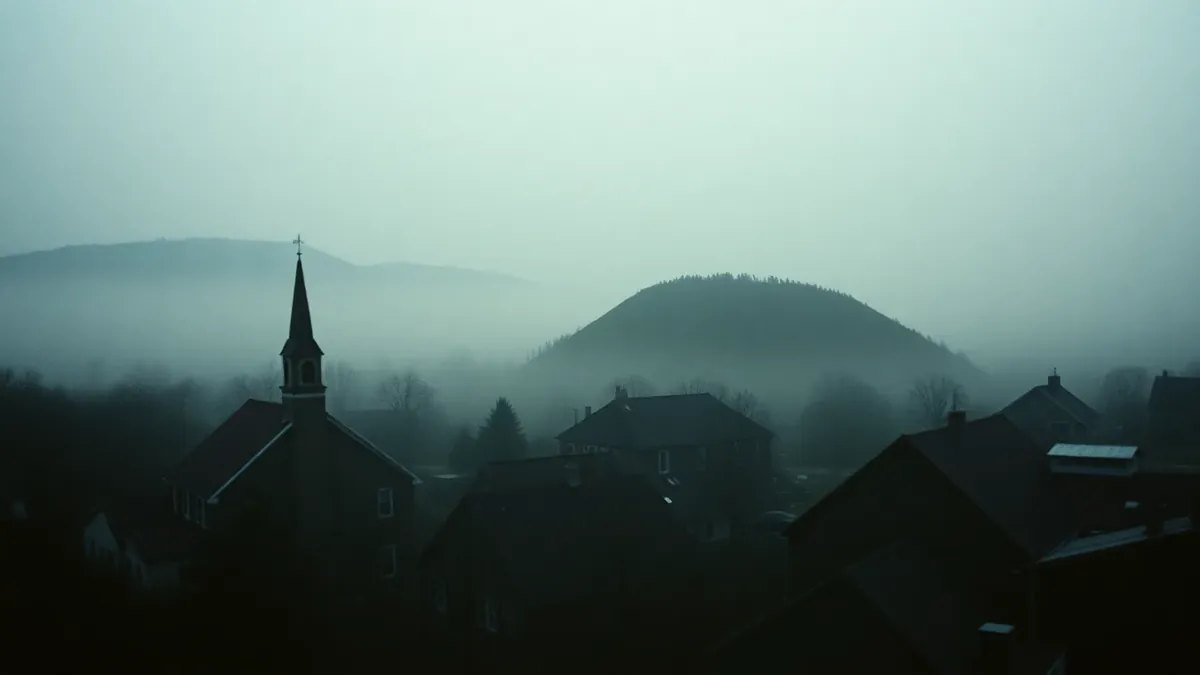
There are certain small towns which to the majority of people are but pinprick dots carelessly sprinkled on maps; in the Hinterland, these forgotten dwellings hide behind ancient mounds or lie cupped in the palm of a valley, and fields stretch between them and the roaring main roads. To the casual traveler, passing through, these small towns may appear to be all alike for they blossom slowly and demurely, each unfolded petal shading a wonder, each layer suggestive of ineffable mysteries.
Such was the small town where my grandparents resided. I only ever experienced the place in those long and lazy summer months before the harvest where everything grew wildly and senselessly in chromatic abundance. The surrounding mounts and fields lounged in all their fecund exuberance below the hot gaze of the sun, offering their gaudy bodies to flocks of cows and sheep. This cornucopia of mad growth had silently invaded the town, its streets uneven because of the proud dandelions, credulous daisies and valiant stems of barley that nudged and pushed and shoved against the poor cobblestones. Shivering, bright green ryegrass and thistles adorned with purplish flower heads filled the spaces between the huddled houses, their flaking walls covered with the green tendrils of climbing plants. On the thatched roofs there sprouted grasses and young birches with the ambition of becoming grand forests; birds nestled there while below, in the dark, moist attics, there was a scurry of small, clawed paws. The boundary between nature and culture was nearly indistinguishable as if the latter were seeded by the first; the church and houses and fountains and street lamps grew naturally from the rich soil and were governed by the same subtle changes as the vegetation. Each day I would discover some new aspect about a certain corner of a house, or a slight difference of mood in the church tower from where the bells naturally blended in with the rustling foliage, the songs and fluttering of birds, the never silent crickets and croaking of frogs.
This blurred boundary gave the impression of a vastly larger town in which it was easy to get disorientated. I might saunter down one of the quaint cobblestone streets and find myself on a gravel path lined with tall and clustered shrubbery, and then, a little further ahead, the path would bend and suddenly become a street of cobble and wildflowers again. Other paths brought the daring explorer into scenes of utter wilderness scattered with lonely, ruined buildings whose roofs had long since caved in to be replaced by deciduous crowns, their grimy windows imprinted with the spectral faces of former inhabitants if not wholly reduced to gaping, dusky holes. And then, past the old vicarage, there was the path which led to the tabooed marl pit.
“Don’t go near the marl pit. People have drowned there,” my grandmother warned me again and again to which my grandfather would invariably nod gravely as if to say, “Listen to your grandmother, lad,” but at the same time giving me a knowing wink behind her back. Such admonishments only ignited my imagination, and no winks from my grandfather were needed for me to commit the crime of trespassing; for whenever my solitary ramblings brought me close to this path, it was as if the breeze changed and became an alluring whisper. And so, one breezy day of July, I jumped the low, sad-looking wooden gate that barred the path, setting forth like an outlawed explorer into terra incognitae.
Before long, the narrow path began to wind its way up a slight slope, bushes of blueberries, stinging nettles, hogweed and ferns gushing forth on each side. Near the end of the slope, the path led me straight to a wall of firs. Onwards I went, but not many feet inside the forest, where the shade was solemn and cool and filled with an orange-like odour, I halted; I had felt a chill, and it was not the chill of a breeze. A few shafts of sunlight penetrated the tree tops, and whenever a cloud passed the sun, the light would change in an uncomfortably suggestive way. It may have been pride or vanity, but I felt convinced it was too late to turn back; there was nothing to do but to make a dash for it and ignore the sportive movements of light and shadow. To my relief, what I had thought to be a forest turned out to be a mere archipelago of firs, or a coniferous screen beyond which the path continued down a steep slope to the banks of the fabled marl pit.
Simultaneously joyful of my discovery and conscious that I had broken a taboo, I halted on the top of that slope and surveyed the prospect before me. The chasmal, pear-shaped mouth of the marl pit brimmed with shimmering water. From its green fat-lipped banks, a few Black Alders sucked their nourishment while, at the far edge, a large, old White Willow leaned out over the mirroring water, its whitish beard trickling the surface. All was calm except for the chirping of crickets, the deep humming of zigzagging dragonflies, and the gentle lapping of water.
It was very tempting to proceed down the path, undress and dive straight into that wonder, and yet I felt somehow unprepared for such a momentous action. Besides, the sun was slowly, steadily setting in peach-orange and rust-red splendours, and the trees threw long shadows across the liquid surface, the wavering shadows of thin, elongated giants; day had turned to late afternoon, and, however reluctantly, I had to retrace my steps and return to my grandparents’ house. It was not until late that evening, when I lay ruminating in the darkness of my small room, listening to the mice on the attic, that I realized that the marl pit was closer to the town proper than it seemed. The path had described a curve, leading from the vicarage to the sloping outskirts of the town where the firs effectively screened the marl pit from view. In some way, the marl pit was the town’s true and inmost secret heart, and what I had seen was literally only the surface of a mystery beckoning to be penetrated. I had been, as it were, in the antechamber of something hitherto unknown, and I could barely wait for a new day to dawn.
As it happened, I was trickled awake by a fly in the very early hours of the morning. Eager to explore the marl pit further, I stole out of the house like a thief in reverse, my grandparents still lost beyond the gates of horn and ivory, and skidded salamander-like across the sleepy town. The sun had barely risen, and the hazy, pale blue sky, the first coat of paint on the emerging picture of the day, endowed everything with the porous quality of ephemeral daydreams, unfulfilled first loves and tip-of-the-tongues. This porousness was counterbalanced, though, by a density of odours; I breathed the dewy freshness of moist grass and leaves, and that strong fragrance of damp earth which perfectly balances the sweet and the rank. As I ventured down the narrow path which would transport me once again to the marl pit, I did my utmost not to disturb the numerous spider’s webs which were suspended across the path, orbed death traps of silk fitted with tiny drops of dew. This time, the phalanx of firs who guarded the marl pit let me pass through their slender legs without further ado, and finally I descended down the slope of the marl pit and reached the edge of the water.
The sun was yet to rise above the trees surrounding most of the slumbering marl pit. Not a wind stirred the water, and the tiny insects which skirted the smooth veneer made but evanescent ripples. Some of the trees stood so close to the edge that parts of their roots were exposed between the soil and the water. A dragon fly buzzed past me like a levitating jewel. I kneeled and probed the water with my hand, but quickly withdrew it with a shock and a shudder. I had not imagined that the water would be so cold; it seemed to refuse my advances by its coldness. Feeling a bit dejected, and with goose bumps all over, I sunk down at the foot of an old tree. On the far side, the thickly foliaged White Willow nodded to itself like a drowsy old man, oblivious to my presence. I wondered how deep the marl pit was as if with my thoughts alone I could sound its depths. I wondered too if there were any fish living in the marl pit and immediately thought of making a fishing rod. The dejection quickly vanished as I began to make plans for fashioning a fishing rod out of a bough, some fishing line, which I was sure I could find in my grandfather’s shed, and a paper clip or something similar for a hook.
Meanwhile, the sun was climbing, but in that languid, lingering fashion that characterizes a July day. It was becoming hot too, and with the rise of temperature, time slowed down as if the hours were in no hurry to move forward but would rather lie coiled like a snake on a warm spot in the sun. On a July day, each moment strive towards an approximation of the eternal; and as time, ordinary time, loses all importance on such a day, thus I was unaware of its passing. Instead I noticed the way that the brown-green tones of the surface would change as the rising sun began to sprinkle the water with shimmering shreds of light, or the way the marl pit’s entire face would change expression when a cloud passed the sun, sometimes sullen, sometimes jovial or teasing. Then, a breeze soughed through the undergrowth, and the surface rippled as if to answer this breezy call. That was the moment when I caught a glimpse of something shadowy beneath the surface where parts of the tree’s thick knotty roots protruded from the soil and dived deep into the water. Kneeling I leaned forward and stretched out as far as possible while supporting my hands on the slippery roots.
Perhaps my probing thoughts really had emitted some kind of sonar, a pulsing telepathy of ethereal dream images, for they came back to me now; not quite as echoes but with a mellifluous murmur. At first, my intense gaze was met by my own undulating mirror image, but the murmur kept me peering, and eventually I glimpsed the shadowy shape once more. By slow gradations the surface cleared and the shadow took the shape of a water elemental floating on her back. She was naked, her breasts white as milk, the blood vessels showing through her translucent skin. She had her arms out to the sides, her long dark hair waving back and forth like an aura made of strips of cloth or rotten weeds moved by calm currents. No doubt, her face was of the same milky-grey whiteness as her breasts, but it was partly veiled by the long dark hair, and I only caught her features in fleeting glimpses: her purplish lips and gaping mouth suggested voluptuousness and wild hunger; her black eyes were yearning and longing. The overall desiderium of her features, coupled with those languishing murmurs that seemed to issue from both the water’s surface and from everywhere around me, as if I heard the voice of the marl pit itself, made me want to reach out for her and join her in the deep.
However, just as I was about to make contact, I was startled by a voice from behind me and almost slipped. I got up, turned around and faced one of the local boys.
“What’re you looking at?” he repeated.
I shrugged, whishing he would go away. But instead, when he advanced to have a look for himself,
I told him it was nothing, “Just a fish but it’s gone now.”
And later, when I was left alone, she really was gone, withdrawn to the depths of the marl pit.

“The Undine” was printed in Harvest Time, No. 5 of Inwood Indiana. Pick up the paperback from Prolific Press; the stories and poems published online are free to read here.
Get the paperback