
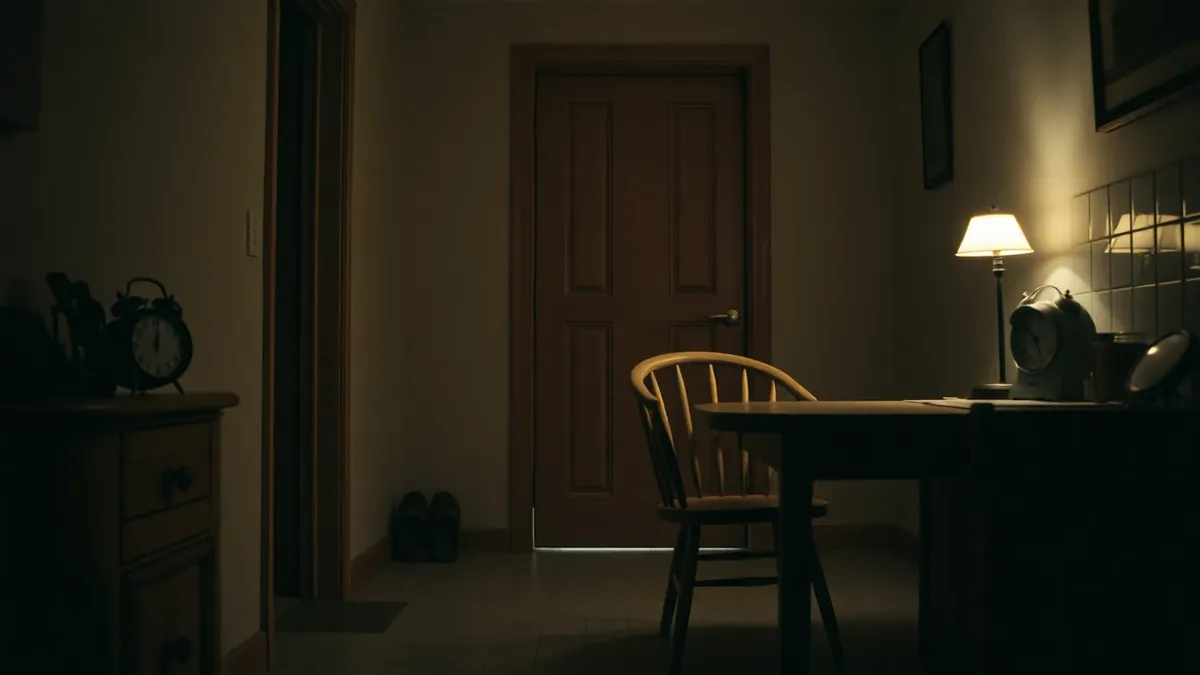
Four minutes is what he demands every night since his father-in-law died. Mr. Lakin stands up. With the backs of his legs, he slowly scoots his chair behind him. It screeches across the floor, but he shows no response. He turns his head to the right, as he does even when someone approaches his left ear. He looks down. Surprisingly, the chair doesn’t suit him tonight. He taps the leg; it quickly adjusts. With the chair now evenly behind his narrow body, he looks back up. He takes his left hand and rubs his fingers across his cracking lips as he cuffs his chin, surprised to feel a prickly patch of hair. The spot surprises him. In all his meticulousness, something is wrong. Mr. Lakin is off tonight.
Being conscious of eyes upon his movement and aware of his minute snafus, he grunts and looks around. Oh, an idea. He wants them to see his mind—the clever, rare profundity of it. Then, of course, he wets his lips. He bites down. He wants his family to admire his concentration. His eyes remain unwavering from the rusted silver watch spinning in the center of the mahogany table. The clock turns 9 o’clock. He slowly chants, holding onto each syllable. The room’s dirty eggshell walls begin to contrast. The light never goes dark. Cracks appear and vanish within the same second. A photo of the family begins to rapidly tick the wall, appearing like a clock possessed to show its prowess, with its furious hands losing control. The photo succumbs—Mr. Lakin, Mrs. Lakin, Junior Lakin, and Boy.
It breaks. Mr. Lakin, though, holds his focus—mostly. A couple of whiskers sprout from the side of his face during the ritual, but they leave, as the summoning fades. Success. Mr. Lakin looks at his wife and his son. He wants his nightly applause. He asks himself, “Don’t I deserve it?” They clap. Boy wags his tail.
“Wife, now you go,” Mr. Lakin instructs Mrs. Lakin. He values the ritual too much to omit even the tiniest command.
“Wait,” Junior interrupts. “Why do you always do the same thing every night? Don’t you think mom and I are competent enough to do this without you explaining every single detail? You know, we aren’t stupid. We know what happens if we don’t do it. I was too young to remember, but Mom tells me stories, you know? We do just fine by ourselves. We could even get it started without you.”
“Junior, you listen and you listen now,” Mr. Lakin says, pushing his finger into Junior’s chest. “Unless you want to go back to how we were before we finally got your grandfather’s watch, I suggest that you shut up and do as I say.”
Junior doesn’t verbally respond; he stares at his father.
“Wife, now you go,” Mr. Lakin, again, instructs Mrs. Lakin.
Mrs. Lakin stands at her command. She whispers her words, and she masterfully completes her process. She sits. No whiskers, no snouts, not even a growl. She shows no signs of weakness.
Mr. Lakin applauds his wife’s performance, while Junior locks eyes with his mother. She leads Junior’s eyes to Boy’s. They agree. Junior and Mrs. Lakin know what they must do.
Junior stands immediately, not giving Mr. Lakin a chance to instruct him. He leaps onto the table to grab the watch. He grasps it, but he puts it down. Junior slides off the table and returns to his chair.
Still seated, Mr. Lakin stares at Junior. Never, in all his years, has the ritual taken more or less than exactly four minutes. Mr. Lakin tries to continue, but he can’t break his stare with Junior.
Junior doesn’t cower. Still looking into his father’s eyes, he begins moving.
Junior reaches his end of the table and turns for his father. Mr. Lakin attempts to stand, but he falls. He gets on his knees to peek above the table. He sees his wife. He sees Junior. He sees Boy. Mrs. Lakin has her father’s watch in her hand.
Mr. Lakin has his hands at the edge of the table. He appears like an observer, spying from the outside. But Mr. Lakin is a husband, a father; in fact, he tells himself, he is the husband, the father of this family. “I did not tell you to touch that watch. Put it down now,” Mr. Lakin demands.
Mrs. Lakin tilts her head and looks at her husband. She sees him better than she has in years. She remembers. She is the one who knows all the spells. She is the one who taught Mr. Lakin all those years ago, when love was new.
Mrs. Lakin pounds on the table. She yells. Violently, the walls shake. The floor rolls, with small waves. The portrait, already on the ground, bounces. The already broken glass pieces break into tiny shards.
Mr. Lakin, still on the ground, peering above the table, tries to stand. He grabs the chair to help him up, but its stability is gone. He collapses again onto the floor. He shouts, “Stop! Stop this now! Stop! I said stop!”
Something unimaginable happens. Boy touches the watch.
“Don’t you dare let that mutt touch that watch! Mary. Don’t. You. Dare!” Mr. Lakin, feverishly sweating, yells from the floor, while still trying to get to his feet.
Junior and Mrs. Lakin look at Mr. Lakin. Without turning away from his eyes, they hold Boy’s paw against the now glowing surface of the old watch. They chant together, as a family. A new family. The one who challenged his father on so many occasions, the one who mocked his father’s foolish nightly ritual and was forbidden from participation, the one who had been what Mr. Lakin so desperately was afraid to become—Boy is back tonight.
Mrs. Lakin, Junior, and Boy all stand side-by-side. Mr. Lakin watches, helplessly crying, unable to even get to his knees.
Mrs. Lakin and her sons walk outside. Junior and Boy climb into the car. She doesn’t—not yet.
She enters the house again and approaches her husband. She stands over him, as he wobbles back-and-forth against the dirty floor. She considers laughing, but she doesn’t. She considers speaking to him, too, but she doesn’t. Instead, she opens her father’s watch and speaks four words. The spell Mr. Lakin fought for so long overtakes him. His nose appears wet; his two legs become four; his tail wags. When she turns to leave, she thinks she sees him chasing it. Satisfaction, almost.
Mrs. Lakin goes back outside to join her boys inside the car.
“Sons,” she asks, “what do you think about being free? Like we used to be?” She turns to look at them in the backseat.
Boy replies, “I think I’d be okay with it. As long as we stick together.”
“Junior?” Mrs. Lakin asks for her other son’s approval.
“Yeah. I don’t remember a lot,” he says looking at his brother, “but as long as we stick together, I’m fine with it, too. ”
“Okay. If you both are sure. But first, I have something I need to do.” Mrs. Lakin gets out of the car. Her boys join her side, as they look at their house. She takes her father’s watch and begins chanting. It’s over quickly. The house collapses and bursts into flames. A helpless yelp echoes, but it’s quick. Sparks shoot across the night sky. Then, she smiles.
Mrs. Lakin turns to Junior and Boy, and they each agree again. It’s decided. She uses the watch one last time. In unison, a pack of three wild dogs run howling into the open, night air.

“The Spell” was printed in Ditch'em, No. 7 of Inwood Indiana. Pick up the paperback from Prolific Press; the stories and poems published online are free to read here.
Get the paperback