
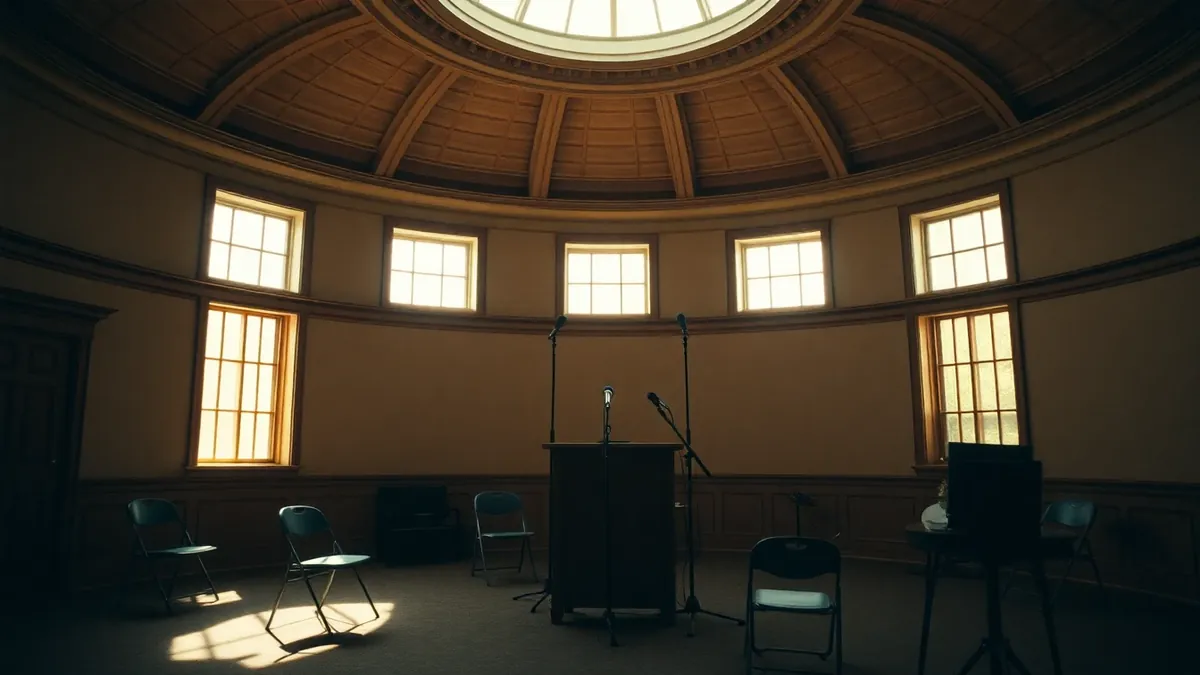
Monday morning, shortly before nine o’clock, a dozen people waited in the rotunda of Town Hall for a press conference. A television crew had set up lights and microphones. Reporters were on hand from local newspapers and radio stations. They had recorders, cameras, notebooks, and disposable cups of coffee. The domed space, with a circular balcony at the second floor, echoed and glared.
The entire staff of the Vindicator was on hand—Walter Nickles, Jimmy Lense, and Louisa Abernethy Jones. Nickles, in his trademark fedora, hob-knobbed with fellow reporters, while Lense checked light levels and camera angles. The television reporter looked predictably like a mannequin, preened and primped for the camera.
Standing on the polished marble floor, Louisa was glad that she wore her sensible shoes with the rubber soles. The only woman in the press corps, she observed the crowd. Patrick Willis had predicted the scene with disturbing accuracy. It was as close to a media circus as Hapsburg had ever seen. Louisa waved to her friend, Mavis Puffenbarger. The Town Hall receptionist had deserted her desk to hover nearby.
“I had to get a peek at the action. Oh, Weeza, maybe you’ll be on TV!”
At nine o’clock sharp, Town Manager Peter Stone stepped up to the lectern—behind him stood a large, solemn man in a gray suit. While Stone was no featherweight, he looked as slender as a reed compared to this man, who weighed three hundred pounds if he weighed an ounce.
“Ladies and gentlemen, I appreciate you all coming out this morning. As some of you may know, we had a busy weekend. On Saturday, an arrest was made in the case of Ralph Willis, who was found shot to death a week ago. That arrest led to an emergency meeting of our town council the same day. At issue was a possible link between our Chief of Police, J. D. Ryder, and the victim. On the recommendation of the council, Captain Ryder was then suspended with pay until further notice. Officer Norman Coles will act as head of the department in the meantime.”
“To continue the ongoing investigation into the death of Ralph Willis, Detective Stewart Blake of the Staunton Police has agreed to help us out. Lieutenant Blake is a familiar figure to some of you from his work in Staunton. A veteran crime solver with close to twenty years of experience under his belt, he will head the team in the days and weeks ahead. Without further ado, it is my pleasure to introduce Lieutenant Blake.”
Stone retreated from the lectern, and the man lurking behind him advanced to meet a flurry of photoflashes. Fortyish, with a barrel chest, thick arms and legs, and a bull neck, Blake seized the sides of the lectern as though he were about to lift it over his head. His gray suit hung on his massive frame like a sack. His black hair was slick on top and trimmed high on the sides, military-style. His necktie was askew, as though he were not used to wearing one.
“This may be a press conference, but I probably can’t answer any of your questions. Sorry to disappoint you on my first day on the job. I reviewed the file yesterday and talked to Officer Coles. He set up a temporary desk for me in police headquarters. I understand that the town has never had a case of this kind. The special circumstances Mr. Stone mentioned led to me standing here today. To the best of my ability, I will press for a speedy conclusion, so things can get back to normal.”
Blake relaxed his grip on the lectern to indicate that he had finished speaking. A reporter immediately thrust a microphone at him.
“Lt. Blake, is it fair to say that this heinous and bloody murder is unparalleled in the two hundred-year history of Hapsburg?”
“At the moment, we are treating it as a homicide which may or may not turn out to be premeditated, which would make it a murder.”
“Do you have any suspects?” another reporter asked.
“I reviewed the case, and at this point there are no solid leads and no suspects.”
“What about Patrick Willis?”
“The judge determined that there is not enough evidence to charge him.”
“Is J. D. Ryder a suspect?”
“As I said, there are no suspects.”
“Is Ryder’s career in law enforcement all washed up?”
“It’s too early to say. In any case, I would not be able to comment on his future.”
“Is it true that the victim engaged in lewd and lascivious behavior that very likely resulted in getting him killed?”
“I can’t comment on that, either.”
“What about the robbery theory?”
“It appears that valuables were taken from the house. In the past week, the police department has been working on a theory that the crime originated as a robbery. It may have escalated to violence that led to the fatal shot.”
“Are you still looking for clues?”
“I am combing through what has been collected so far. I intend to visit the crime scene soon. I will leave no stone unturned in the search for all available evidence.”
“Is the arrest of Patrick Willis a significant breakthrough?”
“In a case that has so far provided few leads, it’s promising.”
“Are you going to charge him again?”
“That depends on additional evidence. So far as I know, Mr. Willis will be in the county jail for six months, during which time he will be available for further questioning.”
“What about Ryder? Are you going to grill him?”
“At the moment, I have no decision on that. I may request that Captain Ryder come in for an interview.”
Peter Stone leaned sideways into the lectern. “A great deal of work lies ahead of Lieutenant Blake, and he is eager to get started. We are fortunate to have him aboard. He has promised to keep us informed of developments as they occur. Thank you all for your interest.”
“Don’t go anywhere,” Nickles said to Louisa. “Stone and Blake agreed to give us first crack at an interview.”
“He just said that he can’t answer questions.”
“And then he did. Come on, Louisa, where’s your sporting instinct?”
As the other news crews started packing up and moving toward the street entrance, Nickles grasped Louisa by the elbow and steered her toward the stair which would take them down to police headquarters.
“Lense, did you get any good shots?”
“Yes, boss.”
“You head back to the office while we grill Lt. Beefsteak. See you there.”
Police headquarters occupied the basement of Town Hall, with windows and a grade-level entrance at the rear of the building. Massive stone walls and the subterranean location evoked a sense of security. Norman Coles was promoted, for the moment, to Captain Ryder’s office, just behind Beth, the office manager and dispatcher. The temporary desk for the detective turned out to be the heavy-duty table in the interrogation cell. A well-worn briefcase lay open on the table, and a file trolley was parked beside it. With his suit jacket off, necktie loosened, and gun in its shoulder holster, Lt. Blake appeared to be right at home. He pointed to two steel side chairs, the only other furniture in the room.
“Thanks for squeezing us in,” Nickles said. “Allow me to introduce Mrs. Jones, who is covering this story for the Vindicator.”
They shook hands. Lt. Blake made no attempt to lessen his vice-like grip, and Louisa winced with pain. He seemed not to notice as her right hand dangled uselessly from the wrist.
“Are you familiar with our newspaper?” she asked.
“I can’t say that I read every page, but I see it at the office. We try to keep up with all the local papers. Don’t you write the social notes?”
“It’s a lifestyle column called Tittle-Tattle.”
“How did Peter Stone locate you?” Nickles asked.
“All the departments in the valley stay in touch,” Blake said. “As it happens, J. D. Ryder is a good friend of the Staunton Police Chief. They were in the same class at the police academy. Stone asked for names, which included my boss, and made some calls. Chief Powell then sent me on this special assignment. It’s a cute town you have here, very historical.”
“We like it,” Louisa said. “Does J. D. Ryder also happen to be a friend of yours?”
“Years ago, we met on the football field. We had some close personal contact in the form of tackles and scrimmages. Since then, we’ve run into each other at regional meetings on police business.”
“Is there a time limit to your assignment?” Nickles asked. “Any idea how long you will be in Hapsburg?”
“As long as it takes. You see, Mr. Knuckles, I’m a bulldog. Once I get my teeth in a case, I don’t let go. Nothing can shake me off.”
“You mentioned that you reviewed the case yesterday,” Louisa said. “That isn’t much time to form an opinion. Can you tell us where it stands?”
“I can’t comment on the work done by my predecessor, except to say that he went by the book. And Coles and Truncheon did everything that could be expected of them in the line of duty. It’s far from an open and shut case.”
“You mentioned questioning Patrick Willis,” Nickles said.
“The brother angle is interesting. I haven’t had a chance to meet him yet. Maybe we can wring something out of him.”
“Do you mean a confession?” Louisa asked.
“If he did it.”
“Somehow, Lt. Blake, that is not reassuring.”
“How so?”
“With very little evidence, and no other suspect handy to interrogate, it sounds as though you intend to apply pressure.”
“My job is to find out what happened and to catch criminals.”
“And our job is report the facts,” Nickles said, looking sidelong at Louisa, “How do the facts look, Lt. Blake?”
“We have the autopsy report, the bullet analysis, prints, and samples recovered from the house, photos taken by your man Lense, and statements from various people like Wolfram, the guy who discovered the body.”
“But no eyewitness, no weapon, no suspect, and no motive,” Louisa said.
“Correct.” The detective’s face darkened. The editor saw a storm looming on the horizon.
“As for the stolen items, wouldn’t they be fenced or pawned by now?”
Louisa asked.
“Only if the thief was desperate for cash. Even then, whoever takes in the items may not be in a hurry to report them. It could take weeks for that kind of information to surface.”
“What if the thief hangs on to them?”
“Then they don’t do us any good.”
“Unless you find them. Wouldn’t they be a link to the killer?”
“Yes, but how? It’s like looking for a needle in a haystack. Check all the pawnshops in the state? Without the victim here to tell us, we’re not even sure what was taken.”
“Come now, Lt. Blake. It isn’t that difficult to find out. In concert, Ralph Willis was a flashy dresser. He wore a tuxedo and jewelry. You should be looking for a gold bracelet and a set of pearl shirt studs.”
“Is that right? I suppose you can tell me if it was 24-carat gold and the size of the pearls. How do you know his new boyfriend didn’t slip them into a pocket? What’s his name?”
“Gary Nash.”
“And if he did, what’s to stop him from claiming they were a gift?”
“All very plausible, Lt. Blake. Why don’t you ask him?”
“As soon as I can get my hands on him, I will.”
“If that happens, I hope you will remember to advise him of his rights.”
“Maybe you know where he is.”
“No more than you do.”
“Maybe you are deliberately withholding evidence.”
“Certainly not; I just gave you a clue.”
“From an unknown source, which may have nothing to do with the case. Anyway, who cares about some homosexual?”
“Are you referring to Mr. Nash or Mr. Willis?”
“Which Mr. Willis?”
“The deceased. It hardly seems appropriate to refer to him by an epithet.”
“Maybe you should go back to your gossip column.”
“Time out, you two,” Nickles said. “Mrs. Jones is new to this type of investigation, Lt. Blake. We appreciate any nuggets of information you can toss our way, and we look forward to briefings in the weeks ahead.”
“I don’t expect it will take that long,” Blake said.
“Thank you, Lt. Blake.” Louisa gathered her coat and bag. Nickles held the door for Louisa, who swept through like a ship in full sail. She calmed down as they walked to the Vindicator office.
“I thought you were going to take a swing at him,” Nickles said. “Then I would have to write about you: Lady reporter attacks meathead detective.”
“Perhaps I went too far.”
“It’s easy enough to do.”
“Thank you for acting as referee.”
“Don’t mention it. And don’t let Blake ruffle your feathers. Maybe he’s a social conservative, or maybe he’s a troglodyte in a cheap suit. Either way, we need him more than he needs us.”
“We’ll see about that.”

“The Press Conference” was printed in Crossroads, No. 8 of Inwood Indiana. Pick up the paperback from Prolific Press; the stories and poems published online are free to read here.
Get the paperback