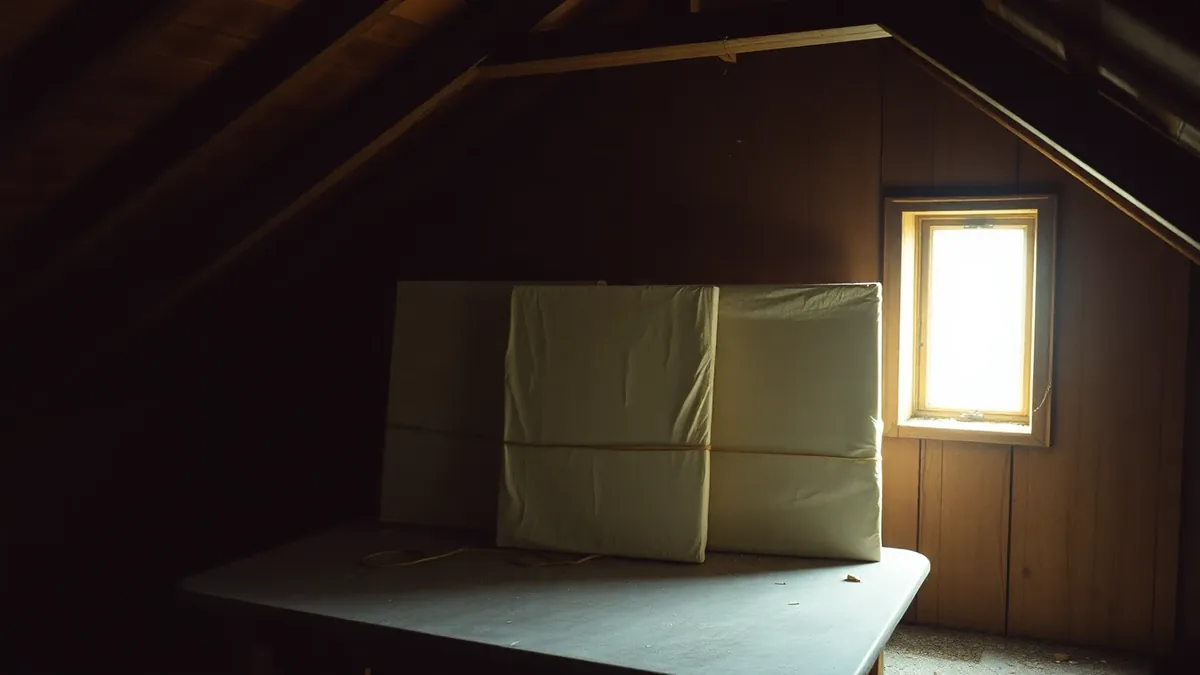
Whoever the artist was, he wasn’t very good. There were three of them altogether; unframed canvases wrapped in tissue paper and bound together with string so old, it snapped and slipped off the packages when he lifted them. Carlos swiped his hand across the first painting and the frail tissue crackled and flaked away. He hauled it out into the bedroom and held it up to the sunlight that streamed in through the gauzy window curtains.
The first painting depicted some sort of medieval courtyard flanked with lush trees and flowers in yellow and pink. A small black mongrel hunched at the foot of a dry fountain. At least the creature looked like a dog. Or perhaps it was a cat or a squirrel. It was hard to tell. At first glance it looked as though the artist had abandoned the painting halfway through finishing it. The second piece Carlos hauled from the closet was a watercolor in no better shape than the first. This one depicted what appeared to be a quaint European village complete with thatched roof houses and a stone bridge arched over a stream. It was a little more refined than the first, but not by much. Carlos could see why his beloved abuela would have preferred to keep these paintings hidden away in the closet rather than hang them on her walls. Knowing her penchant for fine art, she would have been disgusted by such shoddy and amateurish work. He wondered why she had bothered keeping them in the first place. They were of little use for anything other than a yard sale or a dumpster.
The third painting depicted a girl, perhaps in her early teens, sitting in a meadow of rippling grass and gazing wistfully into the horizon. She wore a white apron over a long blue dress and a pink babushka. In her lap she clutched a small bouquet of wildflowers. There was something familiar about her features. Carlos held the painting up higher and squinted at the image. Of course. It was abuela as a young girl. He knew it even before he noticed the words “Rose, 1917” scrawled in the bottom left corner.
Abuela had not been called Rose since her childhood days in Austria.
Once the family had immigrated to Argentina in the 1920’s, she had abandoned her native German and changed her name to Rosa. This was a painting of a girl who no longer existed, not in form nor language. “What’s that?”
The sound of his sister’s voice startled Carlos. Tara stood in the doorway, one hand tapping impatiently against the frame. She looked tired, and she had every right. The task of cleaning out abuela’s house had taken a toll on them both. It wasn’t that her death had come as a big surprise. After all, few people, especially in their family, lived to their nineties, let alone past the one hundred and ten mark. It was a miracle she had lived so long.
“Some old paintings I found in the closet,” Carlos replied and held the portrait out to Tara. “I think this one is of abuela.”
Tara leaned forward and peered at the painting. A lock of grey streaked hair fell loose from its bindings and dangled before one eye. She brushed it back and tucked it behind one ear.
“Not very good,” she said. “Do you want to keep it?”
“I don’t know,” Carlos replied and glanced down at the other two paintings. “We don’t have any other pictures of abuela as a young girl.
And there’s these other two that are even worse.”
Tara picked up the painting of the village and snickered.
“She should have burned these,” she said.
“Maybe they meant something to her,” Carlos suggested.
“Then she should have hung them on the walls.” Tara turned back into the hallway. “Come help me in the kitchen. I’m almost finished.”
Carlos laid the paintings on the bare mattress on the bed. Tara had long since stripped off the sheets and coverlet and packed them into boxes.
He followed her into the kitchen where every cupboard yawned open.
The contents had been removed and the shelves peeled off scarred strips of sticky lining. Several crates of dishes, pots and pans sat the counter. Tara sealed them shut with a tape gun.
Together they lugged the boxes to the garage. There was plenty of room out there. The garage hadn’t housed a car in over thirty years, not since abuela had lost her license and sold her old car. She had never been a very good driver anyway, and it had come as a relief to both Tara and Carlos that they no longer had to worry about her on the road.
It was dark by the time they finished. Carlos lifted the garage door. A light rain had begun to fall and slicked his face with cool drops. The old neighborhood looked so much smaller than he remembered, the street narrower, the other houses more dilapidated. A ‘For Sale’ sign was impaled in the front lawn. So far, there had been no offers.
“I’m going home now,” Tara said, slipping her arms into the sleeves of her coat. “I’m beat. I’ll be back in the morning to finish in the living room.”
“I think I’ll spend the night,” Carlos said. “I’m too tired to drive. Besides, the truck might come early tomorrow.”
Tara hoisted one of the boxes onto her hip and fished her car keys from her pocket.
“I’m taking these dishes,” she said.
“Drive carefully,” Carlos said. “The roads will be slippery.”
He hugged his sister—a little tighter, a little longer than he expected. Abuela’s death had not come as a surprise, but the depth of his grief was still there.
“Get some sleep,” Tara whispered.
“I will. See you in the morning.”
He watched Tara’s car pull away from the house, wipers slapping at the rain that beaded the windshield, scarlet taillights winking and slowly disappearing into the dark mist. He lowered the door and turned to look at all the petty sums of his grandmother’s life stacked in boxes, awaiting the Goodwill truck to cart them away.
The house seemed hollow. Most of the furniture had either been sold or taken away by other relatives—cousins, aunts, uncles, various in-laws, who had pounced like a pack of scavengers the day after the funeral. All that remained was a threadbare couch nobody wanted and a few dining room chairs that were ready to collapse under the weight of whoever tried to sit on them. Abuela’s beloved artworks had been stripped from the walls, leaving behind rectangles of dust on the wallpaper.
Carlos stretched out on the couch and pulled one of abuela’s hand-knit afghans over his body. He was exhausted, right down to the marrow, but he couldn’t sleep. Thoughts of his grandmother skipped through his mind, warm memories of him and Tara spending childhood summers in this house while their parents vacationed alone. She had remained spry right until the end, but in those days, her energy was boundless. She had done all the usual grandmotherly things such as knit sweaters and bake cookies; but she had also taken them on long hikes through the mountains. At night around the fire she had regaled them with stories of her own youth in the “the old country” in her unique accent which was a strange combination of German and Spanish. In their teens, she had encouraged them to take up some sort of creative art such as painting or sculpting, allowing their inner savant to bloom. Carlos was convinced he wouldn’t be the successful graphic artist he was without her support and guidance.
This made the thought of her hoarding such amateurish artwork all the more laughable. The portrait he could understand; after all, she had no pictures or photographs of herself as a girl, and it was probably her one last memento of her childhood. But there was no reason for her to keep the other two. They were so bad she wouldn’t even hang them in the house.
Carlos began to doze. The rain pattering upon the roof was soothing and he allowed his mind to drift. He wondered who the artist was. Perhaps he had been a close friend, a confidant. Given the age of the girl in the painting, perhaps he had even been an early lover. Even in her youth, the thought of abuela sliding under the sheets, or in her case, a hayloft, with a spritely young man, made him snicker. The date on the painting suggested it was toward the end of the first World War, a time when many soldiers from both sides were trekking through central Europe.
Carlos jerked from his slumber and sat straight up on the couch, the afghan falling from his legs. He’d noticed the artist’s signature on the paintings before, but at the time he didn’t bother with the name. Now it became clear.
He leapt from the couch and sprinted down the hallway to the bedroom, flicking on the lights as he went. The paintings lay on the bare bed where he had left them earlier that afternoon. He scanned the lower right corners of each painting. The signatures were all identical and clear:
“A. Hitler”
“The Inner Savant” was printed in Tracks, No. 9 of Inwood Indiana. Pick up the paperback from Prolific Press; the stories and poems published online are free to read here.
Get the paperback