
Dana, the younger brother, had not seen the North Arlington house for so long the sight of it came up hard against his memory. It now seemed such a modest house from the outside and small inside, not much bigger than his condo– kitchen, living room, family room, bedrooms, the one bathroom– all smaller than he remembered or wandered through in dreams. The furniture seemed smaller too. The dark mahogany dresser, his father’s, was no higher than his shoulders, his mother’s companion piece was just waist high, and everything was within reach. He picked up a Lladro figurine, a dandy in a tricorn hat, from his mother’s dresser, then put it back down. He knew he could get something for it, but something told him to leave it alone. It was too soon for that, and he would do better to take in the bedroom, the whole house, as it had always been. His parents’ twin beds, after all, were the same, as was his mother’s writing desk against the window, and when he opened the blinds the view outside in the Saturday afternoon sun was the same—the backyard apricot tree, the long privet hedge screening the property next door, the small opening he could crawl through to escape his older brother, Victor. Down the hall, their own bedroom was also the same.
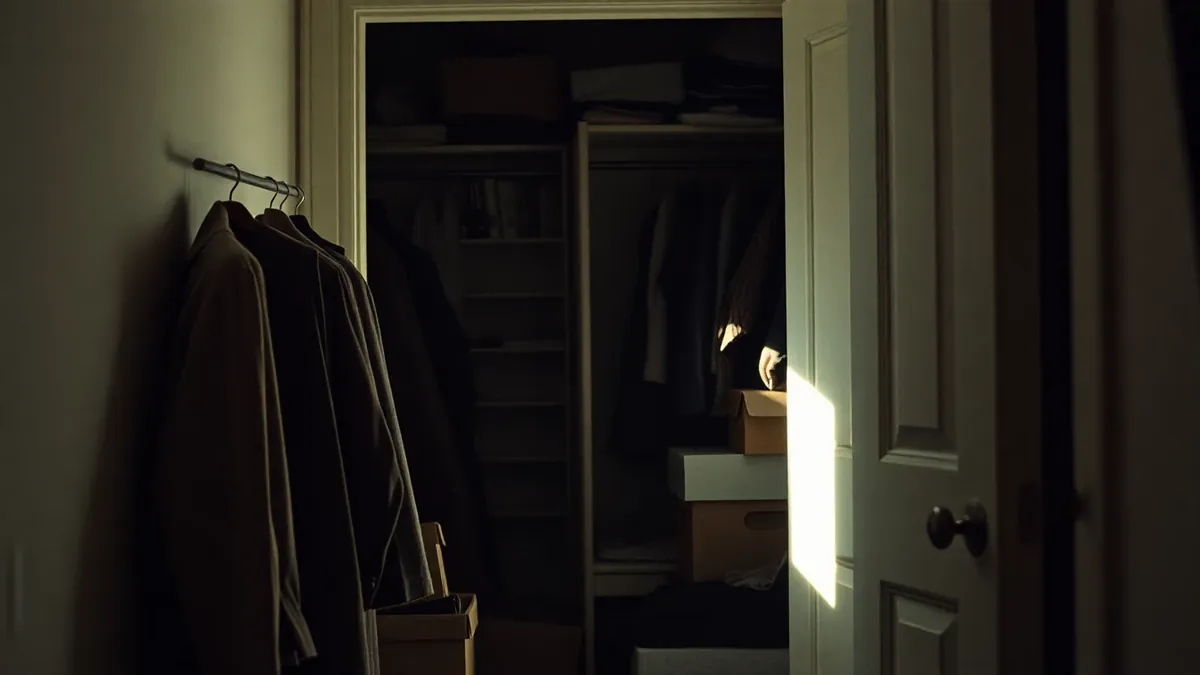
Their boyhood furniture was still there—another twin set, maple, a matching double dresser, two carrel desks, and their window view of the front yard, Wynn Lane and Dr. O’Brien’s house across the street– shadier but about the same. The bedroom closet, though, was in disarray. Both folding doors were off their hinges and leaning against the wall. The inside was piled high with cartons marked “Documents,” “Checks,” “Photos,” and a range of years from his father’s boyhood to his own and Victor’s, a jumble of dates and boxes stacked randomly. Of course, all their old things were long gone, their pressed clothes and good shoes–Victor’s on the right until he left for college in California—and boyhood things they had shared from time to time—the stray hats, baseballs and board games on the shelves, the fishing tackle, racquets and bats leaning in the corners, things that had also led to fights.
He re-arranged two or three boxes of photographs and albums that seemed about to topple over, but he was not about to sit down on the edge of his old bed and start leafing through them. They included him, of course, but they still seemed more his father’s property than his own. He focused more attention on the home movies—eight-millimeter reels in canisters stacked behind the shoeboxes, some of them as old as his father’s childhood but most of them from his own and Victor’s. There were dozens of canisters marked with titles on masking tape— Victor and Dana Swim Team, First Bicycles, Victor/Football, Dana/Halloween, Yellowstone/Grand Tetons, and Birthdays, Birthdays. The old projector in its case and a screen were there, and he recalled how the bar in the family room had been perfect for setting everything up, something he could do himself as a boy while the adults sipped their cocktails. Nowadays, he reflected, people did not watch their old home movies, but transferred them to DVDs– much easier to set up, if just as boring—if they watched them at all, after spending all that money. In any case, his father, likely to stay put in an assisted living complex, could hardly operate a newfangled DVD player any more than he could remember how to work an old movie projector.
He left the closet doors as they were and walked back to the kitchen for a look in the refrigerator. He found a single bottle of Irish beer behind a spoiled carton of milk. As he fished in a drawer for a opener, he wondered why the movies ended up in their old closet, moved from the family room cabinets, handsome built-in cabinets on both sides of the fireplace, the obvious and better place to store them. Their mother had been dead for years, and surely their father had not been up to it. Only Victor could have moved them. Was Victor planning to take charge of the whole archive, estranged, unsentimental Victor? He got the top off and drank the beer over the sink. It then occurred to him the home movies were a unique part of the family archive. Unlike many of the old photos, the movies were an only copy of the past and should be preserved, however expensive it might be. As the older and by far wealthier, Victor should see to this, he told himself, and, lately, he did seem more civil– a change in tone Dana had noticed when they talked a week earlier about a bill from White Beech. The bill should have gone to Victor, not to himself, and Dana had phoned him at his home in McLean on a Sunday afternoon. Victor said he was surprised to hear from him and asked him how he was.
“I have a bill for two hundred dollars,” Dana replied. In the background he could hear music, laughter, people in the swimming pool, Julie, Victor’s wife, laughing, and he pictured Victor sitting on the terrace with a drink. “It’s for a walker. Can you believe that? Two hundred dollars, some special kind of walker.”
“Dana, it’s what they go for and a used one at that.”
“Well, you said in your letter you would be picking up the uncovered expenses.”
“Don’t worry about the bill. I’ll take care of it. As it is, Dad can’t use the thing much. He can barely get out of bed or the wheelchair now, not without someone to lift him. I could send it back, but he has some idea he might need it in case of fire. He thought there was a fire last night, and apparently rolled out of bed onto the floor, then tried to pull himself up. They found him stretched out by the walker with some cuts and bruises on his legs. We got him back in the bed, and the doc came by to bandage him up.”
“Don’t bother. I went ahead and paid the bill myself, and since I have you on the phone I think we should agree on who is going to start keeping up the house. It’s a mess— full of dust, and the fridge should be cleaned out.
Everything in it has spoiled, and one of the closets has both doors off. I think you know which one.”
“Dana, I’m advertising for a tenant, and I’ve lined up a cleaning woman for two days a month. Again, don’t worry about the money. Dad still gets ten percent of everything the law firm makes, not to mention income from two annuities and Social Security. I’m writing his checks and he has plenty of cash in a number of accounts, large amounts in CD’s and a respectable fortune in Treasuries.”
“Do you have a key to let her in?”
“The cleaning woman? She starts Thursday, but I’ll have to let her in and out. He doesn’t want anyone alone in the house, and I can’t talk to him about it. He doesn’t have the attention span. I have one key. He lost his. He can’t remember where it is.”
Dana did not want to press him about a key for himself. Victor, he knew, would not let him have a key, even though he might say he would. But, beyond Victor’s usual possessiveness, he was not worried– He knew he could get in the house on his own whenever he wanted. Today, he had used another key, the back door key, found where it had been hidden twenty years ago– in a sandwich bag under the birdbath by the apricot tree. When they were both in high school, he had looked out the kitchen window and seen Victor put this key in the bag, tilt the birdbath and hide it underneath. He did not blame Victor entirely for the subterfuge. Their father would not let the boys have house keys, not even when they were in their teens, and Victor in desperation had lifted a key from his mother’s purse and taken it to Bede’s Hardware for copying. Mother had found out, then father, and there was a row. Victor had thrown a punch at his father.
Dana finished the beer, saw the trash bin was too full to take anything more, and left the bottle on the counter. The matter of the key gave him some pause, and, as he thought more about it, he began to doubt Victor’s civil tone. Perhaps there would be no point in calling him again and bringing up the home movies more explicitly. If he did, Victor might agree to take on the expense of saving the archive and then do nothing of the kind.
He walked out the back door and locked it. Looking at the birdbath, he realized he could not hold on to the prospect of a reformed, magnanimous Victor and put the key in his pocket. Why indeed had Victor moved the archive from the family room to their old bedroom closet and said nothing about it? What was he up to? The albums and the home movies– especially the home movies—might have offended him early on, and moving them around was perhaps some tactic in a strategy to get rid of them. Half the images were of the two boys together. Dana at least looked happy as a child, but Victor, he remembered, seemed resentful at every age, at every event. Perhaps he wanted the fleeting joy of possession only to throw everything away—a joy more satisfying than reconciling around their father’s deathbed. True, Victor did see his father at White Beech and often, but that did not mean he liked the old man anymore than he liked his brother or had liked their mother. He probably disliked all his relations– Their very existence would have wronged him. His general demeanor had softened somewhat, but underneath must lurk the envious first child and the bully.
Someone, Dana concluded, had better save the archive from Victor, and when he reached his car door he knew he would have to do it himself. He would load up his car—perhaps this week—then drive home and up to the storage room door off the lower level of his building, and somehow make space in his bin. It would be a challenge, but at least the movies would be safe from Victor. Victor had been a difficult, resentful child. Everyone said so. If he did want to make amends by keeping up the house before selling it, so much the better. He could afford to do such things–He was now a partner in his father’s law firm, and, after all, he was the older brother.
He said nothing further to Victor about the closet. That evening, however, he did bring the matter up with his wife, Erica Wong Watmaugh, his second wife. They had not been married long, but they had known each other for years as colleagues in the Department of Motor Vehicles interviewing people who had mislaid their licenses or needed their traffic citation records. She saw right away where he was going and cut him off— “What are you thinking? We don’t have any room here.
We live in a condo not a house. The closets are too small as it is. The building is old, and the closets are small. All the rooms are small, and we don’t even have a dining room. The bathroom is small. One bathroom, and it’s small like the closets. The closets are jammed, and don’t even think about the storage bin. It’s a joke, slapstick joke. Stuff tumbles out like a joke when you open it up. Let Victor take those movies. He has plenty of room. He lives in a big house in a nice neighborhood with lawns.”
“I’m not sure I trust Victor with the movies. It’s like an archive, you know, a family archive.”
“Victor and his wife even entertain people, rich people and lawyers from his divorce cases. I used to talk to Marty Vandever from traffic court, and he knows all about Victor’s firm and his money. Victor makes more than your father did. I’ve been in your father’s house two, three times, and if you want to take something out of that old house don’t take some old movies. Take his bedroom furniture. It’s no good to him anymore. He’s never going back there. Get rid of the crummy bedroom furniture you bought for this crummy condo. Give it back to the curbside where the people pick up divorced man’s kind of furniture. It’s total crap, and we are married two years. Your parents’ bedroom pieces are mahogany, good quality. You told me you had money and I should quit my job, becoming happy homemaker, but if you’re not buying me a decent house at least provide some decent furniture. I’m not asking for whole house of furniture, just one bedroom set, no big deal.”
She walked into the kitchen, and he waited before he followed her. She was taking a pound of hamburger out of the freezer.
“Well then, why don’t you take all of Dad’s furniture?” he said, “the living room, dining room pieces?”
She turned around and looked at him. “His living room is wicker, and the dining room table is glass with wrought iron chairs, like patio furniture. It looks odd, like it doesn’t know where it belongs, inside or outside.
Bedroom set is fine, master bedroom– not the spare bedroom with that exercise stuff, and not your old bedroom furniture, kids’ furniture, definitely not that. Master bedroom is still good. Victor is probably over there already with movers loading it up in a truck.”
“I’m not sure I want my parents’ bedroom set,” he said, “not in my own bedroom. And I’ll tell you about odd. It seems odd to me, familiar but at the same time odd, like I’m sleeping with them, an aura of them.”
“What in hell are you talking about?”
“The furniture you want.”
“I don’t feel any aura.”
“And it’s a twin bed set, you know.”
“I prefer twin beds, and let’s not get into that.”
She went back to the hamburger. He walked out of the kitchen, then outside into the building hall, then back in. She was chopping onions, and he stood in the kitchen doorway.
“All right,” he said, “which parent’s bed do you want for your bed?”
“It doesn’t matter.”
“It might matter to me.”
“In that case I want your father’s bed.”
“Why my father’s?”
“I said it doesn’t matter to me.”
“Is it because you want to sleep in my father’s bed or because my mother died in her bed?”
“Grow up. Your father is seventy- two years old. It’s furniture, just furniture. I’ll use Kam Douglas, Cousin Nancy’s boy, and he can use the pickup from their business, swimming pool service. A big kid, really big, and it will help her out too. She calls me on the phone yesterday and she says, ‘My God that boy eats! He’s eating me out of house and home! He’s bringing his friend Cyril over for dinner last night, someone he’s meeting at pool, and this is disturbing me.’ So I tell her, I tell Nancy, ‘Sounds like a nice rich boy with pool for your business.’ And she says, ‘No, not rich boy, and not nice but loser, dropout, tattoos all over. The kid is someone he’s meeting at pool room in Manassas and not at swimming pool mansion.’ “ “I don’t want any kids like that in my father’s house.”
“We’re both laughing hard on phone about this, about pool and pool, but she is then still going on about this Cyril, who is a bad influence on Kam Douglas. So I think we should use Kam Douglas, pay him a little extra money so he won’t get involved with this guy in any shady kind of deals. Then at the same time she is telling me Cyril has his own truck and does odd jobs. So today I’m thinking we can use him after all to help Kam Douglas with moving furniture—nothing else, just moving–then bring the boy over here for dinner when he’s done moving the furniture– not both boys, just Kam Douglas. I have turkey roast in the freezer– but don’t let him bring Cyril. They can do it Sunday afternoon, only day of the week Kam Douglas can do it because of his job. Two trucks, and the two boys can do it in one trip, three hundred dollars. He can use the extra money, a nice boy compared to Cyril, but not long enough in this country. His English is poor, holding him back. And I’ll have him take your crummy bedroom set to Salvation Army in Manassas, no extra charge. Better say two hundred dollars for each boy. You can afford that at least– a little extra to keep him away from Cyril and some shady deal, who knows what.”
“I want him to bring a few other things from the house,” Dana said. “And I want him to bring all the old home movies with him, plus the projector and the screen.”
“All right, I give you that.”
“They’re in my old room in the closet. Have him put everything in the storage bin here, even if you have to take some things out to make room, things of yours I should think.”
“Your father won’t even know about his furniture. You won’t have to bring it up with him. He’s not even sure where he is most of the time.”
When he thought about seeing father at White Beech, Dana might have said as much himself, but on his next visit, the staff physician, Dr. Flores, told him his father was improving. He was now on a drug regimen newly approved for geriatric care, apparently more aware of his surroundings, and he could stand up and take a few steps without falling. There was yet more encouragement from Dr. Flores– “Mr. Victor Watmaugh, Senior can go back home, provided he has a caregiver for at least part of the day to clean him up and fix one hot meal.”
Then a physician’s qualifier— “And no, I can’t say how long the results will last. I see some patients on this regimen with dramatic improvement for as long as three, even six months or longer. They can move into the apartments, if they want, or go back home. It’s still new, so we really don’t know how long it could last.”
That evening, Dana told Erica the good news.
“A part-time caregiver, that’s all he needs, and it’s less than we’re paying at White Beech. The first thing we’ll do is get him back home in his own bedroom with his own things. I need to line up the caregiver, someone who can cook. Still expensive, of course, but less than now.” She looked up from her TV Guide, frowned, and went back to it.
“ It’s just part-time care,” he continued. “What do you think of that? You should be happy about that.”
She put down the magazine and began to brighten.
“Kam Douglas will be the caregiver,” she said. “Once out of Nancy’s house, he can live in the old house with your father. This is cheaper with food for him too, so he can keep his pool job and buy some of his own food, learning his English in spare time. Lodging should be free for him as the caregiver. He can sleep in your old room where you were younger, and he is improving his English living with lawyer, native speaker with college education. He is also spending lot of this time away from Cyril.”
“Kam Douglas is a boy. You just told me that.”
“He’s nineteen now and took care of his own grandfather in Shanghai for almost a month all the time to the end. He knows what to do and is big enough to lift your father into the bathtub. I can help with the cooking– prepare dishes here, and Kam Douglas can heat things up if he has to. I will just have to wait a little longer for the furniture.”
In bed that night she was still pleasant. He did not raise the question, but she assured him his parents’ twin beds— whenever that day would be– would make no difference when he wanted her. At breakfast the next morning she smiled at him, and he felt more generous himself.
“As soon as Kam Douglas moves in with your father,” he told her, “I’ll have all the home movies transferred to DVD. I’ll take everything down to Monte’s Video and have them do it. I’ll pay for it, and Dad will be able to watch the movies whenever he wants. We’ll all get together at the old house and watch them. I’ll buy him a DVD player, and Kam Douglas can put in the discs for him until he learns how to do it himself.”
“I’ll take care of everything with Kam Douglas,” she said. “He’s good with electric devices. They all are at his age. Mechanical genius.”
She did follow through, and when she finally introduced Dana to Kam Douglas there seemed nothing to worry about. The well-fed young man seemed big enough to lift Mr. Watmaugh in and out of a wheel chair, in and out of a bath, and tuck him in at night. His English was not very good, but he had a cheerful, positive attitude—He responded with “Can do” to every question Dana asked. And Erica reassured them she would visit every day with dinner, or at least once a week with several dinners prepared for the freezer.
Dana followed through as well, and within a week Monte himself called from the video store to say the family film archive, now transferred to six convenient discs, was ready to be picked up. Kam Douglas appeared for further instructions, and Dana asked him to swing by Monte’s for the discs and the originals on his commute to the Arlington house.
“Mr. Watmaugh is back home now,” he told Kam Douglas. “Watch one disc with him when you get there, just one to start, perhaps something from our earlier childhood, a welcome home present for him.”
“Can do,” Kam Douglas said, and he made a rubbing motion with his fingers.
“Already paid for,” Dana said. “Just pick up please.”
“Can do.”
“Perhaps I’m talking too fast. You put in disc in the DVD player I got for father and hooked up to his TV, and you watch movie on disc with father. Erica and I will be over later with dinner and some for freezer.”
“Can do, no problem.”
“Tell Monte or whoever the name—Watmaugh, Dana this, Victor that, childhood, bicycles, birthdays, Halloween, and so on. They are expecting you to pick them up. Six discs.”
“Victor and childhood. No problem.”
“Victor is grown up now. Just say Watmaugh.” He handed Kam Douglas an index card with the family name printed in block letters. “They are expecting you. Call me if there is a problem.”
“No problem. Victor is grown up.”
Kam Douglas followed through as best he could. This meant taking Cyril with him to Monte’s Video.
“It’s hard name for spelling and pronouncing,” he said to Cyril after parking the truck in front of the store.
“Written down here.”
“Watmaugh,” Cyril said. “I know it. What’s the first name?”
“Victor.”
“Victor Watmaugh. What the fuck, Victor Watmaugh the divorce lawyer in McLean?”
“He’s grown up now.”
“He’s a dip shit is what he is. Last year that dick head fucked up my Mom’s divorce so bad she got no alimony, just fucking child support she has to use for rent and shit. And he’s still making her pay his fucking bill—thirty dollars a month every fucking month for five years or some such shit. And we’re here to do what?”
“Pick up old movies. Victor grown up now.”
“Just leave it to me. Wait here.”
Kam Douglas was content to wait, and when Cyril climbed back in the truck and handed him one disc, not six, he did not object.
“It’s all on one disc,” Cyril said. The fucking idiot at the counter had the order all fucked up. He gave me six discs instead of one, and he was expecting me to take back a crate full of film cans and shit, but I told him to throw it all out—‘Throw all that shit out, I want a refund’– and he starts to go fucking ballistic, so I had to take something else from the store to calm him down. Then I had to walk out the back with all that shit in the crate and throw everything in the dumpster on my own. No refund, but I sent a message. This DVD here is a classic”—he held up a budget Hollywood feature in a thin box—“cost me three bucks out of pocket because this Monte or whoever he’s like picking up the fucking phone to call your Victor and looking at me. But, see, I’m telling him I’ve got what you want, because it’s got Victor’s name on it, Victor all grown up, and he says just take it too, so I’m thinking I can send a message to your dip shit friend in McLean, a message for Victor fucking Watmaugh– All Grown Up.”
Kam Douglas nodded at what seemed the gist of the explanation, but he had his doubts about showing up with just the one disc. He said part of the same to his elderly charge later in the day when he put the disc in the player, tried to explain something about it showing Victor all grown up, and outlined a procedure for operating the player.
“A message film, you say,” the old man said. “Jesus H. Christ. Can’t we watch the Sports Channel or maybe Jeopardy? I feel ready for Jeopardy.”
“Your son and someone else say better off watching the message. Son is over here at night with Erica and they’re bringing dinner. They will ask about it, and I can’t understand everything. Help me out and I help you out. This movie is about your home, a home movie. Victor is in it.”
“Victor is in it. Jesus, wake me when it’s over. No, don’t wake me. Let me die peacefully.”
But to Kam Douglas’s peace of mind Mr. Watmaugh stayed awake and alert throughout the film. The feature was not three generations of home movies but Kiss of Death with Victor Mature and Richard Widmark. Thanks to Dr. Flores, Mr. Watmaugh remembered seeing it as a boy on first release in 1947, and he was eager to share the memory with his new caretaker. Kam Douglas was well into his third bowl of popcorn and smiled politely.
“My father took me to see it,” he said. “I was nine.
Mother was visiting Grandma Celeste in Fredericksburg. She had taken the Saturday morning train down there but left dinner for us in the icebox, leg of lamb, which I never liked much but was able to eat with the mint jelly and the baked potato. After dinner, my father and I rode the streetcar downtown to the old Warner Theatre off Pennsylvania Avenue, just the two of us. My first time there– It was a huge theatre, and the movie had started. The usher, a tall, pretty redhead in a uniform and a little hat, led us to our seats with a flashlight because the place was so big and dark. The movie was in black and white, as you saw, and they were so dark in those days. The plot was hard for me to follow, too old for me then. I thought there would be kissing and then someone would die as a result, a kiss with poison lipstick or incurable germs. I did not understand that a kiss of death meant betrayal, someone close to you betraying you. I did not know that word, betrayal, but I could tell the Mature character was not all bad, and I knew Widmark the gangster was hopeless after he kicked the old lady in the wheelchair down the stairs and laughed at her. Do you understand any of this?”
“I can, yes– Must try my best to resist any such temptation in caretaking. But sometimes it is very difficult for me having patience with old people, slow kind of people not in right mind and bad tempered, people too long living.”
“Me too, and don’t get me going about my boys. Back then, I just wanted the picture to be over, but it wasn’t, and my father leans over and whispers to me, ‘I have to make a phone call. I’ll be back in a few minutes.’ He sold insurance, life insurance, house, car, and he had to call people to sell it, even at night. He stands up and leaves his hat on the seat, but then he remembers something important, bends over and whispers in my ear again– ‘Don’t let anyone sit next to you while I’m gone. And don’t let anyone sit on my hat.’ Then he disappears into the darkness. Now I’m frightened of this movie I don’t understand very well, and the darkness, the vast, dark theatre, the harsh and difficult dialogue of the actors, the somber music, the violence, the pervasive unhappiness. And I’m frightened at the prospect of someone strange sitting next to me, someone menacing, a large man who might bother me, or maybe someone who is going to sit on the hat because it’s dark and he can’t see it there on the seat. I was just nine. My father is gone a long time, and I’ve lost any sense of the movie. I look down the aisle wondering where he is and at the same time worrying about someone else showing up. Then it actually happens. It all comes to life. Someone, a large, shadowy figure who can’t possibly be my father starts down the aisle toward me, and I pick up the hat. But then I realize picking up the hat is like inviting the stranger to sit down next to me. I don’t know what the hell to do. I put the hat back on the seat, pick it up again, put it back— and the man sits down on it. ‘Sorry,’ he says, gets up and continues down the aisle. Now I have the hat in my hands, and I can tell it’s ruined– a perfect, neatly blocked, fedora hat that businessmen wore in those days, even when they were just going to the movies with their boy. And now it’s ruined. I try to give it some shape, but I can’t do anything with it. It’s hopeless. I close my eyes, and when I open them I’m looking up at the screen again, but now I see a shadow moving across it—This time it’s my father starting down the aisle toward me . . .”
Kam Douglas put his hand on Mr. Watmaugh’s shoulder– “Enough,” he said. “Stop. Erica is here with Dana. Be distracting from any business problems about Monte’s Video and how many discs. No, maybe not distracting, maybe worse thing all over. Not saying anything is maybe best for family harmony.”
Mr. Watmaugh did not ask Kam Douglas what these business problems might be or what the problem at Monte’s Video– which he took to be a city in South America—was all about. Dinner conversation, however, took a turn toward discovery when Dana brought up the subject of special days and events in the old house– Birthday parties in this very dining room, around this very table, his parties and Victor’s—once even a joint birthday party since their special days were just a month apart. Dana was the only one with a drink, a third glass of white wine, and Erica had brought a chocolate layer cake for dessert.
“Victor raised a stink about sharing a birthday party,” he said. “I didn’t mind it myself. I was ten and he was little more than a year older. I looked up to him, not because he was older and bigger but because I thought he had a certain magnanimity somewhere deep inside him, a big brother trait that would come out when it really counted. That’s what I thought then.”
He sighed and laughed at his lost ingenuousness, then looked at Erica as if for confirmation. She got up from the table, gathered plates and silverware and took them into the kitchen. He turned to his father sitting in his wheelchair, then looked at Kam Douglas seated next to the old man as if expecting one of them to say something. They had no more to say than Erica did, so he brought the conversation into the present.
“What did you two think of all that ancient footage? How much did you get through?”
“We saw good part of it,” Kam Douglas said right away.
“Good movie, not everyone in it all bad, just one all bad.”
“I do know what you mean,” Dana said, “though perhaps that is an observation better left to the immediate family. When I hear you say it, I’m put in an awkward position. I know you mean well.”
“Thanks for passing it on to us,” Mr. Watmaugh said.
“Thoughtful of you, both of you. You are both good boys.”
“It’s meant for you,” Dana said. “That’s why I ordered it.” He filled his glass again.
“You know,” Mr. Watmaugh continued, “seeing it again I understand it better, a lot better. Some good insights do come with age. I even see a theme, something I did not have a word for when I was younger.”
“I suppose you mean something about Victor,” Dana said.
“If you want to put it that way.”
“How would you put it?”
He raised his arm and pointed to a sign in air– “Betrayal.“ He put his arm down. “I never understood it until now—this kiss of death from someone you trusted, an ingrate, a remorseless sociopath really, someone who deserves everything he gets, or doesn’t get, I should say– eventually. It’s biblical, I guess.”
Dana was taken aback at what he heard. True, his brother was no doubt wealthy enough already—but his own father disowning Victor, the first- born– He tried to say No to the old man, but he felt tears and the word caught in his throat.
“I should not have brought it up,” Dana managed to say before starting to weep. He got up quickly—“to help Erica in the kitchen.”
But when he saw her at the sink rinsing plates, he turned away, walked down the hall and ended up in his old bedroom. The room was dark, but he did not turn on the light. He bumped into the closet doors against the wall, and a layer of shoeboxes tumbled down, spilling photographs onto the floor. He felt for them with his hands, then sat down on the floor. He could make out the two beds by the gray light of the window, and he thought about what it meant to be the sole heir of his father’s estate, how his life would change into something magnificent, how ecstatic Erica would be when he told her, and whether having a swimming pool was more trouble than it was worth.
Dinner over, Kam Douglas pushed Mr. Watmaugh into the living room then went back to the table to collect napkins and glasses for the kitchen. Erica sent him to fetch Dana— “He’ll be in one of the bedrooms,” she said, “and I have something to say to both of you.”
Dana had not quite recovered but returned with Kam Douglas and pretended to listen to her.
“I’ve put five dinners in the freezer,” she said drying her hands. “When you’re over here next time all you have to do is heat them up in the microwave. Kam Douglas, you can do it but don’t try cooking anything on the stovetop or have any kind of alcohol to drink– I’ll hear about it and tell your mother. If Cyril shows up, don’t let him in the house and don’t go anywhere with him. I will find out.” Kam Douglas nodded and smiled, and Dana looked up at the ceiling. Clean up remained brisk and quiet, and none too soon the four of them were gathered at the front door, chorusing how well everything had worked out with Mr. Watmaugh– happy, surely, to be back in his own domain. Dana, now composed, feeling more than generous, held out a folded twenty- dollar bill for Kam Douglas and told him how important it was to choose his friends, the right kind of friends, if he wanted to get somewhere in this country. Mr. Watmaugh did not seem to notice this gesture but turned to Erica and motioned for her to bend close to him. He had something to tell her that he did not want Dana to hear.
“My bedroom set,” he whispered close to her ear, “the two beds, the two dressers, the writing desk—I want you to take them, you and Dana, but don’t tell him just yet. Tell him when you get home. No, wait. Don’t ruin the rest of your evening. Tell him in two or three days. I have to touch base with Victor first, but he won’t want that old furniture. He’s happily married and has a fine bedroom set, a big bed, four poster, large night tables, two beautiful dressers, what you call colonial style, highboys. Their bedroom has a sitting area, easy chairs, all very nice furniture, and a large walk-in closet. The master bathroom has a big tub, a spa type with jets, and a separate shower stall, a large one with two nozzles. Two people could use it at the same time. Believe me, he won’t want to bother with a twin bed set.”
“Where will you sleep?”
“I’ll have Kam Douglas haul the old set over to your place. He’s a good boy, you know. I have a new set on order, a double or queen- sized bed, I forget which, a new dresser, night tables, a big TV cabinet like you see in a hotel. Everything will be here soon, maybe next week. I’m not sure of the day.”
“You don’t like your old bed anymore, and your wife’s?”
“In those days twin beds seemed more fashionable, more respectable or something. Heather wanted twin beds. I never liked the arrangement, always wanted a bigger bed, a double. In some ways, you remind me of her as a younger woman.”
“Thank you, Mr. Watmaugh,” she said, and kissed him on the cheek.
“Just call me Victor,” he said, “and you never know, I might get lucky.”

“The Closet Legacy” was printed in Derailed, No. 3 of Inwood Indiana. Pick up the paperback from Prolific Press; the stories and poems published online are free to read here.
Get the paperback