
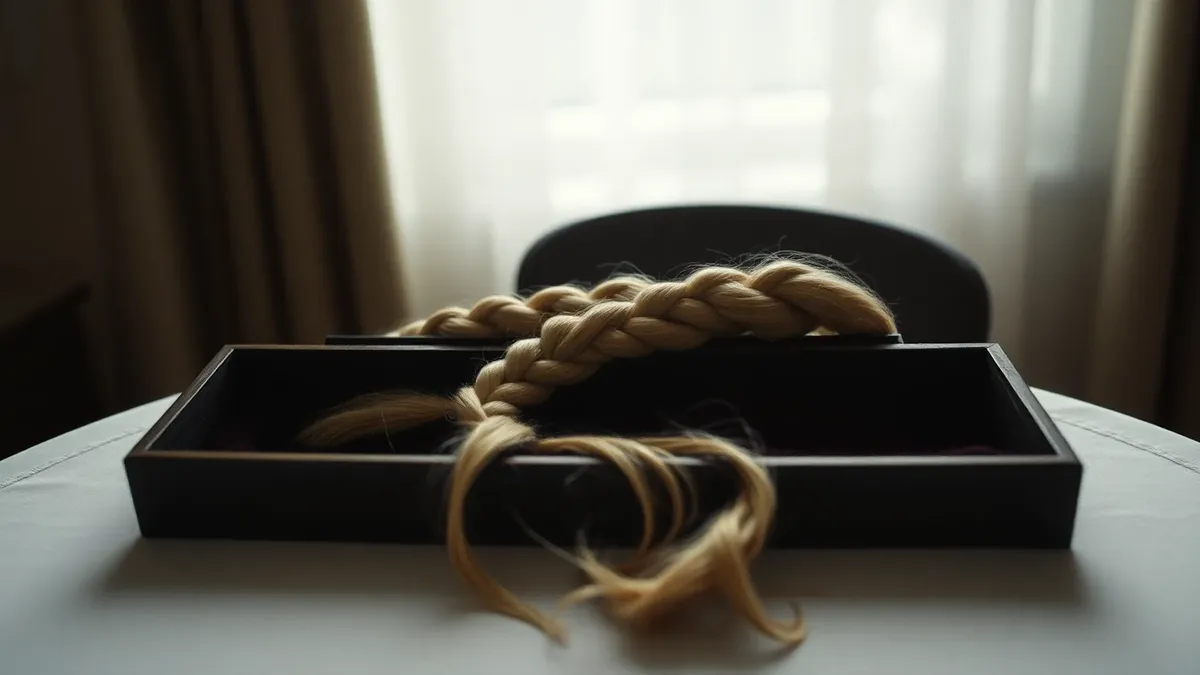
Anna Hansberg’s braid needed trimming. She sat in her hotel room in Vienna with the braid on the table before her, stroking the thick blond rope of hair while she considered increasing its length. The braid lay nestled against the walls of velvet lining in a narrow wooden box. The severed hair had grown over a foot since Anna had last opened the smooth, dark case. She saw the braid, tied at each end with tattered red ribbons, was now curling against the confines of the shallow walls of the case. “I snipped the ends nearly two weeks ago,” she said to no one in particular, for she was alone in the hotel room.
Anna was staying at the Zakeri House on Waringherstrasse while visiting her fiancé Josef, who attended the University. She resided in the small Alpine village called Modane, where both she and Josef had been children, attended school together and spent their winters sledding down the mountain hills holding hands even as they careened down tiny paths at treacherous speeds, narrowly missing ancient fir trees.
Anna was now a lithe, sensual young woman of twenty, with blue eyes that pierced Josef whenever he was near. She was to meet Josef later that evening at a jazz club on the outskirts of the Ringstrasse, not far from the Zakeri. Anna became increasingly agitated with the wait.
The braid did not belong to Anna in the usual sense, in that it had not come from her head. It was not her hair. Counting on one hand, Anna determined she had been in possession of the braid for approximately four months. Each time she and Josef had spoken on the phone, Anna in Modane and Josef in Vienna, Anna tried to tell him about the braid but she found herself unable to do so. At every pause in their conversation she would begin to describe the events leading up to her ownership of the braid, but either Josef interrupted with a sudden need to speak with a professor passing by the payphone, or Anna chose to stall and instead shared a story about another teacher at the school where she taught young children.
As she sat at the little mahogany desk, Anna examined the soft rope of hair as if for the first time. She petted the thick interwoven plait with her long delicate fingers, allowing her naked fingernails to slope into the crevices of each neat tuck, and to follow the journey of each yellow bundle in and out of its folds. The hair was smooth and shiny with a light coating of natural oil, unlike Anna’s own hair, which, although also blonde and without a single piece of gray, sat short on her head like a halo of meringue. She could not have grown a braid like the one before her, and as her fingers moved along the hair from end to end, Anna’s face came closer and closer, until her small nose grazed the braid, and she jumped back in her seat, startled out of the spell the braid had cast upon by its familiar scent.
Anna quickly closed the case, not checking to make sure that the ends of the braid were properly tucked within the confines of the velvet interior. She demanded fresh air, and hurriedly closed the latch of the box, which was about the size of a flute case, and put it into her bag before she laced the long strap over her shoulder and left the room. Anna turned right at the hotel doorstep and walked toward the Inner Ring of the city. At the sweet shop next door, Anna watched three elementary school children squeal and chase one another in a tight circle, their plump hands fervently diving into crisp white bags filled with treats. Their nursemaid ignored them and spoke with the florist’s handsome helper, who sprayed the sidewalk with a hose and flirted with her in kind by playfully spraying too close to her feet. These games reminded Anna of Modane and the days when she and Josef lived a less burdensome existence.
Anna paused fifteen minutes later when she reached the Votivkirche at the mouth of the boulevard. She was flushed from her quick pace and turned into a café for refreshment. Happily, the afternoon was waning and in only a few more hours she would meet Josef.
Anna placed the braid in its case on a café table and ordered a hot chocolate and a piece of sweet bread. Something about the children’s candy, and the vibrant purple and red tulips reflecting like living rubies in the wet sidewalk light outside the florist’s shop had made her hungry for a sweet taste. Anna absentmindedly ran her palm over the wooden box, and when the waiter placed her order before her she was startled to see the sweet bread was a light honey-brown color and braided. She took a hurried sip of the chocolate and burned her tongue.
“Damn it,” she exclaimed to no one in particular, as the café was empty but for an elderly woman in a lode green coat, who sat with her miniature terrier in the back of the room.
Anna traced the shiny curve of the bread with her finger for a moment before she picked it up and took an aggressive bite. It was dry and not as sweet as she expected. She opened the wooden case once she noticed a few blond strands poking as stiffly as horsehair through the crease of the box where it opened. Astonished, Anna picked up the braid and held it out at arm’s length.
“Why, you’re another six inches long!” she said to it. Anna pretended not to notice that the tattered red ribbons remained at the edges of the braid, rather than becoming closer to the center as the hair grew inside its velvety womb. The braid grew as if its knots were multiplying out from the center rather than the unknotted edges of the hair growing outwards as one might expect. Anna finished her chocolate in two large mouthfuls and left the bread half-eaten. She called the waiter from the far side of the room, interrupting his boring conversation with the woman in the green jacket. After paying the bill, Anna fled the café with as much composure as possible given the circumstances.
Outside, the afternoon had paled and the colors of store signs and of passerby’s clothing seemed in need of a dusting in the increasingly dim light. Within her shoulder bag, the wooden case grew heavier on her shoulder. Anna passed by the Votivkirche, resisting the sudden desire to enter and pray beneath its gothic buttresses. The need to be near living, growing things compelled her to the garden—perhaps if the braid were in an environment with trees and flowering bushes that grew in smaller, more modest increments, it could be persuaded to slow its ambitions to match those of the natural world. Anna sat on a cold marble bench beneath an archway of roses that had been tamed to climb a lattice and opened the box on her lap.
“Do you see?” she said to the braid, which lay in its soft open bed. She gestured to the flowers in their soft beds. “They have been trained to climb and grow in beauty in a steady, controlled rate.”
The braid was now long enough to hang over each end of the box, its blond edges touching the smooth polished stone beside Anna’s leg. She leaned her face down towards it and turned her ear close to its center as if waiting for a whisper in reply.
When the braid spoke, it was in her mother’s whisper. It told her that it could not help but grow. It told her that though the body from which it had been cut lay entombed in a graveyard in Modane, its love for her was now the cancer.
Anna corrected her body from its position folded over the braid so quickly she nearly knocked the case from her lap. She looked up at the twin spires of the Votivkirche and made the sign of the cross. Then Anna looked at the quiet, growing braid, in its deep velvet case, and slowly untied each of the red ribbons. She removed a one-eighth section of the braid and carefully made a smaller, thinner braid out of the hair. Anna retied the long ribbons around the ends of the new braid, folded it in half, and placed it into the case. Anna placed the case into her bag, one hand clenched around the thick, unfurling hair that remained.
She knelt in the nearest flower bed, placed the hair beside her in the dirt, and furtively dug between the tulip beds, dirt stuffing itself beneath her fingernails. When the hole was sufficiently deep, Anna laid the blond hair in it, kissed her blackened fingers and touched the hair, and then covered the hole. She hoped the braid would learn from the purple tulips and learn to control itself.
As she walked away from the church park, Anna glanced back and believed no one would notice the little mound of dirt among the flowers that indicated her planting. She would wash her hands at the University and place them on Josef’s cheeks and greet him with enthusiasm. She would mention nothing of the braid, what it had said how she had partitioned and buried it.
Throughout the many years of her happy life with Josef, Anna would keep the braid as her one secret. When the smaller portions grew thick and long enough to have a voice, Anna re-divided the braid and buried the heft responsible for the whispers in various church gardens around Vienna. But she carried the case with her always and over the years said to no one in particular, “I am unable to bury my mother’s love.”

“The Braid” was printed in Salem Cemetery, No. 6 of Inwood Indiana. Pick up the paperback from Prolific Press; the stories and poems published online are free to read here.
Get the paperback