
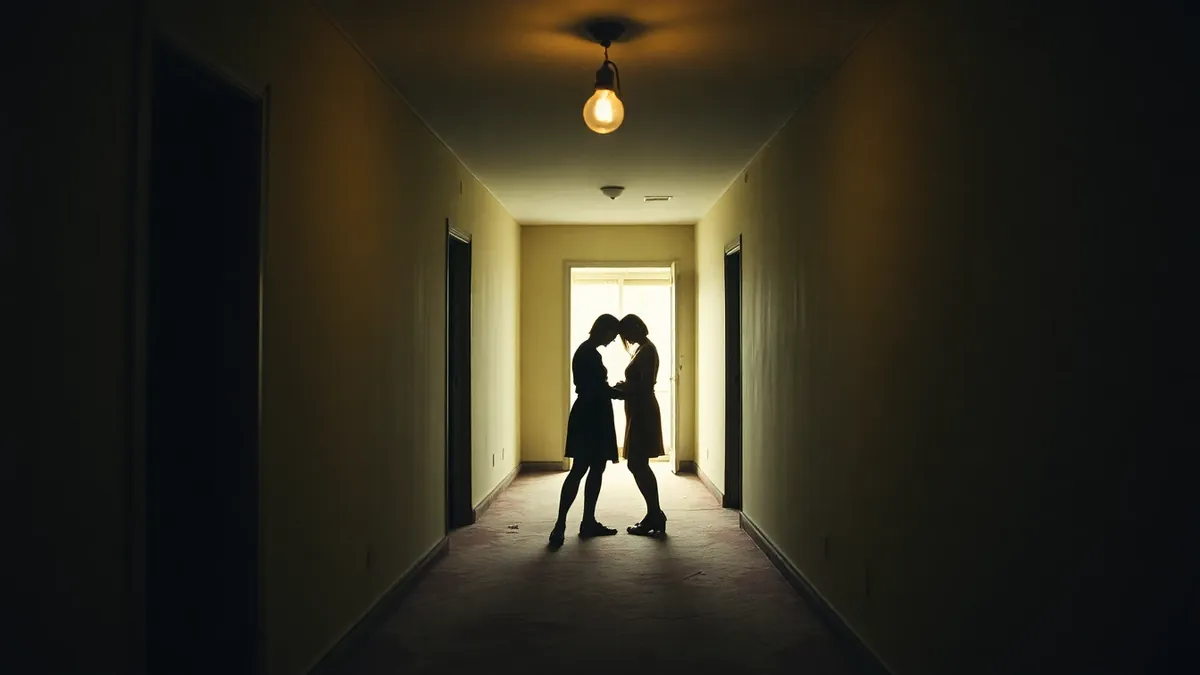
The foyer was empty, which would have comforted Jersey, but Darby kept stumbling as they climbed three flights then shuffled the length of the hallway. While she struggled to shoulder him up, Jersey kept thinking about her mother, right before she’d slapped Jersey’s face and ordered her not to come crawling back. That had been a month ago, but her cheek suddenly flared, as though her mother had reached across time to touch her again.
They reached the door. Darby scarred up the wood around the bolt lock’s casing, rooting for the lock with the key, and she wondered how much he’d had to drink before coming to pick her up, how much drink it had taken him to get up the nerve to go and do what he’d done. Maybe it hadn’t been enough, she thought, judging by his state. He’d gone slack-kneed as soon as his left foot touched the slip-scabbed pavement of the parking lot outside, and she’d had to pull him from the seat and shove him across the sunken lane where the rain always pooled to the door, and then up the stairs to where they now stood, fumbling about in the dim hallway, for any one of their neighbors to come out and see.
Taking his hand, and holding him though he tried to recoil from her touch, she asked as calmly as she could for the keys. He let go of them, then waited patiently to be let inside, quiet as mouse. His eyes were large and seemed to shudder in their sockets, shaking by twitching muscles. She let him in first, and shut the door behind her and turned the lock and then stood there pressing the door closed as if against some intruder, trying in vain to gather up a connected thought though all that came was the look on her mother’s face:
Flat brow, eyes like dimes on a table.
“You’re a child,” she had said, then slapped Jersey’s face. “All you can see is roses.”
She nearly retched on the floor between her shoes, eroded by the fryer grease slicking the floor tiles, spattered and then smeared into the rust-red tiles by Jersey as she poured out the fries into the larger basin beneath the warmer lamps, made up large and small containers, and chicken nuggets for the kids’ meals. The smell of her clothing cloyed at her nostril, her stomach churned again and she coughed and spat, unable to help herself.
Darby had dug the pistol out of the crotch of his jeans and slumped into an armchair by the window, and wordlessly watched as Jersey hurried into the bathroom and stared at the sink’s drain. Nothing came up, and her stomach tilted but held. She still felt sick meeting her eyes in the mirror: dark-rimmed; round as quarters. She touched the glass, smeared a finger across the spotted pane, and figured she’d looked this way probably all night, from getting off at work to riding with Darby back through the town, past the nicer houses toward the shabbier ones, and past those to the trailer homes, abandoned and otherwise, where he parked and got out and was back into the car inside of three minutes, huffing.
“You know what I can’t figure?” Darby said, gazing dumbly at the curtains when she returned to the main room, which was also the bedroom and the dining room. The kitchenette nestled just past Darby against the back wall. “Why he didn’t get up and try to stop me. I walked into the place and he was just sitting there, and I pointed the gun at him and told him to stand up, but he didn’t.”
All but his buzz’s edge had worn off now. Dragging his finger across his teeth, he looked at her—for the first time actually seeing her, it seemed, the way his eyes and lips shrank. With the gun, he pointed at the bed. “Sleep a while. You’ll feel better after a nap.”
She paced the room, hands bunching up in the waistband of her flannel shirt. The walls were textured, choked with speckled bits of paint. It had appealed at first; now the speckles looked like flecks of grime. “You want to wait?”
“What else?”
She stood there, at a loss. She should be packing clothes, running. She didn’t have a car, and maybe three hundred in a bank account.
Darby closed his eyes, leaned back in the chair. “No one in this hole knows or cares one way or another what happened.”
She hugged herself to keep from shaking. When she’d gotten into his car earlier, she hadn’t known he’d brought the gun or that he had any intention of confronting the guy, someone Darby’d split a shift with at the plant, someone Jersey hadn’t known from Adam. He and Darby had gotten into a fight a week before, out at a bar, over some misunderstanding, something the man had said about Jersey being jailbait, underage.
Something, too, about Darby robbing the cradle. A few days later, the guy keyed Darby’s Riviera, an old boat of car Darby’d kept running out of pride more than lack of means.
If Darby hadn’t been laid off, maybe the guy’s comment wouldn’t have mattered so much.
“He died, didn’t he? Did he die?” She stood over him, hands-on-hips frantic, stomach burning. She had sat in the car. She hadn’t seen the man fall. “You’re beyond-a-doubt positive?”
His hands trembled, the gun bobbing uselessly in them. “So what?”
“Well, we’ve got to leave, don’t we? Shouldn’t we run before this gets too hot—?”
“You’re thinking about a cop show,” Darby said, and laughed, then swore, then was silent.
Jersey hadn’t been, but she was now: detectives piecing together clues, asking questions, getting rough with suspects if the situation called for it. She went over and sat on the bed, like Darby’d suggested, but her knees quivered with nervous energy, so she got up and walked into the kitchenette and stood there.
“Are we going to go? You were talking about Raleigh, your uncle and the construction work he could get you. Right? That was serious, right?”
Her neck went cold when she realized she'd turned her back on him. She didn't move when he spoke.
“Serious as a shooting,” he said, and laughed again. “That was a while ago. Maybe it’d still be a go.”
“What,” she said. “Did you just think this would be like any other thing, it’d happen and the world would just forget about it?”
“Mom,” Darby sneered.
Jersey winced. “Jesus, why did you do what you did?” she said, turning and walking back to him, stalling when she saw his hands still around the gun.
“That car was the one I’d always wanted, back when I was a boy, when my dad had one a few days and then wrecked it. A big boat of a car, but it had—” Darby stopped talking. “Whatever it had, now it’s got a big key scar the length of it. It’s got that and that’s all it’s got now. A key scar.”
He met her eyes. “Maybe I took a little too much crap as a kid. Maybe--” he pulled up his shirt and showed her the scar across his stomach, “this isn’t something I want to let happen to me again.”
Jersey watched him lower his shirt and then watched him slide a finger along the length of the gun’s barrel. It was a gun out of a cop show, a snub-nosed little pistol, like a lighter or a letter opener. She didn’t understand how the scar and the asshole from the bar were connected, and she didn’t know how to ask. Darby’d already made up his mind, anyway. He was past answering questions.
Cursing, and ignoring Darby’s command to stop whimpering, she went to night stand, opened the drawer and reached inside, but there wasn’t anything where the little satchel should have been, the piece and the glass beside it. A new ache settled into her stomach.
“No sky rockets in flight for you tonight,” he said, lifting his eyes to the ceiling. “Not like it was yours to begin with.”
“We bought it with money from my job.” Again she tried sitting on the bed, but her hands were shaking to match the trembling in her knees now, and she could no longer stand the sight of the grimy wallpaper or the rattling of her heartbeat as it echoed up into her head. “I don’t understand,” she said, her voice a yelp she struggled to get back under control.
Darby looked dragged-out opening his eyes, hardly the same man whose hands knew where to touch a car’s engine, how to make her come. He’d never hit her, never once shown her violence. Rumors were he’d once knocked a kid’s jaw up into his head with one solid punch. The year before, he’d done time in juvie for dealing. He’d been with another girl then, but that girl had cheated on him, and Darby had got rid of her, and Jersey had been there to talk him through things. He’d danced with her once, in the living room of this very apartment—held her close and led her through what he’d called a rumba, and she was so young and so sick of her mother’s boyfriends eyeing her every time she walked through the living room, she’d been grateful to be treated like something worth handling gently. Darby’d shown her how to fly. He’d been the one to put in her mind the idea she was more than just a girl, or a piece, or a hanger-on.
That gun in his lap made him something else.
“You said you could buff and sand a scuff out of paint job," she said, "that you’d done it yourself when you worked in the garage at Apollo.”
“Principle of the thing,” Darby said. The shade of the lamp fell across his cheeks. He didn’t say anything, likely he knew that she knew what they were against now.
Then he lifted the gun, pointed the black notch of the barrel at her face.
“You’d go to the police,” he said. “That’s what you’re saying.”
“Cut the shit,” Jersey said, heart hammering, sweat breaking out along the length of her spine. Tears came and she begged him to put the gun away. She backed into the bathroom and begged.
“I need you,” he said, “and you turn into this.” His lips quivered, and he lifted the gun barrel to his temple, hefted it there, but she saw his fingers all around the hilt, the trigger untouched. He puckered his lips and blew out a garbled spit-bang.
She took the gun off his finger, dropped it into the trash can, then pulled out the desk chair and sat, listening to the wash of traffic outside the window.
“What are we going to do,” she said.
Darby stood, slipped around her into the bathroom. Through the door she heard the water running, the sound of one deep, dry heave. He came out of the bathroom and tugged the jacket on, asking her for the keys, finding them where she’d left them on the nightstand. Jersey followed him into the hallway, then stood at the stairs and watching him shuffle down the three flights to the main floor, pressing a hand to the wall to help him balance. From the window overlooking the lot, she watched him lumber into the side of the Riviera, leaning against it for support as he dug the keys out of his pocket and unlocked the door. He climbed in. The brake lights glowed as he backed the car into a wide turn, the front quarter panel inches from gouging the Mustang beside it. The old car shuddered between gears for a minute, and Jersey could see him struggling with the gearshift, his free hand pounding the steering wheel. He slammed his forehead against the wheel. He gripped the wheel and she could see him mouthing curses at the car and his lousy luck and his shit life. Soon, he got control of himself, figured out the problem, and then he pulled out of the lot and drove in the direction of the freeway.
She slumped against the glass wall and tried to catch her breath, struggled to keep from crying. She didn’t want to be heard, in case anyone was around. She wanted to hide, and to stay hidden. Her own face in the mirror came back to her, and she couldn’t imagine having to stand in front of another person, anyone besides Darby, and speak in her own defense. Her mother would have nothing to say to her, Jersey knew that. She had set the line and Jersey had already crossed it.
It had grown darker outside, and the sconces filled the hallway with wan light. Standing up on stiff legs, she walked back to the room. The door was open, resting against the jam. She paused, hand on the knob, and imagined opening the door and confronting the business end of the pistol raised to her face. But Darby was gone, and no one had come up the stairs or even entered the building since he’d left, so it was silly, hysterical fear, and once she realized this it was easy to shake it off and give the door a healthy shove.
A wave of light from the sconces spread across the carpet of the empty room. Heartened by the sight of the room as she’d left it, she pushed open the door and crossed without hesitation to the trash can, reached down into its stained and cruddy guts and pulled out the pistol. Then she sat on the bed, cradling the gun in both her hands. It had an angular handle that fit the palm, slender trigger guard, a barrel with a sliding sheath she pulled back, finding a round still chambered. It was still warm from Darby’s hands on it.
Her shakes temporarily forgotten, she turned over the pistol in her hands, her fingerprints marring the barrel’s greased surface. She wondered what would happen if Darby did come back, what he would want to do, with her, with himself. She figured there would be one way, one right way—the way it had to be, now. Running made you guilty, was worse than an admission because it was an action and actions spoke louder, more loudly, than words did. Taking hold of the grip with her right hand, she pointed the gun at the center of the television’s screen and then shifted her aim to the window, toward a stand of trees bordering the interstate. The gun fit perfectly into the groove of her palm, making it easy for her to imagine its kick were she to pull the trigger and send a bullet through the glass and out into the damp night air. She made the sound of an explosion in her throat, lifted the barrel to her lips and blew away the imaginary plume of smoke curling up out of the bore, then dropped the pistol to her lap, laughing in spite of herself—exhilarated by the childish gesture.

“Roses” was printed in Salem Cemetery, No. 6 of Inwood Indiana. Pick up the paperback from Prolific Press; the stories and poems published online are free to read here.
Get the paperback