
The day that marked Joseph Shaw’s one year anniversary of quitting his gambling addiction, his wife left him. Joseph wasn’t surprised. He knew he was the type of guy these things happened to. It didn’t matter that he now worked full-time as a postal carrier, or that he had quit eating refined sugars, or that he successfully completed two sleep studies to try to remedy his snoring problem. It didn’t work, but still…he tried. He even changed his facial hair, going from a full beard to a mustache. He finally had health insurance. He remembered to change oil in both cars. He recycled and was aware of when he, at times of laziness, decided not to. He mailed bills. One year clean of addiction, and here he stood in his kitchen holding the green post-it note that was stuck to the refrigerator.
Joseph, We both KNOW it’s over.
Bye.
He read it over and over again. Did she mean that they both knew it was over the same way people knew that it was “a good way to go?” He had often found this expression to be completely ridiculous. People said it with such surety as though they had heard full reports of drowning being far superior to a plane crash, or a heart attack beating out cancer, or being shot as opposed to being hanged. One was a good way to go, and the other, well…was simply unfortunate.
Was this the same thing? Did they both know with that same blind surety? And, did this outweigh the equally unknown, perhaps simply unfortunate, alternatives?
He had shrugged then. He often communicated in silence.
This was nothing new. And yet, in a way, it was. There was something different about this silence. It was thick, awkward, and wrong.
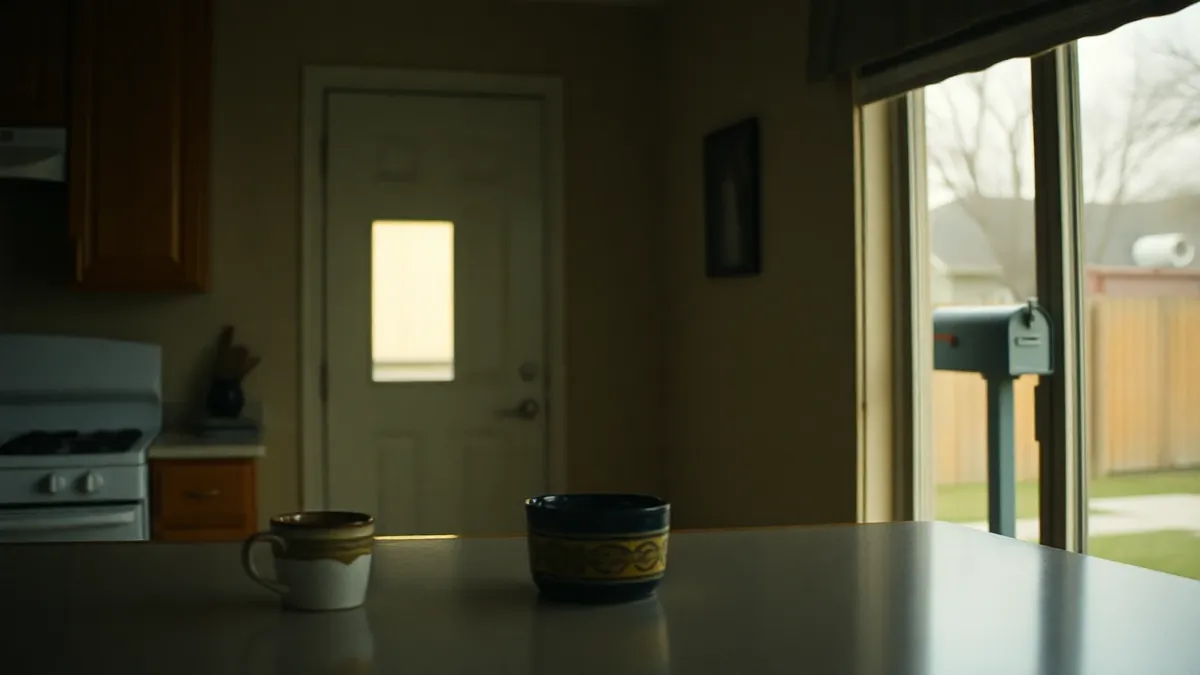
He then did what he always did in a crisis—he removed the tea kettle from the stove and started boiling hot water and removed the jar of peanut butter from the pantry. Even though it was eighty-six degrees outside, he needed hot chocolate and peanut butter. He ate it in spoonfuls. It was one of the few vices he still clung to. It had driven his wife crazy. She often commented about the “sound” that he made while licking the spoon of peanut butter. He tapped the spoon over and over against the side of the mug. He left powdered hot chocolate all over the counter and it would attract ants that they never seemed to be able to get rid of entirely. She was always cleaning up after him. He was aware of this even from the beginning. Yet, he never did try to change it. It was comforting and expected.
Joseph opened the window even though the air conditioner was on, and he listened then. He heard the quiet wind brushing against the tree in the front yard, the only witness to his wife’s departure. He wondered what it sounded like.
Did she cry? Did she laugh? Was there any expression at all?
Did she pause before leaving—looking back on a life that she had built with a man she had often said “embarrassed” her?
He had been married for twenty-three years. Joseph considered this to be a great accomplishment. They made it through the seven-year itch. They made it through two miscarriages, being laid off, the death of parents, the birth of their only daughter, home improvement projects gone awry, unemployment, kidney infections, debt, parent-teacher conferences, addiction.
They made it past ten. They celebrated and toasted glasses of the cheapest champagne ever purchased. They were smug about it, gossiping about family members who would never be as fortunate. They held hands, kissed, and were almost in complete synchronicity with each other. They were One, having moved past being the One and becoming One. Right?
Wasn’t that how it was? Joseph had trouble remembering.
It was during the seventeenth year that his wife started talking about feelings—anger, resentment, suffocation, loneliness, frustration. At first, these all had to do with the betting. He got lucky once in his twenties on a spring break trip to Vegas and spent years looking for it again, long after luck had expired. That’s the thing with luck—it shines more than it lasts. Every New Year’s, he made the same resolution.
His wife had nodded every year, getting him numbers of local support groups, telling him about friend’s friend’s of friends’ cousins’ uncle’s co-workers who had success with building a small support group and replacing the addiction with smoking or exercising or porn or cooking. “Whatever works,” his wife had said. “Just find something.”
He had promised. Again and again and again. He would do fine for a few days and then be back online playing poker or going to the local bar, betting on a dart match, or stopping at the raceway rather than going to work. His wife knew about this even though he tried to hide it. She found the bank statements and saw his notes when he had been considering filing for bankruptcy. She saw the statements on the credit card when he had stayed in a hotel room and had slept in sheets stiff as paper, alone, and had even accused him of not even having the balls to cheat on her. He couldn’t screw up right.
And then one day, he kept that promise—one whole year.
And she wasn’t even around to see it. Figured.
He poured water into the cracked mug his daughter made in pottery class her first year in middle school, dyed his two favorite colors—orange and blue, even though they clearly were not meant to be together on the same mug—and he wondered if that promise could have saved anything other than his own self-respect. It really was a selfish promise, in many ways, now that he thought about it. He laughed out loud. Clearly, even then he cared more about himself.
He wondered what she took with her. The house still had her smell, her fingerprints surely…if he ever needed to check for them, and yet, it seemed completely empty of her. The kitchen was fully stocked. There wasn’t even a granola bar missing from the jar. The milk seemed to be at the same level it was at when he left it that morning before work. The dishes were all there, even the wedding china, boxed in the pantry.
He walked into the living room, heard the crack of the floorboards that he had promised for years to fix. The couch was there and the three chairs and the coffee table and end tables. The television with the remote seemed untouched.
The wall hangings were there—various cheap prints of famous nature paintings. The photos of his daughter hung crookedly. The bathroom was intact. She hadn’t even taken her toothbrush. Her brush and comb were still in the drawer, filled with strands of blonde hair that he imagined of doing some type of voodoo with, just in case. Her expensive shampoo bottles were still in the shower. The bedroom was the same—the bed made not-quite- right, his watch on the bureau. Her wedding ring sat next to his watch. He almost had missed it, but the light caught the glint of diamond. He moved to touch it, and then recoiled. He felt ridiculous, but he thought it could be cursed.
He checked the closet. He had never put the door back on the frame after he had once accidentally locked it. Her clothes hung neatly, while his seemed to have been hurled at the hangers. The shirts were crooked, buttoned in the wrong holes, and the ties thrown over the railing. They were never the neatest of people, though they did care to keep things clean. They tended to build a life of efficiency. His wife would typically make two meals a week and they would live off the leftovers that were carefully shrink-wrapped. She would do laundry once a month, and ironing maybe once a year. She had told him she grew tired of straightening after him. “You don’t put anything back,” she had pointed out to him. Once something was removed from its place, he never could quite figure out how to make it fit back in. Even as he stared at his clothes, messily hung from plastic hangers, he knew that he was always making a mess of his wife’s once perfectly crafted, organized life.
Joseph then wondered if she took the suitcases or the car.
When he went to the garage, he was struck by her car’s appearance, and when he checked the storage room, there were the suitcases. Nothing was missing. She had left a twenty-three year life with someone and found no need to take any of the objects that were filled with memories, objects given to commemorate something special, objects that were like rings on a tree—markings of where they had been and where they would go.
Nothing was missing. Nothing was necessary for her new life, wherever that was taking place. The space was filled with the amount of belongings she had left behind—the genuine leather wallet bought in Milan that he gave her for her thirty-fifth birthday, the emerald earrings his mother left her before she died, photographs of a daughter they created together, recipes collected at showers, towels bought on sale, letters he wrote her when he was young and more romantic.
It was all there and accounted for, simple remnants of a woman who lived with him once, a woman who had taught him everything.
He stared at the post-it note, smelled the ink before he folded it carefully and placed it in his wallet. Even her note seemed weighed by the amount of things she did not want.
Erin called when she needed money and food. Even though Joseph knew her invitation of going out to dinner was usually a ploy to get more money out of him, because she was his daughter, he ignored the ploy. He was excited to go out anyway. Erin was studying art at Seattle Pacific University and she always needed money for supplies.
Joseph still maintained that it was her art supplies and not his gambling addiction that had forced them to file bankruptcy three years ago. Every time he asked how school was or when she thought she would be getting done, she shrugged. “It’s art, Dad. You can’t rush things.” He had the sinking feeling that she was going to be in school forever and that he would always be working to help her afford a canvas, tubes of oil paint, a special kind of brush made of horse hair that cost over three hundred dollars because it needed to have a wooden handle.
“I know this new Indian restaurant,” Erin said when she got into the car. “You might like it…could be interesting.”
Joseph laughed a little. Despite his acid-reflux, he never had quit eating spicy food. He meant to follow the strict regimen that the doctor had laid out for him. He always meant to, really. But, somehow he never could force himself to follow the directions.
“Anyway,” Erin continued, “you need to celebrate your new freedom.”
“Oh,” Joseph said, unsure of how to respond. “So, you know your Mom left?”
“Please. Anyone could see that coming ten miles away. This is the best thing that’s ever happened to you guys. Now you can both be happy.”
“We were pretty happy before—”
“You need to take First Avenue, not Fifth. Here, change lanes,” Erin motioned wildly with her hands. She possessed the characteristics of an only child. He supposed he had himself to blame for this. He had overindulged her.
“And no. You weren’t pretty happy before. Please. At least say it like it is,” Erin said.
Joseph shrugged. He didn’t know how to respond. His daughter had this annoying stoicism that he found hard to handle at times. He knew this had something to do with school and the friends she had made there. He had met her friends, Connor and Helen, when she first moved. They were quiet and reserved, but full of attitude. Maybe Erin had picked this up from them. He never knew why this surprised him. Both he and his wife were not the most expressive of people. They were typically passive—people who were acted on rather than people who acted. He saw life as a game of cards, and rather than counting them and knowing when to jump in, he waited to be invited.
“Well. I hope she’s happy. I mean, wherever she is—”
“She didn’t want to tell you. She doesn’t want to be contacted.”
“But, you heard from her?” Joseph felt relieved. At least she planned on staying in Erin’s life.
“Yeah. She called to say she needed some time to figure things out. She called to say not to call for a few days…well…until she calls me again. You know how she is…she has to have space to manage her psychotic tendencies. Remember that time that she didn’t get out of bed for five days? She still says she was never depressed. Whatever. There are pharmaceuticals for these types of issues. Dad—it’s right here! Ugh! You missed the turn. I think we can park in the back—change lanes.”
Joseph waited, watching the blue sedan in front of him. The sky was overcast and it looked like it was about to rain. He turned left by the side of a building with a bright orange door. He wondered what would happen if he kept driving.
He wondered if Erin would tell him where his wife was.
Inside, the restaurant looked like a typical American knockoff of India. There were gold statues everywhere and wall hangings that depicted seductive looking women with six arms and large eyes. There were small statues of elephants. The lighting was dim. In Seattle, everything reflected Seattle. It didn’t matter what sort of ethnicity was being honored. There was some sort of malfunction in the translation of culture. There was a doormat with an American flag, a cook with a Mariner’s hat rather than a turban, and the smell of grey goose that Joseph found typical of the city. There was a wait of about forty-five minutes, Erin rolled her eyes and stood by the wall.
“We could go someplace else…” Joseph had suggested.
“We’ll run into this problem no matter where we go.”
They had been waiting for about twenty minutes in complete silence when a woman called Erin’s name. She looked familiar, but Joseph couldn’t quite place her. She looked to be about the same age as Erin. But, Joseph never counted on looks to tell him an age. He was usually off by ten or fifteen years with anyone under thirty.
“Dad…you remember Connor?”
Joseph nodded. Connor had long red hair which looked even more vibrant against the black dress that she wore. She was tall, almost an inch taller than him, which he guessed would put her at 5’9. She had long legs and pale skin and had incredible posture. She seemed poised for a photograph.
Joseph had met her a few times…but he had never really interacted with her. His wife always relayed the information about Erin and her friends. That was part of her job.
“We met a long time ago,” Connor said. “I came over for dinner about three years ago…was that about right, Erin? I can’t keep the past seven years of my life straight. School does that to you. I’m on this sort of perpetual Bachelor’s degree program. Every year I get a little farther away from getting my degree, sad to say.”
“You must be on the same plan Erin’s on then,” Joseph laughed. “Are you an artist as well?”
“Dancer…so…kind of. I work for a company outside of school…so that kind of slows things down. I started out in the visual arts, though. Erin’s amazing. You must be really proud.”
Joseph smiled. He hadn’t seen any of Erin’s art since she left the sixth grade. She was fanatically secretive and only shared her work with her mother, who she often said “understood it more.” Joseph didn’t have the patience for art. He wasn’t a museum person. He had walked through the Louvre in twenty minutes on a family vacation. His wife had spent hours with Erin reading every placard and walking around each piece. He had spent hours waiting outside, throwing pieces of a dried-out bagel to the pigeons in the plaza, and laughing about how he was an entire ocean away from his home doing the same thing that he would have been doing there.
“Are you here alone?” Erin asked Connor.
“Yeah. You know how set-ups are. Half the time they say they will meet you, and then they usually take one look and bail. I love this restaurant, though. So, I’ll eat no matter what.”
“You should join us…I mean…we wouldn’t mind…right? Dad?”
“Uh…yeah, of course not. We would be happy to have you.”
“No…I don’t want to intrude. I know that it is a big deal to go out to dinner with your father. Trust me. If mine ever came down here to visit, I wouldn’t want to share him with anyone.”
“Don’t be ridiculous—we don’t care. Seriously. It will make dinner more interesting,” Erin said, winking at Connor.
Connor ran her fingers through her hair, shifted her weight, and shrugged. Joseph noticed the three gold loops in her left ear, the small star tattoo on her wrist. He wondered if her skin smelled as good as it looked. Joseph noticed the curve of her shoulders beneath the fabric of her dress. He thought of his wife then, how she slept half curled on her side. He remembered how he ran his hand along the dry curve of her skin before she would brush his hand away and tell him about her headache or her busy day in the morning. He never knew how to tell her touch could be simply touch.
Connor had a history of bad relationships, which she relayed to both Erin and Joseph. She blamed this on dancing, rather than on her father. She had a series of one-dinner dates. Men become obsessed with her even though they have never been out on an official date. She laughed in between sips of white wine and asked Joseph for his opinion. Joseph shrugged. “I am the last one you should ask about relationships. I have trouble relating to coworkers, let alone, a…well…it’s different when you get older.”
“Oh—come on!” Connor laughed. “You must know something that could be useful later on. Don’t you have any words of wisdom?”
“I can tell you about postage…uh…that’s about it.”
Connor and Erin laughed and laughed. Joseph noticed the small fillings in the back of Connor’s mouth. He watched the curve of her finger around her wine glass and noticed how her skin matched the soap that he had picked up in a bed and breakfast on a college trip in Madrid. He mailed it to his wife, who he was then dating, and wrote the words most feared by men: I love you, I love you.
“Oh…it’s okay, Joseph. This is sort of your initiation to dinner with us. We’ll have to do it again and again. Months from now—I’ll probably be asking the same questions. What can I say? Men have preconceived notions about dancers.
They think we are all…I don’t know…loose or pliable. It’s crazy.”
Erin agreed with her and told her about how it was the same with artists. “Those are the craziest of all,” she said. “Especially the abstract painters. Usually the men get high and try to paint what they see…which is a horrible idea in the first place. Art is never about what you see, but rather about what you don’t or what you could see if you looked at life a certain way. Whatever it is, the men come with baggage.
After Mark…well…I took a vow never to date another artist.”
Joseph remembered hearing about Mark. He was addicted to coke and finally, after months of covering an over drafted checking account, Erin had to break it off. Joseph was silent through most of dinner, watching the interaction of his daughter with someone else. He played the role of the third wheel well. She would go to her mother rather than to him for advice on pretty much anything. Joseph wouldn’t know what to tell her about dating or sex or men. He relied on his wife to give her sound advice and to keep her out of trouble.
He didn’t know how to handle being asked questions about the future. He still felt confused about his own parent’s deaths. He would get home from work late, having stopped by a bar on the way, and would pull a tray of carefully shrink-wrapped leftovers from the refrigerator. He reheated the casserole, enchiladas, stew, or whatever his wife had made earlier that week, and listened as his daughter opened up to her mother in a way she never had or would with him.
“This must be boring for you,” Connor said suddenly. “I mean…I am sure you aren’t like the rest of your species, right? You’ve stayed happily married and you have a pretty excellent daughter. You must be proud.”
Erin choked on her water.
“Yeah…I am,” Joseph heard himself say. “But…uh…I’m not married anymore. Well, technically I still am…I guess you could say…but…uh…I don’t know…” He spooned more of the chicken marsala onto his plate, mixed his rice into the sauce.
He didn’t know how to answer these questions. In many ways, there wasn’t an answer.
“Oh…I am so sorry! That was completely thoughtless of me…I mean…I just assumed—”
“It’s fine, Connor. You didn’t know. Actually, it’s a really good thing,” Erin said. “They were married a long time…you know…but now they are…uh…going in different directions…right, Dad?”
“Um…yeah, you could say that.” Joseph smiled. The silence was awkward and he watched the dim light dance on the side of Connor’s champagne glass. He was struck in that moment by his daughter’s assertion that there were different directions that one went when a marriage ended. It was like giving driving directions at a gas station. He doubted there was any change one took. He felt, with a deep surety, that he would continue in the direction that he was already going.
After dinner, Connor wanted to hit a bar. “The night is young,” she told Joseph, “and you need to celebrate.
Seriously. This is like a sort of…well…baptism by alcohol.
You know…a symbol of the new life you are starting up.” She laughed and put her arm loosely around his shoulders, directing him towards the sidewalk. At first, he pulled away a little. He was old enough to be her father. He knew this. Yet, really, it was the shock of having a woman willingly touch him after so many years. He felt the light frame of her arm, smelled the light floral scent of her perfume.
Joseph felt young and free. They walked into a bar at the corner before the entrance to campus. He had been to this bar before with Erin. She said the artists usually went here.
The music wasn’t as loud as in the other bars, and occasionally, they would allow students to set up performance art productions. “The usual crowd is probably there,” Erin told him on the way. “I might have to talk to Samantha, you know…that girl I told you I can’t stand. I mean, she hasn’t been in the program that long, and yet, she talks to me like she knows everything.”
“Maybe Drew’s there,” Connor said with a smile.
Once inside the bar, Connor drew a cigarette from her purse and lit it with a match, and walked back outside. Joseph hadn’t seen anyone light a cigarette that way in years. He watched her features, which seemed harsher in the dim light, and thought of his wife, who had quit smoking when she found out she was pregnant. Even though she had later miscarried, she had successfully stayed away from smoking.
“You have to give up those tendencies…you know…the psychotic ones. Kids need stable parents. They do,” she had told him once. He remembered lying in the bed next to her and feeling as though she was a stranger. Her smell changed.
She chewed gum and drank peppermint tea. She fidgeted with her coin purse when she got a craving. She lost weight, grew her hair out, started working and told him about each step she made while he spent the days going deeper and deeper in debt, gambling the property his mother left him, his daughter’s trust fund, his savings. He didn’t resent his wife for his addiction and he didn’t resent her for successfully overcoming her own. But it was always the conversations they had at night, in bed, that reminded him how disappointing he really was to her that he resented. She used that term often—psychotic tendencies—to remind him of what he could never live without.
Joseph drank dark beer in the corner of the bar and watched his daughter flirt with a man that looked like Kal Penn. Even though Joseph had a hard time picturing them together, he had to admit that Erin looked happy.
“That’s Drew,” Connor said when she sat across from him.
She poured a glass of beer from the pitcher and wrinkled her forehead when she took a sip.
“Kinda strong…”
“So…Drew…she…uh…”
“Yeah. Likes him. Drew’s a good guy. He’s into photography, though. I don’t think he’s as much of an artist as he thinks he is. He probably will end up doing photojournalism or something. Who knows. But, he’s good. You would like him.”
Joseph laughed. Connor seemed to assume that she knew his tastes. He hadn’t ever liked anyone that his daughter dated.
His wife had always blamed Erin’s bad taste in men on him.
Connor sat in silence, fingering the glass of beer, staring at the table.
“Are you glad?” She asked him suddenly.
“What do you mean?”
“Glad—glad that it’s over. Your marriage. I mean…I know it’s none of my business…but…are you?”
“I don’t really know what I feel…I mean…I came home and she was gone…and…well…she had been wanting to leave for years. And really, she needs to be someplace she can be happy…and…and…” Joseph trailed off when he felt Connor’s soft skin press against his hand. She pulled his hand to hers and stroked his palm. He pulled away and took another sip of beer.
“I…uh…everything’s fine,” he told her.
“It sounds like it is.” They waited in silence until Connor pulled him closer to her. She pushed the table back, looked behind her to see if Erin was out of the way, and then carefully straddled Joseph’s lap. He felt the outline of her body through her dress. He felt the corners of her ribs, her wrist, her neck. She pressed into him, kissed his neck, ran her fingers through his messy, un-cut hair. She moved her lips closer to his, as he was waiting to meet her, to guide her and show her where to go and what to do. She moved closer and closer, and Joseph sat there and waited.
“I’m…uh…I haven’t done anything like this…I mean…I’m old enough to be your father—”
“But you’re not,” she replied as she stroked his neck, stared into his eyes. He sat there, looking at the deep brown of Connor’s eyes, noticing the small spread of freckles across her nose. He wondered what his daughter would say if she saw him there with this young, lithe dancer, sitting over him.
He wondered what his wife would think as he did everything to push himself away from that sharp curve of Connor’s ribs. “Look…I won’t make you do anything. I just thought…well…I just had a thought.” Connor laughed nervously. “I mean, you are alone now, right?” He looked at her, felt the heat of her body, breathed in the smell of spring amidst the smoky air.
She was drunk. Perhaps she had always been drunk. He thought of the sharp square of green paper in his wallet. His hands ran down her back as he felt her frame and tried to decide. He felt her skin inside her dress, moved his hands between the fabric. He checked the room. People laughed under smoke-filled haze. No one could see. There were no witnesses around, only the strong beat of his heart and the things he didn’t know if he could want—other psychotic tendencies from his wife’s disappearance, other shrink-wrapped leftovers from last night’s love. He felt the beat of his heart, the pumping blood swishing in his head, and listened, his hand trying to untangle strands of Connor’s hair, the panic of his daughter being around the corner. He listened to the hum of noise in the bar and felt Connor’s hands as he touched the side of her face and saw the shimmer of luck.
“Other Shrink-Wrapped Leftovers” was printed in Breaking Curfew, No. 4 of Inwood Indiana. Pick up the paperback from Prolific Press; the stories and poems published online are free to read here.
Get the paperback