
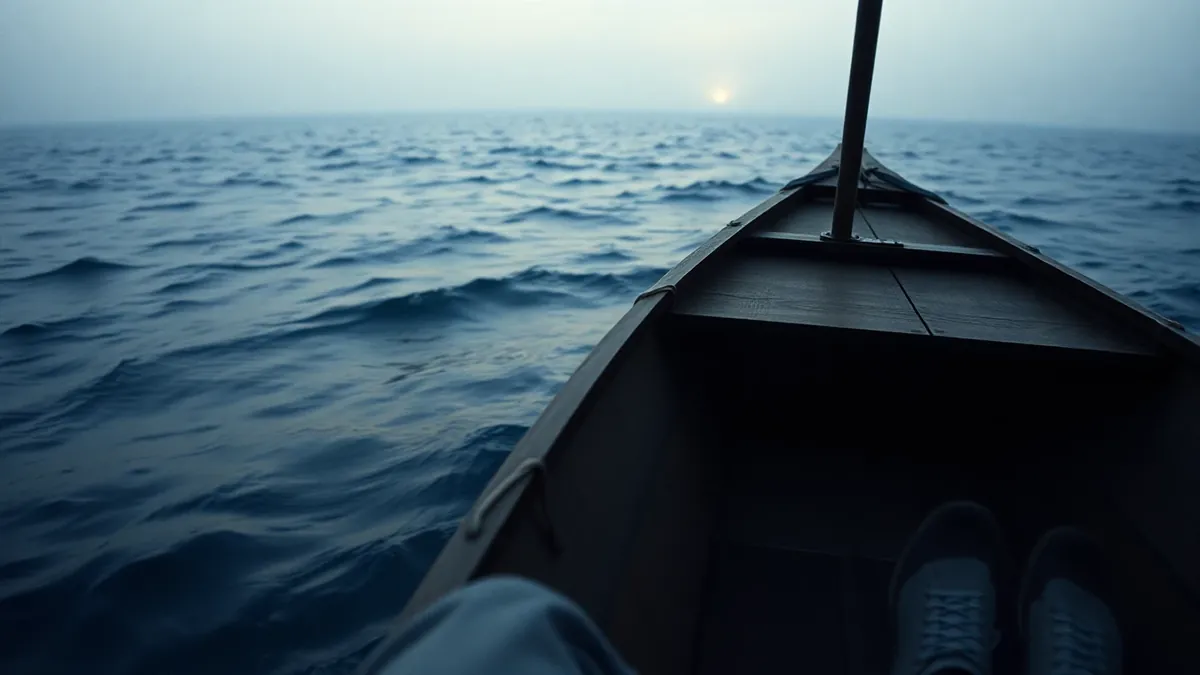
David Lawrence floated in darkness for what seemed like forever—or perhaps no time at all?—before he felt the lurching side to side, heard the rushing of the waves. The faintest light began to tease his eyelids, coaxing him into full wakefulness. He sat up, looked around, and discovered he was on the deck of a massive sailing ship. He got to his feet and began to wander around the deck, examining his new surroundings. The ship was not made of wood, nor of any substance David had ever seen; it was something swirling, shifting, but still somehow holding its shape, with a faint, rosy glow like mother of pearl in the sunshine. He reached out and touched a swirling railing; the substance was warm, made his skin tingle, and bowed to his touch before slowly swirling back into place.
David was amazed. “This can’t be real,” he said softly.
“Just because it can’t be real doesn’t mean it’s not, you know.”
David tipped his head back and peered up the mast and into the sails. There, among the billowing cloth, which gave off a soft golden light all its own, was a woman, hanging upside down from a length of rigging. She smiled at David, and the first thing that struck him was how beautiful she was—inky black hair streaming down from her head, and piercing blue eyes that sparkled with kindness.
“Hi, David, ” she said warmly.
“I’ve been waiting for you. ”
David cleared his throat. “Hello there, Miss,” he said. The woman’s grin widened, and she let go of the rigging, tumbling gracefully through the air and landing on her feet without a sound. She walked up to David and put one hand on each of his shoulders, surveying him.
“Hi, David,” she said warmly. “I’ve been waiting for you.” She patted his cheek in a motherly way.
David’s brow furrowed. “I’m sorry, young lady,” he said, “but—”
“Oh, don’t ‘young lady’ me, David! It’s really not necessary.” She laughed richly, and gave him a wry smile.
Flustered, David tried to recover. “Oh, well excuse me, then, Miss—I— um…what should I call you, then?”
The woman gave no indication of having heard him; she turned, staring into the distance, a small smile playing around her lips. She pranced to the bow of the ship in an instant, and perched on the rail, her legs dangling over the edge. She turned to look back at David, her smile still in place. “It doesn’t matter.”
Did she ever stop smiling? David wondered. “I…it doesn’t?”
The woman shrugged, her legs still swinging carefree over the side of the ship. “Not at the moment, no.”
David opened his mouth to speak, and then shut it again. This woman bewildered him. He passed a hand over his head in exasperation. Under his fingers, he felt a full head of hair—he hadn’t had hair in twenty years.
The woman raised an eyebrow at him. “Something wrong, David?”
“How do you know my name?” He demanded. “What is this? Where are we? What’s happening?”
The woman’s expression began to change; that eternal smile slid off her face and was replaced with a look of concern—concern and pity. “Oh,” she said softly, slowly sliding off the rail and back onto the deck. “Oh.”
David rounded on the woman, his frustration growing. “’Oh’? That’s all you can say? What’s going on here? I have hair. That’s impossible, you understand? I—it…please,” he looked at the woman in desperation. “Please. What’s happening to me?”
The woman walked towards him, extending a hand, cupping his cheek.
David felt himself relaxing, slightly; her touch was incredibly calming, for some reason.
“You don’t know,” she whispered. “You don’t. I thought for sure you’d be one of the ones who knew.”
“Know what?” David pleaded.
The woman bit her lip and glanced away. An instant later, her eyes were back on him, and she had that small smile on her lips again. She dropped her hand from his face and took his hand, interlocking her fingers with his.
“Come here, David,” she said, “I want to show you something.” She began to pull him towards the edge of the ship, but he snatched his hand out of hers, terror getting the better of him.
“I’m not moving until you tell me what’s going on,” he snapped.
The woman sighed and dragged her fingers through her hair—exactly the way David had earlier. She looked at him, a silent plea in her iridescent eyes.
“David,” she said, “please. Come stand by me, and everything will make sense, I promise.”
David was still uneasy. “Why can’t you just tell me what’s going on?”
“Because you won’t believe me.” She extended her hand toward him, an invitation. “I have to show you, to make you understand. Please?”
David considered the woman—his logical side didn’t trust her. But he couldn’t shake the feeling that he knew her, somehow. He reached out and tentatively took the woman’s outstretched hand. The instant they touched, her face broke into a wide grin, and she yanked him swiftly to her side, next to the rail.
“Okay, David,” she said. “Now, look down.”
“Into the water?” He asked.
“Just…look down.”
David stared at the woman for a moment, one eyebrow raised. The woman stared pleasantly back at him, blinking expectantly. David sighed, leaned out over the railing, and looked down.
He immediately pulled back with a cry. “What the hell?” He asked, looking at the woman in terror.
“I know, I know, but…David. Please. Just keep looking.”
David swallowed hard, and lifted his chin slightly, so he was just barely peering down into the swirling mass below the ship. They were not sailing on water. Beneath the ship swirled a mass of colors, every color David could think of, that he’d ever seen. Words and blurred images swam among the colors, nothing clear enough for him to make out—sometimes there was a face, an image that would float up out of the mass with a pang of familiarity—but it was the whispering that unnerved him. The mass beneath whispered to him, soft, indistinct voices, thousands of them, all whispering in his ears. Voices he loved, voices he barely knew, all pressing on him in a hoarse roar. David pulled away from the edge once again, cowering, covering his eyes with one hand, the other grasping the air frantically, searching for the woman. He found her hand, and held it tight, trembling.
“David?” The woman’s voice brought a modicum of calm down upon him; he looked up to find her still smiling at him with that small, comforting smile.
“What is it?” He whimpered.
The woman smiled, and took his hand in both of hers, squeezing it.
“Nothing to be scared of,” she promised. She gently led him back to the railing. “Let’s look together, huh?” She said softly.
David swallowed. “Alright,” he croaked.
The woman’s smile widened slightly, and she looked down over the edge.
David followed suit, and was enveloped once more in the colors and sounds, the words and the whispers—the whispers. Pressing in on him, it felt like each one was fighting to be heard above the others. David screwed his eyes up tight, wanting to retreat, but the woman had his hand pinned against the railing beneath hers, preventing his escape. The whispers pressed in, seeping into his brain, his heart, he felt his very soul. He couldn’t take it, the pressing, the pushing— “Davey!”
David jumped and his eyes flew open, looking around for the source of the sound.
“Davey Lawrence, you come in for supper right now, or I’ll call your father out here to knock you into next week! Davey!”
The whispers had died away, but David barely noticed—he was too focused on the voice, the one shouting his childhood nickname.
“Davey!”
“M…Mom?” David rounded on the woman, shock etched in his face. “This is impossible…”
The woman smiled. “Look down, David.”
David peered over the edge of the ship again. The swirling mass was gone.
It had been replaced by a smooth surface, shining like glass, and there, beneath the ship, was his mother. Wearing a blue-checkered dress and an apron stained with grease, her raven hair pulled back in a knot at the base of her skull, looking exactly as she had when he was a boy. She was staring out in front of her, past the ship, at something David couldn’t see, a severe look on her face.
“Davey! You hear me?”
“Mom!” He shouted. “What are you doing down there? Mom? Mom!”
“Get your behind in this house, you hear?” With that, David’s mother turned and walked away, vanishing into thin air.
“Mom!” David cried, leaning out over the railing as far as he could.
The woman put a cautionary hand on his shoulder, pulling him back to the safety of the deck. “Easy David,” she said, “it won’t do to have you falling in.”
David turned to her in wonder. “But that…my mother…how…how…”
The woman smiled at him through his sputtering. “A memory,” she said, gesturing back to the whispering mass below them, “among a sea of memories.”
“Memories?” David echoed.
The woman nodded. “Yours.” She jerked her head towards the railing.
“What do you see now?”
David lifted his chin and looked over the edge into the sea, which was once again smooth as glass. Standing on the mirror surface now, he saw a girl, around age sixteen, wearing a pink skirt emblazoned with a black poodle, her hair in a ponytail, saddle shoes on her feet. Her eyes were blue, her lips rose pink, and David’s stomach was doing backflips as he stared at her, remembering.
“Melinda,” he breathed, leaning on the railing, distracted, dreaming.
The woman smiled and joined him, resting her chin on her palm as she too gazed down at the memory. “Melinda, huh?” She said playfully.
David nodded, still enveloped in the girl’s beauty.
“Why don’t you tell me about her?”
David sighed, happiness pulling the corner of his mouth into a sideways smile. “She…she was perfect,” he said with a gentle laugh. We’d gone to school together since we were little kids, and…I thought she was the prettiest girl to ever…be pretty.”
The woman laughed. “You don’t say?”
David laughed and passed an embarrassed hand through his hair. “I know. But…she just made me that way, you know? She made me want to pick flowers and write poetry and skip and do all kinds of crazy stuff I never would have done otherwise.”
“Skip?” The woman asked with a smirk.
“Yeah,” David said, laughing at himself. “And…I think this is the day I asked her on our first date,” he said, surprised.
As if on cue, the memory of Melinda turned and smiled at someone who did not appear in the memory. “Oh hey, Davey,” she said warmly, “How’s it going?”
“God, I’d never been so nervous in my life,” he laughed.
The woman watched him, smiling, a trace of longing in her eyes. David continued, “You could’ve dropped me in front of a firing squad, and I would’ve been less scared…but this--”
He stood up a little straighter, as the Melinda in the poodle skirt wavered, melted, and transformed into a slightly older Melinda—her hands covering her mouth, a happy look in her tearful eyes, “--This is the day I asked her to marry me!” He shook his head, grin widening. “I change my mind! I was definitely more nervous that day.”
The woman laughed; “But she said yes, didn’t she?”
“Yeah,” David said, his eyes drifting as the dream of reminiscence crept into his voice, “yeah, she did.”
He looked down again, staring deeply. That Melinda also wavered, and vanished, and was replaced by a quick succession of Melindas as the years went by—Melinda in her wedding gown, Melinda covered from head to toe in brownie batter, learning to use an electric mixer for the first time, Melinda glowing and radiant, her belly swollen with their first child—
David drew back from the railing as if he’d been burned. He turned away from the scene of his pregnant wife down below, breathing hard. The woman turned to look at him, a sad look of understanding on her face.
“You have many happy memories of Melinda, don’t you David?” She said, slowly walking towards him.
“Please,” David croaked, his voice barely above a whisper, “please. Don’t make me watch this.”
“But not all the memories are happy, are they?”
A high, keening scream bubbled up over the edge of the ship, from the mirror surface where David’s memories danced—he turned towards the sound, tears welling in his eyes.
“No,” he whispered, “Not again.”
And yet, as if against his own will, his feet moved him back to the edge of the railing. He looked down to the memory, his wife sitting in the hospital bed, blood soaking the sheets around her waist, crying as she held their blue-lipped, stillborn baby in her arms. “Anabelle,” she sobbed, over and over, “Anabelle, Anabelle, Anabelle…”
Tears were streaming unchecked down David’s face as the memory shuddered, faded and died. He turned to the woman.
“Why did you make me watch this?” He demanded. “Wasn’t suffering through it once enough? More than enough?”
“You couldn’t save her, could you?” The woman said softly. “Not Anabelle, not Melinda. There was nothing you could do to stop her pain, was there?”
“Stop it,” David muttered.
“No,” the woman replied, a challenge in her voice. “You need to remember, David. The pain, the suffering you endured and caused. All of it…”
“Why?” David replied, rage filtering through his pain, making his voice sharp, pounding an angry fist down on the railing. “Why should I have to relive all this pain? Shouldn’t it all be peaceful, be white sands and clear skies now that I’m—“ David choked on the last word as the revelation hit him like a weight. “Oh God,” David whispered. His rage vanished as quickly as it appeared. He looked into the woman’s eyes, all at once timid and afraid.
“Oh my God. I…I’m dead, aren’t I?”
The woman nodded slowly. David felt his knees grow weak; he sank slowly down, sitting with his back against the railing, head cradled in his hands. His heart was pounding as he felt the absolute finality of his situation crash down upon him. Dear God, he was dead…
After a moment, the woman came and sat beside him.
“I’m dead,” David mumbled into his palms.
“You’re dead,” the woman replied.
David lifted his head and turned his tear-streaked face towards her. “Why didn’t you tell me?”
For the first time, the woman’s eyes began to well up, much as David’s had.
“I don’t make the rules,” her voice quivered slightly. “We’re not allowed to tell you, you have to figure it out on your own. It makes the transition…easier.”
“Transition?” David stared around at the effervescent ship. “So…so this isn’t heaven, then?”
The woman gave a soft, humorless snort. “No,” she said, “definitely not. This is merely a vessel. The…final journey, if you will.”
“Where’s it taking us?” David asked.
The woman opened and closed her mouth several times, her brow furrowing. Finally, she shrugged. “On,” she said.
David looked at her blankly. “On?” He repeated. The woman nodded.
David sighed, defeated. “I’m never going to get a straight answer out of you, am I?”
The woman looked apologetic but unyielding. “Like I said, I don’t make the rules. I just have to follow them.”
“Alright then.”
David’s eyes flicked back to the railing of the ship. “So why…why the memories? Why show it all to me again?” His voice broke as he remembered the vision of Melinda, bloody and broken, holding their dead daughter in her arms.
The woman was silent for a long time. “Because it’s important for you to remember,” she said.
“What does that mean?” David asked.
The woman stood, beckoning David to stand with her, and they looked over the edge of the railing once more. David moaned and turned away when he saw the scene that lay below—Melinda, among others, all dressed in black, surrounding a tiny grave, a tiny headstone. Anabelle Jeanine Lawrence, April 2, 1976.
“That this life,” the woman said, “doesn’t come without pain, David. You remember, don’t you?”
There had been a montage of happy scenes with Melinda before, now David had to endure a barrage of the worst moments of his life—the day his mother died with vacant eyes that didn’t remember him, the thud-crack-crunch in the road as their cat got hit by a car, the day his boss looked him in the eye and said, “Sorry, David, but we can’t afford to pay you anymore,” the day he left his brother behind in Vietnam, legs blown off and bleeding, “Help me, Davey! Please don’t leave me…”
More voices drifted up over the railing, and David knew them all too well— drinking buddies at the bar, a swirling tumult of pain that could never quite be drowned away—Vietnam, Melinda, and Anabelle—always Anabelle.
Then there was Melinda, confronting him as he staggered through the door falling-down drunk. Her voice raised, hysterical—an argument.
“You think I like this?” Melinda shrieked from below.
David shook his head and closed his eyes, clapping his hands over his ears, but nothing he did could muffle her voice.
“You go out every night and drink yourself stupid, and I’m left here alone…You aren’t the only one who’s suffering, okay?...I will not shut up, I’ll—”
Her speech was cut off by the crack of flesh striking flesh, followed by a squeal from Melinda that dissolved into sobs.
David moaned and shook his head more violently. The scenes continued to rain down on David like so many heavy blows, more than he could bear.
The guilt swirled in his stomach, making bile rise in his throat.
“Stop! Please! No more!” He begged the woman. The ship seemed to pitch and rock beneath his feet; tumultuous seas for the first time since their journey began. “I can’t do this again! Please! Stop the memories, stop the pain! I know I failed them, okay? I don’t want it!”
The pitching of the ship grew more violent; David could hear a thousand whispering voices, tendrils from his past, roaring in his ears, reminding him of how he’d abandoned the people he loved, and how it was too late to take it all back.
“I’m sorry!” David wailed—whether to the woman or the voices, he had no idea. “I’m so sorry!”
All at once, the sea of memories calmed—the silence pressed in on all sides. David crashed to his knees, sobbing brokenly into his hands. He lifted his head to look at the woman; he was surprised to see tears welling in her eyes once again.
“You say this ship is going ‘on’?” He asked hoarsely.
The woman nodded.
“Good…or…or bad?”
The woman shook her head. “We won’t know until we get there,” she whispered. She stepped forward and offered David her hand. He took it, and she pulled him to his feet. “But between you and me,” she wiped away his tears with her free hand, “I think you deserve the good.”
“How?” He asked. “How can you believe that of me, after everything I’ve done? The ways I messed up…”
The woman shrugged. “You’re only human, as they say. You struggle, you fall, you fail. You’re beautiful creatures, but you screw up sometimes. It happens.” She looked down at her feet. “They key is to ask for forgiveness…and to allow yourself to be forgiven.”
David looked at the woman with new eyes. “Are you…an angel?” He asked in awe.
The woman nodded, smiling at him. She turned to face the bow of the ship. David followed her gaze; he saw a blazing white light ahead, brighter than anything in the universe.
“On?” David asked.
“On,” the angel replied.
David felt his knees begin to tremble as the light grew bigger, threatening to envelop them. The angel gave his hand a reassuring squeeze.
“You never did tell me your name,” David murmured.
The angel turned and looked at David, that small, playful smile back, dancing on her lips.
“My name is Anabelle.”

“On” was printed in Crossroads, No. 8 of Inwood Indiana. Pick up the paperback from Prolific Press; the stories and poems published online are free to read here.
Get the paperback