
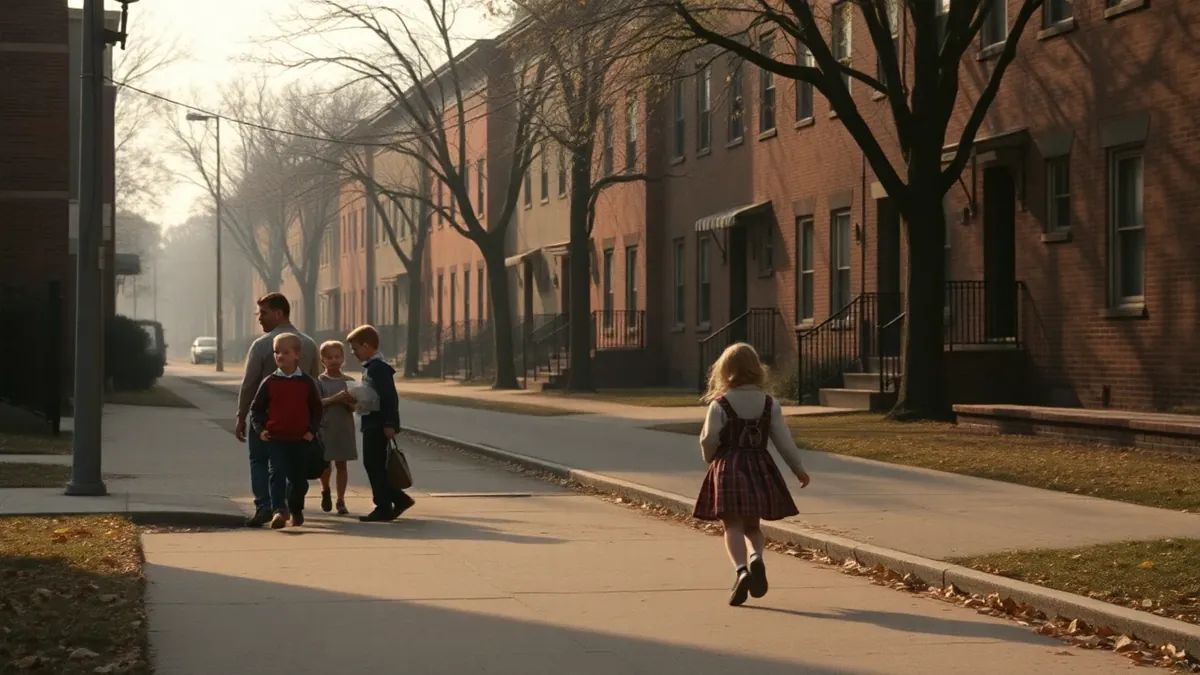
“Moooka!” For the startle effect Richie Visconti raced diagonally across the street to cut in front of the girl. He popped his eyes in her face and extended the “Moo” in a deep, resonate voice to emulate the cow sound. We were not yet teenagers in 1956 but we all knew that “Mucca” meant “cow” in Italian, and that “cow” meant slob or loose woman in English.
On my way to our neighborhood school, dragging 30 feet behind Mucca so that I wouldn’t be identified with her in any way, I felt shame rising like heated mercury, tingeing my face red. I saw Mucca grip her books to her chest and drop her head.
Euphemistically speaking, she was a big-boned girl, yet she seemed to cower inside her ample body. Her dun-colored hair hung as limp and lifeless as the upended mop in the janitor’s closet at school. Mucca’s blouses were faded and stained; tight balls of lint clung to her garments like dried up chicken pox on skin after the fever has passed. She wore her skirt belted high, and though it was looser and longer than the form fitting just-below-the-knee style of the time, it did not hide her protruding belly, blotchy skin or bulging ankles. In those days girls did not wear pants, and there was no such thing as the polyester over-shirt.
Smirking after delivering his verbal assault on hapless Mucca, Richie dashed back across the street to rejoin his buddies Mikey and Bobby DeCarlo, who were guffawing loudly and pointing at him. The three boys slapped and punched each other to reassure Richie Visconti—and themselves—that they were the better, the cooler, the more popular guys in our elementary school. None of them were very bright, but Richie had good hair and a confident swagger and the DeCarlos, who were fraternal twins, did a lot of clowning around, making up in volume for what they lacked in wit.
Though my empathy was with Mucca, I defensively glanced at the boys and smiled. They ignored me, which was as close to a reprieve as I could get. I was fortunate enough to have two athletic brothers, and, though we were not particularly close, their existence served as a semi-permeable membrane between me and the cruel taunts of the budding young gender assassins. Skinny and shabbily dressed, I knew that I could readily become a target. Mucca was the sacrificial prey who spared me and several other pre-adolescent girls from the cruel epithets of the young bullies. I was only eleven years old, but I knew that Mucca was being abused by those boys. Later I came to understand that the boys assumed such bullying and bravado to obscure their own diminutive statures and dismal prospects. At the time, of course, my perceptions were almost pre-verbal and my behavior was predicated on my own instinct for survival. Sadly, I lacked the imagination, the courage, the wherewithal to affect the dynamics, to make a difference for any of us, especially Mucca.
Of course, Mucca wasn’t her real name. I knew very well that the girl’s name was Doris Cornell. She, Richie, and the DeCarlo boys lived in the west end of town, where blue collar families like mine, mostly Italian, Polish, or Irish, had settled. Though we never thought about it as such, deprivation was something we all routinely experienced. In the 1950’s if you were small-town poor and likely also maltreated, one way to elevate your estate was to create a verbal pecking order to harass those who were clearly worse off than you. Behind each other’s backs we kids even referred to our friends from different ethnic groups as “Guinea”, “Wap”, “Pollack”, or “Mick”. It required a somewhat more disparate deviance, however, to get you labeled in a way that made you completely socially ostracized. Mucca’s family was worse off than most, and she was also guilty of being overweight, ill-kempt, and female. I knew the taunts the boys hurled at her were cruel, but I never publicly acknowledged that; hence, my secret shame: silence is complicity. I intuited this long before I studied the holocaust.
It wasn’t just children who were subjected to the scorn and ridicule of our hometown hooligans. There was the rot-toothed “old lady” (likely not more than 35 years old), a single parent raising a shy and mentally deficient son, the boy perpetually, silently, stationed at her side. Their house was dirty—or so we imagined—and stray cats insinuated themselves on their doorstep. I secretly felt sorry for the pair, but joined the other children in dubbing them “The Cat Lady and the Bell Boy.” I’m certain that the woman and her son were tormented relentlessly by our giggling and whispering in their presence.
The taunting wasn’t entirely sexist, either. Boys in our neighborhood could become the objects of mockery almost as readily as girls. I particularly recall Dumb Danny Domby and his god-forsaken family. His slovenly, toothless mother looked like one of our grannies and his red-faced old man was a chronic drunk who ranted incessantly in slurred obscenities while abjectly beating up on his wife and son. Simultaneously bemused and horrified, we kids gathered beneath their apartment window and listened to the raging and howling within. If Danny managed to escape midst one of these episodes, we chased after him, cheering and applauding. He actually savored the chase—I guess it was some kind of personal acknowledgement.
One Christmas season at school Dumb Danny got in trouble with the teacher and had to stay in the classroom while the rest of us went out for recess on the playground. Suddenly there was a loud gasp from the teacher; we followed her gaze to the roof of the school building. There was Danny Domby poised on the roof, hoisting above his head the Christmas tree our class had spent hours decorating with handmade paper ornaments and the teacher’s delicate glass ones. A stand-off quickly developed: Danny threatening to heave the tree; the teacher, joined by other teachers, the janitor and the principal, all cajoling Danny to put down the tree. Some of the little girls on the playground started to cry, about the welfare of the Christmas tree, of course, not Danny Domby. Many children, like me, stood by in stunned silence, while the ruffians shouted for Danny to throw the tree and jump. I could tell Danny was frozen in irresolution. The principal, not much of a negotiator, soon shouted, “That’s it for you Domby, we’re coming up.” With that, Danny stepped forward to the edge of the roof and hurled the tree, in all its ornamented glory, off the roof. The tree tilted slightly sideways, and, as bits of colorful paper and glass orbs whipped away, fell with a thud-bounce-squash on the blacktop of the playground.
“Oooooh-wa!,” came the communal cry from the kids below, followed by applause and some whimpers. Danny turned and dashed across the roof, down the back stairwell and out the rear of the school building. The janitor and the gym teacher scampered in pursuit. We didn’t see Danny at school again until after the holidays. Whatever punishment was meted out by the principal likely paled in comparison to what he got from his daddy. The incident was talked about and enacted animatedly for years, and Danny Domby accrued a modicum of prestige from the notoriety.
While at the time I lacked the means and mettle to confront social injustices, I was generally sympathetic to the more vulnerable children from our end of town. When no one was looking, I would, from time to time, talk to Doris Cornell. She was grateful, but could never meet my eyes. I also remember a young man oddly named Gaston, whose family had fled Cuba and settled in New Jersey. I was clueless to the politics but knew there was something special about his bearing, something different from the other Spanish kids we called “Spics”, who predominantly lived in the next town over. Gaston taught himself brilliant English by watching TV, and his aspirations were beyond most of ours. There were also Jewish kids whom I befriended, mostly at school. They lived on the east end of town and were generally smarter and economically better off than the west end kids. Most of the Jewish kids kept to themselves and did not “come out” as Jews in the Christian-dominated working class milieu of our town. While they enjoyed the cache (and economic advantages) of living on the east side of town, the Jewish kids were still outsiders.
Within the prevailing social strata, I must have been a rather difficult person to peg. At school I hung out with the more academically-oriented youngsters from the east end, but after school and on weekends I was solidly west end. That made me not so much a social isolate as a loner. I navigated the great barrier reef of the social domain like a hyper-alert minnow—now a flash of silver, now camouflaged, hovering in the nooks and crannies, snatching for bits and scraps and eluding the bottom feeders.
Eventually Danny Domby’s family moved away from the west end, likely to a different emerging urban region of the Garden State. By eighth grade Richie Visconti had gotten “sent up the river” (our slang for remanded to reform school), where he attained rapid promotion from within, eventually ending up at Rahway State Prison. One of the DeCarlo brothers was killed in the early days of the Vietnam War, and the other, the last I heard, had opened up a pizza joint at the Jersey shore.
I still wonder what happened to Doris Cornell. Did she, like I, move away from “our town” and reinvent herself? The odds were very much against her. We knew that her father was an alcoholic who beat her, but it wasn’t until she was discernibly pregnant that people realized she was enduring more than beatings at the hands of the man. Even though the local boys claimed that Mucca “put out”, that was highly unlikely. No, her drunken father had, early on, claimed her for himself.
How Doris Cornell must have suffered! To my knowledge, no social service agencies or child advocates ever stepped in on her behalf. The great poet Langston Hughes was soon to pose the question, “What happens to a dream deferred?” My question remains, “What happens to a living nightmare daily sustained?” Growing up I thought my secret shame would be my home life, where my mother was childlike, at times delusional, but with a core of obstinate resiliency. In the 1950’s my father treated her like most working class men treated pesky women and so-called incorrigible children: he screamed at her and slapped or punched her when she got on his last nerve. Eventually I came to terms with both my parents—with a little help from my friends and a few professionals, of course. So my secret shame is not my crazy parents. What is lodged in the back lot of my mind, like one of those non-biodegradable synthetics among decaying debris, is an image of me standing immobilized at a safe distance from Doris Cornell—she a pathetic, wounded animal, arrows protruding. I hope by some miracle Doris prevailed. I hope she found it in her heart to forgive some of us. “Moooka!” The derisive echo persists.

“Mucca” was printed in Esther, No. 1 of Inwood Indiana. Pick up the paperback from Prolific Press; the stories and poems published online are free to read here.
Get the paperback