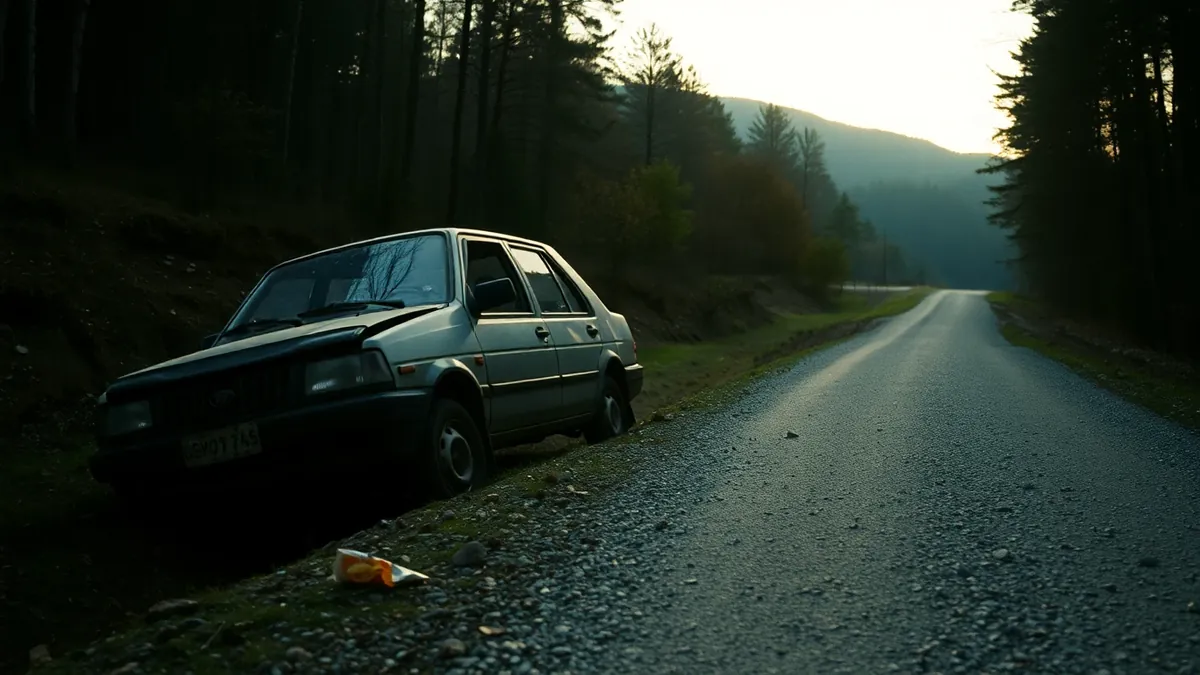
Buchard “Shard” McConnell the Third was hungry—head-hurting, gut-roiling, hands-trembling hungry. Five hours since breakfast. Didn’t these backwoods hill people believe in restaurants? He took his eyes off the narrow dirt and gravel road just long enough to glance down into the trash-littered floorboard of his Dodge Colt and reach for a half-empty bag of nacho chips. The right side of the car dropped off the shoulder into a ditch and low-hanging tree branches exploded against the windshield. McConnell yanked the steering wheel hard left, trying desperately to keep the vehicle from abandoning the road entirely. Gravel pounded the Colt’s metal underbody like machine gun fire, drowning out the anguished cry escaping his throat.
The whole thing was over in a flash. McConnell sat gasping for air, his chest heaving with adrenalin as gray dust hung heavy in the air around him. The car was canted right—half on, half off the road—and the seatbelt bit painfully into the soft flesh of his upper torso.
“Damn, damn, damn!” He struggled at opening the door, finally bracing it with his foot. Unbuckling the seatbelt, he carefully leveraged himself up and out of the car. No small feat for a guy whose weight hovered dangerously close to the big three-oh-oh mark.
The car, Shard. What about the car?
He walked first to the rear of the vehicle then picked his way across the ditch to the edge of the wooded area. The tailpipe was torn loose from its mooring and lay like a crumpled drinking straw in the road. The right front tire was flattened—Not just the tire. Look at the way the wheel is jutting out. That’s kind of an odd angle, isn’t it? – and the windshield was a spider web of cracks that extended top to bottom, left to right.
For a moment, anger overcame his hunger. “Arrrggg! You son of a bitch!” McConnell bent down, grabbed a stone the size of his fist and hurled it at the windshield. The safety glass shattered into marble-sized pellets and rained down across the dashboard and seats.
His anger satisfied, he went back to the right-side window, fished out the nacho chips and stuffed a handful into his mouth. Couple more handfuls and that’s it. This is serious. He leaned against the Colt’s fender and finished the chips, licking his forefinger to scavenge crumbs from the bottom corners of the bag, trying to decide what to do next.
He’d been on this poor excuse for a road nearly an hour and had seen nothing but dense woodlands pocked with an occasional small meadow. No buildings, no mailboxes, no sign that he was even within the boundaries of civilization. And maybe, just maybe you’re not, Shard. The thought gave him a little tingle. Tossing the bag aside, he stepped out to the middle of the road where a narrow slice of early-afternoon sunshine afforded a touch of reassurance. On either side of the roadbed, the land sloped sharply upward. He wondered how long before the sun dropped below the mountainous terrain. It was only late October, but he could feel a cool dryness in the air. It’s colder in the mountains. Dark earlier, too.
Shard checked his cell phone. No signal. No surprise. Walking back to the main road would take hours. Continuing in the direction he’d been traveling would be a crapshoot for sure. But a crapshoot was better than a sure no-win, wasn’t it? He plucked a light cotton sweater from the back seat of the Colt, tied the sleeves over his shoulders and started walking. It was two-fifteen. He’d walk two hours out, and if nothing showed, walk two hours back to the car for the night. At first light, he could head back to the main road and call a tow truck.
An hour and twenty minutes later, he saw the sign. It was almost completely covered with kudzu vine, and as he ripped away at the leafy tentacles, he felt a surge of hope.
E. F. Love’s General Store .5 miles
Then he felt a surge of fear. What if the store was closed? What if that was the reason the sign was covered with kudzu? What if no one cared anymore because the owner, sadly, had passed away back in the winter of ’95? Get hold of yourself, Shard. It’s only half a mile. Maybe ten minutes of uncertainty. You can do that easy. McConnell’s steps quickened as he started off again. Minutes later, when the edge of a weathered storefront crept into view, he began to run—an awkward, loping gait common to many who’ve continually failed to push back from the table. And when he spied a solitary figure sitting in a rocker on the store’s front porch, he almost cried out for joy.
Seconds later, he leaned hands-first against the raised floor of the porch, struggling for breath. From above him, the man he’d seen asked, “You all right, young fella?”
McConnell nodded. “Got food?” he asked, still gasping.
“We’re a general store. We generally have food.” The man chuckled at his own joke. “Mavis’ll help you after you catch your breath.”
McConnell pushed off from the porch and stumbled up the steps and into the store. In less than a minute, he came out clutching two cellophane-wrapped honey buns and a Coca-Cola, and sat down on the edge of the steps. His fingers trembled as he tore the wrapping open and stuffed half of the first bun into his mouth. Honeyed sweetness coursed through his body and he moaned with relief.
“Always been partial to the cream horns, myself,” the man said. “But I like honey buns too, heated up in the oven.”
McConnell finished the first bun and drained most of his soft drink before he spoke. “Sorry—don’t mean to be rude. I just haven’t eaten in a while. Car ran off the road a few miles back.” “Take your time,” the man said. He pulled a corncob pipe from his shirt pocket and lit it with a wooden match, the smoke drifting in swirls around his face as he rocked. “We got all afternoon. Name’s Love, by the way, like the sign says.”
McConnell heaved himself up off the steps and walked over to the store owner. The man was in his early fifties, clean-shaven and lean, with small, amused eyes. “Buchard McConnell the Third, but most people call me Shard.” He held out a hand, then realized it was sticky with sugar and quickly wiped it on his trousers.
Love took his hand without getting up and appeared not to notice any remaining residue. “We don’t get many visitors out this way, Mister McConnell, or maybe you just got lost.”
“I’ll let you tell me, Mister Love. I was headed for Poplar—”
“Yep, you’re lost for sure. Took the wrong turn off Route Eighty. Closest settlement around here’s Buladean, which ain’t sayin’ much.” Love took another puff on the pipe then used a half-straightened paper clip to scratch around in the bowl. “Not much in Poplar, either. You have kinfolk there?”
“Oh no, sir. See, I’m a writer for Ozarks’ Trace magazine.” C’mon now, you’re a stringer—not a staff writer—and nowhere near the contributing editor you want so much to be. “I heard there was a family of folks near Poplar that still spoke the Old English language.” McConnell’s heartbeat accelerated again just thinking about it. This could be “The Story”—the one that transformed him from fat struggling wannabe to highly-respected journalist. “I was hoping to find them, you know, maybe interview them, write their story—make ’em famous?”
“Well,” Love said, “I wouldn’t know ’bout that. Some folks don’t want to be famous, I’d reckon. Like their privacy.”
McConnell finished off the second honey bun. He was feeling better now, on a sugar high. “Yeah, well, if I could use your telephone—”
“Sorry, no phone.”
“No phone?”
“Nope. Got no need for one.” Love pushed up out of the rocker, stretched, and stepped over to the front door, motioning for McConnell to join him. He opened the door and waved McConnell in. “Take a look. What do you see?”
The store had a counter supporting an old-fashioned cash register on the left. On either side of the register stood metal racks of chips and crackers, pastries, and candy bars—the only items McConnell had noticed on his earlier entry. The woman he guessed was Love’s wife sat behind the counter reading a dog-eared paperback. She smiled at him as his gaze swept past her. On the far wall in the rear of the room, sat a long, low freezer and a bright red soft-drink cooler with Coca-Cola emblazoned in white across its front. The remainder of the floor and wall space was filled with barrels and racks of fresh produce—pumpkins and pole beans, potatoes and squash, and a few items McConnell didn’t recognize. He walked over and picked up a strange-looking lump.
“Rutabaga,” Love said. “The thing is, see, folks around here are pretty self-sufficient. They grow most of what they need or trap it, shoot it, or … otherwise make do. The store mostly just provides an outlet for the farmers to sell what they don’t eat…” He pointed to the racks of snack food. “…and buy a few treats they can’t grow.”
McConnell nodded then shrugged. “But about the phone …”
The woman spoke. “Get to the point, E. F. The young man doesn’t have all day.”
“Oh that. Well, as I was getting to—Mavis and I’ll make the trip to town once a week or so and stock up on snacks and soft drinks. We’re too far out and don’t have the sales volume to rate a delivery truck, so …”
“No need for a phone,” McConnell said.
“Exactly.”
“But you do have a truck?”
“Eighty-six Chevy—only eighteen thousand miles.”
McConnell’s face brightened. “So, could you—”
“Sure could,” Love said, “first thing in the morning.”
McConnell started to speak, but the woman cut him off.
“E. F. don’t see all that well at night. Neither do I. We’d oblige you, but it’d be full dark by the time we started back.”
“What about tonight? Is there someplace I can stay tonight?”
McConnell asked. The sugar high was wearing off and he could feel a new gnawing in his stomach.
“Not here, I’m afraid,” Love said, gesturing toward a narrow door between the counter and the rear wall. “Mavis and I have a couple of rooms at the back of the store but we couldn’t accommodate a big fellow like you.” He frowned and rubbed his chin. “What do you think, Mavis? The Leatherbys?”
“Oh sure,” the woman said. “The Leatherbys would love some company. And they have that extra room, too, since the older boy left.”
Love snapped his fingers. “It’s settled then. Some paper, please.” The woman found a note pad and pencil and pushed it across the counter.
“I’m going to write you a note of introduction,” Love said, “and explain your situation.” He scribbled on the pad for a minute, signed with a flourish and ripped the page free of its binding. “C’mon back outside, Mister McConnell, and I’ll point you in the right direction.”
McConnell fell in behind the man and stopped at the edge of the porch. Love shielded his eyes against the late-afternoon sun and pointed up at a mountainside splotched with dark evergreens and a wild array of fall color.
“There,” Love said.
“What? Where?”
“There,” Love said again, waggling his finger. “Right about halfway to the top. See the meadow?”
McConnell squinted into the distance, finally spotting a pale yellow rectangle the size of a postage stamp nestled amid conifers in varying hues of green. “How far is that?”
“Bout half a mile, but it’s a mite steep climb.” Love folded the note and offered it to McConnell. “You’ll probably want another soft drink for the road.”
Love escorted him to a narrow strip that was little more than two wheel ruts in the dirt. McConnell waved a tentative goodbye to the store owner and started up the mountainside.
Ten minutes later, he sat down heavily on a fallen tree trunk, swallowed the last of his cherry soda, and tossed the bottle into the brush. Sweat ran from his temples and dark stains covered the front of his shirt and under his arms. Mmm, mmm, Shard, what have you got yourself into this time? Alone in the woods who-the-hell-knows-where with who-the-hell-knows-what. There’re bears in the woods, you know. Cougars, too… “Stop it!” he shouted. Then, more quietly, “You’re an adult, Buchard. You can do this. You come from good stock. A little out of shape maybe…” He looked down at his belly, hanging like a mushroom cap over his belt. “…but you’ve got stamina.” And a good store of fat in case you’re out here for a while, hmmm?
“Okay, that’s it!” McConnell leapt up from the tree trunk and glanced about frantically—first down the narrow roadbed, then up toward his uncertain destination. He stood frozen to the ground, eyes shut tightly until his pulse stopped pounding in his ears.
Taking a deep breath, he looked back in the direction of the tiny store. Nothing there. Nowhere to sleep. The Leatherby place couldn’t be too much farther. They had a spare bed. And food, too. Wouldn’t they have food?
He pulled the folded note from the pocket of his trousers and opened it. The message was brief and to the point.
Dear Malcolm,
Mister McConnell became lost and his car is disabled. That will be dealt with in the morning. Please feed him well and lodge him for the night. We’ll square things later.
E. F.
Feed you well, Shard. Things will seem a lot brighter when your belly’s full again. “Damn straight they will,” he said to himself, starting back up the road with a new energy in his step.
After another twenty minutes, he rounded a gentle curve in the road and saw the house sitting some fifty yards ahead at the back edge of a sloping meadow. Beyond the house, the terrain rose sharply. Flanking the main structure were two wooden outbuildings that might have housed tools or stores of feed and grain for livestock. McConnell saw no large animals, though, only a few scrawny chickens pecking and scratching in the dusty front yard.
Other movement caught his eye and he glanced to the far side of the main house where a young boy and girl stood staring in his direction. He waved, then watched as the boy scrambled up the steps and into the house. A moment later, a man appeared in the doorway.
“Hello!” McConnell shouted. “Mister Love sent me!”
The man motioned him over and started down the steps. They stopped a few feet apart and exchanged greetings. He was younger than Love, but had the same lean look about him.
“Mister Love sent me,” McConnell said again, offering the note in explanation.
The man read the note quickly then offered his hand. “Welcome, Mister McConnell. I’m Malcolm Leatherby and you’re just in time for supper.” The girl moved to his side and he tilted his head toward her. “This here’s my daughter, Hannah, and that’s my son, Warren, there on the porch.
The girl was older than McConnell had first thought—fifteen maybe, and blossoming all over with newfound womanhood. A pretty thing with hair the pale yellow of the meadow, she smiled shyly and averted her eyes. McConnell tore his own eyes away from her and nodded at the boy who was perhaps a couple of years younger and blond like his sister.
“Wash up before you eat?” Leatherby asked.
“What? Oh, yes, certainly. I’m a bit grungy from all the walking I’ve done.”
Leatherby pointed to an upright barrel stationed at the corner of the house. “Over there. Stored rainwater. Good for the skin.”
Leatherby glanced at the girl again. “Go get Mister McConnell a fresh towel, Hannah, and tell your momma we’re having a guest for the night.”
At the rain barrel, McConnell removed the sweater he’d tied over his shoulders hours ago and turned to see the others disappearing into the house. He thrust his hands into the water and splashed it up into his face. God, it felt good! He glanced back at the house again, quickly stripping off his shirt and splashing more of the cool water over his upper body and under his arms. He finished by ducking his entire head into the barrel, leaving it there until he had to come up for air.
He took a deep breath and wiped the water from his face. When he opened his eyes, Hannah stood six feet away, watching him. He reached for the sweater and held it to his chest. “I didn’t know you were there.”
Her eyes flickered over his half-clothed body and color rose in her cheeks.
McConnell glanced quickly back toward the deserted front porch then ran one hand through his dripping hair. “How old are you, Hannah?”
“Fourteen.” She lifted her chin defiantly for a moment, then lowered it and looked up at him through feathery, corn silk eyelashes. “But I’m mature for my age.”
McConnell let his eyes do a little roaming of their own and felt a growing warmth in his loins. “Yes, I can see that.”
She thrust a towel in his direction. “Momma says supper’s ready.” He took the towel and watched as the girl walked back to the house. Now that is what you’d call a succulent morsel. Careful, though. Does the term “jailbait” strike a familiar note?
He sighed and slipped the sweater over his head. It was a favorite—brown with small, black vertical stripes. He thought it had a slimming effect and was glad he’d brought it along. Mouth-watering cooking smells met him on the front porch and he was about to rap on the door frame when an older version of the daughter appeared in the doorway.
“I’m Olivia, Mister McConnell, Malcolm’s wife. C’mon in the house.” She opened the door wide and stepped back to let him pass. “My, but you’re a robust fellow aren’t you? I’ll bet you’re starving.” She took small, quick steps over to the table and pulled out a chair. “Please, sit.”
He sat across the table from Hannah and Warren—Malcolm and Olivia at the opposite ends. The surface of the table was covered with bowls of steaming vegetables, a platter of smoked sausage links, and cornbread. Saliva formed at the corners of his mouth and he wiped it away with his fingers.
“You have a garden?” he asked. “I didn’t see one.”
“Nope,” Malcolm answered. “It’s too hilly and rocky for more’n a tomato plant or two and a few peppers. We trade with E. F. down at the store. Get most of our vegetables there, swap him some game from time to time.”
Olivia nodded at Malcolm and the family joined hands. She smiled and held her other hand out to McConnell. “Join us for the blessing?” He took her hand and glanced at Malcolm, who extended his hand as well.
Heads bowed and Malcolm began. “Lord, bless this food that we are about to receive. Use it to the good of our bodies, so that we may gain strength to serve you better. Amen.”
“Amen.” Olivia echoed. She gave McConnell’s hand a gentle squeeze and unfolded her napkin. “Don’t be bashful now. Help yourself.”
He did just that, taking a generous helping of each item and two squares of cornbread slathered with butter. He bit into a moist sausage link and juice ran down over his chin. Wiping it away with his napkin, he nodded enthusiastically at Olivia.
“Mmm … great,” he said. She smiled at him and he thought she might have blushed a little.
Between mouthfuls, he answered questions about his job as a contributing editor – nothing wrong with a little embellishment now and then, right, Shard? – and this job in particular.
“It wasn’t actually an assignment. I’m doing this story on my own. As a journalist, you have to do your own investigating, you know. Track down leads, go wherever they take you, find folks who can supply facts that make the story interesting—make it great. That’s what I was doing…” McConnell tried to think of a positive spin for his current predicament, but failed. “…until I got lost and had the problem with the car.”
“All on your own?” Olivia asked. “Couldn’t that be dangerous? I mean, what if you came across a moonshine still? Up in these hills, you might get yourself shot.”
“Maybe, but I can take care of myself. I’m pretty strong and I’ve gotten through some tough scrapes before.” Well, sure you have. You handled that thing with the car today, didn’t you? As a matter of fact, it’s all working out pretty well. He glanced quickly at Hannah. She was watching him. He’d caught her at it a couple of times. Not that it meant anything. Probably don’t get many visitors way up here. But you’re still a little flattered aren’t you. A young thing like that…
Malcolm pushed back from the table and stood. “I suspect you’re mighty tired after your long day, Mister McConnell. If you’re ready, I’ll show you your room.” He stepped into a narrow hallway and McConnell followed. “Here you go,” he said, opening the door to a small, tidy bedroom. On a rough-hewn night table beside the bed, a candle glowed softly. “In the morning, we’ll get you fixed up right. For now, I think you’ll be comfortable enough here.” With that, Malcolm nodded and closed the door.
McConnell tested the bed. It was surprisingly soft. It’s a featherbed, Shard. You’ll sink to the bottom and never come up. But when he lay down, he was asleep in seconds, dreaming of pretty blonde fairies with gossamer wings.
He awoke early to a rooster crowing. “Damn,” he muttered, “that’s worse than an alarm clock.” He sat up, stretched, and rubbed his eyes. Is that biscuits you smell? Don’t want to be late for breakfast—that’d be downright rude. He opened the door and walked down the hallway. Hannah and Warren sat at the table, hands clasped in front of them, looking expectant.
Like they were waiting for you.
Olivia looked up from her wood burning stove and said, “Well, good morning, sleepyhead. We were wonderin’ if you were going to be awake in time for breakfast. Malcolm’s eaten already, tending to chores. Would you like some eggs and biscuits? Afterward, Hannah and Warren will walk you down to Love’s store. They catch the school bus there.”
McConnell’s stomach growled noisily. “You bet! I’ll need some nourishment for my trip.”
Olivia took a basket from under the cabinet and handed it to her daughter. “Take Mister McConnell and y’all gather some eggs from the hen house.” Smiling sweetly at her overnight guest, she added, “You have to work for your food in this household.”
Hannah stood waiting by the door, a mischievous grin playing across lips that looked like ripe cherries.
McConnell said, “No problem.”
He followed the girl to the structure at the right of the house. It was close to fifteen feet tall and about twelve feet wide and deep. A low door, hinged on the side, appeared to provide the only access.
“We’ll have to go in through there,” Hannah said, handing him the basket. “I’ll go through first; you can follow.” She got down on her hands and knees and ducked under the door.
McConnell watched intently as the young girl crawled through the passageway, the thin cotton dress outlining the contours of her hips. Oh, sweet Jesus, Shard. He began to ache with desire.
“You can give me the basket now,” she called back through the opening.
He knelt in front of the doorway and peered inside. A covered wooden chute, two to three feet long, opened out into a dim interior. Straw-filled nest rows lined the rear wall—all he could actually see from his position—and a faintly fetid smell filled his nostrils. Inside, Hannah sat hunkered down on her heels, arms around her knees, a sliver of bare thigh gleaming from under her dress.
“Come on in,” she said.
McConnell’s breath caught in his throat. He tossed the basket through, tucked his head down, and inched forward on all fours. It was a tight fit. A tight fit… hmmm. What sort of image does that bring to mind, stud? He had half of his body stuffed into the enclosure, his face six inches from the straw-covered dirt floor, when a pang of claustrophobia hit him. “I’m not sure I can get through.”
“Sure you can.” Hannah laughed. “Just wiggle.”
McConnell dug in with the toes of his shoes and pushed as hard as he could. Took a breath. Pushed again. Half a minute later, his head and shoulders cleared the top of the chute and he could see Hannah again. She was smiling at him.
“See,” she said. “I knew you could do it.”
He smiled back at her and when she glanced up over his head, he tilted his own face up to follow her gaze.
Oh, Shard…
The eight-pound sledge hammer connected with McConnell’s forehead at a velocity of almost ten feet per second. He dropped like a cow in a slaughterhouse.
Malcolm Leatherby stepped down off the chute and, struggling just a little, pulled the body free of the passageway. McConnell’s eyes were fixed and dull already and there was an inch-deep indentation midway between them and the line of curly brown hair. Malcolm maneuvered a chain and pulley device out into the center of the room, placing a large washtub underneath. “Go out the side door, Hannah, and fetch Warren to come help me with the lifting. Oh, and may as well tell your momma to fire up the smokehouse as soon as she finishes in the kitchen. This part won’t take too long.”
The girl was almost through the door when her father called to her. “You did good, honey. You’re a real asset to the family.”
Down in the hollow later that morning, Earle Franklin Love shook hands with his nephew and watched the junkyard truck disappear down the road with the Dodge Colt in tow. The little car would be stripped and crushed, an unrecognizable lump of scrap metal before noon. He studied the side of the mountain for a moment, saw a trail of smoke from the Leatherby place, then turned and went back inside.
Mavis looked up from her paperback.
Love tapped his pipe into an ash tray and leaned on the counter. “Better make room in the freezer, darlin’. Looks like we’ll be stocking winter meat.”
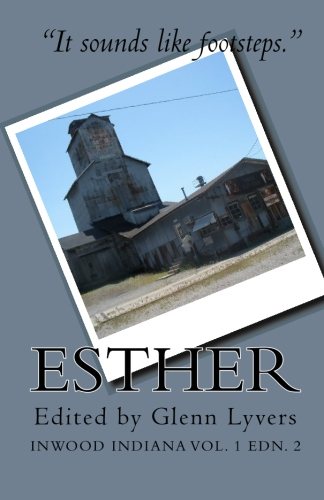
“Hungry” was printed in Esther, No. 1 of Inwood Indiana. Pick up the paperback from Prolific Press; the stories and poems published online are free to read here.
Get the paperback