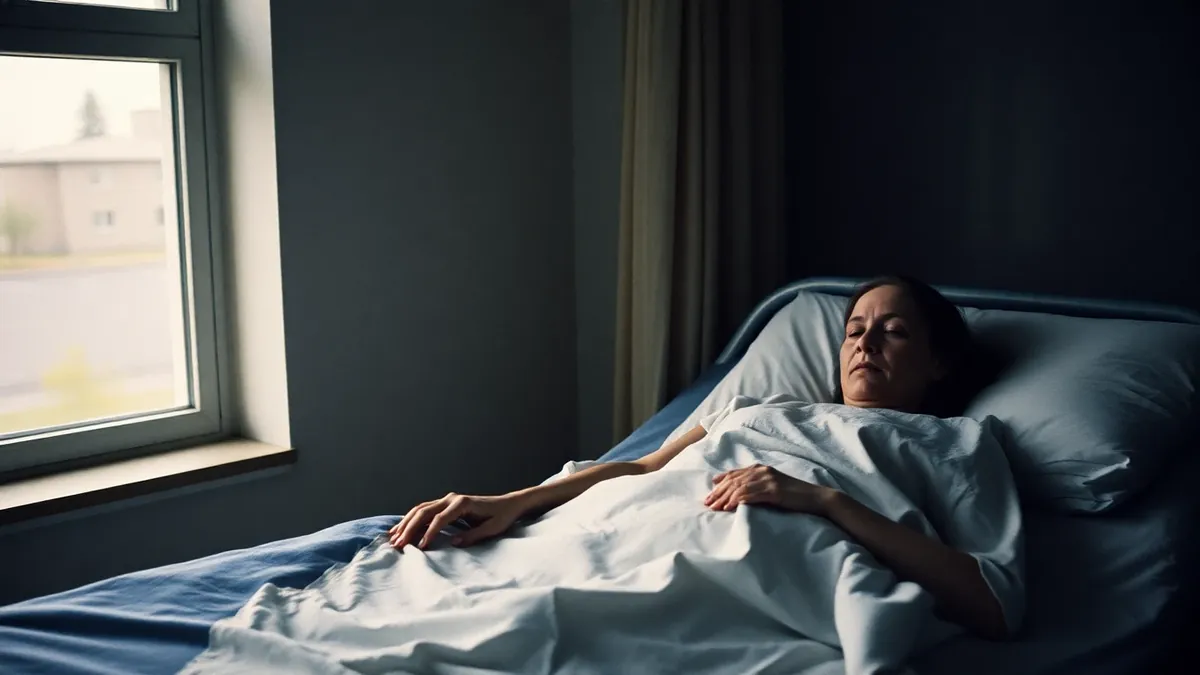
Rose lay upon her hospital bed, listening to Amanda’s bright voice as her sister told her, in exaggerated tones, how well she was looking that day. She silently willed Amanda to shut up, but all she managed to say was, “good kitty,” or something like it, her tongue an alien, thick blob inside her mouth so that the consonants were nearly indistinguishable.
“What's she trying to say, Mom?” Rose’s niece Darla asked. She stood in the doorway as if uncommitted about actually entering the room, pleating the hem of her too-short sweater into folds. The slight pudge of Darla’s stomach peeked out from beneath the sweater, hanging over the waistband of her hip-hugger jeans. Rose herself had worn equally skimpy things at that age, but at least she had had the body for it.
“She said, ‘good kitty,’ didn’t you, sis?” Amanda turned her bleached-blonde head back to her daughter without waiting for a response from Rose. “The therapist says it is the only thing she can say besides ‘yes’ and ‘no.’ She misses her Jackson-kitty. Will you put on that Beethoven CD, hon? I am sure Aunt Rose would love to hear it.”
“No,” Rose said softly, not sure if she meant ‘no’ to missing Jackson, or ‘no’ to listening to Beethoven. Jackson had really been her husband’s cat, and had remained mostly indifferent to her ever since Terrence had died of colon cancer four years ago. The name was supposed to be a joke--he was a solid white cat and Terr had named him after Michael Jackson. Rose wasn’t sure she was ready for Beethoven yet either, unless it would make Amanda shut up. But Darla put on the CD anyway, and Amanda continued her monologue, as though she thought because Rose couldn’t talk, she had to talk enough for both of them. Beethoven's exuberant allegro was relegated to the background, Rose's fingers on her good hand twitching with the memory of a violin she could no longer play.
“Eric thinks he might want to go to law school, don’t you think that would be wonderful? Of course, there's no telling whether he will stick with it.”
Rose hadn’t seen her nephew Eric much since he had started college out of state. She had taken him for a week in New York City for his high school graduation present. They hit all the punk shows, Rose the middle-aged hipster in the combat boots she hadn't worn for years, and Eric trying not to look like a wide-eyed Midwestern farm boy and mostly succeeding. He still talked about it. His last email raved about his pop-culture history class, but made no mention of law school. Of course, he may have simply mentioned that among many possible options and Amanda only heard the part she wanted to hear. Typical. “And Josh sends his love. He would be here but he has a game today in Kokomo.”
“It’s Lafayette, Mom,” Darla said, shifting her weight from foot to foot. Though she had moved from her post in the doorway to turn on the CD player, she stood about as far away from the bed as possible.
“Of course, that is what I meant,” Amanda replied with a careless wave of her hand, then turned her plastic smile back upon Rose. “And Jim is working, of course. With all the new home construction, he stays very busy even on Saturdays! It has been wonderful for us, though, helped us take that trip to Disney World. I showed you the pictures, didn’t I?”
“Yes,” Rose responded, her leaden tongue making her lisp. God, but she needed a cigarette! They wouldn't let her smoke here, and it had been a week. Sure, the smoking was probably a factor in her having a stroke at age 45, but she would have killed for a cigarette. If only Amanda would leave her alone with Darla for a moment, maybe she could get her niece to sneak some in for her. Fat chance she'd get away with it though, with all the nurses hovering. And Darla looked like she would rather be anywhere but here.
Nobody wanted to be here. When she had the stroke, her lover had managed to call 911 immediately, or things might have been much worse. But he had only been to visit her in the hospital once. He bent down to kiss her, bouquet in hand, like dutifully kissing the wrinkled, powdered cheek of some horrid great aunt rather than a woman he had made love to only a few days ago. He didn’t have to tell her it was over. She was damaged goods. She could neither walk nor talk, let alone do anything fun in bed. And playing the violin, ever again, was probably out of the question.
“I’m going to be honest with you,” the doctor had said, peering over the tops of his reading glasses with his squashed-caterpillar eyebrows raised. “This was a very serious stroke, and you probably will not be able to go back to doing all of the things you could do before. But we’re going to do everything we can to get you walking and talking again, and I think the chances of that happening are very good. We need you to work hard, though, Rose. Can you do that?”
Rose didn't feel like working hard. What good would it do her to walk if she couldn’t play her violin? Her throat tightened as Beethoven's joyous strains erupted during a pause in Amanda's continuous prattle. Didn’t anyone just listen to music anymore? This was Beethoven, for gods sake, not muzak! Rose would have rather listened to some of the old punk records she had as a teenager, something like the Stooges, which would better suit her mood. She felt the left side of her mouth turn up into a crooked smile at the thought of Iggy Pop’s monotone voice intoning, “I wanna be your dog” over the relentless, primal bass. She had given most of those records away when she and Terrence had moved from New York back to Indiana. Amanda would never have played that even if Rose, with her limited vocabulary, was able to make her sister understand what she wanted.
“Good kitty,” she said softly.
“Can we bring Jackson here to see her, Mom?” Darla asked. “I think she’s asking for him.”
“The hospital won’t allow pets.” Amanda pushed her chair closer to Rose’s bedside, taking her left hand, the one that still worked. “But as soon as you are well enough that we can wheel you out in the hospital garden, maybe we can bring him. Isn’t it nice of Darla to think of that?”
Amanda leaned close so that Rose imagined she was going to get a big whiff of that floral perfume her sister always wore, but she did not smell it. Perhaps it was an effect of the stroke. “Yes,” she said dutifully, and then tried to say, “nice,” but she could not make her wooden lips and tongue obey her.
“It’s ok, don’t frustrate yourself, Rosie.” Amanda patted her hand. “We understand what you mean.”
No you don’t. And don’t call me Rosie.
As children, they had been Mandy and Rosie to their parents, but both outgrew those nicknames and insisted on being addressed by their given names at some point during high school. Rose, though she was two years younger, had made this decision first, but then Amanda quickly followed suit, and soon she was acting as if it had been her idea all along that the two of them were too grown up for nicknames. The only one who had still called her “Rosie” was her high school boyfriend Tony, who wanted her to sing in his punk band that they would then have called “Rosie and the Riveters.” Tony had an older brother who was going to college in New York City, and he brought home the most outrageous music. Rose and her friends were listening to The Velvet Underground and New York Dolls while most of the other kids were into psychedelic rock or disco. Her hair was short and spiky before it was even cool, when Amanda and all her friends still had long hair down to their waists. But no matter how much she tried to be different, nobody seemed to notice. To their parents, they were still “the girls” and they got the same exact presents for Christmas, like dopey fair-isle sweaters that Amanda wore but Rose gave away.
Even Rose’s desire, as a young child, to play the violin was seen by their parents as an attempt to copy Amanda with her clarinet, an instrument that, as far as Rose knew, ended up in a closet somewhere by junior high and was never played again. “Take piano first, like Amanda did, and then if, after two years, you still want another instrument, how about the flute? That's a nice instrument for a girl,” her father had suggested. But Rose was insistent. It was the violin or nothing. She did manage to get through the required piano lessons, for which she was later grateful, but then, in third grade, she started asking for a violin again. She couldn't remember a time when she hadn't wanted to play the violin. It may have been because of the violinist who came to play sometimes at their church, the brother of the organist. He was not a handsome man, with a bulbous nose and watery, colorless eyes, but his face became so beautiful when he concentrated, his eyebrows raising slightly on some notes, his lips pressing tightly together on others. And the sound had a way of vibrating inside her chest. She could close her eyes and imagine that she was the violin, making the music.
Finally, her parents gave in. Of course, the first sounds that she produced were dreadful, but she surprised everyone by taking it seriously. By the time she got to high school, the first thing she did every day when she got home was to close her door and practice for at least two hours. Then, she would put away her Bach, Mozart, Lalo, or Brahms, and put on the strange, discordant records that baffled her parents.
The punk band had not worked out for many reasons, not the least of which was that Rose got hoarse from trying to scream out Tony’s angst-ridden lyrics, and the band members had looked at her in complete disbelief when she said maybe she could play her violin with them and they could get another singer. Who had ever heard of a punk violinist? She had quipped that at least she knew how to play her instrument, and that was the end of that. But she still let Tony get away with calling her Rosie, as a sort of boyfriend-only privilege.
“You shouldn’t let him call you that,” Amanda, playing the wise older sister, had scolded. “It sounds so little-girl. We’re too old for that now, remember?”
As if Rose hadn’t been the one to decide this in the first place. Years later, even their mother remembered it Amanda’s way. When she would slip up and call Rose “Rosie,” she would laugh her little embarrassed laugh, put her hand to her mouth, and say, “Oops, I know Amanda won’t let me call you girls by your nicknames anymore.” But when her mother was cleaning the house, Rose would sometimes hear her mutter under her breath, “Mandy and Rosie,” for no apparent reason.
Their mother was still living, if one could call it that, in a nursing home, so far gone from Alzheimer’s that she barely said anything anymore, only read the same newspaper over and over again, though Rose knew she couldn’t really read without her glasses. Perhaps she would soon join her mother in the nursing home, and they could have wonderful non-conversations together. She would be younger and more attractive than most of the other residents, and all the old geezers would drool over her and have wheelchair races to decide who got to sit next to her at dinner. "Darla, won't you come and sit down?" Amanda had apparently run out of things to say. "I'm sure your aunt would love to hear about your play."
Darla obeyed her mother, slouching across the room and into the vinyl chair, which responded with a squeak and a long sigh. She folded her hands in her lap. "Umm," she hesitated, "I got in the play."
"Go on," Amanda said, her earrings tinkling as she nodded vigorously. "Just because she can't talk very well doesn't mean she can't hear."
Darla shrugged. "It's a stupid play, though—"
"Of course it's not stupid," Amanda interrupted. "Darla has one of the lead parts in Our Town."
Hardly anyone got a word in with Amanda, with or without being speech impaired.
“Good kitty,” Rose said.
Even with her full vocabulary, Rose couldn’t have explained why that was the only thing she could say. It was a sort of verbal tic she had developed, probably while working on her masters at Julliard, when she had her first cat, her beloved calico angel, Tatiana. She didn't know at the time that the cat was the closest thing to a child she would ever have. She would hold her at the end of a long, frustrating day, stroking her soft fur and whispering like a mantra, “good kitty.” Tatiana’s constant, loving presence and loud purr had gotten her through the stress of competition with other violinists, the burden of having to keep her affair with her much older, married, violin teacher a secret until she had received her degree and Terrence’s divorce was final. But then she found herself saying it when Tatiana wasn't there. At first, she rationalized this by thinking about how much she loved her cat, and naturally, thought of her often.
But later she realized that sometimes when she said it, she had not even thought of Tatiana. The words came out of her mouth unexpectedly when she was deep in thought or under a lot of stress, often when she was thinking something particularly embarrassing, as if the words could bring her back to reality, or somehow cover up guilty thoughts. Fortunately, most of the time she managed to avoid this unless she was alone. But not always. She remembered sitting in a bathroom stall at Terr’s nephew’s wedding reception, after a few drinks, and realizing, to her horror, that she had said it aloud. Peering down, she had seen a pair of black, high-heeled shoes in the stall next to her, and had quickly flushed the toilet and left without even washing her hands, hoping that it was no one she knew.
“We’re taking good care of your Jackson, I promise,” Amanda said loudly. “And we will let you see him as soon as the doctor says you can come outside.”
Rose could picture what would happen. She would sit in a wheelchair in the garden, and Jackson, yowling all the while, would be forcibly extracted from his cat carrier and placed upon her lap, where he would proceed to dig his claws into her legs and everyone would fuss about making sure she didn’t have any cuts, particularly on the right side where she wouldn’t be able to feel it. She would aim a few weak pats at his head and say, “good kitty,” and Amanda would beam and pronounce the encounter a huge success, again congratulating Darla on having such a wonderful idea. It would be the subject of conversation every year at Amanda and Jim’s Christmas party, how Rose had pined away for her cat and Amanda and Darla had heroically brought him to her. Just like when they were kids, Amanda would remember things her way, and her version would be the one that became part of family lore, regardless of whether it bore much similarity to the truth. And now Rose couldn’t even give her own side of the story. The history of the world would now be Amanda’s history, and Rose felt her own life being slowly erased.
Gone was the eccentric Aunt Rose who was loved by her niece and nephews because she was less conventional than Mom and Dad. She used to take Eric, Darla, and Josh to Indiana Beach and ride all the roller coasters with them, screaming with her hands in the air. She had gotten them into symphony dress rehearsals and taken them on backstage tours of Circle Theatre, which Amanda heartily approved, as well as taking them to midnight movies and rock concerts their parents never would have permitted, which was their little secret. Now she was the family invalid, and Rose could tell just by Darla’s posture how uncomfortable her disability made her niece feel. Just put her in a home somewhere and forget about her, better than being pitied and treated like a child. Or for godssake, just let her die!
Amanda stood and leaned over her, reaching down to take her right hand, the one that didn’t work. “Let’s do your exercises, to help you get better.” Her voice still held its forced brightness, which belied the dark circles under her eyes.
Though she knew she was being ungrateful--Amanda and her family, as her closest relatives, were responsible for her care now- -Rose willed her mouth to spew obscenities at her smiling sister. She didn’t want to do her exercises!
“You bitch!”
Rose was stunned to hear her own words come out clear as day. Her mouth worked soundlessly on an apology.
“Yes, Jackson is a good kitty,” Amanda replied placidly as she moved Rose’s arm the way the therapist had showed her. “Mom, I don’t think that's what she said.”
Rose turned her head to see Darla's mouth quirked up into a rare grin, and she realized that her niece understood her perfectly. Darla shot a furtive glance at her mother, and then giggled softly, winking at Rose as if to say that this would be another one of their little secrets.
Rose smiled in return, at least with the good half of her face. Before Amanda and Darla left, her niece came over and awkwardly leaned down to hug her, whispering, “I know you’ll be fine Aunt Rose.”
Rose was still smiling after they were gone, when she whispered, only to herself, “Good kitty.”
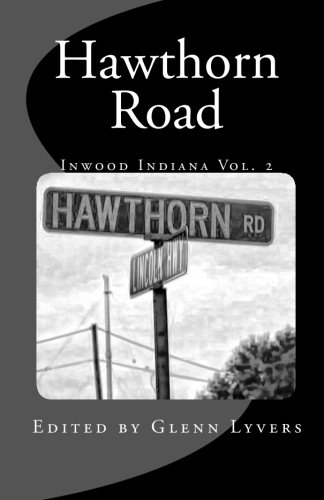
“Good Kitty” was printed in Hawthorne Road, No. 2 of Inwood Indiana. Pick up the paperback from Prolific Press; the stories and poems published online are free to read here.
Get the paperback