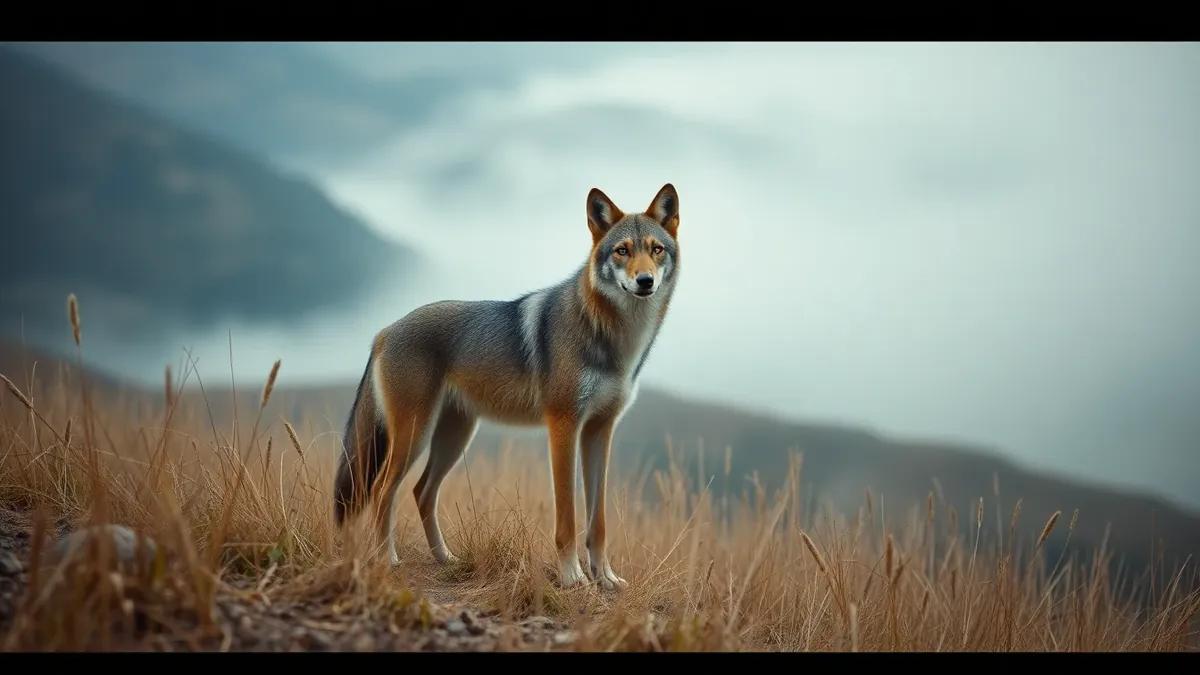
D.J. got low against the ridge with his rifle pushing down tall grass, and the coyote lined in the crosshairs a stone’s throw downhill. One blue eye and one brown eye, she stood with her scrawny legs and matted gray and black shaggy fur. The animal looked in his direction; her slender nose sniffing the air. He closed his left eye to peer down the iron sights as she pawed at the ground and tore off bits of bird carcass, blood dripped off her white jaw. He took a shallow breath, let the air out slowly, and squeezed out two shots. Bark flaked off a tree, and with a quick convulsion and rippling fur, the coyote staggered out of view with a few loud yelps.
He pocketed the two hot shell casing, slung the rifle over his shoulder, and side stepped downhill. The area where he stood was in a small clearing, and the heat baked down as he wiped the sweat off his forehead with the back of his hand. He pulled out a cigarette from his breast pocket and found a hole in the paper, ripped it in two at the base, pinched out the loose tobacco near the filter, and rolled the longer half back into the filter. He lit it, pulled the initial inhale and release, and then took a long solid drag. Blood had pooled where the coyote had stood with a thin red trail heading into the thick of the woods.
He walked softly and lifted his feet not to scuff the grass. The hickories and maples were spaced ten paces or so apart, and the ankle-biting brush was heavy along the blood trail. Around the thicket of briars and vines, he followed the trail farther downgrade. The toes on the coyote's paw prints were closer together than most dogs, and they were imprinted at an even gate. The tracks off the hind legs were less indented then the front, all her weight distributed to release pressure off the wound. He hadn't seen the bullet hole, but he knew he missed the kill shot and hit farther back near the hide of the animal. A long vine hung down a high tree branch, and the sun came down in patches through the leaves.
The wind snaked through the trees hissing the branches, and he scanned the trail: below him the tree line broke into a grassy opening, up to his right was the crest of a hill, and in front of him was an increase in grade that wrapped around the hillside. The blood on the grass heavier from the animal running herself to death, and it coagulated at spots of rest. She couldn't be far. He didn't know why the coyote was out during the day or away from her family, but his father wanted it done. She'd been creeping around the house at night, pawing at the chicken wire; moving between the fog. His father was vigilant in his watch. D.J. would observe him rap his cane against the wallpaper, flip the porch light on and off, and crack a window to grunt at the night and listen for movement. But his father always fell asleep in the armchair with his Panama hat tucked over his eyes, and he would count aloud in his sleep: one, two, three; four. He was counting coyote.
D.J.'s boots were brown and worn. A few holes exposing white material underneath, and one large hole at the seam revealing the white sock when he lifted the boot letting the hole expand. White rock salt residue, from the winters before, lined the sides, and dark brown water and dirt stains near the heel. He firmly planted his feet with each step. In his pack was a case of bullets, and he loaded the rifle by pulling out the bolt and locking the shells into the chamber. He crested a ridge and peered uphill to another ridge to his right or downhill toward the valley to his left. The cigarette had burned to the filter, and he rolled the cherry out of the ground, and he pocketed the filter next to the shell casings. The valley in front of him had telephone poles that came up and over the ridge. Their lines drooping and naked and buzzing. The sky a pale red through the trees, and a willow wept its branches down to his shoulders.
He marched through the ravine under the power lines, and the trail cut uphill to a clearing with a burned down brick house and a charred chimney intact and pointing straight up in the air, the rest of the place in rubble. The white mortar holding the bricks together was cracked but sturdy. He kicked a rock into the fireplace and it ricocheted back out and onto the grass. At the front of the fireplace were chunks and smaller pieces of stone hearth and ash. The blood trail ended here, and the coyote lied curled inside the three walls of the chimney. The animal was motionless, powerless; could've been a stuffed animal on the shelf of a store. Her mouth gaped, pale pink tongue unfolded across a thin set of jagged teeth; tongue tip dipped onto the cement floor. Her body haloed by wood ash. He tiptoed over the rubble and nudged the animal with the barrel of his rifle, and she didn't budge. He scooped up the ash in his palms and sprinkled the grains over her body, and he smoothed the fur around the ears and closed her eyes.
He sat down at the edge of the destruction and drank from a warm canteen. Putting the butt of the rifle flat against the outside of his hip, the barrel faced the northern hillside. The evening dimmed the sky, and the humidity sank with the sun. He sang in a baritone, "Amanda Lynn plays a mandolin./ The night sky is trembling./ Tomorrow's weight is dwindling./ And I am lost, again." The house was there a year ago, but one night, it went up in scorched earth. He knew the family, ran water down from his family's well to their house, and he had played with the boy living there for many years. He looked at the rubble: blackened bricks and torn wood panels, strewn household items and charred magazines, and an abstract pile of scattered objects like linoleum tile, lamps, and baseball cards. Artifacts of a life spent well and spent quick and never coming back. He lied in the grass, stayed silent as twilight turned full dark, and he counted stars until he fell asleep.
When he awoke, dawn had opened up in an orange haze, and his clothes were wet from dew. He peeled off his shirt, pants, socks, and boots and placed them on a broken wall of the razed house. The carcass had been picked over by numerous scavengers. When he got closer, he could see an exposed ribcage and large chunks of fur and flesh dropped around the body. A portion of the tongue was missing, and the eyes were gone. Several crows were making noise in a nearby tree branch, their stomachs probably puffed out on coyote meat. He pulled up his boxers and examined his own body, the farmer’s tan a deep white on his chest and legs, yet the skin on his arms were pink.
His stomach grumbled as he scratched at his sunburned forehead, and he laughed for being passed over by the birds for an easier meal, one that didn’t chew back. He chucked a stone at the birds, and they dispersed quickly, making a noisy spectacle, and the stone chipped bark off a high branch and then came down with a thud and a roll. His bare feet pressed into the soft, wet grass as he walked over to an area where the thicket met with a small clearing, and he knelt down to a bush and pulled out several wild blackberries and ate them raw. He plucked out more berries and consumed them, their taste bitter and sharp, and juice ran down his mouth and stained his fingers. He broke off the shoots and chewed them, and he collected the leaves off the plant and shoved them in his pocket for them to later be dried into tea leaves.
When his clothes dried out by the morning sun, he threw them back on and marched north, his worn boots digging in to the soft earth as he made a slight ascent. When he peaked the hill, he walked across an open field. He was close to the border of his father's land and the neighboring property. He could visualize in his mind’s eye a house about a mile west. A quiet family of five, the kids in middle school. His father often would lend a hand when the neighbors needed help. City water didn't run out here, and he would bring water if needed or dig out a well or a stream to provide the water for others. If trees fell on the narrow road, his father would rummage out a chainsaw and clear the passage.
He was good with farming and gardening, and he'd help harvest if help was needed. D.J. considered selling some timber off his land to help make some extra money. He wondered if there were any minerals that he could sell the rights to. Maybe he'd sell everything: the acreage, the house, and even the damn soil. He assessed the land. The forest was lush and thick. A deadfall of hickories filled a ravine, and they probably fell over last winter.
Around here, people sought out a flat stretch of land among all of these rolling hills, and when that flat stretch was found, property lines were usually drawn up soon after. D.J. knelt through barbed wire that was strung up between wooden posts, and he walked around the bank of a pond to the flat stretch has father found and purchased twenty some years ago. As a boy, he helped lay the foundation, yet his father rifled over blueprints for weeks before breaking ground. D.J. stood and took the two story house in, and it was somehow alien, disfigured. The gray shingles on the roof, the white side paneling, the blue shutters, all of these things in order, but they seemed darker, worn.
He shook it off and went inside and found his father's things where they were left. The dining room table was covered in loose pages of The New York Times and The Wall Street Journal. Several books on the hardwood floor, and he shuffled through them: some about space and time, nothingness and natural history, and transubstantiation and last rites. His father had stacks of nature magazines, books, and comic books on the china cabinet. Stationery for writing letters to his numerous correspondents. A silver letter opener in the shape of a dagger. The dining room had transformed into his study, and D.J. opened a cardboard box and piled in all the books, magazines, newspapers, and etcetera, stripped the room of its clutter. He taped the box up, wrote "Father's Things," and took it up to the attic. D.J. spent the day cleaning up the house, removing dust and dirt and putting his father's things in storage. It was two days after the funeral. The house was empty, quiet. After the cleaning, most of the rooms were bare besides furniture. The living room was a recliner, couch, and plain glass coffee table where his father ate his meals. The dining room was a wooden table, blank-faced china cabinet, and an office chair. The kitchen was smooth countertops, an empty steel sink, and all the dishes and cooking utensils tucked away in cabinets and drawers. Both the bathrooms were just commode, shower, towel closet, and medicine cabinet with abandoned pill bottles and ointments. The master bedroom was an empty walk-in closet with forty wire hangers, king-sized bed stripped of sheets and covers, an empty bookcase, and a barren desk. The second bedroom was a twin-sized bed without sheets and a loan telescope pointing at a window. D.J.'s room was like it was before the funeral, a mess of clothes, CDs, and textbooks. He hadn't got to the basement, barns, or garage, and the attic was packed to capacity. The house was on forty-five acres of forest and meadow. His father had no will, but D.J. was left with the house and land which included two barns and a garden, twelve chickens, two horses, two goats, and a blind German Shepherd. He was left these things because he was next of kin after his mother, and his mother didn't want them. His brothers and sisters had long since left the state.
He stood in the upstairs hallway where the carpet was still pressed down in spots from absent cabinets, and the hallway was empty beside his rifle resting in the corner. He took in deep breaths as he pressed his hands into the artificial wood that covered the walls, and small particles of dust and hair floated past the beams of evening light coming from the windows. He shut his eyes tight and shook his head, and then he moved with large steps down the stairs and outside to the porch. He sat down on a chair as sweat mounted his forehead, and he tried to control the tightening of his chest and heart through breathing. The German Shepherd shuffled his paws, following D.J.'s vibrations as he rocked in his chair, and the dog put his head in D.J.'s lap. He petted the dog's skull, looked at the clouded gray eyes, and smoothed the fur around his spine. He put his head to the dog’s head, and the animal whimpered and rolled on his back.
He peered down the long gravel driveway as a sedan cut the corner and made a crackling ascent up to the house, and he recognized the car to be Tsukiko Inoue’s. She cut the engine, and it sputtered out and clanked hot under the hood. She got out of the car, pushed her sunglasses from the bridge of her nose up to her forehead, and gave him a slow wave. Her black hair flowered down to her shoulders, and she had a sun dress draped over her lean body. She smiled, bent over and hugged him, and then sat down on a chair.
“I just heard about Miller,” she said.
She’d always called his father by his last name. Her Japanese accent had faded from its thickness, yet it was still stressed and jagged at points. Her inflection would singsong when she choked up.
“I’m sorry for your loss. I just got in from Pittsburgh.”
He grunted under his breath, shrugged his shoulders, and lowered his head.
“Would you like to come in? I have a fridge full a food leftover from the wake. It’ll spoil soon.” She nodded.
He used the microwave to heat up pre-prepared plates of the dark meat of turkey, mashed potatoes and gravy, and green beans. He then added to the plates warm rolls and deviled eggs. They sat down at the dining room table, and she pinched a slick egg between her fingers and took a small bite. He tried to scratch up conversation, but everything that he came up with fell flat in his mind. So they sat there in silence consuming their food soundlessly, politely wiping their mouths with napkins after each bite. She had a short forehead, thin bridge on her nose, and sharp eyes. She looked around the room with pursed lips.
“This looks so bare,” she said.
“You don’t like what I’ve done with the place?”
He looked down at his plate, and everything was spoiled green, rotten. He shook his head and the picked over food looked edible again, but he pushed the plate away from himself. His appetite had left the last couple days, and he could only stomach small amounts. She had finished her food, stood, and walked about the room. She had a dancer body, weightless, and moved like a sylph. The Inoues lived down the road a piece, and D.J. had known Tsukiko since early childhood. She didn’t know English when she first arrived, but they still roamed the woods together, their words just animal noises to each other. Her body had transformed over the years: she grew in height but not in weight, her nose and cheeks elongated, and her adult teeth filled out her face. Her small skeleton was agile and limber, and she lifted her body on her tiptoes and opened a high cabinet to find it empty.
“Out with the old…” he said.
“I feel like I’m in a furniture store with their fake dining room setups.”
“My fruit is not plastic, thank you.”
She closed the cabinet and turned to him, “You have fruit?”
“Well, it’s probably bad, actually. My, I didn’t buy it.”
“You doing alright?” She put a small palm on his shoulder.
“Fine,” he said with a quick nod. “Fine.” He bit deeply into his lower lip.
Darkness had set in as she made her way to her car, and he followed her out. The night air was muggy and full of sounds from crickets. As he stood beside her car, he could barely make out the woods around him from the moonlight, and she looked at him for several seconds before embracing him fully. She wrapped her arms tight around his shoulders, and she rested her head into the small dip of his chest. He rubbed the wings of her shoulder blades, and then she broke first and took his hands in hers.
“You take care of yourself, David.”
His hands felt cold as they parted from hers, and he watched as she got in the car and drove down the gravel drive. Her headlights illuminated the paved road below, and she edged out to make sure no one was coming before steering onto the road toward her house. Warmth spread and faded through his chest, and he crossed his arms and rocked on his heels. He finally managed his way back inside his house, and he ran laundry and made the bed in the master bedroom. The house creaked and made a hollow moan, and D.J. felt like the house was settling down deeper into the ground. The room was vacant minus the bed, and he sat down at the foot of it and looked out the window. His mind wandered about as he stretched out on his father’s bed, and he kept thinking of all the things needing done. He pushed those out to the thought of Tsukiko, the places where their bodies touched felt like fire to him in memory, and he covered himself up and closed his eyes in an attempt to drift to sleep. His mind drifted from the darkness of his shut eyes to the dull, flushed colors of memory, and after hours of tossing and turning, he stood straight up out of bed.
He dressed and grabbed his pack, rifle, and industrial strength flashlight, and he made his way out into the night. At the spot that he’d shot the coyote, he marched over a waving hillside, and the landscape was changed by the darkness, transformed via visibility. The cloud covered moon offered little light, and he shot the beam of the flashlight through the woods. The night air breathed across the valleys, slid over stump-like hills, and whipped around trunks of trees. Branches swayed with the strong gusts, and the moisture in the air lifted like heat rising from soil. He was being stealthy, like before, and his boots would softly dig into the ground as he scaled a sharply slanted hill. His heart beat to the rhythm of his marching, blood pumping through thick and visibly blue veins, and he crested another hill to peer downgrade to a couple sweeping valleys with small streams and water run-offs. He clicked off the flashlight, and he lied down with a vantage point of the twin valleys below that crossed into each other but were separated by a high hill divide. In a stretch of flat surface in the left valley was the coyote family, and D.J. readied his rifle.
His heartbeat was up, breathing quick, and his hands were shaking. He closed his eyes to pace himself, looked inward, and took deep gulps of breath. He relaxed all his muscles and lied limply in the grass for several moments. Blades of grass moved against the small hairs of his arms, the wind blew over his body, and he reared his head to cradle the rifle against his shoulder and the ground. He clicked the light on, and the beam revealed the family of five coyotes. The animals looked toward the source of the light. He fired, each shot kicked against his shoulder, and the sound echoed. The animals took off in different directions, and D.J. reloaded, bolted the bullets in, and fired again. Sweat poured down his forehead and watered up in his palms, and he kept shooting, over and over, until his shoulder ached sharply. The animals were gone, but he kept sliding bullets into the chamber, locking them down, and sending them off below. The beam of light showed the ground kicked up, dirt blasting from entrance wounds, and grass and mud flipping in every direction. He stood and chucked the rifle, and it spun and crashed to the earth. D.J. collapsed to the ground. He didn't hit the coyotes, not one shot, but it was OK, they weren't the true killers. They were just the scavengers.
He’d seen the Panama hat first the week before, and it had blown several yards away, the brim was torn jaggedly. Clouds brushed slowly across the sky, and the sun was hidden most of late evening. He was gone a majority of the day busing tables, and he’d come home to hungry animals. The chickens and horses were uneasy and fidgeted when he came near, so he grabbed their feed from the outside crate and filled their bowls. The German Shepherd had his food bowl locked in his jaws, and D.J. grabbed some fresh water for the dog and then fed him. He whistled a tune from the radio, and after searching the house, he went to find his father in the barn. The barn was empty beside a few coiled blacksnakes his father kept there to fend off field mice. One snake had a bulge digesting in the pit of his stomach, and the animal propped its head up before stretching across the strewn straw. D.J. hiked over to the garden, his whistling strong and clear. The garden was cared for, and the only movement he could make out was from the billy goats chewing on sticks, his father leashed them to a brick and threw it over the brush pile letting them eat their way through. Then he saw the hat caught on a bush at the tree line, and the breeze waved the hat at him as he descended the hill toward the edge of the woods.
He picked up the Panama in his hands, turned it over a few times, and then he stepped into the shade of the trees. The coyotes came into view, and they were huddled down as if in group prayer. His whistling stopped as he focused in on the circle of animals, and he spotted a hand. He yelled at the coyotes, and they took off as far away as they could manage. He sprinted around the trunks and came up to the body of his father. Though he’d later find out from the coroner that his father passed from a weak heart during a peaceful stroll, D.J. collapsed to his knees and touched at his father’s wounds at his thighs and side. His fingers pressed down softly on open flesh and bone, and his fingers came out red dipped. The man’s salt shaded hair was mussed and muddy, the muscles in his face were loose and flabby, and his body was rigid. D.J. bit at the loose skin around his hand and popped his knuckles, and bent his ear down to his father’s mouth and searched for breathing, finding none. He looked up through the branches at the graying sky, and then he looked back down at that lifeless body, that lifeless blood.
The body was mostly cold to the touch, but D.J. tilted his father’s head back, opened his mouth, and put his mouth over his father’s cold, blue lips. The man’s chest expanded as D.J. blew air down his throat, and the chest collapsed quickly each time. He put one hand over the diaphragm, and then he put his other hand on top, lacing his fingers together. He straightened his arms and pushed down on the chest with force, the bones giving way underneath and popping on the first couple heaves. He pumped his hands down, counting aloud thirty times, and then gave two more rescue breaths before forcing down on the chest again and again. D.J. closed his mouth down and released all of his breath, his lungs emptied as another pair involuntarily inflated. He was trying to be his father’s lungs, and his hands went numb trying to be his father’s heart. The air smelled of salt and oranges, and the breeze licked through coldly, it carried in a fresh rain from the north. It was the beginning of summer.

“Converge” was printed in Harvest Time, No. 5 of Inwood Indiana. Pick up the paperback from Prolific Press; the stories and poems published online are free to read here.
Get the paperback