
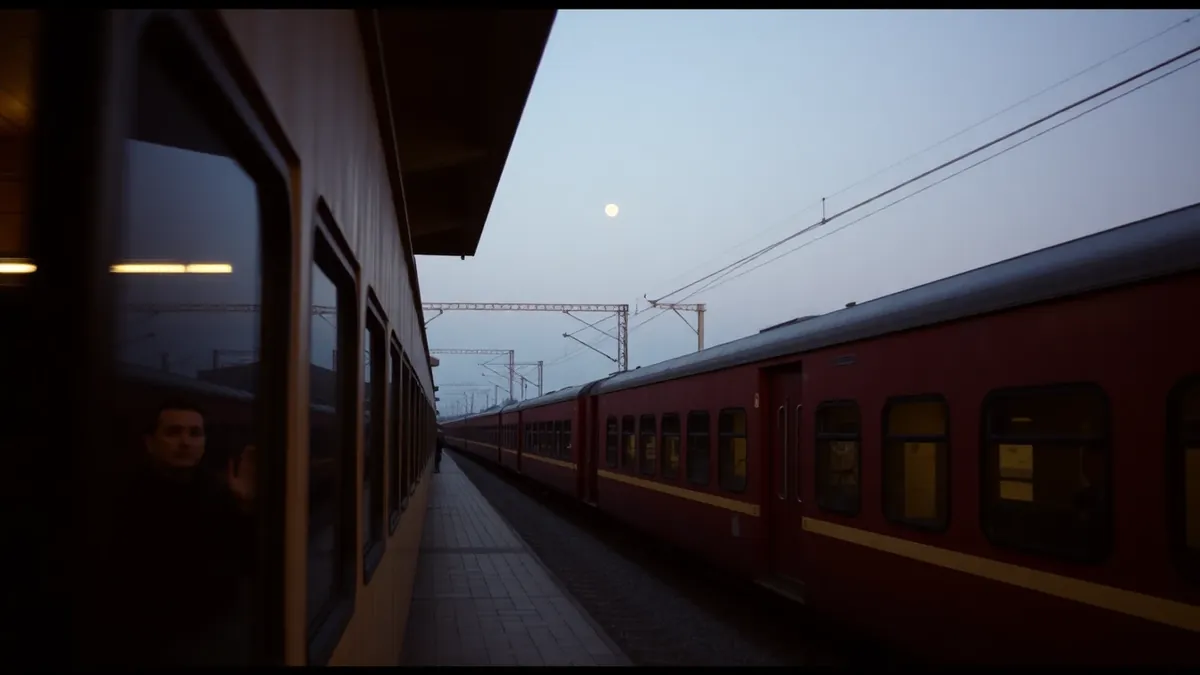
Slowly the passenger train crept out of the station past knots of people waving at those on board.
“You’re not waving,” an elderly woman seated across from Lugar remarked after she finished waving at her daughter and grandchildren.
“Excuse me?”
“Didn’t anyone come to see you off?”
He shook his head.
“You only here on business?”
“No. This is where I live.”
“I’m surprised no one’s here to see you off,” the officious woman observed, tapping a fingernail against the side of her small, veined nose.
He looked up from the magazine folded across his lap. “I’m only going to be away for the weekend.”
“A lot can happen in a weekend, though,” she said. “Those who care about you should know that. They should be here to say goodbye. That’s my opinion, anyway, for what it’s worth.”
He smiled politely and looked back at his magazine. “Nothing, right?”
“Sorry?”
“That’s what my opinion is probably worth to a young man like yourself, isn’t it? Nothing.”
“No, not at all, ma’am.”
She smiled, not believing him for an instant, and propped a pillow behind her neck and closed her eyes.
The carriage swayed a little as the train roared through a narrow turn, waking Lugar who until then had not realized he had fallen asleep. Quickly he looked at his watch and saw that he had been on the train for nearly two hours. He was astonished, not having any idea he was so tired. Then he noticed that the inquisitive woman was no longer seated across from him but instead there was a bearded man playing chess against himself on a small magnetic board.
Turning, he gazed out the window at the trees which spun by so quickly that he imagined the limbs were hands waving at him as he passed. They were the ones seeing him off this morning, he thought, smiling.
Lugar had not been on a train in years, not since he was a boy, and Aidan, a friend of his mother’s, invited him to go fishing one weekend. Along with a couple dozen other anglers, they rode a rickety little silver and blue freight train that travelled up and down the Breakneck River. They were packed inside the one passenger car so closely it was difficult to turn without banging into someone but he didn’t mind because he always enjoyed being with Aidan as much as any of his mother’s male friends.
He scarcely had any memory of his father who, according to his mother, perished in a multiple car traffic accident on his way home from a motorcycle race where he worked on the crew of one of the riders. Because he didn’t have a father at home his mother encouraged her various men friends to do things with him that a father would likely do with his son. So he was taken to baseball games, to bowling alleys and wrestling matches, even once to a racetrack where he was shown how to bet even if he was too young to place the bet at a window. But only Aidan took him out of town aboard a train on a fishing trip, and even though he didn’t catch anything he remembered that weekend more clearly than any of the other places his mother’s friends too him. Not only was it the first time he had spent a night away from home but Aidan made him a promise that somehow he managed to keep.
“You’ll catch something, Matty,” he told him when they reached their fishing spot. “I guarantee it.”
“You do?”
“Absolutely.”
And though he was disappointed when they failed to get even a bite, he still was adamant that the youngster would catch something that day.
“What?” Lugar asked skeptically.
“Fire.”
“Fire? I don’t understand.”
“Here,” he said, kneeling down on the ground, “I’ll show you how to get fire. That’s something worth knowing, isn’t it?”
“I guess.”
“Of course, it is, Matty. Now, if you’re ever in the woods without some matches, you’ll know how to make a fire.” At once, he picked up a foot-long branch and, after making sure it was dry, gathered a handful of brown pine needles as tinder. Vigorously, then, he spun the stick between his hands until the tinder began to smolder then blew on it until the needles ignited into a small flame.
“Now you do it.”
“I don’t think I can.”
“Sure you can.”
It took him quite a while but eventually he did produce a very thin flame, if only for an instant, and felt as satisfied as he had ever felt. Of all his mother’s male friends Aidan was the only one who taught him something he still remembered even if, so far, he had not needed to use the knowledge. And for that he was very grateful.
The train rattled along a narrow river that reminded him of the river he fished with Aidan many years ago. A single man stood along the bank, casting his line, and he wondered if it might be Aidan. He had not seen him in years, doubted if he even would recognize him, because he was friends with his mother for such a brief time. Some of her male acquaintances were around for months but others only a few weeks like Aidan.
Out of the corner of his eye Lugar noticed the bearded passenger staring at him, probably thought he recognized him. He had received that reaction a lot since his picture appeared in the newspaper a couple of weeks ago. Numerous people looked at him as if they were sure they had met him somewhere, their eyes full of confusion and curiosity, while others who did recall seeing his picture in the paper often asked to shake his hand for what he did.
Two weeks ago, soon after he got home from a concert at the opposite end of town, he saw smoke pouring out of an upstairs window in the Christofferson house across the street. Immediately he rushed over to the house where half a dozen other neighbors had gathered on the front lawn. They assured him the fire station had been alerted and that a truck should be arriving any moment. Then he heard a scream from somewhere upstairs and, before he quite realized it, he barged through the front door. The hallway was engulfed in smoke and, after covering his mouth with a handkerchief, he charged up the winding staircase where he found the grandmother on her knees outside her bedroom. Her forehead was bleeding, her eyes stark with fear. Quickly he picked her up and stormed back down the staircase and out the door.
A couple of days later, a picture of him visiting the elderly woman in the hospital appeared on the front page of the Metro section of the morning paper. As a result, he received so many congratulatory calls and messages that he felt like someone who had scaled some towering mountain peak but soon was embarrassed by all the attention and was relieved when it began to taper off by the end of the week. Of course, he would be pleased to shake the hand of the bearded chess player if he asked but would just as soon not be bothered. Among the messages he received in connection with his rescue of Mrs. Christofferson was from a second cousin in Lewiston he never knew he had who sent along an old newspaper clipping about a three-year-old boy from Lewiston who vanished from his bedroom late one night. His reputed cousin claimed he was that boy, taken twenty-six years ago from his father by his aggrieved mother, and included the Lewiston address of the person she said was his father.
He was stunned, not believing the claim for a moment. His mother died in a boating accident last summer but he was sure if she had taken him from his father, as this supposed cousin charged, she would have told him. He was absolutely sure of it yet, a few days later, he found himself aboard a train bound for Lewiston. It happened almost before he knew it, much as it did when he stormed into the burning Christofferson house.
The train slowed down as it approached another station. Two more, Lugar figured, then it would be in Lewiston. Once again, as he waited for the train to pull out, he removed from his coat pocket the wrinkled newspaper clipping sent to him earlier in the week. The name of the abducted boy was Andrew, not Matthew, and, according to the article, “Have You Seen Andy?” fliers were posted all around town by his desperate father. He was surprised the clipping didn’t include a picture of the youngster even though he doubted if he could recognize what he looked like at that age. He had seen other pictures taken when he was a boy and seldom was able to identify himself. Back then, his mother told him, his hair was almost blond, not dark brown as it was for as long as he could remember, and his face was as round as a billiard ball.
Across the street from the Lewiston station was a Hertz office and, as soon as Lugar retrieved his lone suitcase from the baggage carousel, he went over to the office and rented a car for the weekend.
“Have you been in Lewiston before?” the agent asked after she handed him the keys to a new Taurus.
“I don’t believe so.”
“You don’t know?” she said, surprised. “Are we that unmemorable?”
He shook his head, a little embarrassed by his answer. “What I mean is that I might’ve been here when I was a kid. I’m not really sure.”
“There’s no one you can ask?”
“Not anymore I’m afraid.”
“Well, maybe you’ll remember if you’ve been here before once you’ve had an opportunity to explore our city a little bit,” she said and slid across the counter a street map.
“Maybe so.”
Once he got in his car he looked at the map for a few minutes, struggling to figure out the shortest route to the street where the person alleged to be his father resided. He had never been very adroit at reading maps and, more often than not, stopped along the way to ask for directions. And today was no exception because soon after he left the Hertz lot he pulled into a gas station and asked the attendant how to get to Mulberry Street. “That’s clear across town,” the guy said, softly clicking his teeth together, then gave him some general directions that at least pointed him in the right direction. “Thanks.”
“I take it you haven’t been there before?”
He shook his head, not really knowing if he had or not. “Well, if I were you, friend, I’d keep my windows rolled up and my doors locked. There are some pretty ornery characters in that part of town.”
“I’ll do that.”
“You be sure you do.”
It took him close to twenty minutes to reach Mulberry Street which, at first, did not appear much different than the other streets he had seen in Lewiston. But then, the farther north he proceeded, the worse condition the houses were in, with more than a few appearing abandoned as if the residents had fled from a frightful storm. Chimneys were falling apart, with bricks strewn like leaves across the roofs, many windows were broken and patched with electrician tape. Some doors were wide open as if someone were expected at any moment. In the front yards were dismantled cars, pieces of furniture, ropes hanging from the limbs of trees, bicycles and scooters, even a couple of bathtubs. There were things everywhere but the only people he noticed were a few old men who glared at him from their front porches.
The house he was looking for was in the middle of a block that, like so many other blocks he had passed, looked as if a tornado had swept through it, with shingles and scraps of tarpaper scattered across the lawn. He pulled up in front of it and started to turn off the engine then changed his mind and circled the block and parked across the street from the brittle little brown house. He was about to open the door when he abruptly drew his hand back, not really sure what to say to the man who lived there. He stared at the house for a moment, wondering if anyone was inside because it looked abandoned like so many other houses on the street. If the man who was his father was still there, he still didn’t know what to say to him, despite all the things he had rehearsed in his head during the train ride, still didn’t know if he really wanted to meet him after all these years. He was as much a stranger to him as someone who lived in another country. So he decided to wait in the car, hoping perhaps to get a glimpse of him, figuring that might help him decide whether he wanted to introduce himself.
He seldom ever asked his mother about his father because he didn’t really have any memory of him but once after she took him skating at a rink in a shopping mall over town he asked her if his father could skate. She thought a moment. “Only under a cold moon.”
His eyes crinkled in confusion. “What’s that mean?” “Your father said he’d only skate when the pond that we lived near when we first got married froze over, which never happened even in December because it just never got that cold.”
“So you never saw him skate?”
“I never did so I don’t know if he could or not since your father never was one to admit he couldn’t do something.”
He also was reluctant, at times, to acknowledge that he was unable to perform a particular task, Lugar thought, continuing to stare at the brown house. Apparently he had inherited something from his father, after all, despite his mother’s insistence that he had nothing in common with him.
Nearly an hour later, after dozing off in the car, Lugar was awakened by a closed fist banging against his window. Startled, he looked up and saw a burly man with scraggly brown hair motioning for him to roll down his window and he did cautiously.
“You run out of gas, mister?”
He shook his head.
“So why are you sitting here?”
He noticed then another man standing behind the one at his window, staring at him intently beneath a blue watch cap. “I’m waiting for someone.”
“Who would that be?”
“The man who lives in that brown house,” he said, jerking a finger toward the place.
“Well, mister, you’ll be waiting an awfully long time I’m afraid.”
“Why’s that?”
“Because no one lives there anymore,” he said firmly. “Hell, hardly anyone lives on this block anymore.”
“You do, though?”
“Yeah, I do. And that’s why I’m curious when I notice someone who doesn’t belong here.”
“Oh.”
“Oh,” he replied, deftly mimicking the tension in Lugar’s voice.
“You know where the man who lived there went to?” “Nope. All I know is he isn’t there now.”
“Well, I suppose I better be on my way then.”
“I suppose you better.”
At once, he started the engine and drove past the curious man, wondering if he really knew if the owner of the brown house was gone, wondering indeed if he might be the owner. He had no idea, of course, but one thing he did know was that he didn’t belong here. And, as he drove toward the moon beginning now to gleam through the clouds, he decided he didn’t have to meet his father to know that his mother was right to take him away from this place.
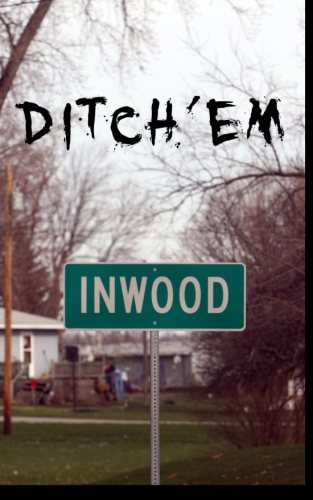
“Cold Moon” was printed in Ditch'em, No. 7 of Inwood Indiana. Pick up the paperback from Prolific Press; the stories and poems published online are free to read here.
Get the paperback