
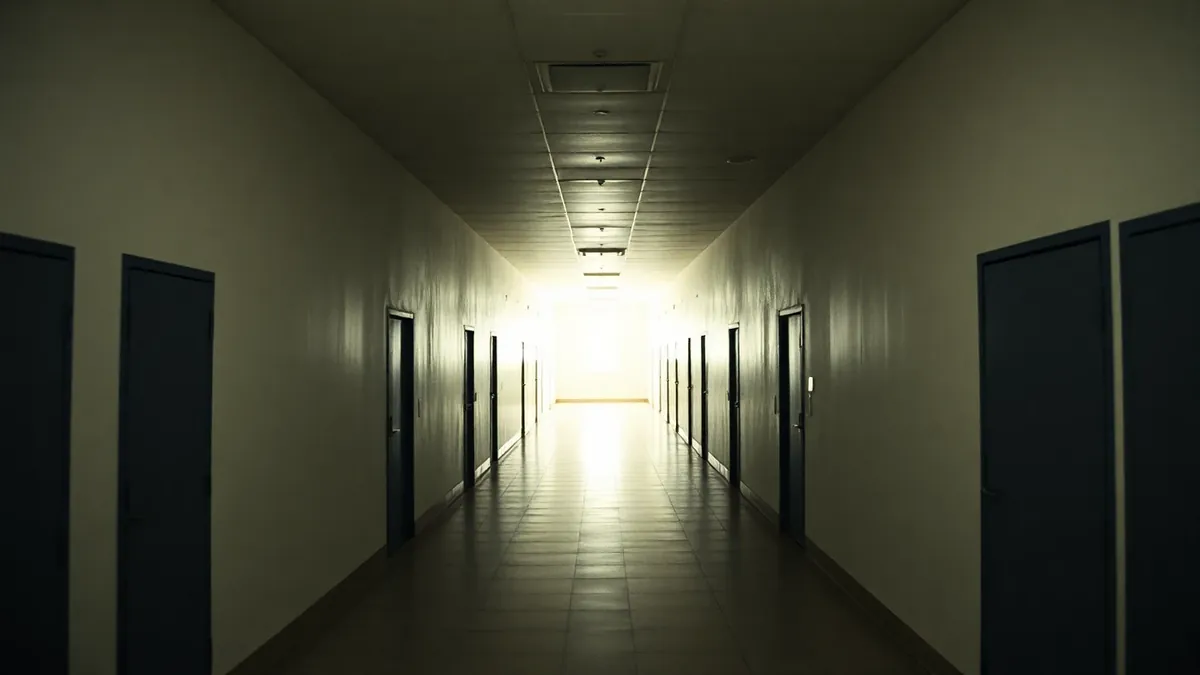
Jay had a recurring dream: he walked, panicked, along a white hallway. Gray doors on either side were locked. Jay thought he had a key but had forgotten it; he felt the doors really should have been unlocked. A view from above would show the hallway continued for some ways in both directions. After he woke, he felt the entire experience folding in on itself as if the dream were a memory and the memory a lie he had told himself.
He found himself thinking of the dream as he stood on Rue des Beaux Arts, staring into the window of small art gallery. Jay stood to the side of the large window so the man inside would not see him. The name of the exhibition of photographs was “Poems.” Hung on the walls of the small gallery were three photographs: an image of a short three sentence paragraph appeared on each. It was impossible for Jay to read the words.
He didn’t enter the gallery. The man inside was typing on a white notebook computer just inside the door. Jay could see his fingers on the keyboard; he was almost able to read the text on the screen. His memory of the dream had caused him to momentarily fear walking through doors, even ones that were open. Jay removed his camera from his pocket and took close-ups of the computer screen and the photos with the words printed. He then took pictures of the sign above the gallery, the man’s hands, and the street number above the door.
He crossed the street to the hotel where Oscar Wilde had passed in 1900 of meningitis. His guidebook mentioned a funny remark that Wilde made shortly before his death. He underlined the quote with his pen and travelled back to Rue de Seine.
Moving across the ocean had been a mistake. For months, Jay had the sinking feeling that the decision he had made was very wrong: it engulfed him in a terrible sea of uncertainty and doubt. He lived at the edge of a small village. Small roads and bike trails connected the wheat, maze, and flaxseed fields beyond his street.
Before his trip to Paris, Jay had started taking daily walks on the roads and trails through the fields. One particular route took him by a series of strange markers and buildings. Jay began formulating a story that linked the places that intrigued him on his walks. By the third or fourth walk, Jay's story was a full-fledged novella, one that he didn't think he had the skill to write. He smiled every time he passed one of the markers, knowing that he had a secret.
After he finished his walking tour of the Left Bank, Jay found a cafe once frequented by Ernest Hemingway and decided to sit and work on his novella The Stations in the Fields. He thought his title was ominous and described a work wrought with mystery and psychological tension. After reading a few Hemingway novels before his trip, he made an effort for muscular, taut prose that was unadorned and left the reader to draw conclusions on his or her own. As he started writing, his thoughts continued to drift back to the man typing in the window of the gallery. He wondered if the words in the frames meant something, or if what the man had typed was a message for him. At the time, he'd felt that the man typing knew he was looking. He took out the camera to look at the photos.
Photo 1, Framed Words: Line 1: "Life damages dreams." Line 2: "Dreams damage the journey." Line 3: "The journey damages life."
Photo 2, Framed Words: Line 1: "Life is not a dream." Line 2: "Dreams inhabit life." Line 3: "Dreams happen to life."
Photo 3, Framed Words: Line 1: "Do not read this." Line 2: "Reading this is harmful." Line 3: "Dreams are harmful."
Jay felt a sense of relief; the framed words were meaningless and had nothing to do with him. He'd seen artwork from fellow students that resembled this: small letters on pure white canvases. The words usually meant nothing – the artist wanted the observer to appreciate the technique of creating perfectly formed letters that would appear type-written from afar when in actuality they were finely painted. Some of the best of these featured painted watermarks and a graininess that simulated the kind of business stationary one would use for a résumé. A friend had once painted a canvas that was his vitae; his professor had used the piece as an example of how to get a gallery owner or art buyer's attention. Jay then remembered that the framed words in the Paris gallery were photographs. The idea was silly to him. The technique was as meaningless as the words themselves.
Jay turned his attention to the picture of the man typing in the window. He zoomed in as far as he could to make out the words on the screen. The words were fuzzy and hard to make out, but eventually he could read most of the writing:
"Don't be frightened. It's taken some time to find you. I am shocked. I need your help. When you think about it, please stop by and see me in person."
Jay was frightened. This must be a trick set-up by someone that knew he was coming to Paris. But how would someone know when he would come this way? It didn't make sense to him. He looked over his shoulder; he thought he heard laughing in the corners of the bar. His stomach tied itself in a knot, and he could hear his own breathing. The itch of paranoia crawled up his spine and lodged itself in his throat. He felt that he might hyperventilate.
The Stations in the Fields by J P
I'm writing to you from the present. As a matter of fact, you can pretend I'm sitting next to you as you read this. I'm sure that you're in a nice comfortable chair with a fire crackling; perhaps, you have a cup of warm tea or coffee and someone you love is sitting next to you. You can pretend I'm part of this lovely domestic scene; I could be reading the story out loud so that all may hear. I'm sitting near you telling you this. I am.
Also, pretend that this is a taut, psychological story: one that might resemble the plot of a novel near the supermarket checkout with familiar characters that resemble you and your friends. The prose should be muscular and tense. You'll need to pretend this. Also, think of this story as more intelligent than the above mentioned supermarket novels: maybe this story is more intelligent in its details and has more discerning reference points; perhaps, it even reminds you of a contemporary fiction writer that is reclusive and genius. You'll need to pretend this.
The way I'll tell the story is like this: there are 5 stations. They are in the fields beyond my house in the foreign country that I live in. It's a small village, and I live on the outskirts. I've not left my house much and am surprisingly depressed and maybe a little out of my mind with loneliness. The stations are along the roads and bike paths that connect the fields. I think the crops are corn, flaxseed, and maybe some type of mint. Can you also pretend that this is a long story...perhaps a novella?
Jay didn't know many people in his new village. No one knew him. He went to work every day and sat almost motionless in his cubicle typing reports, emails, and other documents. He rarely spoke to his coworkers. He was shy and didn't feel making friends would make his life better. He couldn’t think of anyone who could have set up such an elaborate hoax.
He thought he might be hallucinating and referred back to the photo many times to be sure he wasn't delusional. Though, the next day, he did find something in the photo in the bottom corner. Even at the highest resolution, he couldn’t make out what it was. He thought it might be a token hung from a copper bracelet on the man’s wrist. The shape looked very familiar, but he couldn't quite figure out what it was. It was something iconic, one of those images that is stamped into the mind of young children in elementary school. Jay felt that if he solved the riddle of the image, he might have some clue to why this was happening to him.
His thoughts exhausted him, and he found that because of the blurry image he could not continue his tour of Paris. He was tired; every site he travelled to seemed bland and held none of the mystery and grandeur he thought it might. He returned to his small room and lay on the bed, thinking.
Station 1: The Condenser
The first station is right after you pass from the main road that winds through the neighborhood onto the gravel road where the large farm vehicles travel to get to the fields. There is a large home that is unfinished; the outside isn't plastered and building supplies and dirt are piled in heaps behind it. Through the windows, you can see a family sitting at their table, having some simple dinner as you pass; I'm never sure but I don't think they ever speak as I walk past: their lips are never moving. Here's the odd part: not one house in this area has forced air conditioning, but this one does. Most homes have floor or radiator heating and never have cooling systems. Yet this home has a large condenser unit in the back...it rumbles low and certain as I pass. It is heating the house. The sound is so uncommon to me since I left to come here that it scrapes against my senses. In the winter, there are no sounds as I pass except for the rumble and every few steps the croak of crows. The first station, I think, sets the mood for the others. It turns this ordinary family into agents of otherness, as if the fields beyond with the other stations are owned and managed, sinisterly, by them. I cannot fully explain how unsettling all this is, so you have to just take my word for it. Try to remember a particularly foreboding music cue in a suspense movie; play it in your head as you think of this family sitting at their table eating meat and potatoes as the condenser rumbles in their backyard. On the other side of the house, water always stands no matter how long since the last rain; this adds to the eeriness and you should note that the water is grayish-tinged and often capped with ice. Sometimes your feet crunch in the ice as you pass. The sights and sounds will continue to play in your mind well past the first station. I promise you that this happens. I promise you.
In the middle of the night, Jay woke up from a dream that he could not remember. The only thing he remembered was the silhouette of the Eiffel Tower. Jay thought this must be the blurry image in the photo. He struggled with this idea: it seemed far too simple. He often scoffed at movies and books where the key to unlocking some plot sequence was so easy. He preferred unexpected twists, off-kilter plot devices, or even jarring conclusions that left the reader/viewer wondering what would happen next.
Although he wasn't quite convinced, he felt a pull to go the Eiffel Tower, a site he had planned on skipping for all the reasons other tourists wanted to go.
Station 2: The Barn
You must know that approaching the barn is unnerving; know that crows nest here in the rafters, finding holes where large masonry stones have come loose. The outside is littered with juvenile graffiti; even in this foreign land, teenagers find it amusing to draw distorted genitalia and what could be gang signs. I'm sure this frightens the farmers who use this barn to store their equipment and seed. What makes it unnerving is how large it is against the fields. As you approach, it seems very close for a long time because it’s so big. Close up, though, it seems small, like it’s actually nothing to fear. I think this characteristic has a post-modern feel to it. I read this story once where the house kept changing and the character had to adapt each day. He did adapt, perfectly, and even welcomed the change. Then, he went blind from a terrible bacteria that grew in his bathroom. Some pipes had burst when the rooms were changing, and he never bothered to fix it. The bacteria grew and then infected his eye. Then, the rooms altered and changed, and the man couldn't find anything and soon died from hunger and exhaustion. You should wonder about the barn and why it seems large from far away and small from up close. This should make your hair stand on end. You'll still be hearing the rumble of the condenser even though it's far out of range; the noise and the shock of this barn will frighten you. It will be at dusk during the fall and all the dead leaves will crunch under your feet. You may hurry past trying to avoid it, thinking of the bodies of blind men that may be rotting inside. You will want to avoid it. You will.
Jay took the Metro to Avenue d'Iéna. The stop he wanted to get off on was under construction so he had to get off early. He wasn't sure which direction to walk and had to ask directions in his limited French: "Où se trouve la tour Eiffel?". His head was spinning as the Frenchman pointed in various directions, mumbling something incomprehensible. Jay took what he could from the man and walked under a section of scaffolding below a large apartment building. He had to a cross a complex of boards connecting a sidewalk under repair. His head ached with anticipation.
At Place du Trocadéro, he had a very clear view of the tower. The base was crawling with tourists. Jay’s stomach turned; he hated masses of people brought together by expected awe. Everyone's head was tilted back, eyes poised on the interlocking grid of iron that really had no purpose other than to bring tourists. It was disgusting to Jay. He found a bench and sat for a time thinking about what to do.
He decided to approach the tower, stand in line with others, and buy a ticket to the top. He hoped that a clue would reveal itself. He knew that all of this, all of his hope, was probably in vain. None of it made sense to him, even his own expectations. The line was long, wrapping around in many directions, folding in on itself like a maze. He thought he'd found the end a few times, but when he stood behind the last person, someone would tap him on the shoulder or nudge him and point in another direction, speaking French or Italian or German. The barriers that helped form the line were made of gray metal, resembling cages; once inside it was impossible to leave until there was a break in the barriers. The breaks were far apart; Jay usually thought that a break would be the end of the line. He finally found the end after much frustration and doubt. The line was impossibly long. He prepared himself for a long wait.
Jay could feel panic and tension creeping up his throat and spine. Someone or something seemed to watch from above. The skeletal frame of the tower loomed, and even though he knew it was impossible, he perceived a low rumble, something like a sound he wrote about in his novella. He knew that the sound was not real, but it caused him more anxiety. His eyelids started to twitch uncontrollably. He rubbed his forehead and twisted his eyebrows.
The man in front of Jay, perhaps Indian or Tamil, spoke with a British accent. Jay noticed that he had struck up a conversation with a security guard in French and would translate for the other man he was with. Jay listened in, trying to take his mind off of the rumble that was now engulfing his mind. The Indian man translated that the long line was due to a security threat: a package or bag had been left on the second level, and the entire structure had to be evacuated. No one was able to go up until the threat had been cleared. Because the rumble was increasing and wavering, Jay had to lean in to hear. The Indian man noticed and began to turn to Jay, as well, so he could hear the translation. He said that it may take up to two hours before the line would start to move. Jay was upset but couldn't make himself move away from the line.
It became obvious that the rumor was true. Jay could see tiny figures moving down the legs of the structure toward the base. The elevators were not in operation. Hundreds of people were streaming out through the 3 bases of the structure that had staircases open. Tourists in the line started to make their way out of the gray barriers at the breaks; The left in droves, and the line slowly began to move forward. In less than thirty minutes, Jay found himself at the front of the line, awaiting security checks before he could buy his ticket.
After another thirty minutes, Jay approached the ticket counter. He was only able to buy a ticket to the second level; the top had been temporarily closed due to high wind conditions. He asked the clerk about the security threat; the clerk shook his head and muttered something about a "misunderstanding." He was told his ticket would be good for two hours. Jay hoped he didn't need that long to find out why he was there.
Another Indian operated the elevator; he looked very similar to the man in line ahead of him who had left after he heard of the two hour wait. Jay could feel it was the same man. They were the only two in the elevator; the rumble in his ears had stopped, but his eyes were now seeing spots. Jay figured he was only imagining it was the same man.
He stepped on the platform at the second level, and immediately was swept away by the hazy view of Paris. The rain from the morning had exhausted itself and left the entire city shrouded in a wall of fog. Many parts of the city could not be seen at all. He felt that he was hovering above the world on a cloud. The level's shops were all empty; even the food vendors had evacuated. Partially made crêpes were burning on griddles. The smell of sweet bread filled the air.
Jay was alone at the top of Paris and felt nothing but disgust. He had no idea why he was there. He didn’t see any clues. The rumbling in his ears had returned and was beginning to overtake him completely; he was lost in waves of noise. Then, out of the corner of his eyes, he noticed a black briefcase on the stairs leading up to the observation deck. Jay looked around and saw no one. He picked up the case quickly and walked back to the elevator.
Station 3: The Initiative
You've seen movies and television shows that feature places like this. One of them is more recent. You've seen the one with the people who crash in a plane and are stranded on a beautiful tropical island. Other people are on the island and are very mysterious. The survivors find "stations" that have strange structures, mystical powers, and weird symbols painted all over them. Sometimes, they find long numbers on hatch doors that mean something spectacular in the complicated plots. Another show is older. It's about a man who keeps getting transported into weird locations on a hidden island. I think someone is chasing him and finding him and moving him in his sleep. Sometimes, a large sphere chases him. I can't remember if there a bizarre "stations," but you get the same idea when watching this series. The movies are too many to name; there are many of them. If you can't recall any of these, I'll describe the station. I call it "The Initiative" after one of the TV shows. It's completely buried underground except for this hatch or doorway in the front. The whole structure is fenced in with a gray barrier; it's very high and you cannot get through it. The hatch or doorway has the same graffiti as "The Barn." You will notice that the rumbling from "The Condenser" is very loud here. It is not a real thing though; it is only in your mind. It isn't real because you are only imagining it. You'll have to imagine it. It is very loud and consumes your senses. You will want to put your hands over your ears and clamp them down very tightly. The noise will continue. You will begin running to get away from the noise. You may not notice that grass and weeds cover the entire structure except for the doorway or hatch. You’ll want to get away very quickly from this station. You'll want to run fast from it. You will.
Jay ran to the Metro stop, losing his way only once. He was very afraid and the noise in his ears was overwhelming. In the subway, he felt that everyone was watching him. He felt guilt, more guilt than he had ever felt in his life. The feeling was as if the entire world blamed him for taking the case. All eyes focused on him. He moved to the door, wanting to run as soon as the train stopped.
He suddenly found himself in his hotel room. He didn't remember the half-mile walk back there; the noise in his ears had stopped. It seemed to cease as soon as he closed the door. The light from the windows was bluish and soft; he thought to himself that it was very Parisian, artistic and beautiful. If he could have painted that light, he would have.
He sat on the bed and fumbled to open the briefcase. It was not locked but his thumbs kept slipping from the latches. It took him five or six tries to open it. His anxiety was increasing, sweat pouring down over his face and hands. The blue light had suddenly become very yellow and bright; he was now hot and consumed by a feeling of the unknown. He felt his body slipping into a burning and painful place, the light now engulfing his eyes.
Finally, the case opened.
Station 4: The Painting
I'll set the scene. The path winds for some time. You'll see fields of corn and flaxseed here. At times, the path is very narrow with tall stalks on either side. You might feel claustrophobic, but the good news is the rumbling is now gone. The light above you will look unnaturally blue and beautiful. You might want to be an artist so that you could paint it. A calm will come over you. You will feel peace for the first time on your walk. It will all seem worth it. All the guilt in your life will disappear in this moment. I know it will; I've felt this. You'll come to a clearing; the light will change as it becomes harsher yet still pleasant. It might be yellow or burning orange, and it might be hard to see; you'll want to blink. You might get very hot and sweat. Off in the distance in the field of yellow grass, you'll see a small house or shed. It's hard to tell what kind of structure it is from far away. You'll investigate it because you want to get out of the sun to find a cool place. When you get to the house/shed, you might not remember going across the field. It happens to the best of us. Inside, the light will change again. It will turn blue and soft.
Now you should remember a very famous painting. In the painting, a man dressed in a dark gray suit and red tie faces the onlooker. He wears a bowler hat. The sky behind him is filled with storm clouds and a beautiful blue lake is beneath it. He stands before a waist-high cinder block wall. His face is almost completely obscured by a hovering green apple. You can see the tops of his eyes above the apple. Although you can’t see his mouth, you know he’s saying something to you. Maybe he’s telling you a secret, something you need to know to continue. It’s truly a dreadful feeling.
Inside the house/shed, it doesn't look like this. But you get the same sense of dread. It creeps over you. You'll not want to stay long as it climbs up your throat and spine. You'll want to go back to the path. You will.
A print of a famous painting was in the case. Jay didn't touch it; he only stared at it. He remembered it well from his college art history classes. He was surprised. He remembered how he spent long hours staring at this painting thinking of the man that painted it. Jay felt sadness.
He remembered that this painting was in Paris. He had been saving the gallery for his last stop before leaving the city; he had so much anticipation about seeing the works of this artist, he wanted to wait until the very end to see them, leaving a wonderful impression of Paris in his mind.
Jay was exhausted. He lay down on his bed and thought about what to do. He seemed no closer to finding his clue. He was dumbstruck and felt very stupid for chasing something that was only a phantom. He felt he had no hope. He remembered his dream of the long corridor with locked doors. He also remembered the words from a letter he once read: “You can’t see it right now, but you don’t need to find anything.”
Jay was in Paris and had no idea why.
Between the Stations
You may want to take a break but you won't be able to. The next station isn't that bad. It's very relaxing and beautiful and there isn't much noise; maybe some birds. So just walk and relax and be ready for the end of the story. I know it seems like a short one, and maybe I've not been that great of writer. I only have limited skills, and I fear that my metaphors and references are very weak for my ambition. And yet, I feel this is okay with you and you'll sit and listen to my story. This is the calm before a peaceful, beautiful and maybe touching and sad end. If you are with a loved one or friend, maybe you can hold their hand now and whisper how great the story is. And you'll observe how afraid you were and how warm and open you feel about life, now, and what the future will be. After all, art should make us feel what the artist intended. I intend for you to be safe and comforted and joyous. I promise I'm not going to manipulate you. I promise.
Jay woke to his last day in Paris. He had his ticket to the last gallery. He took a long walk; the Metro would only make him more anxious. He wanted a calm walk and the sun beating down on his face. He wanted to feel like Ernest Hemingway, strong and full of youth and wonderment.
He walked through a section of the city known for its art galleries, bohemian shops, and cafes. Jay felt exceptional but had no idea why. He felt as good as he had on the first day. The art gallery and the poems and the Eiffel Tower all felt like an old dream, one that he would forget or maybe write about one day in a new novella.
He stopped in a cafe and ordered a hot drink, burning his hands as he tried to pick it up. He smiled at himself, feeling the heat and small amount of pain run along his fingers, arms, across his chest and into his heart. He sensed something he hadn't felt for years: abandon. He felt as if he could do anything in that moment, as if all things were possible. He knew it was a false sense, but he enjoyed the moment and decided to sit and finish his novella. The wallpaper in the small cafe featured caricatures of famous artists; Hemingway smiled over his shoulder.
Station 5: The Table in the Forest and the Blue Notebook
The journey is now complete. I've been to this station many times and have known that experiencing the first four stations was worth the moments I've spent here. You'll come to a curve in the road and off to the left you'll see path into the forest. It's not a real forest, only a large stand of trees that feels like something greater. You'll want to go inside. A table and bench are here, and a small blue notebook. The notebook is open to a page, and someone has written a message on it. You'll feel compelled to sit and read it. It may not make sense to you at first, but later when you are able to reflect the words will become clear. This will last in your mind forever, and although you may feel hurt, you'll appreciate what was written. You will, I promise. Thanks for listening to me and remember to look for my other stories. I hope to write many, and I hope you read them all.
Jay felt satisfaction once he had finished the novella. It was the most difficult and complex thing he had ever written. It sparkled with what Jay felt was mystery, doubt, humanity, and above all intrigue. He would send it back to his old college and see if the literary quarterly would publish it.
Jay left the cafe and realized he was only blocks from the last gallery. He reached inside his jacket pocket and felt the ticket. He smiled.
The gallery was in an old Parisian mansion, a wonderful maze of rooms and hallways filled with his favorite artist's works. It was grouped by period: Blue, Rose, Cubism, Synthetic Cubism, Classical, etc. All of them were wonderful, and he cherished each one. He followed the map backwards, hoping to save the Blue to the end. He loved the brooding sadness of the period, and although his mood had changed positively on his last day, he wanted to feel the devastation of the poor, hungry, and lonely. He wanted to feel the weight of the world’s indifference.
Jay came to the final room. One painting hung in a large space. No one was in the room. Jay immediately knew that it was the painting from the briefcase. His heart jumped and began spiraling downward into a misery he had only known once before. He closed the door after entering the room; he locked it. He moved quickly across the room to close the exit door; he locked it, too. He averted his eyes until he was directly in front of the painting. He moved closely toward it. The title was written on a small placard in many languages including Braille: Autoportrait, Selbstporträt, Autorretrato. Jay felt the Braille; the bumps felt like his entire world collapsing into points. A tear rolled down his cheek.
The figure stares down, unflinchingly, his eyes as dark as oceans. His coat is a mountain of black, a stone that pierces the unworldly blue. The white face, a ghost of memory, is Jay’s face. He stands locked in this room with himself. Jay knows now. He knows why he is here. He's looking into himself. He's seeing himself for the first time. He sees himself.

“Autoportrait” was printed in Harvest Time, No. 5 of Inwood Indiana. Pick up the paperback from Prolific Press; the stories and poems published online are free to read here.
Get the paperback