
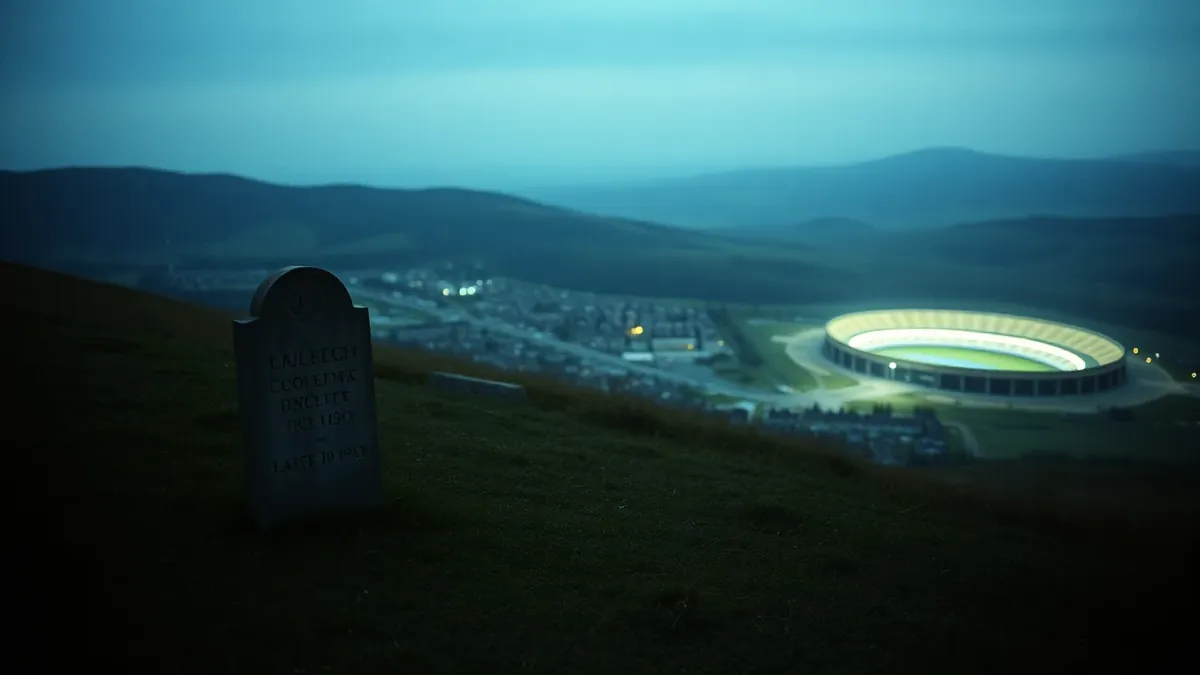
Job had wanted to see the ending of the baseball game before leaving for the cemetery to visit his grandpa. But the game was tied in the 10th and it was getting late. The snaggle-toothed foreman at the coal mine wouldn’t give a care less if a red-hat rookie was late for whatever reason. Leaving the television on, Job snatched his keys from the kitchen counter. He stood outside for a moment and listened to the muffled game before heading to the truck. A year seemed a right fine time to visit the graveside—he’d seen that sort of thing in the movies—but hoped no one else had the same idea. He didn’t want anyone to say his name in that sad way they did, come to him, place an arm around him, offer one of their prayers. “You did the right thing,” someone would inevitably say. “He was in pain.” But most of all, he wouldn’t want them to see him crying. Which he would not do anyhow. The old man never did.
He listened to the game on the way to town. On the other side of Taylorville was the cemetery—if he could find it. He remembered the route cutting through a hoitee toitee neighborhood that he’d been unable to pay too much attention to when driving there a year before. The cemetery was stationed atop a gentle green rise in the middle of yellowing corn. Midway through Taylorville, he stopped at a roadside flower shop and sat there idling in the truck, staring at a wooden wagonload of tacky plastic floral arrangements, the reflection of him staring at these ornaments looking him back through the dirty store window. You did the right thing…
Checking the traffic, Job eased back onto the road just as the game was entering the bottom of the 11th. Grandmother’s house was a block away. He cut that way, but chose to pass it by. It seemed right to stop in and offer her a ride out, but he couldn’t take that look she’d taken to giving him since the early morning her husband had passed.
At the edge of town stood a bar he’d been to once before but barely remembered what it looked like on the inside. He steered onto the gravel lot with a sudden curiosity he realized was bullshit. There was time for a beer. Or two. He talked to a stranger with a lisp for two innings about the mine and baseball and the big titted bartender. Eventually bored with the conversation, Job lied and said he was off to work. Then, for show, he stopped down the bar and took down the bartender’s number, offering a victorious wave to the man he didn’t particularly like or dislike.
The daylight struck him. Job was surprised at the buzz he’d copped and was immediately thankful for already being on the edge of town—near the cemetery. He took a series of wrong turns and ended up in a cul-de-sac only to spend a few minutes chatting with a man about his Harley Davidson he was polishing and affixing a sale sign to. He had no intentions of buying it, but the man was nice and very knowledgeable about seemingly everything. Wondering how the game was progressing, Job turned the key and heard the crackling radio signal, the din of a crowd miles away, the announcer speaking about a game he’d only once seen go this long.
“That game still on?” The man asked, standing and walking pensively over to the truck.
Job nodded. “I’ll be. That’s gotta be a record.”
As if the radio man heard the query, he announced the middle of the 15th inning.
Job laughed, offered a hand, which the man took in a hearty shake. “Nice to meet you.
Nice bike. Anyhow, I gotta see if I can make my way outta here.”
“Outta here. Yeah, it’s pretty wound up back in here. The cemetery.”
“The cemetery?” Job started the truck.
“Yeah, betcha you’re looking for it. My street, it’s like a drain along the way there. All these windy roads, like some bad plumbing that sends people lost and looking for the cemetery to me. Had an entire funeral procession end up down here last spring when I was out trimming my hedges.”
“Yeah?”
“Who you going to see?”
“My grandpa.”
“Sorry to hear that. Been long?”
“A year. Seemed right to…come out.”
The man stood there, nodding, as if weighing the stable of correct answers. “How’d he pass?”
“He was in a lot of pain.”
“Cancer then.”
“So how far away is it?”
The man gave him easy directions and Job arrived. The green rise jutted out like a woeful old sore amidst the desiccated stalks of corn. The cemetery was a small plot of land, three one-hundred yard lengths of gravel road separating the grass and small shrubs, a giant opened bible monument sitting in the dead center. Job pulled onto the middle road. He was pleased to see he had the place to himself, save for a man off in the distance mowing the grass on a rider. He stopped at a small redbud tree that looked familiar, although it was difficult to remember precisely where his grandfather lie for the long row of cars that had lined the road, the black tent jutting around the hole in the ground, the booze he’d soaked himself in before leaving for the funeral.
The bases were loaded, bottom of the 16th, they still had nine innings to go in order to tie the all-time record. Job wanted the Cardinals to win, but, at the same time, he didn’t want this game to end. He sat in the truck and rooted the Pirate on the mound, bases loaded, no one out. He rolled the window down, shut his eyes and listened to the din, remembering watching a game with the old man, no special game, just a dusty snippet from a moment of time. The mower hummed, the breeze blew through the thin branches of the tree.
His grandmother, she didn’t want Dusty’s life to end. But Job had managed that.
The old man’s final comprehensible utterances, offered with a rubbing of Job’s shaved head, “Kill me, buddy.” So Job had simply gave the morphine as ordered by the hospice nurse—against his grandmother’s wishes, tricking her into letting him spend the night so she could rest, then sneaking to her bedside and taking the morphine to grandpa. And in the morning, as the nurse had predicted, he’d slipped away.
When the next three Cardinals struck out and the game was extended, Job exited the truck to look for the grave. He walked in two rows deep, looked left, looked right, then opted to walk towards the entrance. Staring down at the ground, he looked for the flat bronze grave marker he’d heard grandmother complain about as being in need of a good polish. Job walked on and on, confusing himself at times at the directions he’d already came from. Finally he decided on walking a grid: five grave markers north, then five west, five south, five east. But he couldn’t find it. He stared back at the truck for some perspective and was surprised to see the man who’d been mowing standing by, the battered rider sitting off in the distance by the huge stone bible.
“Looking for someone?”
“My grandpa. I’ll find him, thanks.”
“What’s his name?”
“Take you long to mow this?”
“Hells bells it does. About six hours. It’s a job.”
“I reckon so. Well, I’ll be seeing you. I’ll find him.”
“Give me a holler if you need me!”
Job continued his plan for perspective and looked back to the truck, shot a glance about him, and headed back toward the road. He found the grave marker, mottled and dim as his grandmother had said. He stood there staring down at the plate on the ground, the name and the dates. In the distance, the rider fired back up. A motorcycle came up the lane billowing a cloud of white dust behind. It slowed to a stop. A man and a girl climbed off and headed directly to a marker. Not knowing what to do, talk to a patch of earth or pray to a spot of sky—these both seemed absurd—he returned to the truck and idled past the stone bible, the man and his daughter, the man with a job. In silence, he made his way directly back to Taylorville.
In the dimness of the mine locker, alone for he’d missed the cage down, he donned his pit clothes, rubbed his head feeling the old man’s frail hand palming him. He cried, but was quick to wipe the tears and don the red-hat when the foreman barked out from the cage for him to hurry his ass up. On the way down, the foreman complained about the Pirates winning the game in the 19th inning.

“A Patch of Earth, A Spot of Sky” was printed in Salem Cemetery, No. 6 of Inwood Indiana. Pick up the paperback from Prolific Press; the stories and poems published online are free to read here.
Get the paperback