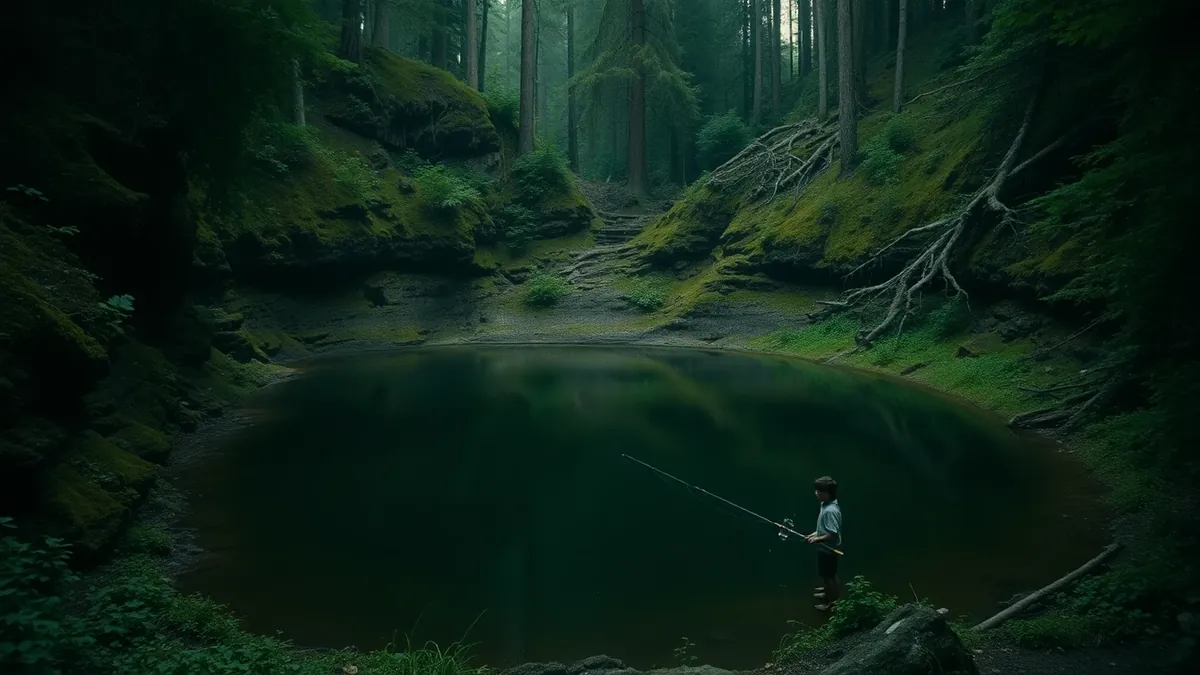
Bobby Isum Jr. was 9 years old when he went fishing in the pond the locals call the pit. The pit is an ominous looking place with black water surrounded by old-growth forest. To access the pond at the bottom, Bobby had to descend the steep banks that surround it on all sides. The locals have all but forgotten the origins of the pit. They just live with it, like some kind of black hole in the middle of Inwood, Indiana. Small towns are like that. Even the most unusual things seem normal when they are in the middle of town. Why people would build homes there is the real mystery.
The kids in Inwood like to tell visitors a comet crash-landed there, but the fact is, the pit is an old remnant left behind after years of deep dredging. Nobody knows how deep it goes or what kinds of caverns the dredging may have opened up beneath the waters. Twenty years ago, several divers ventured into the pit to look for a body, but they never resurfaced. Since then it has been closed to everyone. Closed, officially, that’s the rumor, but Inwood is too small to have a Sherriff, or anyone “official” to keep people away. The locals still go to the pit occasionally, and when they do accidents are not uncommon.
Bobby wasn’t much of a fisherman; he’d only gone to the pit once before with his dad but he remembered the day with perfect clarity because it was so odd. There was a great deal of conversation, as though Bobby’s father, Robert, had so much to say that he could not contain himself. He spent the better part of an hour telling Bobby about the hidden dangers that account for the many “accidents” that happen there. People had a way of dying in the pit, or simply disappearing altogether. Robert explained that the black sticks around the shore can be tricky. They look like sticks but some might be deadly black snakes. Then there were the sloping sides of the pit, covered in slick leaves. A man can slip on those leaves and slide all the way down, maybe even have his head cut off by the remnants of barbed-wire fences hidden in bushes on the inclines. In the winter, some people simply slip through the ice and die. The rumor is that years ago kids threw some old shopping carts filled with rocks in the pit. If you slip through the ice, Robert explained to Bobby, your clothing gets caught on the sharp edges of those carts, and then the carts start rolling down the steep slopes beneath the black water; they drag people down. Occasionally a hunter mistakes a fisherman for a doe, and drops a deer slug into their skull with a sudden hollow thud. He continued for hours, telling Bobby gruesome story after gruesome story to explain the many horrors that happen at the pit. For Robert, the important thing was to make sense of the “accidents.” People don’t just go to the pit and die. There are reasons—explanations that make sense, and all those deaths could be avoided if those who died had half a brain. “Darwinism,” Robert would say, “the gene pool is shallow in small towns and anyone with an ounce of sense can go fishing and come back alive.”
For almost an entire year Bobby had been asking Robert to take him fishing again, but Robert was always too busy working on cars, or going to town to drink beer with his friends. Bobby was almost always alone, but that did not stop him from keeping busy. From a distance, Bobby looked like an adult, only his childish body gave him away in silhouette. The neighbors took to calling him “The Rambling Boy” because Bobby was forever on his own and constantly doing something, but it was not always easy to know what. He seemed to mutter to himself, and he was often seen walking one way, and then the opposite way a few minutes later—he carried himself with the swagger of a grown man who came into his own. He was always up to something, and it was only a matter of time before the idea to go fishing alone overtook him. Bobby had no fear about the pit or the stories. Robert’s wisdom seemed sound; “Anyone with an ounce of sense can go fishing and come back alive.”
As he was approaching the pit, Bobby had been muttering to himself; he would watch his step on the slick banks, watch for snakes, and come back with a big fish that will impress dad. “He’ll be so impressed that he will want to take me fishing every day! It will be just like it was before,” Bobby thought out-loud to himself, “dad will be spending every day with me. It will be great, if I can just get him excited about fishing again.” Bobby felt a lump in his throat as he threw his line in the water. He really needed to catch a fish. He stood there, at the edge of the pit, for about an hour. The tall oak trees seemed to drop leaves on him constantly, even though he could not see leaves falling from trees on the opposite bank. The wind seemed to whirl around the pit, following the bank, causing an undulating whooshing sound in the trees.
Bobby was like many Inwood Indiana kids, or kids from any small Midwest town for that matter. He really only had a few rules—don’t go on the highway—don’t bother people—be home by dark. He took full advantage of the freedom. Bobby knew where the apple trees were, where the best frogs were, where the spring was that bubbled out of the ground. He knew it all because he was always moving, and now he knew what it was like to be fishing in the pit by himself. Nobody else was there to distract him, and after waiting for fish to bite, he was really itching to move around. Bobby wedged his fishing pole between two trees and slowly started walking around the pit. When he got about a third of the way around, he looked back to see his pole half bent over, wobbling like a corn stalk in a storm.
Bobby spun around to make a run for the pole but his right foot slipped in the mud and he ended up with one foot in the water and the other on the bank—his legs spread widely, protruding like some kind of elegant ballet extension, except that the position was so awkward that he was unable to recover right away. After some effort he managed to slide his waterlogged foot toward the shore, but just as he was about to pull his foot out of the water, he felt the water grip his foot. It was painful to struggle against and Bobby couldn’t free his foot no matter how hard he tried. It was the strangest thing. Bobby could see his shoe in the water, and it did not appear to be stuck on anything. His laces were tied neatly, the edges of his shoe were not torn; there was no barbed-wire or other binding wrapped around his foot, but even after several tries it just wouldn’t budge. It was stuck like a wasp in tree sap.
Bobby was in pain but he was also bewildered. It hurt less when he stopped trying to pull, but he had to keep trying. Then a terrifying understanding of his predicament overtook him. He was trapped by something, and there was something else there with him, something big moving in the water. Just twenty feet from the water’s edge, some kind of slick and shiny blackness crested like a humpback whale rising before diving deep. The back of the beast rolled across the water producing large waves that soaked Bobby waist deep. He knew he was in trouble, big trouble— probably the kind of trouble all those others had been in before their “accidents” in the pit.
He screamed the kind of scream that mothers never want to hear, the kind fathers have only heard on battlefields or in nightmares. Bobby held nothing back, and he screamed for all he was worth but the pit has a way of swallowing cries. His screams seemed to circle the pit, intermingling with the sounds of whooshing oak trees, never breaking free to summon help. While Bobby struggled to free his foot, a small eruption of black and green bubbles broke the surface of the water, releasing some kind of noxious gas which lingered on the surface like thick fog. It was impossible to tell where the beast was. The fog spread to the full width of the pit, and Bobby could see turtles emerging from the water. There were dozens of them, some as big as doghouses, and they seemed to be panicked. The turtles were trying desperately to run, the way people try to run in nightmares—a slow-motion panicked lumbering, unable to move fast enough to flee from some unseen horror. The situation was starting to feel hopeless. Bobby was losing his strength. No matter how hard he tried, he could not budge his foot. He could see it; there was nothing visibly restraining him. He could run his hands around his foot and he felt nothing, but no matter how hard he tried, it just wouldn’t move. He did not come from a religious family, but he cried out to God anyway, “God Help me—please help me” and as his cries became more pitiful, the creature broke the surface again, this time much higher than before. It undulated several feet above the fog, a hulking black mass and Bobby could see large interlocking black scales. He knew this was definitely some kind of monster.
Then as he pulled on his leg with both hands, he noticed a man standing on the edge of the water about 50 feet away. He seemed to have appeared when Bobby wasn’t paying attention. Bobby began pleading and screaming for the man to help, but he did not seem to react to Bobby’s panic. He was an older gentleman, a little hefty, wearing pin-stripe overalls and a blue shirt. He seemed to casually stroll in Bobby’s direction, smiling calmly—as though he was mildly amused at the situation unfolding. Bobby pleaded louder and louder, but the kindly gentleman never changed—he never sped up, or changed his expression until he was standing leisurely beside Bobby. He seemed to gaze out across the water, like a sailor with his eyes fixed on the horizon, and he could have been deaf for all Bobby knew because no matter what Bobby did to get the old man’s attention, his efforts seemed to go completely unnoticed.
Finally Bobby was quiet. He stared at the old man, waiting to see what he would do. Sweat was pouring down Bobby’s face, and only after he stopped struggling and screaming did he notice the terrible burning in his throat from the noxious gasses flowing from the pit. His eyes were watering from crying and from the fumes. Somewhere out in the water, from within the fog, there came a low moan and then a spine-chilling stillness. Everything seemed oddly quiet for a long moment, until the old man turned to Bobby and said, “You know, I used to come fishing here when I was a kid.” Bobby was shaken by what seemed to be a complete lack of compassion for his desperate situation.
“What is that thing?” asked Bobby.
“Ohh never mind old Zelda. She’s just a bit temperamental today.”
“Old Zelda? You gave that thing a name?” asked Bobby. “Well, everything has a name kid.”
The old man reached in his pocket and pulled out a cigarette. He lit it and took a long drag. He seemed to hold his breath as though he loved that cigarette, like he would rather be right there with Bobby smoking that cigarette more than anything else in the world, and when he blew out the smoke it seemed to flow from him in an endless stream. First the smoke began to billow into a cloud that engulfed Bobby, stripping away all the noxious gasses, taking away the painful burning sensation in his eyes and throat. Then the smoke seemed to displace the fog completely, sweeping it across the pit like some great wind setting everything right again. Bobby was speechless. He just stood there, dumbfounded by the situation. “This old man must be a ghost or something,” Bobby thought to himself.
Then the old man stopped blowing and let out a couple small coughs. “I really have to give up smoking these things,” he said with a grin. Then he turned to Bobby, “so kid, you know you got a bite, don’t you?” Bobby looked over to his fishing pole. It was still flailing from side to side. “Yeah I guess so.” Then the old man reached out his hand, “Here, let me help you kid.”
Bobby was not sure about whether he should take the old man’s hand or not, but considering his predicament, he really didn’t have a choice. He reached out and as soon as he clasped the old man’s hand, his foot was suddenly released from the water. Bobby quickly walked a few steps away from the bank and stopped to rub his ankle. A large turtle was returning to the water. Its shell was covered in coral and embedded with several huge clam shells. “Those can’t be from around here,” Bobby thought to himself, “coral is only found in the ocean.” It was all so unreal, and everything that was happening seemed to be dreamlike, one shocking thing after another. For a moment Bobby thought about making a run for it. He thought about running all the way home and never looking back, but there was something about that old man, something that made Bobby feel safe enough to gather his things.
He worked his way back around the pit to where his fishing rod was jammed between two trees. After about 10 minutes of reeling, he finally landed a catfish so big he could hardly heft it over his shoulder. “Looks like some good eating kid,” said the old man, “that’s the kind of fish that makes a man proud of his son, wouldn’t you say?” The old man seemed to know things, and this made Bobby even more uncomfortable. “I better be getting home, thanks for the help old man. I think you saved my life.”
Bobby started climbing up the bank of the pit, heading up the same way he came in. When he reached the top and stepped out into the sunlight, he heard a voice coming from the pit, “Remember I said everything has a name kid, mine’s Larry.”

“A Fish for Dad” was printed in Ditch'em, No. 7 of Inwood Indiana. Pick up the paperback from Prolific Press; the stories and poems published online are free to read here.
Get the paperback